Kirjojen hintavertailu. Mukana 11 342 296 kirjaa ja 12 kauppaa.

Kirjahaku

Etsi kirjoja tekijän nimen, kirjan nimen tai ISBN:n perusteella.

1000 tulosta hakusanalla Maral Atmaca

Moral Basis of a Backward Society

Moral Basis of a Backward Society

Edward C. Banfield

The Free Press
1967
pokkari
Looking at how nepotism and family-centric societies sacrifice the public good, Edward C. Banfield uses a study of the people of southern Italy to argue how self-interested families can lead to poverty.Analyzing families in southern Italy in 1955, Moral Basis of a Backward Society discusses how poverty is a result of the inability to trust or associate strongly outside of immediate family. Challenged and argued for years, Edward C. Banfield’s study has become accept by many people in the modern age.
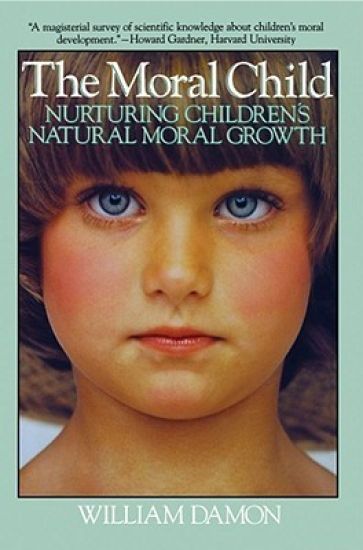
Moral Child

Moral Child

William Damon

The Free Press
1990
pokkari
Drawing on the best professional research and thinking, Professor William Damon charts pragmatic, workable approaches to foster basic virtues such as honesty, responsibility, kindness, and fairness—methods that can make an invaluable difference throughout children's lives.
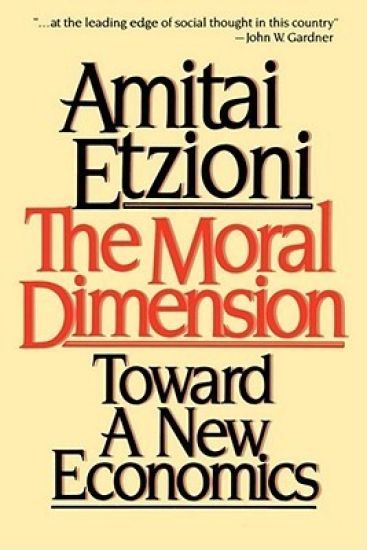
Moral Dimension

Moral Dimension

Amitai Etzioni

The Free Press
1990
pokkari
Blending elements of psychology, philosophy, and sociology with economics, Etzioni presents a bold new vision of the social sciences - one which proposes that broader moral, social and political concerns modify economic behaviour and shape individual decision-making. In establishing the necessitary of moral and social considerations in economic behaviour, he provides a provocative new framework for a more comprehensive, ethical and realistic approach to the social sciences today.
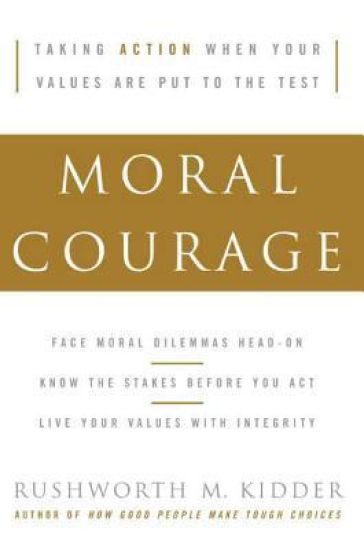
Moral Courage

Moral Courage

Rushworth M Kidder

HarperCollins
2006
nidottu
Why did a group of teenagers watch a friend die instead of putting their own reputations at risk? Why did a top White House official decide to come clean and accept a prison sentence during Watergate? Why did a finance executive turn down millions out of respect for her employer? Why are some willing to risk their futures to uphold principles? What gives us the strength to stand up for what we believe?As these questions suggest, the topic of moral courage is front and center in today's culture. Enron, Arthur Andersen, the U.S. Olympic Committee, abusive priests, cheating students, domestic violence -- all these remind us that taking ethical stands should be a higher priority in our culture. Why, when people discern wrongdoing, are they sometimes unready, unable, or unwilling to act?In a book rich with examples, Rushworth Kidder reveals that moral courage is the bridge between talking ethics and doing ethics. Defining it as a readiness to endure danger for the sake of principle, he explains that the courage to act is found at the intersection of three elements: action based on core values, awareness of the risks, and a willingness to endure necessary hardship. By exploring how moral courage spurs us to strive for core values, he demonstrates the benefits of ethical action to the individual and to society -- and the severe consequences that can result from remaining morally dormant.Moral Courage puts indispensable concepts and tools into our hands, equipping us to respond to the increasingly complicated moral challenges we face at work, at home, and in our communities. It enables us to make clear, confident decisions by exploring some litmus-test questions: Is the benefit worth the risk?Am I motivated by my desire to uphold my beliefs or just to impose them on others?Will my actions create collateral damage among those with no stake in the outcome? While physical courage may no longer be a necessary survival skill or an essential rite of passage out of childhood, few would dispute the growing need for moral courage as the true gauge of maturity. Treating this subject not as an esoteric branch of philosophy but as a practical necessity for modern life, Kidder deftly leads us to a clear understanding of what moral courage is, what it does, and how to get it.
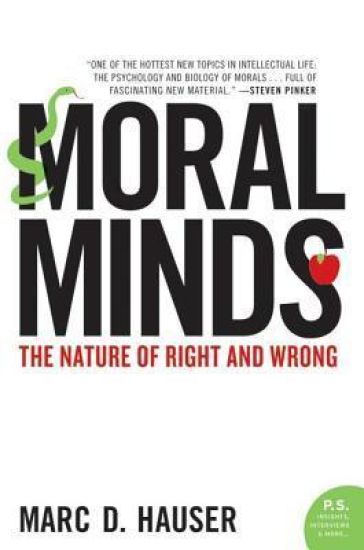
Moral Minds: The Nature of Right and Wrong
In his groundbreaking book, Marc Hauser puts forth a revolutionary new theory: that humans have evolved a universal moral instinct, unconsciously propelling us to deliver judgments of right and wrong independent of gender, education, and religion. Combining his cutting-edge research with the latest findings in cognitive psychology, linguistics, neuroscience, evolutionary biology, economics, and anthropology, Hauser explores the startling implications of his provocative theory vis- -vis contemporary bioethics, religion, the law, and our everyday lives.
Mara and Dann: An Adventure

Mara and Dann: An Adventure

Doris Lessing

HARPER PERENNIAL
1999
nidottu
"Tenderly perceptive....A resounding affirmation of humanity and what it holds dearest, from one of our most gifted storytellers."-- Publishers Weekly (starred review)Thousands of years in the future, all the northern hemisphere is buried under the ice and snow of a new Ice Age. At the southern end of a large landmass called Ifrik, two children of the Mahondi people, seven-year old Mara and her younger brother, Dann, are abducted from their home in the middle of the night. Raised as outsiders in a poor rural village, Mara and Dann learn to survive the hardships and dangers of a life threatened as much by an unforgiving climate and menacing animals as by a hostile community of Rock People. Eventually they join the great human migration North, away from the drought that is turning the southern land to dust, and in search of a place with enough water and food to support human life. Traveling across the continent, the siblings enter cities rife with crime, power struggles, and corruption, learning as much about human nature as about how societies function. With a clear-eyed vision of the human condition, Mara and Dann is imaginative fiction at its best.
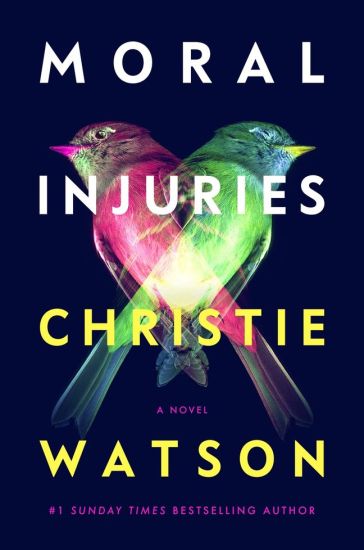
Moral Injuries: When Good Conscience Suffers in a World of Hurt
A psychologist's paradigm-shifting exploration of moral injury--the wound we suffer when our core values are violated by what we've done, failed to do, witnessed, or been compelled to accept--and how to begin to repair it. An invisible malady is reshaping the emotional core of our institutions, communities, and inner lives. This ailment fractures our sense of self, erodes our trust in others, and leaves us questioning not only what has happened to us but also who we've become. It arises in high-stakes moments when we are compelled--or sometimes choose--to participate in, witness, or remain silent as our deepest principles are violated. And it's reaching epidemic levels throughout our society. This condition is known as moral injury. More than stress or trauma, moral injury is a rupture of conscience, itself, signaled by shame, guilt, anger, alienation, and loss of trust. Often confused with PTSD, which is a reaction to mortal threat, moral injury arises in response to moral threat. First observed in soldiers, it is now appearing across professions--from medicine to tech, law to public safety--anywhere people face impossible choices that pit survival, duty, or success against their principles. Dr. Michael Valdovinos, a psychologist, veteran, and trauma expert, has spent over a decade exploring this acute form of ethical and emotional pain. In this urgent and necessary book, he investigates how moral injury manifests, why it matters now more than ever, and what it reveals about our social contract. Rather than offering prescriptive steps, Moral Injuries invites readers into stories of rupture, reckoning, and repair--tracing how individuals begin the work of healing. Through history, science, and lived experience, it also opens a new conversation about the role of conscience in protecting the health of society.
Moral Clarity

Moral Clarity

Susan Neiman

Vintage
2011
pokkari
In Moral Clarity, Susan Neiman shows how the philosophical resources of the eighteenth-century Englightenment can help us to construct a politics that does not repeat the mistakes of Marxism or succumb to the temptation of a cynicism that masquerade as realism.
Miral

Miral

Rula Jebreal

PENGUIN BOOKS
2010
nidottu
Soon to be a major motion picture from the award-winning director Julian Schnabel, starring Freida Pinto. WRITTEN BY the much-admired Italo-Palestinian journalist Rula Jebreal, Miral is a novel that focuses on remarkable women whose lives unfold in the turbulent political climate along the borders of Israel and Palestine. The story begins with Hind, a woman who sacrifices everything to establish a school for refugee Palestinian girls in East Jerusalem. Years later Miral arrives at the school after her mother commits suicide. Hind sees that Miral has the potential to change the world peacefully-but Miral is appalled by the injustice that surrounds her, and flirts with the notion of armed resistance. Hind desperately works to persuade her to stay the course of education, hard work, and non-violent resolution-but is she too late? Watch a Video
Moral Tribes: Emotion, Reason, and the Gap Between Us and Them
"Surprising and remarkable...Toggling between big ideas, technical details, and his personal intellectual journey, Greene writes a thesis suitable to both airplane reading and PhD seminars."--The Boston Globe Our brains were designed for tribal life, for getting along with a select group of others (Us) and for fighting off everyone else (Them). But modern times have forced the world's tribes into a shared space, resulting in epic clashes of values along with unprecedented opportunities. As the world shrinks, the moral lines that divide us become more salient and more puzzling. We fight over everything from tax codes to gay marriage to global warming, and we wonder where, if at all, we can find our common ground. A grand synthesis of neuroscience, psychology, and philosophy, Moral Tribes reveals the underlying causes of modern conflict and lights the way forward. Greene compares the human brain to a dual-mode camera, with point-and-shoot automatic settings ("portrait," "landscape") as well as a manual mode. Our point-and-shoot settings are our emotions--efficient, automated programs honed by evolution, culture, and personal experience. The brain's manual mode is its capacity for deliberate reasoning, which makes our thinking flexible. Point-and-shoot emotions make us social animals, turning Me into Us. But they also make us tribal animals, turning Us against Them. Our tribal emotions make us fight--sometimes with bombs, sometimes with words--often with life-and-death stakes. A major achievement from a rising star in a new scientific field, Moral Tribes will refashion your deepest beliefs about how moral thinking works and how it can work better.
Moral Acrobatics

Moral Acrobatics

Philippe Rochat

Oxford University Press Inc
2021
sidottu
Although it is difficult for us to fathom, pure monsters do not exist. Terrorists and other serial killers massacre innocent people, yet are perfectly capable of loving their own parents, neighbors, and children. Hitler, sending millions to their death, was contemptuous of meat eaters and a strong advocate of animal welfare. How do we reconcile such moral ambiguities? Do they capture something deep about how we build values? As a developmental scientist, Philippe Rochat explores this possibility, proposing that as members of a uniquely symbolic and self-conscious species aware of its own mortality, we develop uncanny abilities toward lying and self-deception. We are deeply categorical and compartmentalized in our views of the world. We imagine essence where there is none. We juggle double standards and manage contradictory values, clustering our existence depending on context and situations, whether we deal in relation to close kin, colleagues, strangers, lovers, or enemies. We live within multiple, interchangeable moral spheres. This social-contextual determination of the moral domain is the source of moral ambiguities and blatant contradictions we all need to own up to.
Moral Reasoning: A Text and Reader on Ethics and Contemporary Moral Issues
Offering students an accessible, in-depth, and highly practical introduction to ethics, Moral Reasoning: A Text and Reader on Ethics and Contemporary Moral Issues covers argumentation and moral reasoning, various types of moral arguments, and theoretical issues that commonly arise in introductory ethics courses, including skepticism, subjectivism, relativism, religion, and normative theories. The book combines primary sources in moral theory and applied ethics with explanatory material, case studies, and pedagogical features to help students think critically about moral issues. Visit www.oup.com/us/morrow for student and instructor resources.
Moral Minorities and the Making of American Democracy

Moral Minorities and the Making of American Democracy

Kyle G. Volk

Oxford University Press Inc
2017
nidottu
Should the majority always rule? If not, how should the rights of minorities be protected? In Moral Minorities and the Making of American Democracy, Kyle G. Volk unearths the origins of modern ideas and practices of minority-rights politics. Focusing on controversies spurred by the explosion of grassroots moral reform in the early nineteenth century, he shows how a motley but powerful array of self-understood minorities reshaped American democracy as they battled laws regulating Sabbath observance, alcohol, and interracial contact. Proponents justified these measures with the "democratic" axiom of majority rule. In response, immigrants, black northerners, abolitionists, liquor dealers, Catholics, Jews, Seventh-day Baptists, and others articulated a different vision of democracy requiring the protection of minority rights. These moral minorities prompted a generation of Americans to reassess whether "majority rule" was truly the essence of democracy, and they ensured that majority tyranny would no longer be just the fear of elites and slaveholders. Beginning in the mid-nineteenth-century, minority rights became the concern of a wide range of Americans attempting to live in an increasingly diverse nation. Volk reveals that driving this vast ideological reckoning was the emergence of America's tradition of popular minority-rights politics. To challenge hostile laws and policies, moral minorities worked outside of political parties and at the grassroots. They mobilized elite and ordinary people to form networks of dissent and some of America's first associations dedicated to the protection of minority rights. They lobbied officials and used constitutions and the common law to initiate "test cases" before local and appellate courts. Indeed, the moral minorities of the mid-nineteenth century pioneered fundamental methods of political participation and legal advocacy that subsequent generations of civil-rights and civil-liberties activists would adopt and that are widely used today.
Moral Resilience

Moral Resilience

Oxford University Press Inc
2018
nidottu
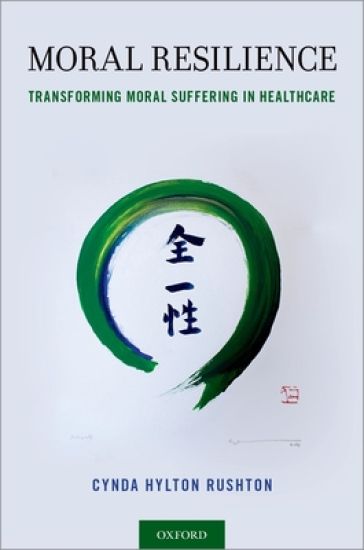
Suffering is an unavoidable reality in healthcare. Not only are patients and families suffering, but more and more the clinicians who care for them are also experiencing distress. The omnipresent, daily presence of moral adversity is, in part, a reflection of the burgeoning complexity of healthcare, clinicians role within it, and the expanding range of available interventions that must be balanced with competing demands. There is an urgent need to design solutions that address the myriad of factors which create the conditions for imperilled integrity within the healthcare system. Moral resilience is a pathway to transform the effects of moral suffering in healthcare. Dr. Rushton and colleagues offer a novel approach to addressing moral suffering that engages transformative strategies for individuals and systems alike and leverages practical skills and tools for a sustainable workforce that practices with integrity, competence, and wholeheartedness, and dismantles the systemic patterns that impede ethical practice. This is a must-read for clinicians and front line-nurses, physicians, system leaders, and policymakers, as it will require collective collaboration, aligned values, shared language, and intentional design to make our healthcare organizations and their clinicians healthy again.
Moral Failure

Moral Failure

Lisa Tessman

Oxford University Press Inc
2016
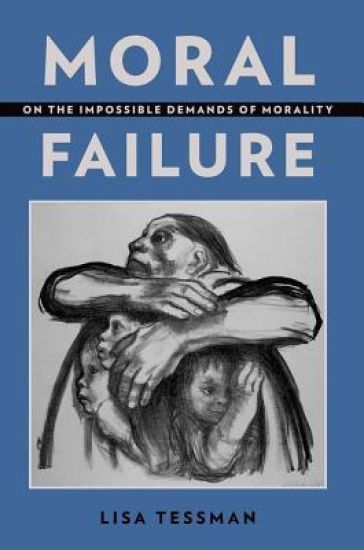
nidottu
Moral Failure: On the Impossible Demands of Morality asks what happens when the sense that "I must" collides with the realization that "I can't." Bringing together philosophical and empirical work in moral psychology, Lisa Tessman here examines moral requirements that are non-negotiable and that contravene the principle that "ought implies can." In some cases, it is because two non-negotiable requirements conflict that one of them becomes impossible to satisfy, and yet remains binding. In other cases, performing a particular action may be non-negotiably required -- even if it is impossible -- because not performing the action is unthinkable. After offering both conceptual and empirical explanations of the experience of impossible moral requirements and the ensuing failures to fulfill them, Tessman considers what to make of such experience, and in particular, what role such experience has in the construction of value and of moral authority. According to the constructivist account that the book proposes, some moral requirements can be authoritative even when they are impossible to fulfill. Tessman points out a tendency to not acknowledge the difficulties that impossible moral requirements and unavoidable moral failures create in moral life, and traces this tendency through several different literatures, from scholarship on Holocaust testimony to discussions of ideal and nonideal theory, from theories of supererogation to debates about moral demandingness and to feminist care ethics.