Kirjojen hintavertailu. Mukana 12 353 630 kirjaa ja 12 kauppaa.

Kirjahaku

Etsi kirjoja tekijän nimen, kirjan nimen tai ISBN:n perusteella.

1000 tulosta hakusanalla Marcelo M. Giugale

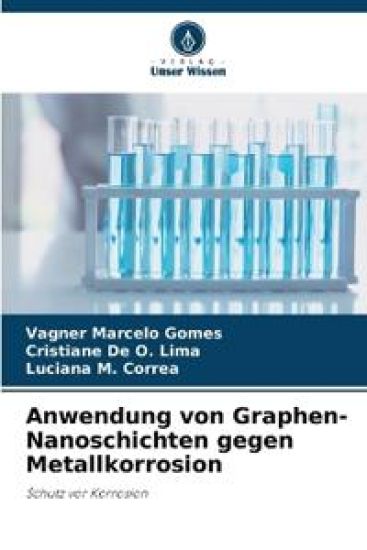
Anwendung von Graphen-Nanoschichten gegen Metallkorrosion

Anwendung von Graphen-Nanoschichten gegen Metallkorrosion

Vagner Marcelo Gomes; Cristiane de O Lima; Luciana M Correa

Verlag Unser Wissen
2024
pokkari
In dieser Arbeit wird eine Bewertung der Passivierungskapazit t von Graphen-Nanoschichten (NG) vorgeschlagen, die auf der Oberfl che von Kupfer-, Aluminium- und Eisenplatten durch Abscheidung mit organischen L sungsmitteln mit niedrigem Siedepunkt adsorbiert werden. Dazu war es notwendig, Graphen experimentell durch chemische Exfoliation, ausgehend von pulverisiertem Graphit, herzustellen. Die Ablagerung von Graphen-Nanoschichten auf Metallen wurde mit der Adsorptionsmethode durchgef hrt, wobei organische L sungsmittel getestet wurden: Ethylacetat, Chloroform und Ethylether. Anschlie end wurden Korrosionsangriffe mit 6mol/L Schwefels ure und einem Oberfl chenenth llungsmittel f r jedes untersuchte Metall simuliert (Kupfer: L sung mit 5g Eisen-III-Chlorid, 30mL konzentrierter Salzs ure und 100mL destilliertem Wasser; Eisen: 10%ige alkoholische Salpeters urel sung und Aluminium: 0,01mol/L Natriumhydroxidl sung). Der Korrosionstest bewertete auch den Einfluss der Temperatur auf die Fixierung der Graphen-Nanoschichten, indem einige beschichtete Metalle 30 Sekunden lang einer Temperatur von 1000 C ausgesetzt wurden.
Application of graphene nanolayers against metal corrosion

Application of graphene nanolayers against metal corrosion

Vagner Marcelo Gomes; Cristiane de O Lima; Luciana M Correa

Our Knowledge Publishing
2024
pokkari
This work proposes an evaluation of the passivating capacity of Graphene Nanolayers (NG) when adsorbed onto the surface of copper, aluminum and iron plates through deposition with low boiling point organic solvents. To do this, it was necessary to produce graphene experimentally by chemical exfoliation, starting from powdered graphite. The deposition of the graphene nanolayers on the metals was carried out using the adsorption method, where the organic solvents tested were ethyl acetate, chloroform and ethyl ether. Afterwards, corrosion attacks were simulated with 6mol/L sulfuric acid and a surface revealing agent for each metal evaluated (copper: solution containing 5g of iron III chloride, 30mL of concentrated hydrochloric acid and 100mL of distilled water; iron: 10% alcoholic nitric acid solution and aluminum: 0.01mol/L sodium hydroxide solution). The corrosion test also assessed the influence of temperature on the fixation of graphene nanolayers by exposing some coated metals to 1000 C for 30s.
Application des nanocouches de graphène contre la corrosion des métaux

Application des nanocouches de graphène contre la corrosion des métaux

Vagner Marcelo Gomes; Cristiane de O Lima; Luciana M Correa

Editions Notre Savoir
2024
pokkari
Ce travail propose une valuation de la capacit de passivation des nanocouches de graph ne (NG) lorsqu'elles sont adsorb es sur la surface de plaques de cuivre, d'aluminium et de fer par d p t avec des solvants organiques bas point d' bullition. Pour ce faire, il a fallu produire exp rimentalement du graph ne par exfoliation chimique, partir de graphite en poudre. Le d p t de nanocouches de graph ne sur les m taux a t effectu par la m thode d'adsorption, en testant des solvants organiques: ac tate d' thyle, chloroforme et ther thylique. Ensuite, des attaques de corrosion ont t simul es avec de l'acide sulfurique 6mol/L et un agent r v lateur de surface pour chaque m tal valu (cuivre: solution contenant 5g de chlorure de fer III, 30mL d'acide chlorhydrique concentr et 100mL d'eau distill e; fer: solution d'acide nitrique alcoolique 10% et aluminium: solution d'hydroxyde de sodium 0,01mol/L). Le test de corrosion a galement valu l'influence de la temp rature sur la fixation des nanocouches de graph ne en exposant certains m taux rev tus 1000 C pendant 30s.
Applicazione di nanostrati di grafene contro la corrosione dei metalli

Applicazione di nanostrati di grafene contro la corrosione dei metalli

Vagner Marcelo Gomes; Cristiane de O Lima; Luciana M Correa

Edizioni Sapienza
2024
pokkari
Questo lavoro propone una valutazione della capacit passivante dei nanostrati di grafene (NG) quando vengono adsorbiti sulla superficie di lastre di rame, alluminio e ferro mediante deposizione con solventi organici a basso punto di ebollizione. A tal fine, stato necessario produrre sperimentalmente il grafene mediante esfoliazione chimica, partendo da grafite in polvere. La deposizione di nanostrati di grafene sui metalli stata effettuata con il metodo dell'adsorbimento, dove sono stati testati i solventi organici: acetato di etile, cloroformio ed etere etilico. Successivamente, sono stati simulati attacchi di corrosione con acido solforico 6mol/L e un agente rivelatore di superficie per ciascun metallo valutato (rame: soluzione contenente 5g di cloruro di ferro III, 30mL di acido cloridrico concentrato e 100mL di acqua distillata; ferro: soluzione di acido nitrico alcolico al 10% e alluminio: soluzione di idrossido di sodio 0,01mol/L). Il test di corrosione ha anche valutato l'influenza della temperatura sulla fissazione dei nanostrati di grafene esponendo alcuni metalli rivestiti a 1000 C per 30s.
Finite Difference Methods in Heat Transfer

Finite Difference Methods in Heat Transfer

M. Necati Özisik; Helcio R. B. Orlande; Marcelo J. Colaço; Renato M. Cotta

Apple Academic Press Inc.
2017
sidottu
Finite Difference Methods in Heat Transfer, Second Edition focuses on finite difference methods and their application to the solution of heat transfer problems. Such methods are based on the discretization of governing equations, initial and boundary conditions, which then replace a continuous partial differential problem by a system of algebraic equations. Finite difference methods are a versatile tool for scientists and for engineers. This updated book serves university students taking graduate-level coursework in heat transfer, as well as being an important reference for researchers and engineering.FeaturesProvides a self-contained approach in finite difference methods for students and professionalsCovers the use of finite difference methods in convective, conductive, and radiative heat transferPresents numerical solution techniques to elliptic, parabolic, and hyperbolic problemsIncludes hybrid analytical–numerical approaches
Analysis and Synthesis of Logics

Analysis and Synthesis of Logics

Walter Carnielli; Marcelo Coniglio; Dov M. Gabbay; Paula Gouveia; Cristina Sernadas

Springer-Verlag New York Inc.
2008
sidottu
Starting with simple examples showing the relevance of cutting and pasting logics, the monograph develops a mathematical theory of combining and decomposing logics, ranging from propositional and first-order based logics to higher-order based logics as well as to non-truth functional logics. The theory covers mechanisms for combining semantic structures and deductive systems either of the same or different nature (for instance, two Hilbert calculi or a Hilbert calculus and a tableau calculus). The important issue of preservation of properties is extensively addressed. For instance, sufficient conditions are provided for a combined logic to be sound and complete when the original component logics are known to be sound and complete. The book brings the reader to the front line of current research in the field by showing both recent achievements and directions of future investigations (in particular, multiple open problems). It also provides examples of potential applications in emergent fields like security protocols, quantum computing, networks and argumentation theory, besides discussing more classical applications like software specification, knowledge representation, computational linguistics and modular automated reasoning. This monograph will be of interest to researchers and graduate students in mathematical logic, theory of computation and philosophical logic with no previous knowledge of the subject of combining and decomposing logics, but with a working knowledge of first-order logic. The book will also be relevant for people involved in research projects where logic is used as a tool and the need for working with several logics at the same time is mandatory (for instance, temporal, epistemic and probabilistic logics).
Customização do Sistema de Educação à Distância Chamilo

Customização do Sistema de Educação à Distância Chamilo

Celina Ferreira Ribeiro; Francisco W M Hirano; Marcelo Moreno Costa

Novas Edicoes Academicas
2017
pokkari
O Chamilo um sistema de educa o dist ncia gratuito, seguro, de f cil uso, simples de baixar e de configurar e que pode ser utilizado em qualquer institui o que promove cursos dist ncia. O sistema pode ser configurado em diversos idiomas e conforme as necessidades de cada institui o. Diante disso, objetivou-se a revis o da bibliografia e customiza o do AVA Chamilo para se adequar ao Instituto Federal de Educa o e Tecnologia do Tocantins (IFTO), de forma a adequ -lo s suas necessidades e proporcionar aos usu rios da modalidade de educa o dist ncia uma alternativa de sistema que possua uma boa usabilidade. A customiza o incluiu altera es envolvendo a troca da logomarca; cores da plataforma; inser o de v deos, links e not cias; redu o de idiomas permanecendo o portugu s, ingl s e espanhol. Criaram-se tamb m, cadastros de usu rios com diferentes perfis, categorias de cursos, cursos e avalia o. Ap s a customiza o, desenvolveu-se pesquisa de campo com aplica o de question rios para conhecer os AVAs e a opini o das pessoas com rela o a EaD e realizou-se testes para testar a usabilidade do Chamilo. O Chamilo depois de customizado foi avaliado com boa usabilidade.