Kirjojen hintavertailu. Mukana 12 390 323 kirjaa ja 12 kauppaa.

Kirjahaku

Etsi kirjoja tekijän nimen, kirjan nimen tai ISBN:n perusteella.

1000 tulosta hakusanalla Martyn Hilbert

A Missouri Confederate in the Civil War: The Journal of Henry Martyn Cheavens, 1862-1863

A Missouri Confederate in the Civil War: The Journal of Henry Martyn Cheavens, 1862-1863

Henry Martyn Cheavens; James E. Moss

Literary Licensing, LLC
2011
sidottu
""A Missouri Confederate In The Civil War: The Journal Of Henry Martyn Cheavens, 1862-1863"" is a historical account of the Civil War from the perspective of a Confederate soldier. The book is a collection of journal entries written by Henry Martyn Cheavens, a Missouri native who joined the Confederate army in 1862. The journal entries cover a period of one year, from 1862 to 1863, and provide a detailed account of Cheavens' experiences during the war.The book begins with Cheavens' decision to join the Confederate army and his journey to Arkansas to join his regiment. The journal entries describe his experiences in camp, his interactions with other soldiers, and his duties as a soldier. Cheavens also writes about the battles he participated in, including the Battle of Prairie Grove, and the hardships of war, such as illness and lack of supplies.Throughout the book, Cheavens provides insight into the mindset of a Confederate soldier and the reasons why he fought for the Confederacy. He also writes about his opinions on the Union army and the political situation of the time.The book concludes with Cheavens' capture by Union forces and his imprisonment in a Union prison camp. The journal entries end abruptly, leaving the reader to wonder about Cheavens' fate.Overall, ""A Missouri Confederate In The Civil War: The Journal Of Henry Martyn Cheavens, 1862-1863"" is a valuable historical document that provides a unique perspective on the Civil War. It is a must-read for anyone interested in the history of the Civil War or the experiences of Confederate soldiers.Extracted From Missouri Historical Review V57, No. 1, October, 1962.This scarce antiquarian book is a facsimile reprint of the old original and may contain some imperfections such as library marks and notations. Because we believe this work is culturally important, we have made it available as part of our commitment for protecting, preserving, and promoting the world's literature in affordable, high quality, modern editions, that are true to their original work.
Thirty-eight Plates, With Explanations; Intended to Illustrate Linnæus's System of Vegetables, and Particularly Adapted to the Letters on the Elements of Botany. By Thomas Martyn,
The 18th century was a wealth of knowledge, exploration and rapidly growing technology and expanding record-keeping made possible by advances in the printing press. In its determination to preserve the century of revolution, Gale initiated a revolution of its own: digitization of epic proportions to preserve these invaluable works in the largest archive of its kind. Now for the first time these high-quality digital copies of original 18th century manuscripts are available in print, making them highly accessible to libraries, undergraduate students, and independent scholars.Medical theory and practice of the 1700s developed rapidly, as is evidenced by the extensive collection, which includes descriptions of diseases, their conditions, and treatments. Books on science and technology, agriculture, military technology, natural philosophy, even cookbooks, are all contained here.++++The below data was compiled from various identification fields in the bibliographic record of this title. This data is provided as an additional tool in helping to insure edition identification: ++++British LibraryT081066The 'Letters' are by J. J. Rousseau; the plates by F. P. Nodder. With a final leaf of advertisements.London: printed for B. and J. White, 1794. vi,72, 2]p., plates; 8
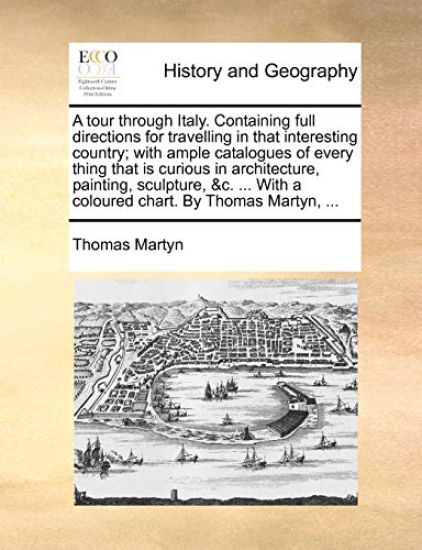
A Tour Through Italy. Containing Full Directions for Travelling in That Interesting Country; With Ample Catalogues of Every Thing That Is Curious in Architecture, Painting, Sculpture, &c. ... with a Coloured Chart. by Thomas Martyn,
The 18th century was a wealth of knowledge, exploration and rapidly growing technology and expanding record-keeping made possible by advances in the printing press. In its determination to preserve the century of revolution, Gale initiated a revolution of its own: digitization of epic proportions to preserve these invaluable works in the largest archive of its kind. Now for the first time these high-quality digital copies of original 18th century manuscripts are available in print, making them highly accessible to libraries, undergraduate students, and independent scholars.Rich in titles on English life and social history, this collection spans the world as it was known to eighteenth-century historians and explorers. Titles include a wealth of travel accounts and diaries, histories of nations from throughout the world, and maps and charts of a world that was still being discovered. Students of the War of American Independence will find fascinating accounts from the British side of conflict. ++++The below data was compiled from various identification fields in the bibliographic record of this title. This data is provided as an additional tool in helping to insure edition identification: ++++British LibraryT081839Originally published in 1787 as 'The gentleman's guide in his tour through Italy'.London: printed for C. and G. Kearsley, 1791. xxxix, 1],480, 8]p., plate: map; 8
Henry Martyn Saint and Scholar

Henry Martyn Saint and Scholar

George Smith

Createspace Independent Publishing Platform
2017
nidottu
At Gwennap also we found the people in the utmost consternation. Word was brought that a great company of tinners, made drunk on purpose, were coming to do terrible things-so that abundance of people went away. I preached to the rest on 'Love your enemies.' By 1774 we read 'the glorious congregation was assembled at five in the amphitheatre at Gwennap.' Next year we find this: 'At five in the evening in the amphitheatre at Gwennap. I think this is the most magnificent spectacle which is to be seen on this side heaven. And no music is to be heard upon earth comparable to the sound of many thousand voices when they are all harmoniously joined together singing "praises to God and the Lamb." Four-and-twenty thousand were present, frequently, at that spot. And yet all, I was informed, could hear
Marguerite Martyn: America's Forgotten Journalist

Marguerite Martyn: America's Forgotten Journalist

George Garrigues

Independently Published
2019
nidottu
"Marguerite Martyn - America's Forgotten Journalist" was compiled and published by George Garrigues, a journalism professor and retired Los Angeles Times journalist. His appreciation of her work is evident in the book's preface, and he adds clarifying notes throughout to provide perspective for Martyn's stories.Readers with an interest in St. Louis history will appreciate Martyn's accounts of visits to interview residents of Westmoreland Place and her descriptions of the city's illegal "Lid Clubs," where illicit and underage drinking took place on Sundays.She goes to great lengths to describe the women's suffrage movement in Missouri, traveling to Jefferson City to report on the suffragists' lobbying of the all-male Legislature.Her subject matter for the feature columns sometimes bordered on hard news, but her descriptive writing style, which relied heavily on her interview subjects and her surroundings, truly set her work apart from the day's standard news stories. Of sand castles being built by idle newsboys at construction sites in downtown St. Louis, she wrote: "I have seen these things materialize in the middle of Broadway. Amid the noises of hammer upon steel, the clash of metal upon stone. Ponderous drays and cars bear down upon these builders, but these small businessmen are oblivious to all outside their kidhood." It is easy to discern in reading these articles that Martyn was quite a character herself. Visiting Denver to cover the Democratic National Convention, she set out to describe what she saw in that city: "The Denver girl, for example, is highly colored. I haven't seen a pale one yet. And she doesn't get tired, for she weighs about five pounds less than she would at a lower altitude and her hair doesn't come out of curl. But she squints because the sun shines so bright, and that is why they say she grows old quickly, for she gets crow's feet around her eyes." After publication of Martyn's gut-wrenching story of a young St. Louis girl who had lost her arms in a child labor accident, Garrigues noted, "Marie, who had been working for $5.90 a week, received $1,800 in donations." She also won a cash settlement from the employer.Martyn interviewed presidents, first ladies, governors, suffragists and everyday people, sketching them as they talked. These illustrations would later be inked to accompany her articles. Often, readers would note Martyn had inserted a small self-portrait in the sketches, showing herself sketching the person being interviewed. Garrigues writes that she always showed up for interviews carrying her sketchbook, often without calling ahead to arrange an appointment.- Frank Absher review in the St. Louis Post-Dispatch.
Henry Martyn - Saint and Scholar

Henry Martyn - Saint and Scholar

George Smith

Hansebooks
2017
pokkari
Henry Martyn - Saint and Scholar - first modern missionary to the Mohammedans, 1781-1812 is an unchanged, high-quality reprint of the original edition of 1892. Hansebooks is editor of the literature on different topic areas such as research and science, travel and expeditions, cooking and nutrition, medicine, and other genres. As a publisher we focus on the preservation of historical literature. Many works of historical writers and scientists are available today as antiques only. Hansebooks newly publishes these books and contributes to the preservation of literature which has become rare and historical knowledge for the future.