Kirjojen hintavertailu. Mukana 11 717 486 kirjaa ja 12 kauppaa.

Kirjahaku

Etsi kirjoja tekijän nimen, kirjan nimen tai ISBN:n perusteella.

191 tulosta hakusanalla Monocle

Monoclonal Antibodies in Headache

Monoclonal Antibodies in Headache

Springer Nature Switzerland AG
2021
sidottu
Intended to promote a more appropriate and modern therapeutic approach to migraine management, this book is the first to deal with monoclonal antibodies in this context. Authored by the most respected migraine experts from around the globe and drawing on the lessons learned in both clinical trials and clinical practice, it reviews the current state of knowledge on this important therapeutic innovation, which has produced impressive data in randomized controlled trials, and the efficacy and safety of which have been confirmed in day-to-day real-world use. Given its scope, the book will appeal to a broad range of specialists, including pharmacologists, clinical pharmacologists, neurologists and internists, but also to residents and medical students.
Monoclonal Antibodies in Headache

Monoclonal Antibodies in Headache

Springer Nature Switzerland AG
2022
nidottu
Intended to promote a more appropriate and modern therapeutic approach to migraine management, this book is the first to deal with monoclonal antibodies in this context. Authored by the most respected migraine experts from around the globe and drawing on the lessons learned in both clinical trials and clinical practice, it reviews the current state of knowledge on this important therapeutic innovation, which has produced impressive data in randomized controlled trials, and the efficacy and safety of which have been confirmed in day-to-day real-world use. Given its scope, the book will appeal to a broad range of specialists, including pharmacologists, clinical pharmacologists, neurologists and internists, but also to residents and medical students.
Monoclonal Antibody-Directed Therapy
The book deals with therapeutic monoclonal antibodies (mAbs) broadly, and relevant topics such as challenges and opportunities, next-generation antibody products, Antibody-Drug-Conjugates (ADC), bispecifics, glycosylation, and T-cell engagers are covered. Each topic has been written by leading groups around the world and the book should be of interest to researchers from both academia and industry.
Monoclonal Antibodies
Monoclonal antibodies are established in clinical practice for the treatment of cancer, and autoimmune and infectious diseases. The first generation of antibodies has been dominated by classical IgG antibodies, however, in the last decade, the field has advanced, and, nowadays, a large proportion of antibodies in development have been engineered. This Special Issue on "Monoclonal Antibodies" includes original manuscripts and reviews covering various aspects related to the discovery, analytical characterization, manufacturing and development of therapeutic and engineered antibodies.
Monoclonal Antibodies

Monoclonal Antibodies

G. Köhler

Springer-Verlag Berlin and Heidelberg GmbH Co. K
2011
nidottu
The present new version of this popular laboratory manual is at the same time the first one of this text in the English language - and this makes me even a little proud, as it reminds me of probably the first collection of monoclonal recipes in English, written by myself, which circulated for a couple of years in many laboratories. In the meantime many researchers have put enormous effort into improving methods for monoclonal antibody production. The proce­ dures have become more and more standardized and by this have more and more lost the character of magic secrets. Hinrich Peters and Horst Baumgarten, who had followed this good tradition already in the previous edition, written in German, suc­ ceeded in making laboratory tricks teachable. They had contributed their own experiences in cell culture and immunology, and were able to engage a number of experienced authors to contribute to the work. They were all willing to follow the general concept of this book, which contains a brief theoretical background for the methods described and presents the procedures in a highly organized structure. So the book has retained its shape as a "cook-book", which I especially like.
Monoclonal Antibodies in Transplantation

Monoclonal Antibodies in Transplantation

Springer-Verlag Berlin and Heidelberg GmbH Co. K
2013
nidottu
Experimental and clinical evidence presented in this book illustrates that antibodies expressing different specificities can be very effective in preventing or reversing established transplant rejection. Moreover, the data leads us to hope that the use of these new therapeutic agents may allow the induction of specific tolerance to transplant alloantigens which is the only means to avoid the major risks of sustained immunosuppression, namely an increased susceptibility to infection and tumor development. In this volume the editors combine contributions dealing with very practical aspects of the clinical use of monoclonal antibodies with a more general discussion on the developments one may foresee in the near future.
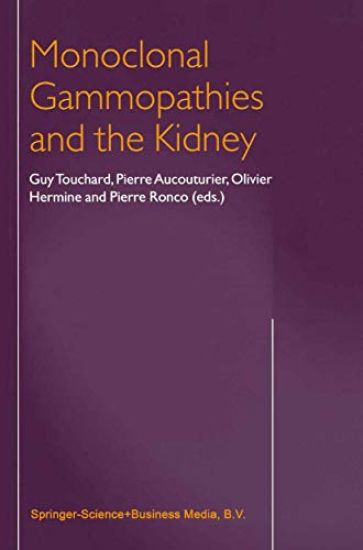
Monoclonal Gammopathies and the Kidney
Table 1 Comparison of MIDD and immunoglobulinic amyloidosis MIDD Amyloidosis Presentation Multivisceral or predominant involvement of an organ (kidney) Underlying disease Monoclonal immunoproliferative disorders, mostly myeloma. Monoclonal bone marrow plasma cell populations without overt malignancy. Possibility of 'non-secretory' forms. Deposits by EM (Granular) non-organized Fibrillar (13 pleated sheets) Spectrum LCDD : L chains, most K, either AL-amyloidosis : fragments (?)* of or apparently enlarged, normal-sized normal-sized or apparently enlarged or short. Frequent glycosylation L chains most A. Frequent and polymeration. glycosylation.Abnormal susceptibility to proteolysis. LHCDD : associated H chains Cases with associated short H chains (short by biosynthesis by biosynthesis experiments. experiments). HCDD: short H chains. AH-amyloidosis : short H chains. L chain isotypy V K IV predominance. VAVI C A3predominance. V region mutations Yes Yes *Found in necropsy material; whether they exist in vivo is doubtful. 3 After Preud'homme et al. AL-amyloidosis). Therefore, we believe' that the term MIDD should be restricted to this pathological entity, whatever the Ig content of the deposits, light 4 5 ) or both (LHCDD ). However, the chains (LCDD), heavy chains (HCDD New York group used the denomination MIDD for both Randall's disease and immunoglobulinic amyloidosis'S". The two processes have many features in common (Table I) and they can be associated in the same patients.
Monoceros

Monoceros

Jonas Ellerström

Ellerströms Förlag
2016
nidottu
I diktsamlingen Monoceros samsas dåsiga höstflugor med jaktfalkar och agraffer. Jonas Ellerström låter de vardagliga betraktelserna löpa fritt bredvid de minst sagt ovanliga. Diktjaget rör sig rastlöst mellan Värnanäs och Ramallah, i tid och rum, mellan verklighet och fantasi – men kanske söker han bara efter ett hem? Mitt i oron anas alltid lyckan – den manifestar sig i en glädje över tillvarons detaljer: det välbekanta hotellrummet, gärdsmygens sång utanför fönstret eller perfektionen i ett schackdrag.
Monoclonal Antibodies to Receptors
Receptor specific antibodies are excellent probes for a wide range of biological investigations on receptor structure and function. The hybridoma technology (Kohler and Milstein, 1975) has inevitably had a major impact on this field with most of the better known receptors now identified with monoclonal antibodies. This volume of the Receptors and Recognition series provides reviews of recent developments in this field and emphasizes in particular the new opportunities afforded by the judicious application of monoclonal reagents. It is assumed that most readers will be familiar with the now fairly routine methods of cell fusion, hybridoma cloning and selection for producing monoclonal antibodies and so few details of the basic technical procedures are described. Several good reviews on this topic are however available (see Galfre and Milstein, 1981; Goding, 1980; Yelton and Scharf, 1981; McMichael and Fabre, 1982). By no means all vertebrate receptor species are discussed here; omissions include antibodies to low density lipoprotein receptors (Beisiegel et al. , 1981; Kita et al. , 1981), prolactin and growth hormone receptors (Friesen etal. , 1982; Simpson et al. , 1983) and the hepatocyte asialoglycoprotein receptor (Schwartz et al. , 1981; Harford et al. , 1982). Nevertheless the coverage is comprehensive and critical and the individual chapters provided illustrate vividly the rapid progress being made.