Kirjojen hintavertailu. Mukana 11 244 527 kirjaa ja 12 kauppaa.

Kirjahaku

Etsi kirjoja tekijän nimen, kirjan nimen tai ISBN:n perusteella.

1000 tulosta hakusanalla Robert L Perry

The Worldly Philosophers

The Worldly Philosophers

Robert L Heilbroner

Penguin Books Ltd
2000
pokkari
The final revision of this classic bestseller, the 7th edition defines the common thread linking the world's greatest economic thinkers and explores the philosophies that motivate them. Hailed by Galbraith as a "brilliant achievement", The Worldly Philosophers with over 2 million copies sold worldwide, not only enables us to see more deeply into our history, but helps us to better understand our own times. Heilbroner provides the new theme that connects thinkers as different as Adam Smith andKarl Marx: the desire to understand how a capitalist society works. A new chapter conveys a concern that today's increasingly "scientific" economics may overlook fundamental social and political issues that are central to economics.
Anwar al-Sadat

Anwar al-Sadat

Robert L. Tignor

Oxford University Press Inc
2015
nidottu
Part of The World in A Life series, this brief, inexpensive text provides insight into the life of Anwar al-Sadat, one of the most transformative figures in Middle Eastern and world history. Little was expected of Sadat, as he came to power after the death of Egypt's powerful modernizing leader, Gamal Abdel Nasser. However, he left an unparalleled mark on Egypt, the Middle East, and Cold War relations. He surprised the Israelis by starting the 1973 war, crossing the Suez Canal into Sinai. Though eventually Egypt was forced to sue for peace, Sadat won the support and praise of the Americans. His chief American supporters at the time were President Richard Nixon and Secretary of State Henry Kissinger. Not content with this partial military success, Sadat traveled to Jerusalem in 1977 to address the Israeli Knesset (parliament), marking the first time that an Arab leader had traveled to Israel and openly negotiated with the Israelis. He followed this trip with a peace treaty with Israel in 1979, signed between Prime Minister Menachem Begin and himself and brokered by President Jimmy Carter. In short, Sadat broke Egypt's dependence on the Soviet Union, established strong relations with the United States, and recognized the state of Israel--all of these transformative events in Middle Eastern and world history. We live in a global age where big concepts like "globalization" often tempt us to forget the personal side of the past. The titles in The World in A Life series aim to revive these meaningful lives. Each one shows us what it was like to live on a world historical stage. Brief, inexpensive, and thematic, each book can be read in a week, fit within a wide range of curricula, and shed insight into a particular place or time. Four to six short primary sources at the end of each volume sharpen the reader's view of an individual's impact on world history.
The Ethics of Sport

The Ethics of Sport

Robert L. Simon

Oxford University Press Inc
2016
nidottu
The Ethics of Sport explores moral issues that arise in sports, especially competitive athletics, in a manner that is accessible not only to sports fans or participants but also to those critical of sports or simply interested in an introduction to the kind of moral issues raised by the practice of athletics. The issues considered range from the more abstract, such as the importance that should be assigned to winning in sports, to specific controversies such as arguments over the use of performance enhancing drugs, the nature of gender equity, and the evaluation of violence in competition. The book explores different sides of these issues and suggests reasonable resolutions to the kinds of ethical questions prevalent in the practice of sports.
The Ethics of Sport

The Ethics of Sport

Robert L. Simon

Oxford University Press Inc
2016
sidottu
The Ethics of Sport explores moral issues that arise in sports, especially competitive athletics, in a manner that is accessible not only to sports fans or participants but also to those critical of sports or simply interested in an introduction to the kind of moral issues raised by the practice of athletics. The issues considered range from the more abstract, such as the importance that should be assigned to winning in sports, to specific controversies such as arguments over the use of performance enhancing drugs, the nature of gender equity, and the evaluation of violence in competition. The book explores different sides of these issues and suggests reasonable resolutions to the kinds of ethical questions prevalent in the practice of sports.
Dickens, Death, and Christmas

Dickens, Death, and Christmas

Robert L. Patten

Oxford University Press
2023
sidottu
"Marley was dead, to begin with." Why does the most beloved of Christmas books open with a death? What has death to do with Christmas and New Years, and with Dickens's Christmas books and stories over his entire life? This book starts at the Paris Morgue and takes Dickens through his Christmas experiences from childhood and beyond, his celebrations of the season, and the sorrows that he often reviews in the New Year. Robert L. Patten weaves together Dickens's life, career, writings, journalism, travel, theatrical presentations, and religious convictions to offer a richly designed and entertaining narrative, fulsomely illustrated, of the manifold ways Dickens figures the spirit and traditions of the winter holidays in Victorian England. Both the gothic of ghosts and retribution and what he saw as the grotesque of lower-class enjoyment surface importantly in Dickens's fantasies. This volume discloses many hitherto overlooked connections between Dickens's writings and life and arrives at some surprising conclusions about Dickens's imagination, understanding of the conditions and meaning of Christian life, and the failures of British society to meet the pressing needs of its people. Not only does it address the public reception of these writings; it also tracks the responses and understandings of Dickens's illustrators, friends who found novel ways of telling, and mis-telling, the stories.
Of Arms and Men

Of Arms and Men

Robert L. O'Connell

Oxford University Press Inc
1989
sidottu
In this provocative book, Robert O'Connell examines the role and significance of weapons from the dawn of human history to the present, and the attempts of western civilization to come to terms with the grim results of its own inventiveness. This is not simply a history of the technology of weapons. It integrates the evolution of human society with the development of weapons and strategy into a single, coherent story. While primarily historical in his approach, O'Connell also draws upon anthropology, sociology, biology, and literature in his effort to explain certain recurring phenomena of warfare: the human need to dehumanize the enemy; arms races involving weapons which have developed beyond the point of utility; or the ideal of heroism rendered obsolete by deadly new technologies.
Of Arms and Men

Of Arms and Men

Robert L. O'Connell

Oxford University Press Inc
1991
nidottu
In this provocative book, Robert O'Connell examines the role and significance of weapons from the dawn of human history to the present, and the attempts of western civilization to come to terms with the grim results of its own inventiveness. This is not simply a history of the technology of weapons. It integrates the evolution of human society with the development of weapons and strategy into a single, coherent story. While primarily historical in his approach, O'Connell also draws upon anthropology, sociology, biology, and literature in his effort to explain certain recurring phenomena of warfare: the human need to dehumanize the enemy; arms races involving weapons which have developed beyond the point of utility; or the ideal of heroism rendered obsolete by deadly new technologies.
Sacred Vessels

Sacred Vessels

Robert L. O'Connell

Oxford University Press Inc
1993
nidottu
Awesome in size, immensely powerful and ingrained in the socio-economic and psychological structure of the U.S. Navy, the battleship served as chief guardsman of territory, reigning as monarch of the sea. For two hundred years it played an essential role in U.S. military affairs, yet as Robert L O'Connell demonstrates, the battleship was never actually an effective weapon of war - even before advances in submarine and aircraft technology rendered it impractical. Battleships have never played an actively important role in the outcome of any modern war but they have continued to be resurrected and refurbished, capturing the hearts of the public with their awesome beauty and size, and the myopic devotion of the military with their patently inefficient presence. Sacred Vessels tells the story of the evolution of the battleship. It is a cautionary tale about the often unacknowledged influence of human faith, culture and tradition and of the exceedingly important, costly and, supposedly rational, process, of nations arming themselves for war.
Ride of the Second Horseman

Ride of the Second Horseman

Robert L. O'Connell

Oxford University Press Inc
1999
nidottu
`Accurst be he that first invented war', wrote Christopher Marlowe - a declaration that most of us would take as a literary, not literal, construction. But in this sweeping overview of the rise of civilization, Robert O'Connell finds that war is indeed an invention - an institution that arose due to very specific historical circumstances, an institution that now verges on extinction. In Ride of the Second Horseman, O'Connell probes the distant human past to show how and why war arose. He begins with a definition that distinguishes between war and mere feuding: war involves group rather than individual issues, political or economic goals, and direction by some governmental structure, carried out with the intention of lasting results. With this definition, he finds that ants are the only other creatures that conduct it - battling other colonies for territory and slaves. But ants, unlike humans, are driven by their genes; in humans, changes in our culture and subsistence patterns, not our genetic hardware, brought the rise of organized warfare. O'Connell draws on anthropology and archeology to locate the rise of war sometime after the human transition from nomadic hunting and gathering to agriculture, when society split between farmers and pastoralists. Around 5500 BC, these pastoralists initiated the birth of war with raids on Middle Eastern agricultural settlements. The farmers responded by ringing their villages with walls, setting off a process of further social development, intensified combat, and ultimately the rise of complex urban societies dependent upon warfare to help stabilize what amounted to highly volatile population structures, beset by frequent bouts of famine and epidemic disease. In times of overpopulation, the armies either conquered new lands or self-destructed, leaving fewer mouths to feed. In times of underpopulation, slaves were taken to provide labor. O'Connell explores the histories of the civilizations of ancient Sumeria, Egypt, Assyria, China, and the New World, showing how war came to each and how it adapted to varying circumstances. On the other hand, societies based on trade employed war much more selectively and pragmatically. Thus, Minoan Crete, long protected from marauding pastoralists, developed a wealthy mercantile society marked by unmilitaristic attitudes, equality between men and women, and a relative absence of class distinctions. In Assyria, by contrast, war came to be an end in itself, in a culture dominated by male warriors. Despite the violence in the world today, O'Connell finds reason for hope. The industrial revolution broke the old patterns of subsistence: war no longer serves the demographic purpose it once did. Fascinating and provocative, Ride of the Second Horseman offers a far-reaching tour of human history that suggests the age-old cycle of war may now be near its end.
Information Graphics

Information Graphics

Robert L. Harris

Oxford University Press Inc
2000
nidottu
This beautifully illustrated book is the first complete handbook to visual information. Well written, easy use, and carefully indexed, it describes the full range of charts, graphs, maps, diagrams, and tables used daily to manage, analyse, and communicate information. It features over 3,000 illustrations, making it an ideal source for ideas on how to present information. It is an invaluable tool for anyone who writes or designs reports, whether for scientific journals, annual reports, or magazines and newspapers.
The Sounds of Milan, 1585-1650

The Sounds of Milan, 1585-1650

Robert L. Kendrick

Oxford University Press Inc
2002
sidottu
In this book, a follow-up to his 1996 monograph Celestial Sirens, Robert Kendrick examines the cultural contexts of music in early-modern Milan. This book describes the churches and palaces that served as performance spaces in Milan, analyses the power structures in the city, discusses the devotional rites of the Milanese, and explores the connections among city-politics, city-scape and music. Milan's music, Kendrick argues, was the best representation of that city's symbolic system. More than a typical "patrons and institutions" analysis of music's influences, The Sounds of Milan makes use of social anthropological methods to illuminate the roles of composers, performers and audiences. Kendrick traces the rise of polyphony from early appearances in secular music to an important feature of devotional music, all occurring under the careful regulation of the church hierarchy. He illuminates how lay musicians, organised into professional guilds, collaborated on civic festivals and even borrowed from one another's work. Reflecting extensive research into architecture, art, politics, religion, this book offers a complete and interdisciplinary portrait of Milan, one of the most vibrant -- and most musical -- cities in early-modern Italy.
Regulating Tobacco

Regulating Tobacco

Robert L. Rabin; Stephen D. Sugarman

Oxford University Press Inc
2001
sidottu
This collection includes essays by eleven leading public health experts, economists, physicians, political scientists, and lawyers, whose activities encompass Congressional testimonies, Surgeon General's reports on youth smoking, and clinical trials for drugs for smoking cessation. They analyze specific strategies that have been used to influence tobacco use, including taxation, regulation of advertising and promotion, regulation of indoor smoking, control of youth access to cigarettes and other tobacco products, litigation, and subsidies of smoking cessation, and set them against the latest scientific findings about tobacco and the changing cultural and political setting against which policy decisions are being made.
Voodoo Science

Voodoo Science

Robert L Park

Oxford University Press Inc
2001
pokkari
In a time of dazzling scientific progress, how can we separate genuine breakthroughs from the noisy gaggle of false claims? From Deepak Chopra's "quantum alternative to growing old" to unwarranted hype surrounding the International Space Station, Robert Park leads us down the back alleys of fringe science, through the gleaming corridors of Washington power and even into our evolutionary past to search out the origins of voodoo science. Along the way, he offers simple and engaging science lessons, proving that you don't have to be a scientist to spot the fraudulent science that swirls around us. While remaining highly humorous, this hard-hitting account also tallies the cost: the billions spent on worthless therapies, the tax dollars squandered on government projects that are doomed to fail, the investors bilked by schemes that violate the most fundamental laws of nature. But the greatest cost is human: fear of imaginary dangers, reliance on magical cures, and above all, a mistaken view of how the world works. To expose the forces that sustain voodoo science, Park examines the role of the media, the courts, bureaucrats and politicians, as well as the scientific community. Scientists argue that the cure is to raise general scientific literacy. But what exactly should a scientifically literate society know? Park argues that the public does not need a specific knowledge of science so much as a scientific world view--an understanding that we live in an orderly universe governed by natural laws that cannot be circumvented.
Regulating Tobacco

Regulating Tobacco

Robert L. Rabin; Stephen D. Sugarman

Oxford University Press Inc
2001
nidottu
This collection includes essays by eleven leading public health experts, economists, physicians, political scientists, and lawyers, whose activities encompass Congressional testimonies, Surgeon General's reports on youth smoking, and clinical trials for drugs for smoking cessation. They analyze specific strategies that have been used to influence tobacco use, including taxation, regulation of advertising and promotion, regulation of indoor smoking, control of youth access to cigarettes and other tobacco products, litigation, and subsidies of smoking cessation, and set them against the latest scientific findings about tobacco and the changing cultural and political setting against which policy decisions are being made.
The Brain Takes Shape

The Brain Takes Shape

Robert L. Martensen

Oxford University Press Inc
2004
sidottu
Using historical and anthropological perspectives to examine mind-body relationships in western thought, this book interweaves topics that are usually disconnected to tell a big, important story in the histories of medicine, science, philosophy, religion, and political rhetoric. Beginning with early debates during the Scientific Revolution about representation and reality, Martensen demonstrates how investigators such as Vesalius and Harvey sought to transform long-standing notions of the body as dominated by spirit-like humors into portrayals that emphasized its solid tissues. Subsequently, Descartes and Willis and their followers amended this 'new' philosophy to argue for the primacy of the cerebral hemispheres and cranial nerves as they downplayed the role of the spirit, passion, and the heart in human thought and behaviour. None of this occurred in a social vacuum, and the book places these medical and philosophical innovations in the context of the religious and political crises of the Reformation and English Civil War and its aftermath. Patrons and their interests are part of the story, as are patients and new formulations of gender. John Locke's psychology and the emergence in England of a constitutional monarchy figure prominently, as do opponents of the new doctrines of brain and nerves and the emergent social order. The book's concluding chapter discusses how debates over investigative methods and models of body order that first raged over 300 years ago continue to influence biomedicine and the broader culture today. No other book on western mind-body relationships has attempted this.
Adult Learning Disabilities and ADHD

Adult Learning Disabilities and ADHD

Robert L Mapou

Oxford University Press Inc
2009
nidottu
Based on the author's popular workshop, this concise volume provides scientific and practical guidance on assessing learning disabilities and ADHD in adults. It includes instructions for accessing the author's downloadable PowerPoints, as well as a Continuing Education component (3 credits) that is administered by the American Academy of Clinical Neuropsychology. Topics include definitions of disability (including legal definitions), assessment, and management approaches (from medications and therapy to educational and workplace accommodations), and assistive technology and software. Three case examples are provided, along with a sample report. The book is aimed at clinical neuropsychologists and clinical psychologists who are involved in the assessment and management of adults with learning disabilities and/or ADHD.
Cultural Anthropology: Asking Questions about Humanity

Cultural Anthropology: Asking Questions about Humanity

Robert L. Welsch; Luis A. Vivanco

Oxford University Press
2020
nidottu
What is cultural anthropology, and how can it explain--or even help resolve--contemporary human problems? Robert L. Welsch and Luis A. Vivanco's Cultural Anthropology: Asking Questions About Humanity, Third Edition, uses a questions-based approach to teach students how to think anthropologically, helping them view cultural issues and everyday experiences as an anthropologist might. Inspired by the common observation that ninety-nine percent of a good answer is a good question, Cultural Anthropology combines a question-centered pedagogy with the topics typically covered in an introductory course. It emphasizes up front what the discipline of anthropology knows and which issues are in debate, and how a cultural perspective is relevant to understanding social, political, and economic dynamics in the contemporary world. Cultural Anthropology also represents an effort to close the gap between the realities of the discipline today and traditional views that are taught at the introductory level by bringing classic anthropological examples, cases, and analyses to bear on contemporary questions.
Asking Questions About Cultural Anthropology

Asking Questions About Cultural Anthropology

Robert L. Welsch; Luis A. Vivanco

OXFORD UNIVERSITY PRESS INC
2023
nidottu
Unlike textbooks that emphasize the memorization of facts, Asking Questions About Cultural Anthropology: A Concise Introduction, Third Edition, teaches students how to think anthropologically, helping them view cultural issues as an anthropologist might. This approach demonstrates how anthropological thinking can be used as a tool for deciphering everyday experiences. The book covers the essential concepts, terms, and history of cultural anthropology, introducing students to the widely accepted fundamentals and providing a foundation that can be enriched by the use of ethnographies, a reader, articles, lectures, field-based activities, and other kinds of supplements. It balances concise coverage of essential content with a commitment to an active, learner-centered pedagogy.
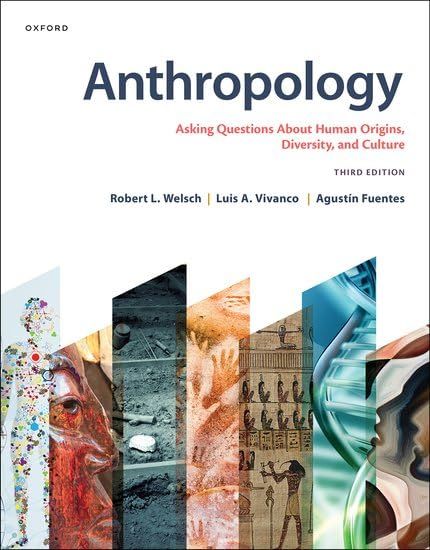
Anthropology

Anthropology

Robert L. Welsch; Luis A. Vivanco; Agustin Fuentes

OXFORD UNIVERSITY PRESS INC
2024
nidottu
This general anthropology text takes a holistic approach that emphasizes critical thinking, active learning, and applying anthropology to solve contemporary human problems. Building on the classical foundations of the discipline, Anthropology: Asking Questions About Human Origins, Diversity, and Culture, Third Edition, shows students how anthropology is connected to such current topics as food, health and medicine, and the environment. Full of relevant examples and current topics--with a focus on contemporary problems and questions--the book demonstrates the diversity and dynamism of anthropology today.
Doctor, Will You Pray for Me?

Doctor, Will You Pray for Me?

Robert L. Klitzman

OXFORD UNIVERSITY PRESS INC
2024
sidottu
The modern world faces religious, spiritual and existential quandaries, as new technologies redefine the beginnings and ends of life. Excruciating choices arise about when to turn off the machines - whether and when we should "play God." The COVID-19 pandemic made these dilemmas ever more acute. Increasingly, however, public discourse on religion and spirituality is polarized, with evangelicals on one side and vehement atheists on the other. Psychiatrist and bioethicist Robert Klitzman explores how patients and families struggle to make sense of serious disease and threats of death and other medical crises, seeking hope, purpose and larger connections beyond themselves. Physicians and other clinical staff are frequently uncomfortable with these issues, and chaplains have been filling the void, developing valuable approaches and insights. Most Americans will die in hospitals or nursing homes, and face existential and spiritual quandaries. Many of their prior religious and spiritual beliefs will fall short, and chaplains will often be the ones to assist, partly by reframing narratives and understandings of illness and spirituality. Yet people often know little, if anything, about these professionals. Klitzman presents stories about the spiritual lives of patients and explores the role of chaplains - who they are, what they do and the challenges they face. Drawing on in-depth interviews and the author's personal experiences, Doctor, Will You Pray for Me? provides vital information that can assist in medical care decisions. Robert Klitzman argues that a better understanding of the relationship between these realms will enable more holistic and humane treatment of patients.