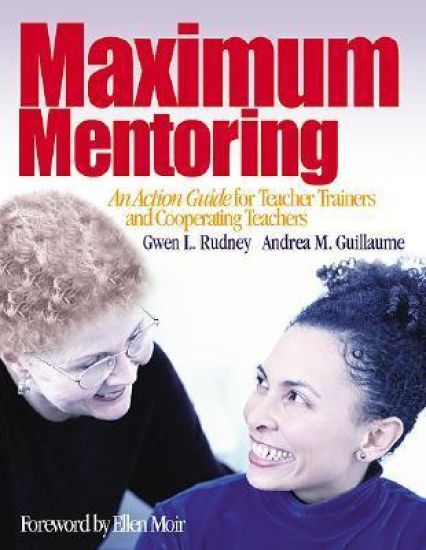
New teacher development, support, and retention all require intensive levels of one-to-one training and mentoring. Mentors may be cooperating teachers whose classrooms host the field placements of student teachers and interns, they may be mentor teachers in induction programmes, and they may be staff trainers/staff developers. This is an action guide for all mentors. It accompanies the trainer and the co-operating teacher every step of the way through the complexities of the school-based mentoring process to ensure maximum success for both mentor and mentee. Clear coverage of rules, roles, relationships, responsibilities, and procedures are accompanied by such hands-on essentials as reproducible forms, reflective exercises and answers to the difficult questions that are sure to arise. Key chapters cover the first week of school; dimensions of teaching; building trusting relationships; school-university supervisory partnerships; observation and feedback; summative evaluation; professional growth and development; and techniques for working with struggling student and novice teachers.
New teacher development, support, and retention all require intensive levels of one-to-one training and mentoring. Mentors may be cooperating teachers whose classrooms host the field placements of student teachers and interns, they may be mentor teachers in induction programmes, and they may be staff trainers/staff developers. This is an action guide for all mentors. It accompanies the trainer and the co-operating teacher every step of the way through the complexities of the school-based mentoring process to ensure maximum success for both mentor and mentee. Clear coverage of rules, roles, relationships, responsibilities, and procedures are accompanied by such hands-on essentials as reproducible forms, reflective exercises and answers to the difficult questions that are sure to arise. Key chapters cover the first week of school; dimensions of teaching; building trusting relationships; school-university supervisory partnerships; observation and feedback; summative evaluation; professional growth and development; and techniques for working with struggling student and novice teachers.
This brief traces the story of one of our most common medicines – aspirin. On a journey involving science, diverse characters, shady business deals, innovative advertising and good old-fashioned luck, Rooney and Campbell describe how aspirin was developed and marketed on a global scale. Starting at the beginning of the twentieth century, the authors explain the use of aspirin during the First World War, the development of competition drugs such as ibuprofen during the interwar years, and the application of aspirin to heart disease in the 1950s and 1960s. On a broader level, Rooney and Campbell show that the development of America’s modern pharmaceuticals was a complex weaving of chemistry and mass culture. They argue that aspirin’s story provides a way to understand the application of complex chemical formulas in medical results. This brief is of interest to historians of chemistry and medicine as well as the general educated reader.
Food packaging materials have traditionally been chosen to avoid unwanted interactions with the food. During the past two decades a wide variety of packaging materials have been devised or developed to interact with the food. These packaging materials, which are designed to perform some desired role other than to provide an inert barrier to outside influences, are termed 'active packaging'. The benefits of active packaging are based on both chemical and physical effects. Active packaging concepts have often been presented to the food industry with few supporting results of background research. This manner of introduction has led to substantial uncertainty by potential users because claims have sometimes been based on extrapolation from what little proven information is available. The forms of active packaging have been chosen to respond to various food properties which are often unrelated to one another. For instance many packaging requirements for post harvest horticultural produce are quite different from those for most processed foods. The object of this book is to introduce and consolidate information upon which active packaging concepts are based. Scientists, technologists, students and regulators will find here the basis of those active packaging materials, which are either commercial or proposed. The book should assist the inquirer to understand how other concepts might be applied or where they should be rejected.
Food packaging materials have traditionally been chosen to avoid unwanted interactions with the food. During the past two decades a wide variety of packaging materials have been devised or developed to interact with the food. These packaging materials, which are designed to perform some desired role other than to provide an inert barrier to outside influences, are termed 'active packaging'. The benefits of active packaging are based on both chemical and physical effects. Active packaging concepts have often been presented to the food industry with few supporting results of background research. This manner of introduction has led to substantial uncertainty by potential users because claims have sometimes been based on extrapolation from what little proven information is available. The forms of active packaging have been chosen to respond to various food properties which are often unrelated to one another. For instance many packaging requirements for post harvest horticultural produce are quite different from those for most processed foods. The object of this book is to introduce and consolidate information upon which active packaging concepts are based. Scientists, technologists, students and regulators will find here the basis of those active packaging materials, which are either commercial or proposed. The book should assist the inquirer to understand how other concepts might be applied or where they should be rejected.
The purpose of this book is to show that the prevalent view of personal characteristics, which has been influenced to a large extent by factor analysis, may not be the soundest or the most useful. Structural equation modeling entails a more comprehensive approach to modeling relationships between variables than factor analysis and enables one to test alternative models to the factor model in accounting for these relationships.In this work this proposition is demonstrated by drawing on the research the authors have conducted in three important domains of personal characteristics--abilities, personality disorders, and self-attitudes. The authors' discoveries in these areas have far-reaching and innovative implications not only for psychological and psychosocial theory but also for applied areas such as teaching, psychotherapy, and communication.
This book discusses individual differences in how people react to uncertainty. The authors show that while some people are relatively comfortable dealing with uncertainty and strive to resolve it (uncertainty-oriented), others are more likely to avoid uncertainty, preferring the familiar or the known (certainty-oriented). They go on to examine the implications of an uncertainty orientation for understanding processes of self-knowledge, social cognition and attitude change, achievement, motivation and performance, interpersonal and group processes, and issues relating to physical and psychological health concerns. Research is discussed which links this uncertainty orientation to each of these issues, raising important practical and theoretical questions for each. The book also considers possible implications for people of both orientations of living in times that may be characterized as being uncertain.
This book discusses individual differences in how people react to uncertainty. The authors show that while some people are relatively comfortable dealing with uncertainty and strive to resolve it (uncertainty-oriented), others are more likely to avoid uncertainty, preferring the familiar or the known (certainty-oriented). They go on to examine the implications of an uncertainty orientation for understanding processes of self-knowledge, social cognition and attitude change, achievement, motivation and performance, interpersonal and group processes, and issues relating to physical and psychological health concerns. Research is discussed which links this uncertainty orientation to each of these issues, raising important practical and theoretical questions for each. The book also considers possible implications for people of both orientations of living in times that may be characterized as being uncertain.
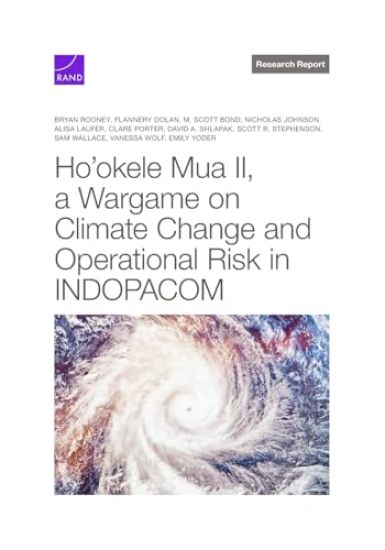
This report describes a wargame intended to aid U.S. Indo-Pacific Command operational planning by allowing players to explore the extent of operational risk that climate change could impose on the joint force in the Indo-Pacific region in the 2040s.
With its use of football stories, Gridiron Leadership provides a fresh, new approach to capturing and understanding the concepts and practice of leadership, strategy, and execution. Gridiron Leadership: Winning Strategies and Breakthrough Tactics uses real moments from the worlds of professional and college football, as well as a wide range of evocative football metaphors, to dissect the craft of leadership and communicate essential management lessons. With so many leadership and strategy books sending the same messages in the same ways, this fresh approach is truly groundbreaking, using a familiar frame of reference to capture and understand the concepts and practice of leadership, strategy, and execution. The language of sports is already common vernacular among today's successful leaders. Gridiron Leadership uses the accessible, recognizable terminology of sports in a thoughtful, systematic way, making the connection between the culture of football and the kinds of organizational and leadership situations encountered everyday. It covers the full range of modern organizational issues, including human resources, crisis leadership, ethical leadership, strategic decision making, and organizational change. With topics covering everything from building a winning team to analyzing the needs of stakeholders, this is the playbook today's leaders have been waiting for.
Fundamentals of Biomechanics: From Cells to Organ Systems combines biology with engineering to provide a comprehensive overview of biomechanics. It covers cell, tissue, and fluid mechanics in a way that is easy to understand, requiring only a basic background in biology and mechanics. The book includes a wide range of topics, from single-cell mechanics to forces in the musculoskeletal system. Each chapter provides an introduction to biological systems, along with examples and practice problems throughout the text. The book also offers step-by-step derivation of equations from principles. This textbook has been classroom-tested and is designed for advanced undergraduate engineering courses in bioengineering, biomechanics, and physiology. It is also a valuable reference for graduate students, practicing engineers, and medical professionals. Integrates biology with engineering;Includes examples and practice problems throughout the text;Requires a limited background in biology and mechanics.
This Brief takes the reader on a chemical journey by following the history for over two centuries of how an opiate became an opioid, thus spawning an empire and a series of crises. These imperfect resemblances of alkaloids are both natural and synthetic substances that, particularly in America, are continually part of a growing concern about overuse. This seemed an inviting prospect for those in pain, but as the ubiquitous media coverage continues to lay bare, the levels of abuse point to the fact that perhaps an epidemic is upon us, if not a culture war. Seeking answers to how and why this addiction crisis transpired over two hundred years of long development, this Brief examines the role that the chemistry laboratory played in turning patients into consumers. By utilizing a host of diverse sources, this Brief seeks to trace the design and the production of opioids and their antecedents over the past two centuries. From the isolation and development of the first alkaloids with morphine that relieved pain within the home and on the battlefield, to the widespread use of nostrums and the addiction crisis that ensued, to the dissemination of drugs by what became known as Big Pharma after the World Wars; and finally, to competition from home-made pharmaceuticals, the progenitor was always, in some form, a type of chemistry lab. At times, the laboratory pressed science to think deeply about society's maladies, such as curing disease and alleviating pain, in order to look for new opportunities in the name of progress. Despite the best intentions opioids have created a paradox of pain as they were manipulated by creating relief with synthetic precision and influencing a dystopian vision. Thus, influence came in many forms, from governments, from the medical community, and from the entrepreneurial aspirations of the general populace. For better, but mostly for worse, all played a role in changing forever the trajectory of what started with the isolation of a compound in Germany. Combining chemistry and history in a rousing new long-form narrative that even broadens the definition of a laboratory, the origins and future of this complicated topic are carefully examined.
This book classifies the maximal subgroups of the almost simple finite classical groups in dimension up to 12; it also describes the maximal subgroups of the almost simple finite exceptional groups with socle one of Sz(q), G2(q), 2G2(q) or 3D4(q). Theoretical and computational tools are used throughout, with downloadable Magma code provided. The exposition contains a wealth of information on the structure and action of the geometric subgroups of classical groups, but the reader will also encounter methods for analysing the structure and maximality of almost simple subgroups of almost simple groups. Additionally, this book contains detailed information on using Magma to calculate with representations over number fields and finite fields. Featured within are previously unseen results and over 80 tables describing the maximal subgroups, making this volume an essential reference for researchers. It also functions as a graduate-level textbook on finite simple groups, computational group theory and representation theory.