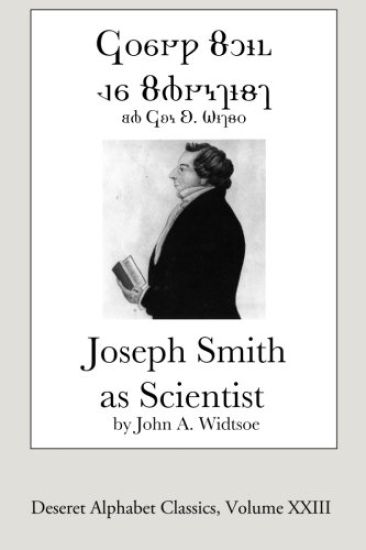
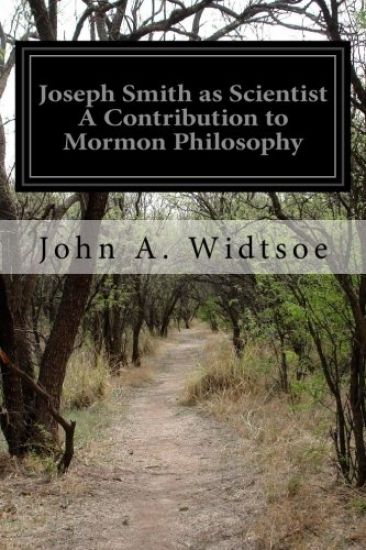
Joseph Smith as Scientist-A Contribution to Mormon Philosophy is a classic religios biography by John A. Widtsoe. In the life of every person, who receives a higher education, in or out of schools, there is a time when there seems to be opposition between science and religion; between man-made and God-made knowledge. The struggle for reconciliation between the contending forces is not an easy one. It cuts deep into the soul and usually leaves scars that ache while life endures. There are thousands of young people in the Church to-day, and hundreds of thousands throughout the world, who are struggling to set themselves right with the God above and the world about them. It is for these young people, primarily, that the following Joseph Smith biography has been written.
"That ye may be prepared in all things when I shall send you again to magnify the calling, whereunto I have called you, and the mission with which I have commissioned you."-Doctrine and Covenants, 88:78-80. "And verily, I say unto you, that it is my will that you should hasten to translate my Scriptures, and to obtain a knowledge of history, and of countries, and of kingdoms, of laws of God and man, and all this for the salvation of Zion."-Doctrine and Covenants, 93:53. "It (theology) is the science of all other sciences and useful arts, being in fact the very foundation from which they emanate. It includes philosophy, astronomy, history, mathematics, geography, languages, the science of letters, and blends the knowledge of all matters of fact, in every branch of art and research.......
In the whole history of the English people there is no period so absolutely heroic, so full of enthralling interest, as that in which the might of England made itself apparent by land and sea-the period which saw good Queen Bess mistress of English hearts and Englishmen and sovereign of the great beginnings which have come to such a magnificent fruition under Victoria.
American tourists, sure appreciators of all that is ancient and picturesque in England, invariably come to a halt, holding their breath in a sudden catch of wonder, as they pass through the half-ruinous gateway which admits to the Close of Wrychester. Nowhere else in England is there a fairer prospect of old-world peace.
In the heart of London, John Ashton--the man from Australia--has been murdered. It seems clear that the motive was not robbery, and as he apparently had no acquaintances in town, the exposure of the murderer appears hopeless. Nevertheless, Mr. Fletcher accomplishes it in a story that keeps the reader in suspense until the very last word. This talented author has no rival to-day in ingenuity.