

Kirjahaku
Etsi kirjoja tekijän nimen, kirjan nimen tai ISBN:n perusteella.
1000 tulosta hakusanalla Timothy D. Johnson




Shooting to Survive: How to Fight with a Pistol
Timothy D. Blakeley
Policetech Publications
2014
sidottu
Shooting to Survive is a must-read guide for responsible civilians carrying concealed, law enforcement officers protecting communities, and military operators conducting combat missions. This is not only a book on shooting a pistol, but more importantly a book on fighting with a pistol detailing the reasons for the techniques. The techniques are designed around the response of the human body when experiencing a body alarm reaction. Shooting to Survive contains information from some of the best instructors throughout the United States and internationally in competitive shooting, private security, law enforcement SWAT, and military Special Operations. Volumes of information that would cost a great deal of money and fill a personal library are conveniently assembled in this one book to inform and educate you on how to fight with a pistol. Shooting to Survive is a 600-page book broken into easy-to-read sections that are conveniently organized providing an in-depth analysis. There are nearly 300 illustrations and over 1400 endnotes. The techniques in the book on fighting with a pistol apply to any brand including those with a decocker, grip safety, or manual safety. The book also contains detailed information about the internationally popular Glock pistols.

Shooting to Survive: How to Fight with a Pistol
Timothy D. Blakeley
Policetech Publications
2013
nidottu

Anxious about her approaching wedding and desperate to clear her mind, Lindsey Holland decides to leave her native Texas and spend the summer working for friends who manage a Christian coffee house in Oregon. Staying at the seaside mansion of Mrs. Katherine Cutler, a reclusive widow, Lindsey faces recurring nightmares of a woman imprisoned in a lighthouse and disturbing encounters with spectral beings that haunt the mansion's dark chambers and twisting corridors. At first, she dismisses the experiences as pre-wedding jitters, but, as the intensity grows, she fears that she may be in the grip of supernatural forces beyond her understanding or, perhaps even more terrifying, descending into madness. A young married couple, a jealous fianc , an aspiring filmmaker, and a troubled teen who claims to have psychic powers all join her on a harrowing journey through the twisting mazes of the heart to confront the dark secret that has held Mrs. Cutler prisoner for over sixty years.


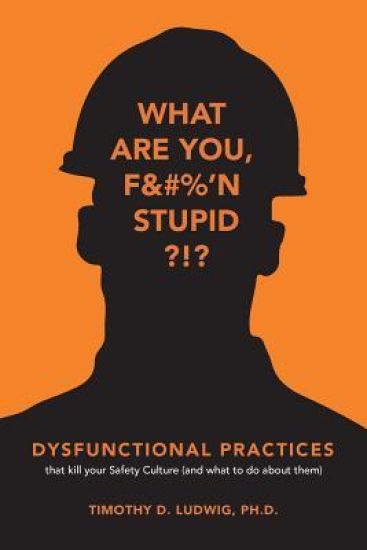
Dysfunctional Practices: that kill your Safety Culture (and what to do about them)
Timothy D. Ludwig
Calloway Publishing
2018
nidottu
(Alternate cover available. Choose "See all formats" and choose the April edition of the book) A MAN FINDS HIMSELF on the top step of a step ladder; a woman removes the guard to her machine; a worker is not wearing her safety glasses in the plant; a roustabout uses the wrong sized clamp instead of retrieving the right tool from the supply truck; a supervisor teaches a new worker to take short cuts; a mechanic climbs on top of the active machine to find the oil leak. Why do these folks do these things? Is it because they are stupid?One tendency is to blame workers for safety errors and label their personal failings as the cause of the error. Labeling does not solve problems that cause error and, frankly, it may all be an illusion of human perception leading us to false conclusions. Our human tendencies result in interactions that hurt the safety of our workers and the effectiveness of the systems we put in place to protect them.These tendencies build dysfunctional management practices that create fear associated with your safety programs. I want to teach you a better way to analyze the behaviors of your employees to understand why they were put in a position to take the risk in the first place. Your system may be perfectly designed to promote risks and create safety traps. By analyzing the context of behavior we can discover ways to change your system to optimize safe behavior and reduce injury. This book presents new ideas and methods using stories we can all relate to.Human behavior is at the crux of your safety program. Physics and chemistry create hazards ready to be released when things go wrong. Human behavior happens right before that release. Therefore, we look at the behavior associated with the resulting injury and blame the person as the root cause. We label the person "stupid" and feel we have solved the problem. We haven't. Instead, a dysfunctional practice creeps into our safety management system blinding us from finding the true root causes of at-risk behavior. If our goal is to create a safety culture in which workers are engaged with situational awareness, peer coaching, and reporting, we will fail. Our offensive labeling will create avoidance of the very engagement we desperately need from our workers.We can't fix people, let's not be that pompous. But we can change behavior... we know how; there is a science behind it. We want to define behaviors in a way that are as open to unbiased analysis as the elements of physics and chemistry. Behavior is not a static variable of study. It's not a geologic formation changing over the epoch of time. Behavior is a dynamic variable, reacting with each passing moment along predictable paths, like water in a river, but always ready and able to jump its banks and forge new paths.We will discover that behavior is neutral, not good or bad, right or wrong. We will learn that for every safe behavior you want from your workers, there are a plethora of competing alternative behaviors that can put them at-risk. What determines this decision is predominantly the work context and your management systems.With this perspective we can better ask what put the worker in a position to take the risk. We will build an alternative to labeling with dispassionate, actionable and effective analyses to help build the system that helps workers discriminate the best behaviors for the situation.This book is for managers who seek to shape their safety culture to drive out fear and engage their workforce as they drive out risk. I want to help leaders at the top break through their biases and look at safety through a different, more effective lens. Similarly, this book is for the noble safety professional who must build safety management systems to avoid biases and other human tendencies; systems that focus on the controls, senior leadership involvement, and adequate safety resources that shape and maintain safe behaviors.

Merleau-Ponty's Phenomenology of Perception
Timothy D. Mooney
Cambridge University Press
2024
pokkari
This is an advanced introduction to and original interpretation of Merleau-Ponty's greatest work, Phenomenology of Perception. Timothy Mooney provides a clear and compelling exposition of the theory of our projective being in the world, and demonstrates as never before the centrality of the body schema in the theory. Thanks to the schema's motor intentionality our bodies inhabit and appropriate space: our postures and perceptual fields are organised schematically when we move to realise our projects. Thus our lived bodies are ineliminably expressive in being both animated and outcome oriented through-and-through. Mooney also analyses the place of the work in the modern philosophical world, showing what Merleau-Ponty takes up from the Kantian and Phenomenological traditions and what he contributes to each. Casting a fresh light on his magnum opus, this book is essential reading for all those interested in the philosophy and phenomenology of the body.

Merleau-Ponty's Phenomenology of Perception
Timothy D. Mooney
Cambridge University Press
2022
sidottu
This is an advanced introduction to and original interpretation of Merleau-Ponty's greatest work, Phenomenology of Perception. Timothy Mooney provides a clear and compelling exposition of the theory of our projective being in the world, and demonstrates as never before the centrality of the body schema in the theory. Thanks to the schema's motor intentionality our bodies inhabit and appropriate space: our postures and perceptual fields are organised schematically when we move to realise our projects. Thus our lived bodies are ineliminably expressive in being both animated and outcome oriented through-and-through. Mooney also analyses the place of the work in the modern philosophical world, showing what Merleau-Ponty takes up from the Kantian and Phenomenological traditions and what he contributes to each. Casting a fresh light on his magnum opus, this book is essential reading for all those interested in the philosophy and phenomenology of the body.

A key aspect of robotics today is estimating the state (e.g., position and orientation) of a robot, based on noisy sensor data. This book targets students and practitioners of robotics by presenting classical state estimation methods (e.g., the Kalman filter) but also important modern topics such as batch estimation, Bayes filter, sigmapoint and particle filters, robust estimation for outlier rejection, and continuous-time trajectory estimation and its connection to Gaussian-process regression. Since most robots operate in a three-dimensional world, common sensor models (e.g., camera, laser rangefinder) are provided followed by practical advice on how to carry out state estimation for rotational state variables. The book covers robotic applications such as point-cloud alignment, pose-graph relaxation, bundle adjustment, and simultaneous localization and mapping. Highlights of this expanded second edition include a new chapter on variational inference, a new section on inertial navigation, more introductory material on probability, and a primer on matrix calculus.

The scientific realism debate directly addresses the relation between human thought and the reality in which it finds itself. A core question: Can we justifiably believe that science accurately describes the reality that lies beneath the limits of human experience? Exploring this question, this Element begins at the most foundational level of scientific realism, the endeavor to justify belief in the existence of unobservables by way of abduction. Raising anti-realist challenges, some much discussed in the literature but also some generally overlooked, it works its way toward more refined variants of scientific realism. Because scientific realism is the default position of many scientific realists themselves often assuming it is the default position of scientists– the emphasis will be on the challenges. Those challenges will also motivate the variants of scientific realism traced. The Element concludes with a brief articulation of the author's own position, Socratic scientific realism.

Fifth Air Force Light and Medium Bomber Operations During 1942 and 1943
Timothy D Gann
Hutson Street Press
2025
sidottu

Fifth Air Force Light and Medium Bomber Operations During 1942 and 1943
Timothy D Gann
Hutson Street Press
2025
pokkari

Fifth Air Force Light and Medium Bomber Operations During 1942 and 1943
Timothy D Gann
Hutson Street Press
2025
sidottu

Quantification of Risk for USAF Fire and Emergency Services Flights as Result of Shortages in Manpower
Timothy D Dalby
Hutson Street Press
2025
sidottu

Fifth Air Force Light and Medium Bomber Operations During 1942 and 1943
Timothy D Gann
Hutson Street Press
2025
pokkari

Quantification of Risk for USAF Fire and Emergency Services Flights as Result of Shortages in Manpower
Timothy D Dalby
Hutson Street Press
2025
pokkari