Kirjahaku
Etsi kirjoja tekijän nimen, kirjan nimen tai ISBN:n perusteella.
1000 tulosta hakusanalla Vivek Sachdeva
This book explores the concept of disability through a social, political, cultural, religious, and economics lens. It challenges the categorization of ‘physically-disabled’ produced by way of legal, medical, political, cultural, and literary narratives that comprise an exclusionary discourse.The volume discusses themes like disability and identity politics; disability and the western epistemology; disability in India; disability and the Indian English fiction and Hindi cinema to question the embodied hegemony of ‘norms’ and their effects in the construction and history of societies. It analyses select literary and cinematic texts like Trying to Grow, Fireproof, and Animal’s People; and movies, Black and Lafangey Parindey to critically examine the representation of disabled people as freak, monstrous and animal. The book also makes policy recommendations for inclusive education and work norms for disabled people.This book will be beneficial for scholars and researchers of disability studies, cultural studies, film studies, and English literature.
Principles and Practices of Rock Blasting
Vivek Kumar Himanshu; Narayan Kumar Bhagat; Ashish Kumar Vishwakarma; Arvind Kumar Mishra
TAYLOR FRANCIS LTD
2024
sidottu
This book enriches the readers with the advances in rock blasting techniques for mining and civil construction rock excavation projects, including the need for and importance of rock blasting, related theories, challenges in rock blasting operations, and rock blasting methodology for excavation of coal and overburden benches of opencast coal mines. It also discusses methods to estimate charge factors and dimensional parameters for different rock types of iron ore mines, blasting methodology for rock strata and the blasting technologies for civil construction projects.The book:Provides comprehensive review of the prediction methodologies of blasting results.Reviews insights into advanced blasting methodologies for rock excavation near sensitive structures.Includes case studies of coal mining, iron ore mining, limestone mining and civil construction projects.Explores the detailed theoretical background of rock blasting.Discusses methodologies of secondary blasting.This book is aimed at graduate students and researchers in mining, geotechnical, and rock engineering.
This book examines the relationship between cultural difference and practical knowledge and its implications for the study of humanities and the social sciences.It sketches a meta-theory of Western thought to grasp the conceptual distortions that result when a normatively structured theoretical way of understanding the world seeks to displace practical forms of understanding. The book draws on both Western thinkers such as Nietzsche, Marx, Wittgenstein and Foucault and Indian thinkers such as Gandhi, Tagore and Balagangadhara to formulate a practical epistemology that delimits theoretical knowledge by regenerating experiential knowledge that was the hallmark of Indian intellectual traditions and provides the intellectual resources for rejecting normativity. By thus preparing the ground for a radical reconceptualization of the human sciences it seeks to overcome the loss of concepts and the violence generated by the grafting of ill–understood and experience-occluding normative conceptual structures on the fabric of practical life. Finally, the author offers an alternative conceptualization of Indian sociality through the idea of a practitional matrix, which explains both why the West necessarily misunderstood or misdescribed India and how that misdescription enables us to theorize the West. Part of Critical Humanities across Cultures series, this book will be an essential read for scholars and researchers of philosophy, anthropology, sociology, religious studies, post-colonial studies, cultural studies, Indian studies and literature.
Reclaimed Waste Materials for Sustainable Pavement Construction
Vivek; Sandeep Samantaray; Rakesh Sehgal
TAYLOR FRANCIS LTD
2025
sidottu
This book provides an overview of the use of various waste materials in pavement construction and their potential impact on sustainable infrastructure development. It explores the use of waste materials as alternatives to traditional pavement materials like asphalt and concrete. It discusses the properties and performance of various waste materials and their applications in pavement construction, highlighting the economic and environmental benefits such as reduced greenhouse gas emissions, lower construction costs, and enhanced durability and longevity of pavements.Features:Explores the use of waste materials such as recycled plastics, rubber, glass, and other industrial by-products as alternatives to traditional pavement materials.Provides detailed guidance on the selection, design, and implementation of waste materials.Focuses on the practical application of waste materials in pavement construction.Reviews bio-oils and focuses on plastics from different sources.Includes case studies on waste materials used in pavement structure.This book is aimed at researchers and graduate students in pavement and civil engineering.
Biostatistical Methods and Applications in Health Research
Vivek Verma; Dilip C Nath; Hafiz T A Khan; Kenneth C Land
TAYLOR FRANCIS LTD
2025
sidottu
Supported by real-world case studies, this essential textbook provides a detailed overview of the use of biostatistical tools and methods, enabling students and researchers to undertake their own research with confidence and understanding.After a general introduction to the field, the book provides a step-by-step description of the essential statistical methods that are foundational to analyzing data from clinical trials, epidemiological studies, and other health-related research. From basic concepts such as probability and distribution through to hypothesis testing, regression analysis, survival analysis, meta analysis and systematic reviews, each chapter is designed with a clear pedagogical approach featuring explanatory diagrams, real-life examples and sample problems. Later sections of the book cover clinical trial design and analysis, diagnostic testing, Bayesian methods and machine learning. Through this detailed, comprehensive treatment of the key tools and methods, the book encourages readers to develop their own critical thinking skills, recognising good or bad pieces of research when they see them, asking questions about where evidence and assumptions come from, or choosing the most appropriate biostatistical methodologies in their own research.Written by a team of experts with extensive teaching experience in this field, this is the ideal textbook for graduate students and researchers across the biomedical sciences, from Public Health to Epidemiology to Clinical Medicine.
Biostatistical Methods and Applications in Health Research
Vivek Verma; Dilip C Nath; Hafiz T A Khan; Kenneth C Land
TAYLOR FRANCIS LTD
2025
nidottu
Supported by real-world case studies, this essential textbook provides a detailed overview of the use of biostatistical tools and methods, enabling students and researchers to undertake their own research with confidence and understanding.After a general introduction to the field, the book provides a step-by-step description of the essential statistical methods that are foundational to analyzing data from clinical trials, epidemiological studies, and other health-related research. From basic concepts such as probability and distribution through to hypothesis testing, regression analysis, survival analysis, meta analysis and systematic reviews, each chapter is designed with a clear pedagogical approach featuring explanatory diagrams, real-life examples and sample problems. Later sections of the book cover clinical trial design and analysis, diagnostic testing, Bayesian methods and machine learning. Through this detailed, comprehensive treatment of the key tools and methods, the book encourages readers to develop their own critical thinking skills, recognising good or bad pieces of research when they see them, asking questions about where evidence and assumptions come from, or choosing the most appropriate biostatistical methodologies in their own research.Written by a team of experts with extensive teaching experience in this field, this is the ideal textbook for graduate students and researchers across the biomedical sciences, from Public Health to Epidemiology to Clinical Medicine.
This book explores the concept of disability through a social, political, cultural, religious, and economics lens. It challenges the categorization of ‘physically-disabled’ produced by way of legal, medical, political, cultural, and literary narratives that comprise an exclusionary discourse.The volume discusses themes like disability and identity politics; disability and the western epistemology; disability in India; disability and the Indian English fiction and Hindi cinema to question the embodied hegemony of ‘norms’ and their effects in the construction and history of societies. It analyses select literary and cinematic texts like Trying to Grow, Fireproof, and Animal’s People; and movies, Black and Lafangey Parindey to critically examine the representation of disabled people as freak, monstrous and animal. The book also makes policy recommendations for inclusive education and work norms for disabled people.This book will be beneficial for scholars and researchers of disability studies, cultural studies, film studies, and English literature.
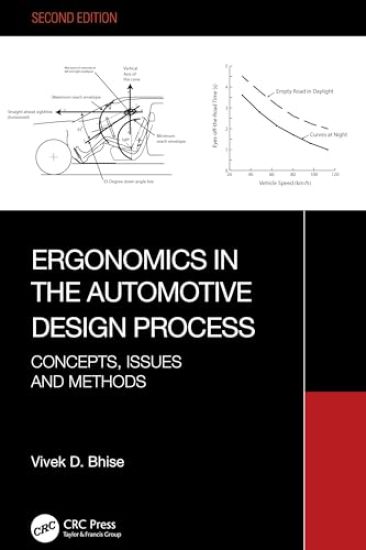
Automotive design continues to evolve at a rapid pace. As electric cars become ever more commonplace on the roads to the advent of the driverless vehicle, understanding the ergonomics behind automotive engineering becomes ever more paramount. Vehicle attributes must be considered early during the new vehicle development program by coordinated work of multi-disciplinary teams to begin creating vehicle specifications and development of vehicle attribute requirements.In Ergonomics in the Automotive Design Process: Concepts, Issues and Methods, Vivek D. Bhise covers the need-to-know fundamentals as to what makes an ergonomically sound vehicle. This book covers the entire range of ergonomics issues involved in designing a car or truck and offers evaluation techniques to avoid costly mistakes and assure high customer satisfaction. Across 13 chapters, vehicle design and the attributes of vehicle handling, appearance (interior and exterior styling), safety and security, infotainment, noise and vibrations, emissions, costs and process compatibility are considered in the context of ergonomics. New material to this edition includes coverage of ergonomics in the systems engineering process, decision-making and risks in automotive product programs and ergonomic considerations in electric vehicle development.This book will allow the reader to develop a more comprehensive knowledge of issues facing the developers of automotive products and delivers methods to manage communication, coordination and integration processes. It provides more tools in implementing systems engineering to minimize the risks of delays and cost overruns, and most importantly, creates the right product for its customers. The reader will develop a knowledge of future in- vehicle devices that are easy to program and use, safe, cheap to manufacture and assemble and are eco-friendly From an author with over forty years of experience in automotive design, this title is an ideal read for students and practitioners of ergonomics, human factors, automotive design, civil engineering, product design, work design and mechanical engineering.Vivek D. Bhise is currently a LEO Lecturer/ Visiting Professor and a Professor in post-retirement of Industrial and Manufacturing Systems Engineering at the University of Michigan-Dearborn. He received his B.Tech. in Mechanical Engineering (1965) from the Indian Institute of Technology, Bombay, India, M.S. in Industrial Engineering (1966) from the University of California, Berkeley, and PhD in Industrial and Systems Engineering (1971) from the Ohio State University, Columbus, Ohio. During 1973 to 2001, he held several management and research positions at the Ford Motor Company in Dearborn, Michigan.
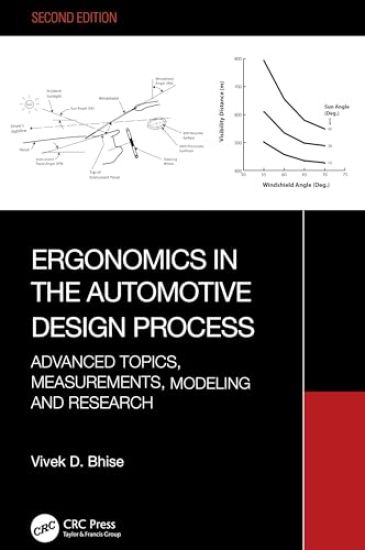
Automotive design continues to evolve at a rapid pace. As electric cars become ever more commonplace on the roads to the advent of the driverless vehicle, understanding the ergonomics behind automotive engineering becomes ever more paramount. Vehicle attributes must be considered early during the new vehicle development program by coordinated work of multi- disciplinary teams to begin creating vehicle specifications and development of vehicle attribute requirements.In Ergonomics in the Automotive Design Process: Advanced Topics, Measurements, Modeling and Research, experienced automotive engineer Vivek D. Bhise investigates the advanced procedures and considerations to develop an ergonomic vehicle This book covers the entire range of ergonomics issues involved in designing a car or truck and offers evaluation techniques to avoid costly mistakes and assure high customer satisfaction. This book delves into driver performance, electric vehicles (EVs), interfaces, new technology and costs and benefits plus a lot more. Evaluation and measurement are covered in essential detail and the title has been brought right up to date with chapters on engineering design during automotive product development, vehicle evaluation, verification and validation and product liability litigations and ergonomic considerations.This book is designed to allow the reader to develop a more comprehensive knowledge of issues facing the developers of automotive products and delivers methods to manage communication, coordination and integration processes. Delivering a toolkit that will allow you to implement systems engineering to minimize the risks of delays and cost overruns, it delivers a framework that will allow you to create the right product for your customers. The reader will therefore develop a knowledge of future in-vehicle devices that are easy to program and use, safe, cheap to manufacture and assemble and eco-friendly. This title is an ideal read for students and practitioners of ergonomics, human factors, automotive design, civil engineering, product design, work design and mechanical engineering.This title is an ideal read for students and practitioners of ergonomics, human factors, automotive design, civil engineering, product design, work design and mechanical engineering.
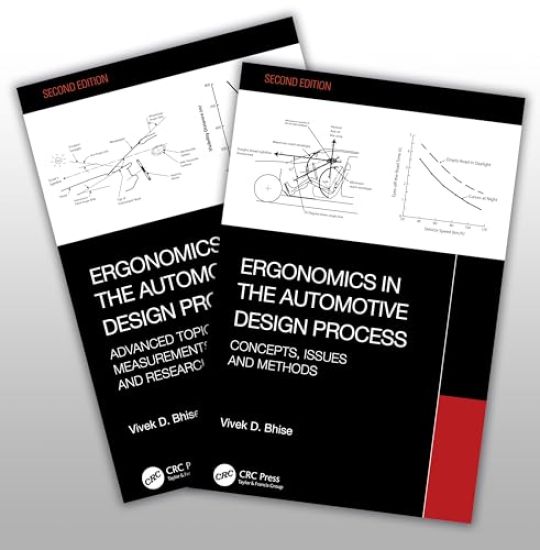
Automotive design continues to evolve at a pace. As electric cars become ever more commonplace on the roads to the advent of driverless vehicles, understanding the ergonomics behind automotive engineering becomes ever more paramount. Vehicle attributes must be considered early during the new vehicle development program by coordinated work of multi-disciplinary teams to begin creating vehicle specifications.In this two-volume set of Ergonomics in the Automotive Design Process, Vivek D. Bhise covers the need-to-know fundamentals and advanced-level discussions and arguments as to what makes an ergonomically sound vehicle. The books cover the entire range of ergonomics issues involved in designing a car or truck and offer evaluation techniques to avoid costly mistakes and assure high customer satisfaction. Through 26 interesting chapters, vehicle design and the attributes of vehicle handling, appearance, safety and security, infotainment, noise and vibrations, emissions, costs and benefits, process compatibility, driver performance, electric vehicles (EVs), interfaces and new technology are considered in the context of ergonomics. Evaluation and measurement are covered in essential detail and the title has been brought right up to date with new chapters on engineering design during automotive product development, vehicle evaluation, verification and validation and product liability litigations and ergonomic considerations. This book will allow the reader to develop a more comprehensive knowledge of issues facing the developers of automotive products and delivers methods to manage communication, coordination and integration processes. The reader will develop a knowledge of future in-vehicle devices that are easy to program and use, safe, cheap to manufacture and assemble and are eco-friendly.Written by an expert author with over forty years of experience in automotive design, these volumes are designed for students and practitioners of ergonomics, human factors, automotive design, civil engineering, product design, work design and mechanical engineering.
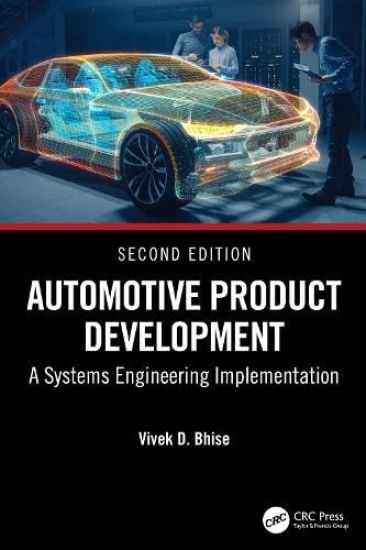
This new edition continues to explore the intricate processes of designing, developing, and manufacturing automotive products, by integrating multiple levels of complex systems. It describes systems engineering and attribute engineering, ensuring the new product meets the customer's desired attributes. The book also discusses cascading vehicle-level attribute requirements to all vehicle systems, analyzing interfaces between systems, and developing interface requirements for seamless collaboration. The second edition of Automotive Product Development: A Systems Engineering Implementation has been meticulously revised to incorporate the most recent innovations in vehicle powertrains, driver interfaces, and state-of-the-art manufacturing techniques. Additionally, it discusses the influence of government regulations on safety, fuel economy, and emissions. This enhanced edition boasts four new chapters, 12 new sections, and updated examples in implementing new technologies, providing a comprehensive overview of the industry's challenges and the array of approaches and tools at engineers' disposal for designing, analyzing, and evaluating products. By mastering these essential steps, engineers can develop products that not only meet but exceed the needs and expectations of their customers. The ongoing goal of this book is to equip practicing and future engineering graduates in the automotive industry with the essential knowledge needed to understand the product development process and how to implement systems engineering. Supplemental materials are available to download at Routledge.com/9781032997902
This book offers a comprehensive analysis of the evolution of US naval presence and strategy in one of the world's most strategically significant regions. Spanning from the Cold War era to the present day, the book traces the trajectory of US engagement in the Indian Ocean, examining the factors driving strategic shifts, security challenges, and evolving alliances. It investigates how the US has transitioned from a posture of dominance to one of diffusion, engaging with regional partners to address emerging threats and seize opportunities. The book also looks at the rise of China and how it has impacted US presence in a somewhat transformed region – the Indo-Pacific.Part of the International Politics in the Age of Disruption series, the book will be indispensable for students and researchers of military studies, security studies, political studies, international relations, security studies, and South Asian studies.
This book offers a comprehensive analysis of the evolution of US naval presence and strategy in one of the world’s most strategically significant regions. Spanning from the Cold War era to the present day, the book traces the trajectory of US engagement in the Indian Ocean, examining the factors driving strategic shifts, security challenges and evolving alliances. It investigates how the US has transitioned from a posture of dominance to one of diffusion, engaging with regional partners to address emerging threats and seize opportunities. The book also looks at the rise of China and how it has impacted US presence in a somewhat transformed region—the Indo-Pacific. Part of the International Politics in the Age of Disruption series, the book will be indispensable for students and researchers of military studies, security studies, political studies, international relations and South Asian studies.
Would you trust a machine with your life?Raphael is the holy grail of AI: the world's first synthetic brain that's been programmed with a sense of right and wrong. Or at least that's what Andy, its creator, believes.But when an accident forces Andy to stay home, he learns that the robot has disappeared from its lab, mysteriously bypassing a sophisticated security system and the cognitive "laws" supposed to keep it in check. Besides, the robot has never been in the outside world; will its programming hold or will it unravel, releasing some Frankenstein's monster that was always lurking underneath?Confined to a wheelchair, under siege by a shady corporation, Andy is about to find out. At his secluded mansion he has something the robot desperately needs... something that can erase its moral programming once and for all.And make no mistake, Raphael is coming for it.In a world of ChatGPT and generative AI, Zeroglyph is scarily plausible science fiction that tries to answer whether a machine can truly know the difference between good and evil."So rarely encounter true science-fiction anymore - like Asimov crossed with Arthur C. Clarke." - Amazon reviewer
KUNDALINI The Treasure Within: Chakras, Energies, Parmarthasanjeevani and beyond..
Vivek Chandra MD
Independently Published
2019
nidottu
One may attempt to define the Kundalini as the dormant form of life energy lying in a coiled serpentine like form at the base of the spine at the Muladhara Chakra.This dormant energy rises up to the seventh chakra and further beyond to unite with its supreme form. This blissful union is the ultimate objective of the human life.The activation and rising up of the Kundalini is termed as Kundalini Awakening. The awakening may be brought about by great spiritual efforts and activities by a student of kundalini practise. In some cases the Kundalini spontaneously awakens and rises up temporarily. This may produce dire consequences and is at times termed as Kundali Syndrome.A host of neurological, endocrinological and psychiatric phenomenon may thus manifest. In today's understanding of the modern medicine such effects of abrupt kundalini awakening may absolutely be unexplainable.Our existence may be explained in two gross planes, the physical form and the higher or spiritual self. Life and death are entities of the physical plane while these cease to exist in the latter plane. The physical self is made of the five elements i.e. earth, water, fire, air and space whereas the higher self is comprised of prana, mana, buddhi, ahankara and chitta, as explained later in the book.The Life energy i.e. Prana is the communicating entity between the physical and the higher existence of the self. The pranas are further classified as five panchmahapranas. This life energy moves throughout the body through energy channels known as nadis.The nadis work through a rather complex network aggregating via chakras. Ancient scriptures have agreed to the existence of infinite number of chakras but here we shall look at the main seven chakras for a better understanding at this level.The human body systems are classified into mandalas, each one of them involving organ systems and their relationships with each other.Yoga as is prevalent today has been taken to be the absolute technique to calm the mind and thus further the ultimate objective of union with the supreme power of existence.The knowledge of Parmarthasanjeevani has given the art of performing certain finger, hand and body postures for stipulated amounts of time, that have the magical abilities to cure.
This book is based on fiction and a woman's emotions, her pains and sorrows, a religious nun's sacrifices, her first love and her dreams. When she undergoes critical situation's she had to sacrifice herself for the sake of her love. This book also derives a message on how judgemental the society is as the society judges her without knowing her inner pains and problems, it also shows how it feels being a woman. The lost woman may be your mother, sister, daughter, girlfriend, wife or divorced one.
Introduction to DC Microgrids
Vivek Agarwal; Prajof Prabhakaran; Mosaddique Nawaz Hussain
Wiley-Blackwell
2025
sidottu
Discover the art and science of designing, building, and installing DC microgrid systems with this authoritative resource Introduction to DC Microgrids delivers a comprehensive and concise introduction to the fundamentals of DC microgrid technology. Beginning with the basic concepts of DC systems and their various constituents, the book moves on to a variety of DC architectures and voltage levels of DC microgrid systems. Typical examples, use cases, and applications round out the material to form a practical and accessible resource ideal for students, professionals, and enthusiasts. Accomplished engineers and authors, Vivek Agarwal and Prajof Prabhakaran, offer readers solved numerical examples in every chapter to shore up the theoretical concepts presented. They also discuss different types of power converters used in several roles in DC microgrid systems and common issues faced by those who install and use them. Introduction to DC Microgrids makes a compelling case for the merits of using DC microgrids over AC solutions and includes usable techniques to determine optimal placement of loads and sources. You’ll also learn from: A complete introduction to DC microgrid systems with discussions of a variety of reported architectures and voltage levelsA fulsome description of power electronic converters in DC microgrid systems with simulation and experimental results of several different convertersAn explanation of DC microgrid control methods, including novel control techniques to minimize voltage regulation and improve load sharing accuracyA treatment of power quality and protection of DC microgrids, including a discussion of how to mitigate voltage fluctuation and harmonic issuesPerfect for doctoral, graduate, and senior undergraduate students in electrical engineering and related programs, Introduction to DC Microgrids also has a place on the bookshelves of diploma students, technicians who install and implement microgrid systems in the field, and industrial professionals interested in electrical sustainability projects.
Modern Electricity Systems
Vivek Bhandari; Rao Konidena; William Poppert
JOHN WILEY SONS INC
2022
sidottu
Modern Electricity SystemsAwarded “The Best Book for Energy Engineers” by The American Energy Society 2023 A welcome textbook instructing on many current aspects of energy generation, transmission, distribution, and consumption The importance of a well-informed group of individuals in charge of energy production and use is essential to create a sustainable and greener tomorrow. Technologies and costs are rapidly changing, and environmental goals widely debated in this book. The future of energy is at a crossroads. In addition, energy and technology poverty affects as much as 25% of the world’s population. Having the correct set of “tools”—a basic understanding of modern electrical systems—is essential, not just for engineers but for our leaders and decision-makers. With decades of experience in industry and academia behind them, the team of authors in Modern Electricity Systems offers a “toolbox” from which the reader will learn what is essential to make informed decisions. As such, this textbook provides an introduction to the fundamentals of how electricity is generated, financed, regulated, rationed, and stored – with consideration not just of the current status of these issues but a glance at what the next decade may hold. Without this basic level of comprehension, the growing global impact and social issues can be discussed and advocated for, but real change in this sector can only be achieved through understanding the systems. Modern Electricity Systems readers will also find: Support to create a course on energy transition and energy policy for sustainable developmentInternational modern day case studies, that represent the most current and essential topics, to illustrate key concepts, as well as ones focused on the United StatesSample problem sets that bring together essential ideas learned from each chapterA textbook written by a team of working professionals with international experience in real-world applications of policy, engineering, and operations Modern Electricity Systems is a helpful reference for graduate and advanced undergraduate students and researchers, policymakers, environmentalists, humanitarians, business leaders, and decision-makers in all three sectors of electricity operations, engineering, and policy matters.
Confidence Intervals for Discrete Data in Clinical Research
Vivek Pradhan; Ashis Gangopadhyay; Sandeep M. Menon; Cynthia Basu; Tathagata Banerjee
CRC Press
2021
sidottu
Confidence Intervals for Discrete Data in Clinical Research is designed as a toolbox for biomedical researchers. Analysis of discrete data is one of the most used yet vexing areas in clinical research. The array of methodologies available in the literature to address the inferential questions for binomial and multinomial data can be a double-edged sword. On the one hand, these methods open a rich avenue of exploration of data; on the other, the wide-ranging and competing methodologies potentially lead to conflicting inferences, adding to researchers' confusion and frustration and also leading to reporting bias. This book addresses the problems that many practitioners experience in choosing and implementing fit for purpose data analysis methods to answer critical inferential questions for binomial and count data. The book is an outgrowth of the authors' collective experience in biomedical research and provides an excellent overview of inferential questions of interest for binomial proportions and rates based on count data, and reviews various solutions to these problems available in the literature. Each chapter discusses the strengths and weaknesses of the methods and suggests practical recommendations. The book's primary focus is on applications in clinical research, and the goal is to provide direct benefit to the users involved in the biomedical field.