This work is an attempt to re-establish the importance of absolute values in a world where such values re becoming increasingly irrelevant, and the necessity of preserving those immutable and self evident truths upon witch was established our nation's framework and foundation. To this end I propose to establish in the field of education a curriculum of the civilizing arts, who's purpose is to clarify and strengthen the original commitments witch underlie and empower the United States Constitution and Declaration of Independance.
A much needed examination of contemporary approaches to animal healing in South Africa, and the role of local knowledge. Understanding local knowledge has become a central academic project among those interested in Africa and developing countries. In South Africa, land reform is gathering pace and African people hold an increasing proportion of thelivestock in the country. Animal health has become a central issue for rural development. Yet African veterinary medical knowledge remains largely unrecorded. This book seeks to fill that gap. It captures for the first time the diversity, as well as the limits, of a major sphere of local knowledge. Beinart and Brown argue that African approaches to animal health rest largely in environmental and nutritional explanations. They explore the widespread use of plants as well as biomedicines for healing. While rural populations remain concerned about supernatural threats, and many men think that women can harm their cattle, the authors challenge current ideas on the modernisation of witchcraft. They examine more ambient forms of supernatural danger expressed in little-known concepts such as mohato and umkhondo. They take the reader into the homesteads and kraals of rural black South Africans and engage with a key rural concern - vividly reporting the ideas of livestock owners. This is groundbreaking research which will have important implications for analyses of local knowledge more generally as well as effectivestate interventions and animal treatments in South Africa. William Beinart is Rhodes Professor of Race Relations, African Studies Centre, University of Oxford; Karen Brown is an ESRC Research Fellow at the Wellcome Unit for the History of Medicine, University of Oxford. Southern Africa (South Africa, Namibia, Lesotho, Zimbabwe and Swaziland): Wits University Press
Bill Starbuck has been one of the leading management researchers over several decades. In this book he reflects on a number of challenges associated with management and social science research - the search for a 'behavioral science', the limits of rationality, the unreliability of many research findings, the social shaping of research agendas, cultures and judgements. It is an engaging, chronologically structured account in which he discusses some of his own research projects and various methodological debates. This is a feisty argument from someone who has been fully engaged with all aspects of research - carrying out research programmes, evaluating research, tirelessly questioning the assumptions and claims of social science research, and never avoiding the awkward theoretical or practical challenges that face organizational researchers. Well written, provocative and unusual, this quasi autobiographical account will inform and entertain, and be a valuable guide to current and future research students.
The miscellany of essays, notes, fragments, and jottings to which William Carlos Williams gave the title The Embodiment of Knowledge was found in manuscript after his death in the archive of his papers at the Beinecke Library at Yale University. Written in 1928-30, and dedicated to his sons, it was intended as a concrete demonstration of the organic nature of education, to show that knowledge is an ongoing process by which we create our selves from day to day. And to underscore the fact that so many of his own books were extended works of self-exploration, Dr. Williams wrote on the cover of his manuscript: “to be printed as it is, faults and all.”
Ibn al-'Arabi is still known as "the Great Sheik" among the surviving Sufi orders. Born in Muslim Spain, he has become famous in the West as the greatest mystical thinker of Islamic civilization. He was a great philosopher, theologian, and poet.William Chittick takes a major step toward exposing the breadth and depth of Ibn al-'Arabi's vision. The book offers his view of spiritual perfection and explains his theology, ontology, epistemology, hermeneutics, and soteriology. The clear language, unencumbered by methodological jargon, makes it accessible to those familiar with other spiritual traditions, while its scholarly precision will appeal to specialists.Beginning with a survey of Ibn al-'Arabi's major teachings, the book gradually introduces the most important facets of his thought, devoting attention to definitions of his basic terminology. His teachings are illustrated with many translated passages introducing readers to fascinating byways of spiritual life that would not ordinarily be encountered in an account of a thinker's ideas. Ibn al-'Arabi is allowed to describe in detail the visionary world from which his knowledge derives and to express his teachings in his own words.More than 600 passages from his major work, al-Futuhat al-Makkivva, are translated here, practically for the first time. These alone provide twice the text of the Fusus al-hikam. The exhaustive indexes make the work an invaluable reference tool for research in Sufism and Islamic thought in general.
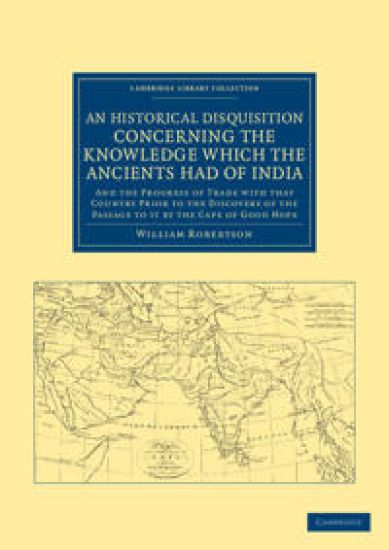
William Robertson (1721–93), Principal of the University of Edinburgh and historiographer to His Majesty for Scotland, published this work in 1791. Already famous for a History of Scotland, which went into many editions, and a History of America, Robertson aimed to synthesise all earlier western accounts of the subcontinent from classical times to the sixteenth century. Beginning with a consideration of the practical difficulties facing explorers from Europe and Africa who headed east, Robertson discusses the (legendary) Pharaoh Sesostris of Egypt, Alexander the Great, and Roman military incursions into, and trade with, India, before turning to the Portuguese, Spanish, French and English explorers of the early modern period, furnishing his account with copious source notes. A long appendix then describes 'the genius, the manners, and institutions of the people of India, as far as they can be traced from the earliest ages to which our knowledge of them extends'.
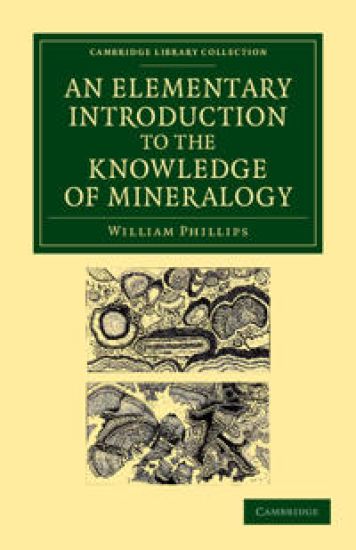
William Phillips (1773–1828) was a printer and geologist who became a Fellow of the Royal Society in 1827. A founder of the London Askesian Society, he was also an active member of the British Mineralogical Society. In 1807 he and twelve others founded the Geological Society of London, and he was described by the Society's historian as 'the most distinguished, as a geologist, of the original founders'. His pioneering 1818 digest of British geology, Outlines of the Geology of England and Wales, was the most ambitious and influential work of its kind. Phillips gave free lectures to young people in his village in 1814, and these were published the following year. This work followed in 1816, and both went on to become standard textbooks. Aimed at students, it collects observations of a wide range of minerals' characteristics and occurrence, incorporating crystallographic work using the new reflecting goniometer.
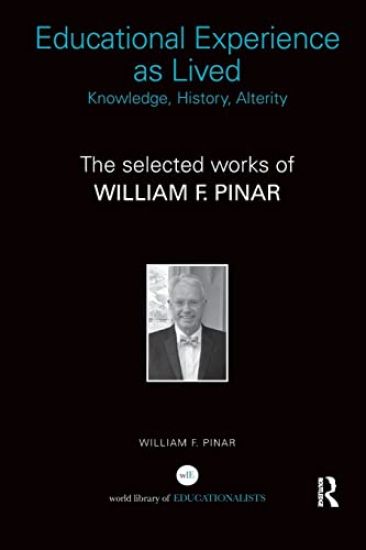
In this volume, Pinar enacts his theory of curriculum, detailing the relations among knowledge, history, and alterity. The introduction is Pinar’s intellectual life history, naming the contributions he has made to understanding educational experience. Study is the center of educational experience, as he demonstrates in the opening chapter. The alterity of educational experience is evident in his conceptions of disciplinarity and internationalization, interrelated projects of historicization, dialogical encounter, and recontextualization. By reactivating the past, not by instrumentalizing the present, we can find the future, explicated in his studies of the Eight-Year Study, the Tyler Rationale, and the gendering and racialization of U.S. school reform. The interrelation of race and gender is emphasized in the chapters on Ida B. Wells and Jane Addams. The technologization of education is critiqued through analysis of the achievements of George Grant and Pier Paolo Pasolini. The educational project of subjective and social reconstruction is explored through study of Musil’s essayism, a genre that corrects the problems accompanying ethnography and created by identity politics.
In this volume, Pinar enacts his theory of curriculum, detailing the relations among knowledge, history, and alterity. The introduction is Pinar’s intellectual life history, naming the contributions he has made to understanding educational experience. Study is the center of educational experience, as he demonstrates in the opening chapter. The alterity of educational experience is evident in his conceptions of disciplinarity and internationalization, interrelated projects of historicization, dialogical encounter, and recontextualization. By reactivating the past, not by instrumentalizing the present, we can find the future, explicated in his studies of the Eight-Year Study, the Tyler Rationale, and the gendering and racialization of U.S. school reform. The interrelation of race and gender is emphasized in the chapters on Ida B. Wells and Jane Addams. The technologization of education is critiqued through analysis of the achievements of George Grant and Pier Paolo Pasolini. The educational project of subjective and social reconstruction is explored through study of Musil’s essayism, a genre that corrects the problems accompanying ethnography and created by identity politics.