Kirjojen hintavertailu. Mukana 11 342 296 kirjaa ja 12 kauppaa.

Kirjahaku

Etsi kirjoja tekijän nimen, kirjan nimen tai ISBN:n perusteella.

1000 tulosta hakusanalla Alan Knight

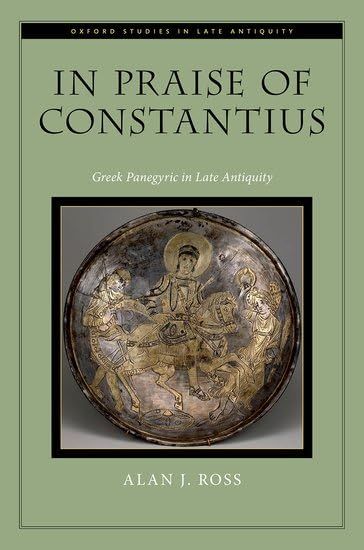
In Praise of Constantius

In Praise of Constantius

Alan J. Ross

OXFORD UNIVERSITY PRESS INC
2026
sidottu
In Praise of Constantius offers historical and literary analysis of eight Greek panegyrics composed by Libanius, Themistius, and Julian in the 340s and 350s CE, and addressed to Constantius II and his wife, the empress Eusebia. Its central concerns are the role that the composition, performance, and dissemination of imperial panegyric played in establishing the careers of the three most prominent Greek pagans of the fourth century; and their development of Greek epideictic literature in an era beyond the Second Sophistic. The book deftly exposes the rich intertextual dynamics between these eight speeches, other contemporary works, and canonical works of Greek political literature. It revises standard interpretations of panegyric's communicative function, and treats the orator less as a vector for others' messaging and instead as an active agent in political discourse in pursuit of his own ends. The volume substantially re-writes the early careers of each of its subjects, emphasizing their precarity and the utilization of performed paideia in managing moments of personal and political upheaval.
Faultlines: Cultural Materialism and the Politics of Dissident Reading
If we come to consciousness within a language that is complicit with the social order, how can we conceive, let alone organize, resistance? This key question in the politics of reading and subcultural practice informs Alan Sinfield's book on writing in early modern England. New historicism has often shown people trapped in a web of language and culture; through agile and well-informed discussions of writing by Shakespeare, Sidney, Donne, and Marlowe, Sinfield reassesses the scope of dissidence and control. The early modern state, Christianity, and the cultural apparatus, despite an ideology of unity and explicit violence, could not but allow space to challenging voices. Disruptions in concepts of hierarchy, nationality, gender and sexuality force their way into literary texts. Sinfield is often provocative. He `rewrites' Julius Caesar to produce a different politics, compares Sidney's idea of poetry to Leonid Brezhnev's, and reinstates the concept of character in the face of post-structuralist theory. He keeps the current politics of literary study always in view, especially in a substantial chapter on Shakespeare in the United States. Sinfield subjects interactions between class, ethnicity, sexuality, and the professional structures of the humanities to a detailed and hard-hitting critique, and argues for new commitments to collectivities and subcultures. This is a controversial, lucid, informed, and timely book by a leading exponent of cultural materialism.
The Greek Anthology from Meleager to Planudes
The Greek Anthology is one of the great books of European literature, `a garden containing the flowers and weeds of 1500 years of Greek epigram'. This study adds a wealth of new information about its growth over an even longer period, from the earliest papyrus anthologies down to the rediscovery in 1606 of the Palatine Anthology (AP), our principal source for the entire history of the Greek epigram, from Simonides to the Byzantine age. It was a Byzantine schoolmaster, Constantine Cephalas, who excerpted all the major ancient collections in about 900. His work is reconstructed in this book from a close analysis of the Palatine Anthology at about 940 and the various later collections. Following a number of neglected clues, Professor Cameron identifies the compiler of AP as Constantine the Rhodian, and solves the mystery of the Manderings of AP during the Renaissance, showing that it once belonged to Sir Thomas More.
Cato the Censor

Cato the Censor

Alan E. Astin

Oxford University Press
1978
sidottu
Oxford Scholarly Classics is a new series that makes available again great academic works from the archives of Oxford University Press. Reissued in uniform series design, the reissues will enable libraries, scholars, and students to gain fresh access to some of the finest scholarship of the last century.
The Revolution in Provincial France

The Revolution in Provincial France

Alan Forrest

Clarendon Press
1996
sidottu
This book presents a provincial view of the French Revolution and assesses the experience of revolution across a broad swathe of south-western France, in an area which increasingly looked to Bordeaux as its capital city. Here the Revolution was not simply a pale reflection of events in Paris. Local conflicts and personal rivalries are vital to our understanding of the shape of events in the region, as are contrasting traditions of religious affiliation, peasant radicalism, and obedience to the state. The book examines the Revolution within a thematic framework, and discusses such aspects as the growth of a local political culture, the incidence of rural insurrection, religious responses to the Revolution, the chequered appeal of federalism, and the uneven experience of Terror and political repression.
English Medieval Books

English Medieval Books

Alan Coates

Clarendon Press
1999
sidottu
This history of the books of Reading Abbey covers the period from the abbey's foundation to its dissolution, and follows up the dispersal of the book collections to c.1610. It provides valuable material on the use ways in which books were used, and about the intellectual life of a medieval monastery. By continuing the story beyond the Dissolution, and charting the initial stages of the dispersal of the Abbeys books (many into the large institutional collections which are their homes today), Alan Coates makes a valuable contribution to our understanding of the fate of monastic books and book-collecting in the post-Dissolution period.
Food for War

Food for War

Alan F. Wilt

Oxford University Press
2001
sidottu
Food for War is a ground-breaking study of Britain's food and agricultural preparations in the 1930s as the nation once again made ready for war. Historians writing about 1930s Britain have usually focused on the Depression, appeasement, or political, military, and industrial concerns. None have dealt adequately with another significant topic, food and agriculture, as the nation moved, albeit reluctantly, from peace to war. In this new account Alan F. Wilt makes right this omission by examining in depth the relationship between food, agriculture, and the nation's preparations for war. He reveals how food and agriculture became closely linked to rearmament as early as 1936; that the government's preparations in this sector, as contrasted with other areas of the economy, were relatively well-developed when war broke out in 1936; and that rural and farm interests well understood the effect that war would have on their way of life. He argues that food and agriculture need to be integrated into the more general historical discourse, for what happened in Britain in the 1930s not only set the stage for World War II, but also contributed to a more robust agriculture in the decades that followed.
Alfonso the Magnanimous

Alfonso the Magnanimous

Alan Ryder

Clarendon Press
1990
sidottu
Alfonso V of Aragon, who won from his contemporaries the title `the Magnanimous', was one of the most brilliant of the fifteenth-century monarchs. Professor Ryder follows him from childhood in the chivalric world of Castile, to the newly-acquired states of Aragon, and his subsequent accession to the Aragonese throne. Pulled by powerful dynastic interests towards intervention in the turbulent world of Castilian politics, Alfonso eventually broke free to pursue his own ambitions in the central Mediterranean. Here he conquered Naples, bent the papacy to his will, broke the power of Genoa, and strove against Turkish advances in the Balkans. Based on extensive archival research, this is the first complete biography of Alfonso. It paints a vivid picture of political and cultural developments during his reign.
Medieval Law and the Foundations of the State

Medieval Law and the Foundations of the State

Alan Harding

Oxford University Press
2002
sidottu
The state is the most powerful and contested of political ideas, loved for its promise of order but hated for its threat of coercion. In this broad-ranging new study, Alan Harding challenges the orthodoxy that there was no state in the Middle Ages, arguing instead that it was precisely then that the concept acquired its force. He explores how the word 'state' was used by medieval rulers and their ministers and connects the growth of the idea of the state with the development of systems for the administration of justice and the enforcement of peace. He shows how these systems provided new models for government from the centre, successfully in France and England but less so in Germany. The courts and legislation of French and English kings are described establishing public order, defining rights to property and liberty, and structuring commonwealths by 'estates'. In the final chapters the author reveals how the concept of the state was taken up by political commentators in the wars of the later Middle Ages and the Reformation Period, and how the law-based 'state of the king and the kingdom' was transformed into the politically dynamic 'modern state'.
Hegel's Idea of Freedom

Hegel's Idea of Freedom

Alan Patten

Oxford University Press
1999
sidottu
Freedom is the value that Hegel most greatly admired and the central organizing concept of his social philosophy. Alan Patten offers the first full-length treatment in English of Hegel's idea of freedom - his theory of what it is to be free and his account of the social and political contexts in which this freedom is developed, realized, and sustained. Patten's investigation illuminates and resolves a number of central questions concerning Hegel's ethics and political theory. Is Hegel's outlook unacceptably conservative? Can freedom be equated with rational self-determination? Is there any special connection between freedom and citizenship? By offering interpretations of Hegels views on these and other questions, Patten develops an original 'civic humanist' reading of Hegel's social philosophy that restores to its proper, central place Hegel's idea of freedom. The book is written in a clear and jargon-free style and will be of interest to anyone concerned with Hegel's ethical, social, and political thought and the sources of contemporary ideas about freedom, community, and the state.
Sextus Empiricus and Pyrrhonean Scepticism
Alan Bailey offers a clear and vigorous exposition and defence of the philosophy of Sextus Empiricus, one of the most influential of ancient thinkers, the father of philosophical scepticism. The subsequent sceptical tradition in philosophy has not done justice to Sextus: his views stand up today as remarkably insightful, offering a fruitful way to approach issues of knowledge, understanding, belief, and rationality. It is widely supposed that any form of scepticism that arrives at a global denial of the availability of rationally justified beliefs is self-refuting and unliveable. Bailey shows that the former objection can be disarmed by distinguishing between the mature Pyrrhonean sceptic's assessment of his negative epistemological arguments and the assessment forced upon his philosophical opponents by their own rationalistic code. The latter objection overlooks the role Sextus allocates to beliefs that are necessitated by the Pyrrhonist's psychological and biological constitution. Alan Bailey's refreshing presentation of Sextus to a modern philosophical readership rescues scepticism from the sceptics.
Reasons and Experience

Reasons and Experience

Alan Millar

Clarendon Press
1991
sidottu
There is a tendency in current philosophical thought to treat sensory experiences as a peculiar species of propositional attitude. Alan Millar argues against this view. While allowing that experiences may in some sense bear propositional content, he presents a view of sensory experiences as a species of psychological state. He applies the resulting analytical framework to a discussion of justified belief, dealing, firstly, with how beliefs may derive justification from other beliefs, and secondly, with how current sensory experiences may contribute to the justification of a person's beliefs. A key theme in his general approach is that justified belief results from the competent exercise of conceptual capacities, some of which involve an ability to respond appropriately to current experience. In working out this approach the author develops a view of concepts and their mastery, explores the role of groundless beliefs drawing on suggestions of Wittgenstein, illuminates aspects of the thought of Locke, Hume, Quine, and Goldman, and finally offers a response to a sophisticated variety of scepticism.
Value and Context

Value and Context

Alan Thomas

Clarendon Press
2006
sidottu
Alan Thomas presents an original study of the status of value and its relation to the contexts in which evaluative claims are justified. He articulates and defends the view that human beings do possess moral and political knowledge, but that it is historically and culturally contextual knowledge in ways that, say, mathematical or chemical knowledge is not. His exposition of a 'cognitivist contextualism' in ethics and politics builds upon contemporary work in epistemology, moral philosophy, and political theory to fashion an argument that is relevant to current debates about culture, modernity, and relativism.
Punishment, Responsibility, and Justice

Punishment, Responsibility, and Justice

Alan Norrie

Oxford University Press
2000
sidottu
Punishment, Responsibility and Justice builds on Alan Norrie's previous work in the philosophy of punishment and criminal law to develop a challenging and ground-breaking critique of Kantian justice thinking. It casts a bold new light on recent debates about punishment and the criminal law in a period when traditional thinking has undergone opposition, crisis and change. The retributive and 'orthodox subjectivist' approaches, which have driven the textbook tradition and law reform for forty years, have been doubly challenged. A 'revisionist' critique opposes their Kantian insistence on formal individual autonomy from both a communitarian position on punishment and a 'morally substantive' view of responsibility. A 'postmodern' critique opposes orthodoxy for its failure to see how the Kantian subject is constructed in relations of power and domination. Against both orthodox subjectivist and revisionist views, Norrie develops a relational or dialectical critique to argue that they in fact both work in the same Kantian problematic. He establishes the concept of a 'blaming relation' as the basis for a critique of both, and to challenge the standard analytical account of criminal justice thinking. Moving from the legal theory of Ashworth, Duff, Fletcher, Moore, Smith and Williams to the jurisprudence of the courts, Norrie analyses the seemingly irresolvable problems of punishment, responsibility and justice in the criminal law from a relational point of view. Against the postmodern approach, he argues for the need to retain what remains of moral value in Kantianism by seeking 'a non-Kantian answer to the Kantian question' of individual justice. The result is a relational critique of punishment, responsibility and justice, which recognises the ambiguity and ambivalence that accompany judgment of wrongdoing, and which asserts both the real moral value and the fundamental limits of Kantian justice thinking.
Atonement and Justification

Atonement and Justification

Alan C. Clifford

Clarendon Press
1990
sidottu
This book examines and compares the theological views of Dr John Owen (1616-83), the Puritan pastor and theologian, and John Wesley (1703-91), the evangelist and founder of Methodism. Protracted doctrinal debate occurred during the period under review over the doctrines of atonement and justification, Owen and Wesley respectively representing the Calvinist and Arminian interpretations of the controversy. Dr Clifford demonstrates that the Arminian reaction to scholastic high Calvinism might have been avoided had theologians like Theodore Beza and John Owen pursued the relatively moderate theological formulations of John Calvin and the Anglican Reformers. Instead Owen buttressed his orthodoxy by resorting to Aristotelian logic and metaphysics, especially in his doctrine of limited atonement. Clifford indicates here that the suspected via media of Richard Baxter (1615-1619) and Archbishop Tillotson (1630-1694) is much closer to original Calvinism than has been allowed hitherto, confirming his verdict that, in several respects, Calvin's theology received a more authentic expression in Wesley's Arminianism than in Owen's high Calvinism. In this study Clifford seeks both to assess the various areas of the debate within the context of historical theology and to evaluate them according to the criteria of biblical exegesis. He offers for the first time a critical, in-depth discussion of the philosophical foundations of the ultra-orthodoxy of John Owen, and also expounds a positive solution to a controversy which was shelved rather than solved, and which continues to vex those who seek a coherent biblical grasp of the Reformed Faith.
Origen and the Life of the Stars

Origen and the Life of the Stars

Alan Scott

Clarendon Press
1994
nidottu
It was widely assumed by intellectuals from antiquity to the Middle Ages that the beauty and regularity of the heavens was a sign of their superior life. Through this belief the stars gained an important position in Greek religion, and speculations on their nature figured prominently in discussions of human psychology and eschatology. In the third century AD the influential Christian theologian Origen included Hellenistic theories on the life and nature of the stars in his cosmology. This marked an interesting episode in the history of the idea, but it also had important implications for early Christian theology. Although he was condemned as heretical for these (and other) speculations, he was successful in incorporating traditional philosophical theories about the stars into a biblical theology.
The Countess of Huntingdon's Connexion

The Countess of Huntingdon's Connexion

Alan Harding

Oxford University Press
2003
sidottu
This is the first detailed study of the operation of the Countess of Huntingdon's Connexion, an important group in early Methodism. Alan Harding explores how the Connexion developed locally; the identity of its preachers and their training; the religious and social origins of those who joined its congregations; and the relationship between central direction and local initiative. The book examines the Connexion's attitudes to the Church of England and also to Dissent, to whose revival in the later eighteenth century it made a significant contribution. It considers the Connexion's relationship with other sections of the Revival, and reflects on the doctrinal issues that divided it from Weleyan Methodism.
Human Rights Approaches to Environmental Protection

Human Rights Approaches to Environmental Protection

Alan E. Boyle; Michael R. Anderson

Clarendon Press
1998
nidottu
This collection of essays explores links between the environment and human rights, and responds to the growing debate among activists, lawyers, academics and policy-makers on the legal status of environmental rights in both international and domestic law, and on the proposals for a human right to a satisfactory environment. The collection is an original and timely contribution to the existing literature on this subject, and offers a sustained analysis which addresses both the conceptual and practical problems of environmental rights. The conceptual dimensions are particularly rich, raising fundamental questions concerning the human/environment relationship as well as more general issues regarding the form, content and limitations of international and domestic human rights law. The first part of the book deals mainly with the protection of the environment in international human rights law and EC law, while part two concentrates on problems and experience in developing countries, some of which have already incorporated environmental rights and international constitutional law and from which a growing jurisprudence has emerged. This is where at present human rights approaches seem to be of greatest value. Each chapter is written by an author well qualified in the field. The volume will have a wide appeal to anyone interested in environmental law and human rights.
Multinationals as Flagship Firms

Multinationals as Flagship Firms

Alan Rugman; Joseph R. D'Cruz

Oxford University Press
2000
sidottu
The international dimension of business networks has remained relatively unexplored, mainly because international business writers focus upon multinational enterprises and network writers ignore international issues. In this book Professors Alan Rugman and Joseph D'Cruz bridge the literature on networks and multinationals by introducing the new concept of the flagship firm. In each business network strategic leadership is provided by the flagship firm, which is defined as a multinational enterprise. It has other partners: key suppliers; key customers; key competitors; and key partners in the non-business infrastructure. These business networks are usually located in the 'triad' regions of the European Union, North America, and Japan. There are strong cross-border network linkages within these regions, but less 'globalization' than regional economic integration. The theory of the flagship firm/five partners model is applied to the telecommunications, chemicals, automotive, and electronics sectors, amongst others, and the book reports on both empirical studies and field research of the international competitiveness of these sectors. The book will be of interest to academics, students, and professionals in the areas of international business, strategic management, political science, law, and sociology.