Kirjojen hintavertailu. Mukana 11 699 587 kirjaa ja 12 kauppaa.

Kirjahaku

Etsi kirjoja tekijän nimen, kirjan nimen tai ISBN:n perusteella.

1000 tulosta hakusanalla Albert J. Geritz

Albert O. Hirschman

Albert O. Hirschman

Michele Alacevich

Columbia University Press
2022
pokkari
Winner, 2023 Best Book Award, Italian Association for the History of Economic ThoughtOne of the most original social scientists of the twentieth century, Albert O. Hirschman led an uncommonly dramatic life. After fleeing Nazi Germany as a youth, he fought in the Spanish Civil War, took part in antifascist activities in Italy, and organized an underground rescue operation in Marseille through which more than 2,000 people, including Marc Chagall, Arthur Koestler, and Hannah Arendt, escaped Europe. Hirschman moved across topics, methodologies, and disciplinary boundaries as fluidly as he did among countries and languages. His work is marked by a deep suspicion of all-encompassing theories, valuing instead doubt and a sensitivity to contingencies and unexpected consequences.In this intellectual biography, the economic historian Michele Alacevich explores the development and trajectory of Hirschman’s characteristic approach to social-scientific questions. He traces the many strands of Hirschman’s thought and their place in his multifaceted body of work, considering their limitations as well as their strengths. Alacevich puts Hirschman’s ideas into context, following his participation in the major intellectual and political debates of his times. He examines Hirschman’s pioneering work in development studies and his analyses of social change, the history of capitalism, and the workings of democracy alongside his activities in the postwar reconstruction of Europe and economic development in Latin America. A compelling intellectual portrait of a profoundly distinctive thinker, this book also reflects on Hirschman’s legacy and lasting influence.

Albert's Dream

Albert's Dream

Roberto Zompi

Lulu.com
2020
pokkari
In Albert Einstein's study room at Princeton Institute for Advanced Study, a manuscript hidden behind the blackboard is found by chance. A few phrases reveal that the physicist was developing secretly a new quantum theory to solve a fundamental problem of physics, still open. The manuscript, however, is incomplete and the search for the missing parts puts in competition world-leading research institutions. A small group of creative students joins the race, but with an innovative approach. The story is invented. Still, it reports real events and ideas of the Physics of the last century, as a framework, together with new ideas for the future, to be developed.
Albert Maysles

Albert Maysles

Joe McElhaney

University of Illinois Press
2009
nidottu
Albert Maysles has created some of the most influential documentaries of the postwar period. Such films as Salesman,Gimme Shelter, and Grey Gardens continue to generate intense debate about the ethics and aesthetics of the documentary form. In this in-depth study, Joe McElhaney offers a novel understanding of the historical relevance of Maysles. By closely focusing on Maysles's expressive use of his camera, particularly in relation to the filming of the human figure, this book situates Maysles's films within not only documentary film history but film history in general, arguing for their broad-ranging importance to both narrative film and documentary cinema. Complete with an engaging interview with Maysles and a detailed comparison of the variant releases of his documentary on the Beatles (What's Happening: The Beatles in the U.S.A. and The Beatles: The First U.S. Visit), this work is a pivotal study of a significant filmmaker.
Albert Ellis

Albert Ellis

Daniel N. Wiener

Praeger Publishers Inc
1988
sidottu
A psychotherapist and long-time acquaintance of Albert Ellis presents a biography of one of the leading contributors to the theory and practice of modern psychotherapy. Ellis, a prodigious writer, has been a center of controversy for his writings on sex, and for his development and advocacy of rational-emotive therapy. Wiener provides good insights into how ideas are shaped by a scientist's personal characteristics. Choice The volume is fascinating: Ellis is and has been outspoken and intellectually stimulating to listeners on his favorite topic: `how to live well'. Psychological ReportsThis fascinating study portrays Ellis as a living model of his own therapy. The author details how Albert Ellis arrived his theories through his need to find a way of handling his own psychologically neglected childhood and adolescence. Drawing upon the recollections of Ellis' brother, childhood friends, Ellis himself, his associates and companions, former students and patients, and Ellis' autobiographical notes and correspondence, Wiener presents an account of the man who, during the mid-fifties, revolutionized psychotherapy with a more direct, active style of treatment. Ellis maintained that a person gains nothing by considering and treating himself as if he had been victimized. Rather, the person needs immediately to start changing himself by adopting a different, more objective attitude toward his problem. This alternative to psychoanalysis is termed RET, or Rational Emotive Therapy, and is a direct forerunner of the behavioral cognitive therapy approach.
Albert Bandura

Albert Bandura

Richard I. Evans

Praeger Publishers Inc
1989
sidottu
The latest addition to Praeger's Dialogues in Contemporary Psychology Series, this book is a dialogue with one of the seminal contributors to American psychology. Albert Bandura: The Man and His Ideas will introduce the reader to Bandura's major ideas and points of view, conveying through the extemporaneousness of the dialogue style a feeling for his personality. Posing questions which focus on Bandura's research and published works, editor Richard Evans gives the reader an overview that traces Bandura's career from early training onward. With an introduction by noted psychologist Ernest R. Hilgard and a complete bibliography of Bandura's published work, this book will prove an invaluable resource for students and scholars. The book begins with an examination of Bandura's early training and how he was influenced by the logical positivism and behavioralism which pervaded during the Kenneth Spence era at Iowa. He talks about his early work on modeling and how he developed and applied an empirical theory based approach to psychotherapy. In subsequent chapters Bandura discusses his theories and research in the area of aggression and how the results from his research have become an issue in public policy regarding such issues as the role of mass media in generating violence. He talks about his conceptions of moral development and moral disengagement. He discusses his views on the role of competency and skills in the individual and how they relate to the individual's level of self-efficacy. Finally, Bandura reacts to some of the criticism of his work.
Albert Gallatin's Vision of Democratic Stability

Albert Gallatin's Vision of Democratic Stability

Louis B Kuppenheimer

Praeger Publishers Inc
1996
sidottu
This study established an intellectual profile of Albert Gallatin through his vision of government's role in a democratic republic and the republic's role in the community of nations. Only through a comprehensive analysis of Gallatin's political and diplomatic activities can the student of history learn to see his actions as expressions of clearly formulated principles. Gallatin was much more involved in the shaping of administrative policy than has been recognized. Moreover, he followed his unique Gallatinian approach to domestic policy as well as international diplomacy, always in pursuit of one paramount objective: the preservation of individual liberty within the context of a republic.
Albert Camus

Albert Camus

Parker Emmitt

University of Wisconsin Press
1966
nidottu
""No free man is assured of his dignity in the face of such procedures. When base methods can lead to the imprisonment of men whose lives are already only a series of privations, then for all of us they amount to a kind of personal insult that it is impossible to bear."" —Albert Camus, defending Muslim workers convicted on the basis of confessions obtained by torture, later repudiated by the accused, 1937 The words of this principled French writer and philosopher, who was born in Algeria, ring strongly today. Besides being a novelist and a playwright, Camus was an active journalist, writing hundreds of articles and editorials for newspapers, such as Combat and L'Express, in Algeria and in France during the Resistance and postliberation periods. In focusing on these extensive journalistic activities, Emmett Parker brings into clear relief the figure of Camus as an artiste engagé and demonstrates the evolution, the development, as well as the profound unity of Camus's thought. This Wisconsin paperback edition was first published in 1966. It includes an appendix of selected citations in French by Camus, an appendix of articles and editorials by Camus, and a list of works consulted, which were mostly in French.
Albert Oehlen

Albert Oehlen

Reto Thüring; Albert Oehlen; Michael Wertmüller; Christopher Williams

Yale University Press
2017
muu
This multimedia boxed set presents a sweeping look at work by pioneering German painter Albert Oehlen (b. 1954), one of the most energetic and significant artists working today. Deeply influenced by literature, music, film, and graphic design, Oehlen’s paintings are the result of a complex layering of methods, subject matter, and viewpoints. This distinctive set contains a catalogue of the winter 2016--17 exhibition at the Cleveland Museum of Art as well as an anthology of texts and images edited by Christopher Williams, a poster, and a vinyl record with a new work by composer and musician Michael Wertmüller, reflecting Oehlen’s singular approach to art-making and the collaborative nature of this publication.Distributed for the Cleveland Museum of ArtExhibition Schedule:Cleveland Museum of Art (12/04/16–03/12/17)
Albert Sabin

Albert Sabin

Karen Torghele; Roger Glass

YALE UNIVERSITY PRESS
2026
sidottu
The untold story of Albert Sabin, who developed the oral polio vaccine and became a controversial public health advocate for children worldwide Jonas Salk may be the name most associated with the polio vaccine, but it was Albert Sabin’s oral vaccine that made the goal of global eradication of poliomyelitis a possibility. Epidemiologist Karen Torghele draws on exclusive interviews, archival research, and the scientist’s own lab notebooks to deliver the first definitive biography of Sabin (1906–1993). She reveals a man driven by compulsion, whom Yale virologist John R. Paul described as “a fierce joy” when he was making new discoveries. But though his work reshaped virology and vaccine development, he was burdened by ego and an abrasive personality that would haunt his legacy. Sabin’s journey spanned continents and conflicts, from being a World War II hero to facilitating Cold War diplomacy, culminating in a risky experiment to test his vaccine in the USSR near the peak of the McCarthy era. Torghele combines biography and science to establish Sabin’s place in medical history, illuminating the research, politics, and private issues behind one of the twentieth century’s most controversial personalities—and offering insight into what we can learn from Sabin’s experiences as we encounter vaccine-preventable diseases like measles, address vaccine safety questions, and deal with deadly new viruses.
Albert Roussel

Albert Roussel

Robert Follet

Greenwood Press
1988
sidottu
Although recognized as one of the greatest French composers of the twentieth century, Albert Roussel (1869-1937) has been frequently overlooked in recent years. However, the publication of this bibliography coincides with a renewed interest, especially in Roussel's native land, in recording his compositions. While the majority of English-language works on Roussel have concentrated on the details of his life or attempted to define and analyze his compositional style, this first annotated bibliography and discography focuses on his opus and provides copious information about specific works, performances, recordings, and reviews. Born in Tourcoing, France, Roussel received recognition for his compositions as early as 1897. His productivity soared during the 1920s, when his work was influenced by Impressionism, and his neo-classical compositions of the 1930s achieved national recognition. The work commences with a biography, and then presents a listing voice, and includes a directory of publishers. A discography, broken into similar divisions, follows. The annotated bibliography covers books and articles about Roussel, program notes, and writings by the composer. Two appendices provide an index to first lines and a chronological list of compositions. An index of personal and corporate names completes the reference. This bibliography will be an important addition to university libraries and music departments.
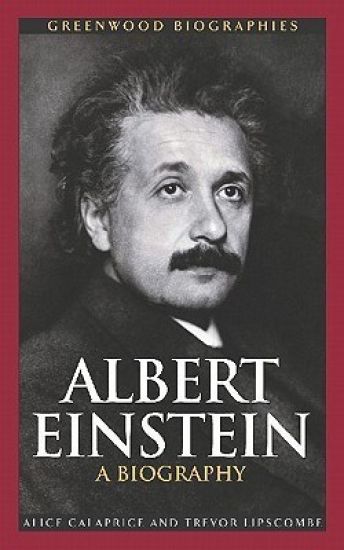
Albert Einstein

Albert Einstein

Alice Calaprice; Trevor Lipscombe

Greenwood Press
2005
sidottu
Albert Einstein remains one of most famous scientists in world history. His image is instantly recognizable by even the most scientifically uninformed person—for many people, Einstein personifies genius. But who was Einstein really? What was he like as a person? What did his science actually mean? This fresh biography of Albert Einstein provides students and general readers a concise, accessible introduction to the life and science of this revolutionary man. Underneath his genius, Einstein was an ordinary person, with human frailties and weaknesses, but also with charm, modesty, a wry sense of humor, and idiosyncrasies. Readers will understand why he was named the Person of the Century by Time magazine. Albert Einstein: A Biography will cover the entire history of this brilliant physicist's life and career, including: his early education, during which he was an excellent student, contrary to what is commonly believed; Einstein's struggles to find an academic position, which led him to work as a clerk at the Swiss patent office during the same period he was formulating his most famous and revolutionary theories; his troubled marriages and family life; Einstein's rise to international fame, and his use of that fame to fight for world peace; and Einstein's major contributions to physics, explained in ways that can be understood by anyone who wishes a fuller understanding of his scientific theories. The book includes a bibliography of secondary works that are useful for further reading, and a timeline of important dates in the life of Einstein.
Albert Camus

Albert Camus

Ramin Jahanbegloo

Routledge India
2019
sidottu
This book interprets the ideas, thoughts and concepts that characterize the writings and philosophy of Albert Camus for our contemporary times. It investigates Camus’ "revolted compassion" as an outsider and a philosopher-writer who in his own words believed in "creating dangerously". The author examines Camus’ interventions on political, philosophical and moral questions, such as Algerian independence, capital punishment, ideological violence, nihilism in the context of his ideals of the absurd and revolt, and justice and liberty. Further, it goes on to provide an exhaustive analysis of Camus’ critique of violence and his intellectual resistance to totalitarianism. Bringing together latest scholarship with an acute analysis of Albert Camus’ philosophy, this sourcebook throws a powerful light on the intellectual foundations of the twentieth century and its relevance for the twenty-first. The book will be of interest to scholars of literature, philosophy and African Studies.
Albert Einstein’s Special Theory of Relativity

Albert Einstein’s Special Theory of Relativity

Arthur I. Miller

Springer-Verlag New York Inc.
1997
nidottu
This book analyzes one of the three great papers Einstein published in 1905, each of which would alter forever the field it dealt with. The second of these papers, "On the Electrodynamics of Moving Bodies," had an impact in a much broader field than electrodynamics: it established what Einstein sometimes referred to (after 1906) as the "so-called Theory of Relativity." Miller uses the paper to provide a window into the intense intellectual struggles of physicists in the first decade of the 20th century: the interplay between physical theory and empirical data, the fiercely held notions that could not be articulated clearly or verified experimentally, the great intellectual investment in existing theories, data, and interpretations -- and associated intellectual inertia -- and the drive to the long-sought- for unification of the sciences. Since its original publication, this book has become a standard reference and sourcebook for the history and philosophy of science; however, it can equally well serve as a text in the history of ideas or of twentieth-century philosophy. From reviews of the previous edition: ÄMillerÜ has written a superb, perhaps definitive, historical study of Einstein's special theory of relativity.... One comes away from the book with a respect for both the creative genius of the man and his nerve: he simply brushed aside much of the work that was going on around him. - The New Yorker