
Kirjahaku
Etsi kirjoja tekijän nimen, kirjan nimen tai ISBN:n perusteella.
1000 tulosta hakusanalla Bernard Cooper

Bernard Sigme has one month to get a girlfriend. How difficult can that be? When Bernard accepts a hundred pound bet that he can get a girlfriend in one month things get tricky. I mean honestly how difficult is it to get a girlfriend? If your name is Bernard Sigme and your hobbies include spoon collecting and modelling the Great Western Railway - June 15th 1935 just after teatime, Torquay, Platform 2 - it can be very difficult indeed This is a short story.
The Literary Correspondence of Bernard Barton
University of Pennsylvania Press
1966
sidottu
This book is a volume in the Penn Press Anniversary Collection. To mark its 125th anniversary in 2015, the University of Pennsylvania Press rereleased more than 1,100 titles from Penn Press's distinguished backlist from 1899-1999 that had fallen out of print. Spanning an entire century, the Anniversary Collection offers peer-reviewed scholarship in a wide range of subject areas.

Candy is new to the escort industry, she hasn't made any mistakes yet, which surprises even herself, one can expect a cock up or two in the first few weeks of a job. She arrives at the address she's received by text to deliver a full VIP. As always she doesn't know exactly what to expect with a first time client. When the door opens she meets Bernard a small old man, he is about to get the shock of his life, and so is she. The explicit details are Far Too Taboo to mention anymore here. Click the Look Inside to take a peek
The Selected Letters of Bernard DeVoto and Katharine Sterne
University of Utah Press,U.S.
2012
sidottu
Bernard DeVoto (1897–1955) was a historian, critic, editor, professor, political commentator, and conservationist, and above all a writer of comprehensive skill. As a contributor for more than thirty years to Harper’s and other magazines, he was known for his forceful opinions. His essays were often brash and opinionated and kept him in the public limelight. One stinging essay even led the FBI to create a file on him. His five serious novels are forgotten today, but his magazine short stories and the well-paid potboilers that he wrote under a pseudonym (John August) subsidised the first of the significant works of American history that brought DeVoto lasting fame. Four of his historical works, all still in print, are The Year of Decision: 1846, a Book-of-the-Month Club selection in 1943; Across the Wide Missouri, which won the Pulitzer Prize in history in 1948; 1953 National Book Award–winning The Course of Empire; and his popular abridged edition of the Journals of Lewis and Clark, which also appeared in 1953.A busy man with a busy life, DeVoto found time to write and answer letters in abundance. In 1933 he received a fan letter from Katharine Sterne, a young woman hospitalised with tuberculosis; his reply touched off an extraordinary eleven-year correspondence. Sterne had graduated with honours from Wellesley College in 1928 and had served as an assistant art critic at the New York Times before her illness. Despite her enforced invalidism she maintained an active intellectual life. Sterne and DeVoto wrote to each other until her death in 1944, sometimes in many pages and as often as twice a week, exchanging opinions about life, literature, art, current events, family news, gossip, and their innermost feelings. DeVoto’s biographer, Wallace Stegner, states that in these letters DeVoto “expressed himself more intimately than in any other writings.” Although their correspondence amounted to more than 868 letters (and is virtually complete on both sides), DeVoto and Sterne never met, both of them doubtless realising that physical remoteness permitted a psychological proximity that was deeply nourishing.This volume contains 140 of their letters. They have been selected by DeVoto’s son Mark, who has also provided detailed notes clarifying ambiguities and obscure references. Readers will enjoy these letters for their wit and literary flair, but they will also gain insight into the cultural and historical crosscurrents of the 1930s and ’40s while taking an intimate and engaging look at a friendship forged entirely through words.
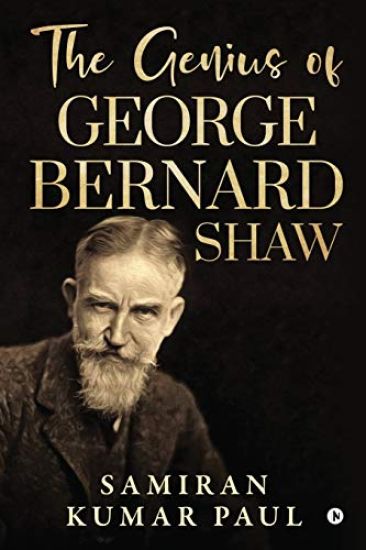
The Genius of George Bernard Shaw
Notion Press
2020
pokkari
The Genius of George Bernard Shaw is a criticism of George Bernard Shaw's work that explores his art, aesthetics, philosophy, and revolutionary ideas. Shaw wrote his plays raising and dealing with the problems of individuals, families, society, nations, and the world. It is occasionally stated that Shaw's support for totalitarianism grew out of his frustration with nineteenth-century liberalism, which ineffectually culminated in a disastrous world war. Yet, close analysis to two of Shaw's Major Critical Essays from the 1890s shows that even then Shaw expressed a desire for a ruthless man of action unencumbered by the burden of conscience to come on the scene and establish a new world order, to initiate the utopian epoch. Indeed, further analysis of a number of plays from before the war shows the impulse to be persistent and undeniable.Shaw hated disorder, and he wanted to see society managed efficiently by a small caste of technocratic experts who were at the same time, in Karl Popper's memorable phrase, utopian social engineers. He had very little confidence in the average man and woman, who could not work mentally at the same speed‖ as the Fabian executive committee, his ideal of what a ruling caste would look like. Shaw's ideal society, what I am calling his utopian vision, resembles Plato's ideal city or Comte's Religion of Humanity more than any society that has presumably ever existed on earth. This need for absolute order and control found many means of expression in both his life and work and was intricately bound up with his longing for perfection.This book is useful for world teachers, students, and research scholars in English in schools, colleges, universities all over the world.



128 pages, 70 pictures by Bart van Bussel, Texts by Bernard Le Dauphin. Bernard Le Dauphin has collected Noh masks during all his life. Looking only for the Best and oldest Masks he succeeded in making a 30 masks collection from the 14th to the 19th century. This book shows front and back sides of the masks and described them with all the knowledge patiently accumulated during his long career.

A spring break vacation has turned into an empowering, learning experience for a little boy, who has come to know his root in China and found his ancestors' endeavor to build a mighty defense under very harsh conditions more than two thousand years ago. Thousands of lives were lost, while building the Great Wall, of which, many sections are currently in disrepair or eroded away by sand storms. At the end of the story, the little boy has found his mission to save the ancient wall, a legacy his ancestors had left to him as well as to the entire world."The Great Wall like a beautiful dragon, is winding gracefully across the high mountain ridges. The ancient dragon is so powerful and so long that Bernard can't see the beginning or the end of it. The little boy stands on the Great Wall, so tall and high above the world. He can feel the amazing ancient dragon flying beneath his feet..."As a symbol of China, the Great Wall has stood for more than two thousand years to protect the ancient empire and has witnessed the country's so many historical changes. By taking an amazing journey to visit the Great Wall with the little boy Bernard, readers will have a glimpse of the depth and richness of the fascinating Chinese history and cultures.A newly released history title, by Connie Du, the author of Bernard Eats Healthy and Bernard Goes to Music School. You don't want to miss a good read about China
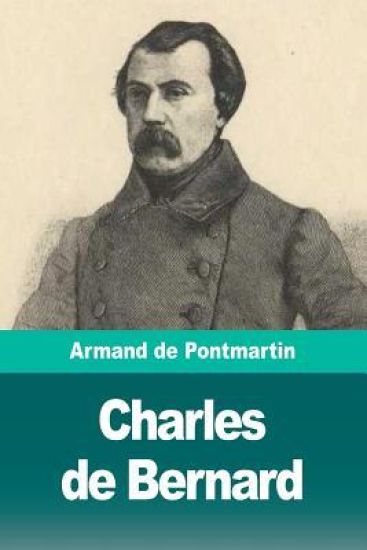
" Si la premi re place, en litt rature comme en toutes choses, appartient aux hommes dont le talent ou le g nie a rendu tout ce qu'il pouvait rendre, un int r t, sinon plus vif, au moins plus affectueux et plus tendre, s'attache ceux qui, par leur fin pr matur e, la disposition particuli re de leur esprit ou la faute des circonstances, offrent, dans l'ensemble de leur vie et de leurs ouvrages, ce je ne sais quoi d'inachev qui ne s'accorde, h las que trop bien avec la destin e de l'homme et les tristes conditions de son passage ici-bas. Ceux-l , on les aime la fois pour ce qu'ils ont fait et pour ce qu'ils auraient pu faire; si l'on regrette qu'ils n'aient pas laiss une trace plus profonde, ce n'est pas eux qu'on s'en prend; c'est leur temps, l'absence de ces convictions vigoureuses qui sont la s ve des mes, ce sentiment de lassitude pr ventive qui arr te en chemin certains esprits tr s fins et tr s justes, faute d' tre assez s rs de leur force, de leur marche et de leur but. Il nous semble alors que nous sommes tous complices de leurs d faillances, qu'elles tablissent entre eux et nous un lien de plus, et que c'est pour avoir partag nos ennuis et nos m comptes qu'ils ont ainsi disparu sans avoir dit leur dernier mot. Toutefois, comme il ne manque pas, pendant ce temps, de noms sonores et de vanit s bruyantes pour occuper le devant de la sc ne et absorber l'attention, il n'est pas rare que ces sobres et discrets amans de la renomm e vivent et meurent dans une sorte de demi-silence et de demi-jour, dont ils ne paraissent ni s'effrayer, ni se plaindre. On dirait que leur mort ne laisse pas de vide parce que leur existence ne fait pas de bruit..."
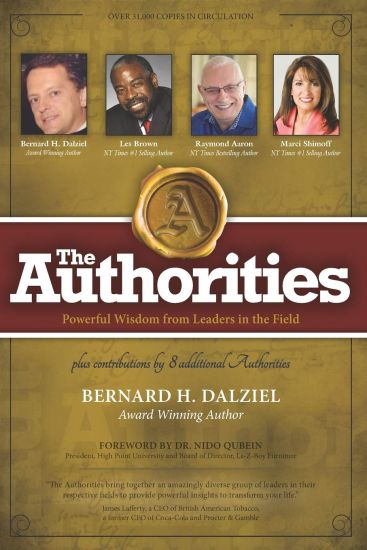
The Authorities - Bernard H. Dalziel: Powerful Wisdom from Leaders in the Field
Les Brown; Raymond Aaron; Marci Shimoff
10-10-10 Publishing
2018
nidottu

In 1892 hunger, poverty and desolation were endemic in the area around Foxford in County Mayo in the aftermath of the great famine and the Land War. It was in this context that Agnes Morrogh-Bernard, a member of the Irish Sisters of Charity, achieved what many thought was impossible. She was a pioneering and visionary woman who, in a male dominated society, managed to establish the world famous Foxford Woollen Mills, which to this day provide an important source of employment to the surrounding area. This is her incredible story. She lived through a time spanning the 19th and early 20th centuries, 1842–1932, a time of strife and unrest, emigration and eviction. Into this mix, this woman brought hope where there was despair, light where there was darkness and joy where there was once sadness. She also had absolute trust in Providence, which was her bastion in this quest. Her story is a fascinating one, whether you are familiar with the area or not.

Author David Ross's biography of Georoge Bernard Shaw is exceptionally readable and entertaining. The life, wit and prolific achievements of this Irish icon are conveyed with insight and understanding.

The first ever modern edition of Bernard Barton’s selected verse, recovering an important and prolific figure from the Romantic era. Instantly recognisable to his contemporaries as ‘the Quaker poet’, Barton wrote nature and landscape poetry in a distinctive vein, as well as spanning strikingly diverse themes that engaged politics, society and religion. This selection encompasses all these tones and genres, providing freshly edited texts from the first printed sources, supplemented by textual apparatus, critical commentary and informative footnotes. The book also includes a selection of contextual material, including prefaces and reviews, as well as a selection of Barton’s lively epistolary correspondence. A substantial scholarly essay serves as the introduction, describing Barton’s life and career, as well as analysing his uniquely Quaker poetic identity in its full literary and historical context.

The first ever modern edition of Bernard Barton’s selected verse, recovering an important and prolific figure from the Romantic era. Instantly recognisable to his contemporaries as ‘the Quaker poet’, Barton wrote nature and landscape poetry in a distinctive vein, as well as spanning strikingly diverse themes that engaged politics, society and religion. This selection encompasses all these tones and genres, providing freshly edited texts from the first printed sources, supplemented by textual apparatus, critical commentary and informative footnotes. The book also includes a selection of contextual material, including prefaces and reviews, as well as a selection of Barton’s lively epistolary correspondence. A substantial scholarly essay serves as the introduction, describing Barton’s life and career, as well as analysing his uniquely Quaker poetic identity in its full literary and historical context.