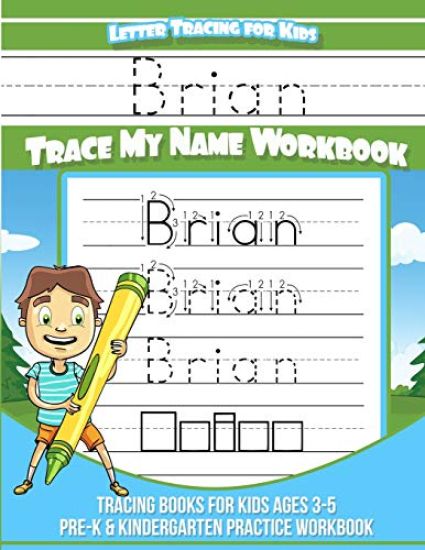
BRIAN Name Tracing Workbook - Preschoolers Kindergarten Practice Workbook - Toddlers Writing Notebook - Learn How to Write BRIAN - Preschoolers Activities Teaching your child the basics of writing is a difficult task especially if he or she is full of energy and finds it more difficult to focus. In order to give him a push in the first years of school or kindergartner, we are presenting a revolutionary way of teaching your baby the basics of the alphabet: the name tracing workbook for children. Why our workbook? The name tracing workbook has been designed specifically to teach children the basic of spelling and writing. By learning to write his own name, your child will develop the abilities and skills needed in the first years of schools while having fun. The 100 pages activity book is the perfect choice if you are searching to invest in your child's education from the beginning so don't hesitate and get him the only workbook he needs LEARNING THE FIRST LETTERS teaching your toddler the first letters and how to spell his or her name is difficult, which is why we have designed a special workbook that will make the learning process easier and a lot more fun, adding to the baby's educational fund. PERSONALIZED WORKING: the name is the first word any child should learn how to spell, but it is almost impossible to find special help for that task. BRIAN Name Tracing Workbook is divided in 12 themed chapters that will teach your toddler how to spell his or her name in a fun and interactive way. WHAT IT CONTAINS: BRIAN Name Tracing Workbook counts no less than 100 pages divided in 12 themed sheets that propose recognition activities, letter tracing practice and letter games, that are sure to teach your child the basics of writing and spelling. FOR TODDLERS: BRIAN Name Tracing Workbook is made especially for children aged 3 to 6 so your son or daughter will be well prepared for both kindergarten and first grade Learning the alphabet will be a piece of cake if your kid will already have the foundation letter tracing so why not give him a head start in school. THE PERFECT GIFT: offering a present to a toddler that is both fun and parents-approved is an almost impossible task, but the name tracing workbook has it all: it is educational, personalized and made especially for youngsters ages 3 to 6 so, if you're trying to bring a smile on a kid's face, this is it
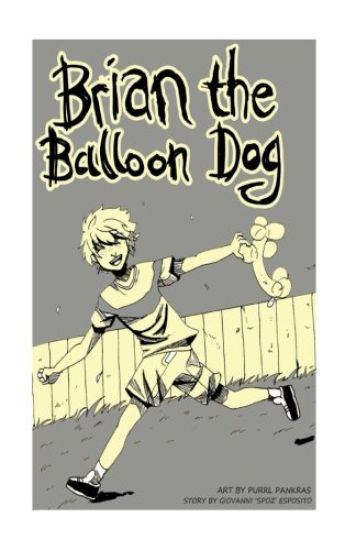
Poem by Giovanni 'Spoz' Esposito, Illustration by L.J.Durose - A oneshot story about a shy young boy trying to become more confident, with the help of his best friend, Brian.
The Brian Friel Papers at the National Library of Ireland are a record of a life’s work in progress. They represent a way of working and of making art over a period spanning more than fifty years. This book is the first of its kind in its attempt to interrogate the role of the Brian Friel Papers in Friel’s legacy as a working artist with a richly developed creative practice. By means of an unprecedented focus on Friel’s artistic process, Kuczynska asks not only how and by whom Friel was being influenced and inspired, but also how and for whom Friel’s praxis might come to be an inspiration. Combining forensic archival scholarship with original, collaborative practice-based research, this study remains focused on the ‘how’ of influence, showcasing an approach to literary archives that foregrounds live practices of access in the spirit of creative encounter. Whether uncovering forgotten source materials for Friel’s plays or working with current practitioners in the arts, Kuczynska reveals how an approach to literary archives grounded in artistic practice might provide the tools for setting a major creative legacy not in stone but rather in motion.
Studying Brian Moore’s Black Robe (1985), this book examines the dual adaptation process of historical sources into fiction and fiction into film. The fictionalisation process is analysed on the basis of the Jesuit Relations of the 17th century and Moore’s novel. Besides transforming and compiling information from these annual reports, Moore also uses them to justify his choice of obscene language for the indigenous characters. The visualisation process is studied with the help of various versions of the screenplay with respect to the differences of narrative and narration in fiction and film. A final exemplary analysis illustrates in detail how the original historical sources were transformed via the novel and the screenplays into the final visualisation in the motion picture.
This feminist study is an innovative reassessment of Brian Moore’s five novels featuring eponymous heroines. The author reviews previous interpretations, exposing their sexist bias. Highlighting Moore’s empathetic insights, she also discusses the novelist’s limitations. She compares Moore’s heroines to Flaubert’s Emma Bovary, reinterpreted by Mieke Bal, Tolstoy’s Anna Karenina revisioned by Aritha van Herk, and to female characters created by Canadian women writers. Rejecting biocriticism, the study focuses on Moore’s biblical, Victorian and modernist inspirations, and his indebtedness to film. Ideas of female thinkers illuminate the condition of Moore’s female protagonists.