

Kirjahaku
Etsi kirjoja tekijän nimen, kirjan nimen tai ISBN:n perusteella.
1000 tulosta hakusanalla Bruno Loureiro Mahe

The Political Paul presents Paul as a political thinker. Many studies claiming Paul for Greek Hellenism discuss the influence upon him of various aspects of Hellenistic culture, but strangely neglect Hellenistic political philosophy with its roots in Classical antiquity. The Political Paul explores this dimension of PaulAEs thought within the general context of Hellenistic political reflection to focus on the intriguing body of literature known as the Pythagorean pseudepigrapha. These researches support the highly original argument that Christianity has foundations in Hellenistic kingship theories. Paul constructs a political theory for Christianity. He conceives it as a polis-basileia system, politics proper and divine rule, each with its own dikaiosyne; this the study re-evaluates as a political concept.

'To Richter (no first name necessary), warm greetings to the best pianist in the Soviet Union - indeed in the whole world.' ProkofievThroughout a life dedicated to music, Richter maintained a stubborn silence about his own ideals and aspirations. Here at last he opens up his heart in these exceptional interviews with Bruno Monsaingeon, who became close to Richter not long before the pianist's death in 1995. These conversations take us on a journey which begins with Richter's childhood memories, follows his early career and his development into 'an artist of the people', and finally charts his rise to international acclaim.Richter's personal notebooks, kept for nearly thirty years, constitute an unparalleled witness to the music of our time. The pianist writes with precision, humour and clarity and is uninhibitedly himself. These are the private thoughts of a nonconformist, one of the greatest performers of the century, yet one whose life was inextricably bound to the history of the USSR.

A major work by one of the more innovative thinkers of our time, Politics of Nature does nothing less than establish the conceptual context for political ecology—transplanting the terms of ecology into more fertile philosophical soil than its proponents have thus far envisioned. Bruno Latour announces his project dramatically: “Political ecology has nothing whatsoever to do with nature, this jumble of Greek philosophy, French Cartesianism and American parks.” Nature, he asserts, far from being an obvious domain of reality, is a way of assembling political order without due process. Thus, his book proposes an end to the old dichotomy between nature and society—and the constitution, in its place, of a collective, a community incorporating humans and nonhumans and building on the experiences of the sciences as they are actually practiced.In a critique of the distinction between fact and value, Latour suggests a redescription of the type of political philosophy implicated in such a “commonsense” division—which here reveals itself as distinctly uncommonsensical and in fact fatal to democracy and to a healthy development of the sciences. Moving beyond the modernist institutions of “mononaturalism” and “multiculturalism,” Latour develops the idea of “multinaturalism,” a complex collectivity determined not by outside experts claiming absolute reason but by “diplomats” who are flexible and open to experimentation.
Bruno Latour has written a unique and wonderful tale of a technological dream gone wrong. The story of the birth and death of Aramis—the guided-transportation system intended for Paris—is told in this thought-provoking and fictional account by several different parties: an engineer and his professor; company executives and elected officials; a sociologist; and finally Aramis itself, who delivers a passionate plea on behalf of technological innovations that risk being abandoned by their makers. As the young engineer and professor follow Aramis’s trail—conducting interviews, analyzing documents, assessing the evidence—perspectives keep shifting: the truth is revealed as multilayered, unascertainable, comprising an array of possibilities worthy of Rashomon. This charming and profound book, part novel and part sociological study, is Latour at his thought-provoking best.

A scientist friend asked Bruno Latour point-blank: “Do you believe in reality?” Taken aback by this strange query, Latour offers his meticulous response in Pandora’s Hope. It is a remarkable argument for understanding the reality of science in practical terms.In this book, Latour, identified by Richard Rorty as the new “bête noire of the science worshipers,” gives us his most philosophically informed book since Science in Action. Through case studies of scientists in the Amazon analyzing soil and in Pasteur’s lab studying the fermentation of lactic acid, he shows us the myriad steps by which events in the material world are transformed into items of scientific knowledge. Through many examples in the world of technology, we see how the material and human worlds come together and are reciprocally transformed in this process.Why, Latour asks, did the idea of an independent reality, free of human interaction, emerge in the first place? His answer to this question, harking back to the debates between Might and Right narrated by Plato, points to the real stakes in the so-called science wars: the perplexed submission of ordinary people before the warring forces of claimants to the ultimate truth.
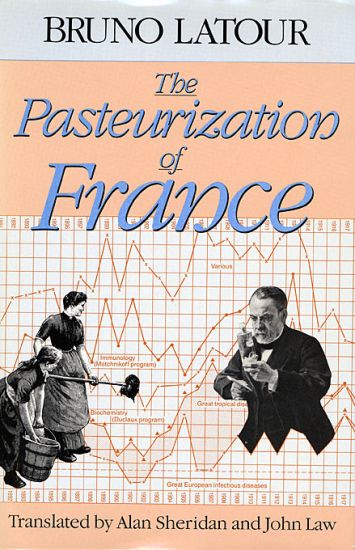
What can one man accomplish, even a great man and brilliant scientist? Although every town in France has a street named for Louis Pasteur, was he alone able to stop people from spitting, persuade them to dig drains, influence them to undergo vaccination? Pasteur’s success depended upon a whole network of forces, including the public hygiene movement, the medical profession (both military physicians and private practitioners), and colonial interests. It is the operation of these forces, in combination with the talent of Pasteur, that Bruno Latour sets before us as a prime example of science in action.Latour argues that the triumph of the biologist and his methodology must be understood within the particular historical convergence of competing social forces and conflicting interests. Yet Pasteur was not the only scientist working on the relationships of microbes and disease. How was he able to galvanize the other forces to support his own research? Latour shows Pasteur’s efforts to win over the French public—the farmers, industrialists, politicians, and much of the scientific establishment.Instead of reducing science to a given social environment, Latour tries to show the simultaneous building of a society and its scientific facts. The first section of the book, which retells the story of Pasteur, is a vivid description of an approach to science whose theoretical implications go far beyond a particular case study. In the second part of the book, “Irreductions,” Latour sets out his notion of the dynamics of conflict and interaction, of the “relation of forces.” Latour’s method of analysis cuts across and through the boundaries of the established disciplines of sociology, history, and the philosophy of science, to reveal how it is possible not to make the distinction between reason and force. Instead of leading to sociological reductionism, this method leads to an unexpected irreductionism.

Science and technology have immense authority and influence in our society, yet their working remains little understood. The conventional perception of science in Western societies has been modified in recent years by the work of philosophers, sociologists and historians of science. In this book Bruno Latour brings together these different approaches to provide a lively and challenging analysis of science, demonstrating how social context and technical content are both essential to a proper understanding of scientific activity. Emphasizing that science can only be understood through its practice, the author examines science and technology in action: the role of scientific literature, the activities of laboratories, the institutional context of science in the modern world, and the means by which inventions and discoveries become accepted. From the study of scientific practice he develops an analysis of science as the building of networks. Throughout, Bruno Latour shows how a lively and realistic picture of science in action alters our conception of not only the natural sciences but also the social sciences and the sociology of knowledge in general.This stimulating book, drawing on a wealth of examples from a wide range of scientific activities, will interest all philosophers, sociologists and historians of science, scientists and engineers, and students of the philosophy of social science and the sociology of knowledge.


With the rise of science, we moderns believe, the world changed irrevocably, separating us forever from our primitive, premodern ancestors. But if we were to let go of this fond conviction, Bruno Latour asks, what would the world look like? His book, an anthropology of science, shows us how much of modernity is actually a matter of faith.What does it mean to be modern? What difference does the scientific method make? The difference, Latour explains, is in our careful distinctions between nature and society, between human and thing, distinctions that our benighted ancestors, in their world of alchemy, astrology, and phrenology, never made. But alongside this purifying practice that defines modernity, there exists another seemingly contrary one: the construction of systems that mix politics, science, technology, and nature. The ozone debate is such a hybrid, in Latour’s analysis, as are global warming, deforestation, even the idea of black holes. As these hybrids proliferate, the prospect of keeping nature and culture in their separate mental chambers becomes overwhelming—and rather than try, Latour suggests, we should rethink our distinctions, rethink the definition and constitution of modernity itself. His book offers a new explanation of science that finally recognizes the connections between nature and culture—and so, between our culture and others, past and present.Nothing short of a reworking of our mental landscape, We Have Never Been Modern blurs the boundaries among science, the humanities, and the social sciences to enhance understanding on all sides. A summation of the work of one of the most influential and provocative interpreters of science, it aims at saving what is good and valuable in modernity and replacing the rest with a broader, fairer, and finer sense of possibility.

Over the past twenty-five years, Bruno Latour has developed a research protocol different from the actor-network theory with which his name is now associated—a research protocol that follows the different types of connectors that provide specific truth conditions. These are the connectors that prompt a climate scientist challenged by a captain of industry to appeal to the institution of science, with its army of researchers and mountains of data, rather than to “capital-S Science” as a higher authority. Such modes of extension—or modes of existence, Latour argues here—account for the many differences between law, science, politics, and other domains of knowledge.“Magnificent…An Inquiry into Modes of Existence shows that [Latour] has lost none of his astonishing fertility as a thinker, or his skill and wit as a writer…Latour’s main message—that rationality is ‘woven from more than one thread’—is intended not just for the academic seminar, but for the public square—and the public square today is global as never before.”—Jonathan Rée, Times Literary Supplement“Latour’s work makes the world—sorry, worlds—interesting again.”—Stephen Muecke, Los Angeles Review of Books

Essays discuss Freud, the history of psychoanalysis, children, autism, the Holocaust, and the author's life

This highly original work presents laboratory science in a deliberately skeptical way: as an anthropological approach to the culture of the scientist. Drawing on recent work in literary criticism, the authors study how the social world of the laboratory produces papers and other "texts,"' and how the scientific vision of reality becomes that set of statements considered, for the time being, too expensive to change. The book is based on field work done by Bruno Latour in Roger Guillemin's laboratory at the Salk Institute and provides an important link between the sociology of modern sciences and laboratory studies in the history of science.
Curiously, economists, whose discipline has much to do with human well-being, have shied away from factoring the study of happiness into their work. Happiness, they might say, is an "unscientific" concept. This is the first book to establish empirically the link between happiness and economics--and between happiness and democracy. Two respected economists, Bruno S. Frey and Alois Stutzer, integrate insights and findings from psychology, where attempts to measure quality of life are well-documented, as well as from sociology and political science. They demonstrate how micro- and macro-economic conditions in the form of income, unemployment, and inflation affect happiness. The research is centered on Switzerland, whose varying degrees of direct democracy from one canton to another, all within a single economy, allow for political effects to be isolated from economic effects. Not surprisingly, the authors confirm that unemployment and inflation nurture unhappiness. Their most striking revelation, however, is that the more developed the democratic institutions and the degree of local autonomy, the more satisfied people are with their lives. While such factors as rising income increase personal happiness only minimally, institutions that facilitate more individual involvement in politics (such as referendums) have a substantial effect. For countries such as the United States, where disillusionment with politics seems to be on the rise, such findings are especially significant. By applying econometrics to a real-world issue of general concern and yielding surprising results, Happiness and Economics promises to spark healthy debate over a wide range of the social sciences.

Sviatoslav Richter: Notebooks and Conversations
Bruno Monsaingeon
PRINCETON UNIVERSITY PRESS
2002
nidottu
Sviatoslav Richter was a dazzling performer but an intensely private man. Though world famous and revered by classical music lovers everywhere, he guarded himself and his thoughts as carefully as his talent. Fascinated, author and filmmaker Bruno Monsaingeon tried vainly for years to interview the enigmatic pianist. Richter eventually yielded, granting Monsaingeon hours of taped conversation, unlimited access to his diaries and notebooks, and, ultimately, his friendship. This book is the product of that friendship. Richter reveals himself as a man and an artist. Unsentimentally and with his characteristic dry humor and intelligence, the musician describes his poignant childhood and spectacular career, including his tumultuous early days at the Moscow Conservatory and his triumphant 1960 tour of the United States. His laconic recounting of playing in the orchestra at Stalin's surreal, interminable state funeral is riveting. Most important for music lovers, Richter discusses his influences and views on musical interpretation. He describes his encounters with other great Russian performers and composers, including Prokoviev, Shostakovich, Oistrakh, and Gilels. Candid sections from his personal journals offer his sober and unguarded impressions of dozens of performances and recordings--both his own and those of other musicians. This volume offers readers the sizable pleasure of lingering in the thoughts and words of one of the most important pianists of the twentieth century. Unlike many other star performers, Richter was also an intellectual who had interesting things to say, particularly about the musician's proper role as interpreter of the composer's art. This alone makes the book worth reading. Sviatoslav Richter belongs on the shelves of everyone with a classical music collection and will also appeal to lovers of autobiography and admirers of Russian musical culture.
The first book to offer a comprehensive exploration of Marx’s relationship to republicanism, arguing that it is essential to understanding his thoughtIn Citizen Marx, Bruno Leipold argues that, contrary to certain interpretive commonplaces, Karl Marx’s thinking was deeply informed by republicanism. Marx’s relation to republicanism changed over the course of his life, but its complex influence on his thought cannot be reduced to wholesale adoption or rejection. Challenging common depictions of Marx that downplay or ignore his commitment to politics, democracy, and freedom, Leipold shows that Marx viewed democratic political institutions as crucial to overcoming the social unfreedom and domination of capitalism. One of Marx’s principal political values, Leipold contends, was a republican conception of freedom, according to which one is unfree when subjected to arbitrary power.Placing Marx’s republican communism in its historical context—but not consigning him to that context—Leipold traces Marx’s shifting relationship to republicanism across three broad periods. First, Marx began his political life as a republican committed to a democratic republic in which citizens held active popular sovereignty. Second, he transitioned to communism, criticizing republicanism but incorporating the republican opposition to arbitrary power into his social critiques. He argued that although a democratic republic was not sufficient for emancipation, it was necessary for it. Third, spurred by the events of the Paris Commune of 1871, he came to view popular control in representation and public administration as essential to the realization of communism. Leipold shows how Marx positioned his republican communism to displace both antipolitical socialism and anticommunist republicanism. One of Marx’s great contributions, Leipold suggests, was to place politics (and especially democratic politics) at the heart of socialism.
A kaleidoscopic and original new history of urbanization—from Lisbon to New York, Paris to Rio de Janeiro, and Buenos Aires to LagosFor the past three centuries, urban dwellers and planners have imagined future cities that would be radically different from those of the past. Planners pursued progress, whether focused on flying vehicles above, sewage systems below, or daily life in between. Yet, as Bruno Carvalho shows in this original and wide-ranging history, which features some sixty illustrations, modern cities continuously defied predictions. Visionary designs and technological innovations created dramatic, unforeseen outcomes, and the ongoing urban boom is a story of continuity as well as rupture. A compelling history of imagined futures and the transformation of urban life, The Invention of the Future also suggests what we might learn from the stories of our cities as we shape them for the twenty-first century.Moving between large-scale changes and detailed examples, this captivating narrative tells the story of key moments and turning points: the rebuilding of Lisbon after the 1755 earthquake; the 1811 Commissioners’ Plan for Manhattan; Parisian reforms from 1853 to 1870; Le Corbusier’s plans for South American cities in the 1920s and 1930s; the postwar victory of the car; the utopian capital of Brasília; and urban growth in Africa.In recent decades, Carvalho argues, the capacity to invent urban futures has become increasingly constrained. Social and environmental challenges loom large. But the story is not over. While cities helped create current problems, compact and transit-rich urbanization might be our best hope to combine high living standards with sustainability. Sometimes, moving forward can involve reaching back to the future.

This illustrated book plunges you into a dark fantasy full of brave heroes, beautiful damsels, and loyal allies. Dyosphir will face many challenges as he quests after the Rose of Sharon. At the end of his adventure, he will be confronted with a choice that will change everything for his people and his land.This epic poem from Bruno Ribeiro presents you with a new kind of fairy tale. The love story between Dyosphir and Ivalisee is a dark fantasy full of lush settings, chivalrous adventures, true love, and unimaginable peril. Ride along with Dyosphir as he and his companions plot to save his love and kingdom. The Book of All Lovers is an epic poem adapted for a modern audience with modern tastes.