Kirjojen hintavertailu. Mukana 12 414 269 kirjaa ja 12 kauppaa.

Kirjahaku

Etsi kirjoja tekijän nimen, kirjan nimen tai ISBN:n perusteella.

1000 tulosta hakusanalla Carbone Gerald M.

Carbon Capital

Carbon Capital

Sean Field

NEW YORK UNIVERSITY PRESS
2025
sidottu
Surprising insights into the worldviews of oil and gas financiers It is no secret that the fossil fuel industry, whose products power modern America both physically and financially, inflicts immense destruction to our environment. The past, present, and future of US energy have been determined not just by engineers, but by financiers, an under-studied group of energy investors. Drawing on four years of ethnographic work in Houston, Texas, the financial center of the oil industry, Carbon Capital explores how oil financiers decide what a good investment is, and how they incorporate ethics into their decision making. While many who are concerned about climate change see those involved in the gas and oil industries as immoral profit chasers who do not care about the environment, the author finds that this is not the case. His interviews and observations demonstrate that the people who finance the energy industries are actually deeply concerned with ethics. They grapple with questions about climate change and what it means to do the right thing, but the choices they make are ultimately guided by a combination of how they perceive the historical context in which they operate, their faith, which is largely religious Christian; their financial interests; plus the capitalist system in which they are running, all of which come together to shape their moral understandings about what a good energy future looks like. While the worldview of oil financiers may not align with our own, the author argues that given their importance in shaping environmental approaches, it is crucial that we understand what drives their ethical sensibilities.
Carbon Capital

Carbon Capital

Sean Field

NEW YORK UNIVERSITY PRESS
2025
pokkari
Surprising insights into the worldviews of oil and gas financiers It is no secret that the fossil fuel industry, whose products power modern America both physically and financially, inflicts immense destruction to our environment. The past, present, and future of US energy have been determined not just by engineers, but by financiers, an under-studied group of energy investors. Drawing on four years of ethnographic work in Houston, Texas, the financial center of the oil industry, Carbon Capital explores how oil financiers decide what a good investment is, and how they incorporate ethics into their decision making. While many who are concerned about climate change see those involved in the gas and oil industries as immoral profit chasers who do not care about the environment, the author finds that this is not the case. His interviews and observations demonstrate that the people who finance the energy industries are actually deeply concerned with ethics. They grapple with questions about climate change and what it means to do the right thing, but the choices they make are ultimately guided by a combination of how they perceive the historical context in which they operate, their faith, which is largely religious Christian; their financial interests; plus the capitalist system in which they are running, all of which come together to shape their moral understandings about what a good energy future looks like. While the worldview of oil financiers may not align with our own, the author argues that given their importance in shaping environmental approaches, it is crucial that we understand what drives their ethical sensibilities.
Carbon Nanotube and Graphene Nanoribbon Interconnects

Carbon Nanotube and Graphene Nanoribbon Interconnects

Debaprasad Das; Hafizur Rahaman

Apple Academic Press Inc.
2014
sidottu
An Alternative to Copper-Based Interconnect TechnologyWith an increase in demand for more circuit components on a single chip, there is a growing need for nanoelectronic devices and their interconnects (a physical connecting medium made of thin metal films between several electrical nodes in a semiconducting chip that transmit signals from one point to another without any distortion). Carbon Nanotube and Graphene Nanoribbon Interconnects explores two new important carbon nanomaterials, carbon nanotube (CNT) and graphene nanoribbon (GNR), and compares them with that of copper-based interconnects. These nanomaterials show almost 1,000 times more current-carrying capacity and significantly higher mean free path than copper. Due to their remarkable properties, CNT and GNR could soon replace traditional copper interconnects. Dedicated to proving their benefits, this book covers the basic theory of CNT and GNR, and provides a comprehensive analysis of the CNT- and GNR-based VLSI interconnects at nanometric dimensions. Explore the Potential Applications of CNT and Graphene for VLSI CircuitsThe book starts off with a brief introduction of carbon nanomaterials, discusses the latest research, and details the modeling and analysis of CNT and GNR interconnects. It also describes the electrical, thermal, and mechanical properties, and structural behavior of these materials. In addition, it chronicles the progression of these fundamental properties, explores possible engineering applications and growth technologies, and considers applications for CNT and GNR apart from their use in VLSI circuits.Comprising eight chapters this text: Covers the basics of carbon nanotube and graphene nanoribbonDiscusses the growth and characterization of carbon nanotube and graphene nanoribbonPresents the modeling of CNT and GNR as future VLSI interconnectsExamines the applicability of CNT and GNR in terms of several analysis worksAddresses the timing and frequency response of the CNT and GNR interconnectsExplores the signal integrity analysis for CNT and GNR interconnects Models and analyzes the applicability of CNT and GNR as power interconnectsConsiders the future scope of CNT and GNRBeneficial to VLSI designers working in this area, Carbon Nanotube and Graphene Nanoribbon Interconnects provides a complete understanding of carbon-based materials and interconnect technology, and equips the reader with sufficient knowledge about the future scope of research and development for this emerging topic.
Carbon Nanomaterials Sourcebook

Carbon Nanomaterials Sourcebook

Apple Academic Press Inc.
2016
sidottu
The Carbon Nanomaterials Sourcebook contains extensive, interdisciplinary coverage of carbon nanomaterials, encompassing the full scope of the field—from physics, chemistry, and materials science to molecular biology, engineering, and medicine—in two comprehensive volumes.Written in a tutorial style, this first volume of the sourcebook:Focuses on graphene, fullerenes, nanotubes, and nanodiamondsDescribes the fundamental properties, growth mechanisms, and processing of each nanomaterial discussedExplores functionalization for electronic, energy, biomedical, and environmental applicationsShowcases materials with exceptional properties, synthesis methods, large-scale production techniques, and application prospectsProvides the tools necessary for understanding current and future technology developments, including important equations, tables, and graphsEach chapter is dedicated to a different type of carbon nanomaterial and addresses three main areas: formation, properties, and applications. This setup allows for quick and easy search, making the Carbon Nanomaterials Sourcebook: Graphene, Fullerenes, Nanotubes, and Nanodiamonds, Volume I a must-have reference for scientists and engineers.
Carbon Nanomaterials Sourcebook

Carbon Nanomaterials Sourcebook

Apple Academic Press Inc.
2016
sidottu
The Carbon Nanomaterials Sourcebook contains extensive, interdisciplinary coverage of carbon nanomaterials, encompassing the full scope of the field—from physics, chemistry, and materials science to molecular biology, engineering, and medicine—in two comprehensive volumes.Written in a tutorial style, this second volume of the sourcebook: Focuses on nanoparticles, nanocapsules, nanofibers, nanoporous structures, and nanocompositesDescribes the fundamental properties, growth mechanisms, and processing of each nanomaterial discussedExplores functionalization for electronic, energy, biomedical, and environmental applicationsShowcases materials with exceptional properties, synthesis methods, large-scale production techniques, and application prospectsProvides the tools necessary for understanding current and future technology developments, including important equations, tables, and graphsEach chapter is dedicated to a different type of carbon nanomaterial and addresses three main areas: formation, properties, and applications. This setup allows for quick and easy search, making the Carbon Nanomaterials Sourcebook: Nanoparticles, Nanocapsules, Nanofibers, Nanoporous Structures, and Nanocomposites a must-have reference for scientists and engineers.
Carbon Nanomaterials Sourcebook, Two-Volume Set
This two-volume sourcebook is the most comprehensive reference for carbon nanomaterials, bringing together the physics, chemistry, materials science, molecular biology and engineering of all carbon nanomaterial types that are important in electronics, energy, biomedical and environmental applications. Each chapter addresses the fundamental properties, growth mechanisms, processing and functionalization of a particular nanocarbon. The first volume covers graphene, fullerenes, nanotubes and nanodiamonds. The second volume focuses on nanoparticles, nanocapsules, nanofibers, nanoporous structures and nanocomposites.
Carbon Is Life: Why humans and wildlife depend upon carbon dioxide nutrient, and how false global warming claims put all our lives at risk
CARBON IS LIFE is the must-read book for everyone concerned with the environment and the wonderful creatures who share it with us. The writer, a trained scientist, shows why carbon dioxide, far from being "pollution", is actually the essential basis of life on Earth. The book is written for the intelligent lay reader. It shows, with reference to thousands of peer-reviewed scientific experiments, how more carbon dioxide in the air will feed hundreds of millions of humans and untold numbers of wildlife. This means that, as a society, we are currently setting up taxes on carbon that will force us to do exactly the opposite of what is needed to help the planet and ourselves. These are huge and vitally important claims, the truth of which would require us to completely reverse course on all our 'climate change' policies. Accordingly, Carbon Is Life sets out the case in a clear and logical way so that the reader can verify the facts for him- or herself. But as important as the hard facts is the puzzle of how we could all come to believe the precise opposite of the truth? To gain some insight into this, the author explores our situation as members of a unique technological species, and our exile from the natural world that followed from our technological mastery, and which is portrayed symbolically in the story of the Garden of Eden. The book ends with some suggestions from the author about our future and our choices as the "thinking, tool-making, language-using, record-keeping, technological, star-gazing, story-telling, civilisation-building species that nature made us."
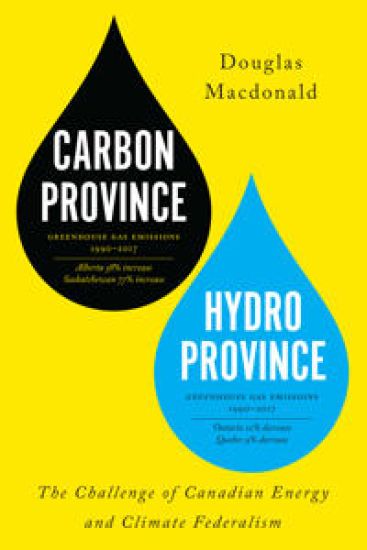
Carbon Province, Hydro Province

Carbon Province, Hydro Province

Douglas Macdonald

University of Toronto Press
2020
sidottu
Why has Canada been unable to achieve any of its climate-change targets? Part of the reason is that emissions in two provinces, Alberta and Saskatchewan – already about half the Canadian total when taken together – have been steadily increasing as a result of expanding oil and gas production. Declining emissions in other provinces, such as Ontario, Quebec, Nova Scotia, and New Brunswick, have been cancelled out by those western increases. The ultimate explanation for Canadian failure lies in the differing energy interests of the western and eastern provinces, overlaid on the confederation fault-line of western alienation. Climate, energy, and national unity form a toxic mix. How can Ottawa possibly get all the provinces moving in the same direction of decreasing emissions? To answer this question, Douglas Macdonald explores the five attempts to date to put in place coordinated national policy in the fields of energy and climate change – from Pierre Trudeau’s ill-fated National Energy Program to Justin Trudeau’s bitterly contested Pan-Canadian program – analysing and comparing them for the first time. Important new insights emerge from this analysis which, in turn, provide the basis for a new approach. Carbon Province, Hydro Province is a major contribution to the vital question of how our federal and provincial governments can effectively work together and thereby for the first time achieve a Canadian climate-change target.
Carbon Province, Hydro Province

Carbon Province, Hydro Province

Douglas Macdonald

University of Toronto Press
2020
pokkari
Why has Canada been unable to achieve any of its climate-change targets? Part of the reason is that emissions in two provinces, Alberta and Saskatchewan – already about half the Canadian total when taken together – have been steadily increasing as a result of expanding oil and gas production. Declining emissions in other provinces, such as Ontario, Quebec, Nova Scotia, and New Brunswick, have been cancelled out by those western increases. The ultimate explanation for Canadian failure lies in the differing energy interests of the western and eastern provinces, overlaid on the confederation fault-line of western alienation. Climate, energy, and national unity form a toxic mix. How can Ottawa possibly get all the provinces moving in the same direction of decreasing emissions? To answer this question, Douglas Macdonald explores the five attempts to date to put in place coordinated national policy in the fields of energy and climate change – from Pierre Trudeau’s ill-fated National Energy Program to Justin Trudeau’s bitterly contested Pan-Canadian program – analysing and comparing them for the first time. Important new insights emerge from this analysis which, in turn, provide the basis for a new approach. Carbon Province, Hydro Province is a major contribution to the vital question of how our federal and provincial governments can effectively work together and thereby for the first time achieve a Canadian climate-change target.
Carbon-based Membranes for Separation Processes

Carbon-based Membranes for Separation Processes

Ahmad Fauzi Ismail; Dipak Rana; Takeshi Matsuura; Henry C. Foley

Springer-Verlag New York Inc.
2014
nidottu
This book provides a significant overview of carbon-related membranes. It will cover the development of carbon related membranes and membrane modules from its onset to the latest research on carbon mixed matrix membranes. After reviewing progress in the field, the authors indicate future research directions and prospective development. The authors also attempt to provide a guideline for the readers who would like to establish their own laboratories for carbon membrane research. For this purpose, detailed information on preparation, characterization and testing of various types of carbon membrane is provided. Design and construction of carbon membrane modules are also described in detail.
Carbon Capture

Carbon Capture

Jennifer Wilcox

Springer-Verlag New York Inc.
2014
nidottu
This book approaches the energy science sub-field carbon capture with an interdisciplinary discussion based upon fundamental chemical concepts ranging from thermodynamics, combustion, kinetics, mass transfer, material properties, and the relationship between the chemistry and process of carbon capture technologies. Energy science itself is a broad field that spans many disciplines -- policy, mathematics, physical chemistry, chemical engineering, geology, materials science and mineralogy -- and the author has selected the material, as well as end-of-chapter problems and policy discussions, that provide the necessary tools to interested students.
Carbon Nanotubes

Carbon Nanotubes

Humana Press Inc.
2016
nidottu
Due to their rare combination of high chemical stability, exceptional optical and electrical properties, high surface-to-volume ratio, and high aspect ratio, carbon nanotubes (CNTs) have made an enormous impact on materials science, molecular biology, biomedicine, and bioanalytical chemistry. Carbon Nanotubes: Methods and Protocols provides reliable, consistent protocols on the application of CNTs in molecular biology-related fields. These are of vital importance, as the commercially available CNTs differ in purity, agglomeration state, as well as length and diameter distribution, all of which have a profound influence on the dispersability and surface properties of the tubes. The volume contains detailed sections on functionalization, toxicity, trafficking, scaffolds, and biosensors, provided by expert researchers from various fields. Written in the highly successful Methods in Molecular Biology™ series format, chapters include introductions to their respective topics, lists of the necessary materials and reagents, step-by-step, readily reproducible laboratory protocols, and notes on troubleshooting and avoiding known pitfalls. Authoritative and cutting-edge, Carbon Nanotubes: Methods and Protocols serves to contribute to the achievement of common standards and helps researchers to avoid discrepancies in future biology-related CNT studies.
Carbon Nanomaterials

Carbon Nanomaterials

Rakesh Behari Mathur; Bhanu Pratap Singh; Shailaja Pande

Productivity Press
2017
sidottu
The study of nanostructures has become, in recent years, a theme common to many disciplines, in which scientists and engineers manipulate matter at the atomic and molecular level in order to obtain materials and systems with significantly improved properties. Carbon nanomaterials have a unique place in nanoscience owing to their exceptional thermal, electrical, chemical, and mechanical properties, finding application in areas as diverse as super strong composite materials, energy storage and conversion, supercapacitors, smart sensors, targeted drug delivery, paints, and nanoelectronics. This book is the first to cover a broad spectrum of carbon nanomaterials, namely carbon nanofibers, vapor-grown carbon fibers, different forms of amorphous nanocarbons besides carbon nanotubes, fullerenes, graphene, graphene nanoribbons, graphene quantum dots, etc. in a single volume.