Kirjojen hintavertailu. Mukana 11 627 373 kirjaa ja 12 kauppaa.

Kirjahaku

Etsi kirjoja tekijän nimen, kirjan nimen tai ISBN:n perusteella.

1000 tulosta hakusanalla Christine Gibson

On the Significance of Religion in Conflict and Conflict Resolution

On the Significance of Religion in Conflict and Conflict Resolution

Christine Schliesser; S. Ayse Kadayifci-Orellana; Pauline Kollontai

Routledge
2020
sidottu
In this ground-breaking volume, the authors analyze the role of religion in conflict and conflict resolution. They do so from the perspectives of Judaism, Christianity, and Islam, while bringing different disciplines into play, including peace and conflict studies, religious studies, theology, and ethics. With much of current academic, political, and public attention focusing on the conflictive dimensions of religion, this book also explores the constructive resources of religion for conflict resolution and reconciliation. Analyzing the specific contributions of religious actors in this field, their potentials and possible problems connected with them, this book sheds light on the concrete contours of the oftentimes vague “religious factor” in processes of social change. Case studies in current and former settings of violent conflict such as Israel, post-genocide Rwanda, and Pakistan provide “real-life” contexts for discussion. Combining cutting-edge research with case studies and concrete implications for academics, policy makers, and practitioners, this concise and easily accessible volume helps to build bridges between these oftentimes separated spheres of engagement.The Open Access version of this book, available at:http://doi.org/10.4324/9781003002888, has been made available under a Creative Commons Attribution-Non Commercial-No Derivatives 4.0 license.
Recognising Adoptee Relationships

Recognising Adoptee Relationships

Christine A. Lewis

TAYLOR FRANCIS LTD
2022
sidottu
With a triadic perspective, this autoethnographic narrative explores the temporal, situated nature of interactions between the author as an adoptee with her adult adopted children as well as those between herself and her birth father and mother. The epiphanic adoptive family narratives that are foregrounded seek to deepen and challenge understanding of how kinship affinities are experienced. The autoethnographic narratives are written in a critical, evocative style which is valuable for two reasons. Firstly, the processes of reflexive self-introspection, self-observation and dialogue with relational others have established a critical connection between recognising and responding to kinship affinities and personal growth. Secondly, lying at the intersection of the self and other this narrative contributes to deepening insights around epistemic in/justice in adoptive kinship. This book will be of interest to educators and scholars of adoption in offering an insider perspective on unique family relationships as well as how the author undertakes critical evocative autoethnography. Adoptees, adoptive parents, and birth parents will also find the narratives in Part II of this book of particular interest in informing an understanding of kin relationships and how these may be subject to change over time.
Recognising Adoptee Relationships

Recognising Adoptee Relationships

Christine A. Lewis

TAYLOR FRANCIS LTD
2024
nidottu
With a triadic perspective, this autoethnographic narrative explores the temporal, situated nature of interactions between the author as an adoptee with her adult adopted children as well as those between herself and her birth father and mother. The epiphanic adoptive family narratives that are foregrounded seek to deepen and challenge understanding of how kinship affinities are experienced. The autoethnographic narratives are written in a critical, evocative style which is valuable for two reasons. Firstly, the processes of reflexive self-introspection, self-observation and dialogue with relational others have established a critical connection between recognising and responding to kinship affinities and personal growth. Secondly, lying at the intersection of the self and other this narrative contributes to deepening insights around epistemic in/justice in adoptive kinship. This book will be of interest to educators and scholars of adoption in offering an insider perspective on unique family relationships as well as how the author undertakes critical evocative autoethnography. Adoptees, adoptive parents, and birth parents will also find the narratives in Part II of this book of particular interest in informing an understanding of kin relationships and how these may be subject to change over time.
Research Methods for Criminal Justice and Criminology
This book explains and illustrates criminal justice research topics, including ethics in research, research design, causation, operationalization of variables, sampling, methods of data collection (including surveys), reliance on existing data, validity, and reliability. For each approach, the book addresses the procedures and issues involved, the method’s strengths and drawbacks, and examples of actual research using that method. Every section begins with a brief summary of the research method. Introductory essays set the stage for students regarding the who, what, when, where, and why of each research example, and relevant discussion questions and exercises direct students to focus on the important concepts.Research Methods for Criminal Justice and Criminology: A Text and Readerfeatures interesting and relevant articles from leading journals, which have been expertly edited to highlight research design issues. The text offers instructors a well-rounded and convenient collection that eliminates the need to sift through journals to find articles that illustrate important precepts. All articles are recent and address issues relevant to the field today, such as immigration and crime, security post-9/11, racial profiling, and selection bias in media coverage of crime. Ensuring a rich array, additional articles are downloadable at the Support Material tab at www.routledge.com/9780367508890. Instructors can access password-protected PowerPoint slides, test banks, and exercises at the link under Instructor & Student Resources.The book encourages classroom discussion and critical thinking and is an essential tool for undergraduate and graduate research methods courses in criminal justice, criminology, and related fields.
Research Methods for Criminal Justice and Criminology
This book explains and illustrates criminal justice research topics, including ethics in research, research design, causation, operationalization of variables, sampling, methods of data collection (including surveys), reliance on existing data, validity, and reliability. For each approach, the book addresses the procedures and issues involved, the method’s strengths and drawbacks, and examples of actual research using that method. Every section begins with a brief summary of the research method. Introductory essays set the stage for students regarding the who, what, when, where, and why of each research example, and relevant discussion questions and exercises direct students to focus on the important concepts.Research Methods for Criminal Justice and Criminology: A Text and Readerfeatures interesting and relevant articles from leading journals, which have been expertly edited to highlight research design issues. The text offers instructors a well-rounded and convenient collection that eliminates the need to sift through journals to find articles that illustrate important precepts. All articles are recent and address issues relevant to the field today, such as immigration and crime, security post-9/11, racial profiling, and selection bias in media coverage of crime. Ensuring a rich array, additional articles are downloadable at the Support Material tab at www.routledge.com/9780367508890. Instructors can access password-protected PowerPoint slides, test banks, and exercises at the link under Instructor & Student Resources.The book encourages classroom discussion and critical thinking and is an essential tool for undergraduate and graduate research methods courses in criminal justice, criminology, and related fields.
Subjects of Intergenerational Justice

Subjects of Intergenerational Justice

Christine J. Winter

Routledge
2021
sidottu
This book challenges mainstream Western IEJ (intergenerational environmental justice) in a manner that privileges indigenous philosophies and highlights the value these philosophies have for solving global environmental problems.Divided into three parts, the book begins by examining the framing of Western liberal environmental, intergenerational and indigenous justice theory and reviews decolonial theory. Using contemporary case studies drawn from the courts, film, biography and protests actions, the second part explores contemporary Maori and Aboriginal experiences of values-conflict in encounters with politics and law. It demonstrates the deep ontological rifts between the philosophies that inform Maori and Aboriginal intergenerational justice (IJ) and those of the West that underpin the politics and law of these two settler states. Existing Western IEJ theories, across distributional, communitarian, human rights based and the capabilities approach to IJ, are tested against obligations and duties of specific Maori and Aboriginal iwi and clans. Finally, in the third part, it explores the ways we relate to time and across generations to create regenerative IJ. Challenging the previous understanding of the conceptualization of time, it posits that it is in how we relate—human to human, human to nonhuman, nonhuman to human—that robust conceptualization of IEJ emerges. This volume presents an imagining of IEJ which accounts for indigenous norms on indigenous terms and explores how this might be applied in national and international responses to climate change and environmental degradation.Demonstrating how assumptions in mainstream justice theory continue to colonise indigenous people and render indigenous knowledge invisible, this book will be of great interest to students and scholars of environmental and intergenerational philosophy, political theory, indigenous studies and decolonial studies, and environmental humanities more broadly.
Subjects of Intergenerational Justice

Subjects of Intergenerational Justice

Christine J. Winter

TAYLOR FRANCIS LTD
2023
nidottu
This book challenges mainstream Western IEJ (intergenerational environmental justice) in a manner that privileges indigenous philosophies and highlights the value these philosophies have for solving global environmental problems.Divided into three parts, the book begins by examining the framing of Western liberal environmental, intergenerational and indigenous justice theory and reviews decolonial theory. Using contemporary case studies drawn from the courts, film, biography and protests actions, the second part explores contemporary Maori and Aboriginal experiences of values-conflict in encounters with politics and law. It demonstrates the deep ontological rifts between the philosophies that inform Maori and Aboriginal intergenerational justice (IJ) and those of the West that underpin the politics and law of these two settler states. Existing Western IEJ theories, across distributional, communitarian, human rights based and the capabilities approach to IJ, are tested against obligations and duties of specific Maori and Aboriginal iwi and clans. Finally, in the third part, it explores the ways we relate to time and across generations to create regenerative IJ. Challenging the previous understanding of the conceptualization of time, it posits that it is in how we relate—human to human, human to nonhuman, nonhuman to human—that robust conceptualization of IEJ emerges. This volume presents an imagining of IEJ which accounts for indigenous norms on indigenous terms and explores how this might be applied in national and international responses to climate change and environmental degradation.Demonstrating how assumptions in mainstream justice theory continue to colonise indigenous people and render indigenous knowledge invisible, this book will be of great interest to students and scholars of environmental and intergenerational philosophy, political theory, indigenous studies and decolonial studies, and environmental humanities more broadly.
A Neuropsychologist’s Guide to Training Psychometrists
A Neuropsychologist's Guide to Training Psychometrists: Promoting Competence in Psychological Testing provides a framework for busy neuropsychologists faced with training their newly-hired psychometrist. It supplies concrete guidelines and provides a roadmap for training that can be customized to any practice, department, or clinic setting. In this essential resource, Dr. Christine S. Ghilain discusses the role of the psychometrist in various neuropsychological practice settings and provides suggested minimum standards of competence across training domains. She dives deeply into the core components of assessment—from optimizing testing conditions, to standardized test administration, to keen observations of behavior—and includes coverage of topics such as testing with unique populations, behavioral management strategies for challenging situations, as well as promoting ongoing competence over time. A compilation of several sources of data, the book includes excerpts from Dr. Ghilain’s practice-specific psychometry training manual along with advice and illustrative examples from many neuropsychologists and psychometrists who shared their experiences.This book is an indispensable guide for neuropsychologists looking to instill high standards of competence in their hired professionals and for those involved in training graduate students who are just learning to administer cognitive tests. It is also of interest to other assessment-focused professionals looking to enhance their skills and refine their psychological testing knowledge.
A Neuropsychologist’s Guide to Training Psychometrists
A Neuropsychologist's Guide to Training Psychometrists: Promoting Competence in Psychological Testing provides a framework for busy neuropsychologists faced with training their newly-hired psychometrist. It supplies concrete guidelines and provides a roadmap for training that can be customized to any practice, department, or clinic setting. In this essential resource, Dr. Christine S. Ghilain discusses the role of the psychometrist in various neuropsychological practice settings and provides suggested minimum standards of competence across training domains. She dives deeply into the core components of assessment—from optimizing testing conditions, to standardized test administration, to keen observations of behavior—and includes coverage of topics such as testing with unique populations, behavioral management strategies for challenging situations, as well as promoting ongoing competence over time. A compilation of several sources of data, the book includes excerpts from Dr. Ghilain’s practice-specific psychometry training manual along with advice and illustrative examples from many neuropsychologists and psychometrists who shared their experiences.This book is an indispensable guide for neuropsychologists looking to instill high standards of competence in their hired professionals and for those involved in training graduate students who are just learning to administer cognitive tests. It is also of interest to other assessment-focused professionals looking to enhance their skills and refine their psychological testing knowledge.
Redesigning the Global Seed Commons

Redesigning the Global Seed Commons

Christine Frison

Routledge
2020
nidottu
There is much current controversy over whether the rights to seeds or plant genetic resources should be owned by the private sector or be common property. This book addresses the legal and policy aspects of the multilateral seed management regime. First, it studies in detail the International Treaty on Plant Genetic Resources for Food and Agriculture (the Treaty) in order to understand and identify its dysfunctions. Second, it proposes solutions - using recent developments of the "theory of the commons" - to improve the collective seed management system of the Treaty, a necessary condition for its member states to reach the overall food security and sustainable agriculture goals. Redesigning the Global Seed Commons provides a significant contribution to the current political and academic debates on agrobiodiversity law and governance, and on food security and food sovereignty, by analyzing key issues under the Treaty that affect the design and implementation of regulatory instruments managing seeds as a commons. It also examines the practical, legal, political and economic problems encountered in the attempt to implement these obligations in contemporary settings. In particular, it considers how to improve the Treaty implementation by proposing ways for Contracting Parties to better reach the Treaty’s objectives taking a holistic view of the human-seed ecosystem. Following the tenth anniversary of the functioning the Treaty’s multilateral system of access and benefit-sharing, which is currently under review by its Contracting Parties, this book is well-timed to examine recent developments in the field and guide the current review process to design a truly Global Seed Commons.
Citizenship and Intercultural Dialogue
In the wake of tragic terrorist attacks in Western Europe, so-called parallel communities have come under increased scrutiny and pressure to be engaged and integrated in the politics and society of the country of settlement. In this context, the tools of intercultural dialogue and citizenship have been proposed to bridge the ‘gap’ between majority and minority communities. Yet, how are these concepts understood on the ground? This book explores perceptions of citizenship and intercultural dialogue among minority youth in Berlin and London; chosen for their contrasting citizenship and immigration policies. Germany has a strong ethnic heritage and the presence of a large minority community from Turkey. The policies and relationship with the Turkish community have often served to perpetuate cultural and ethnic boundaries, their presence overshadowing the numerous other ethnicities living within Germany. In the UK, the large presence of immigrants of Afro-Caribbean and Asian descent often dominates centre stage in a much more territorially defined political context, while the needs and demands of smaller communities are not commonly known. Nonetheless, these smaller communities shape and even offer unique insights into the way that local contexts interact with international and transnational structures. It is argued that in both cities, minority youths communicated feelings and experiences of marginalization and contestation, generally feeling a sense of belonging to their local neighbourhoods but not to broader society. The book explores the process of ‘valuisation’, the idea that a value is put on an immigrant according to their desirability or undesirability, based on ethnicity or skills. Furthermore, it assesses the role of education as a mediator between state and society.By arguing that local engagement has international ramifications, and highlighting the importance of the role of youth in international politics, this book offers a new perspective on International Relations and Diaspora Studies.
Disability and Sexuality in Zimbabwe
Disabled women represent one of the most marginalised minority groups in the world, hence they are largely silent while their sexuality is ignored, suppressed, forbidden and buried underneath the carpet. Until recently, most of the Global Northern published literature on the subject of the sexuality of disabled women has predominantly been constructed from hearsay and second-hand narratives in studies which draw from the perspectives of parents, service providers and advocates, without much consultation of the relevant women. By facilitating the voice of disabled women in Zimbabwe and illuminating their experiences of sexuality, this book hopes to shift the experiences of sexuality of disabled women from the periphery of society to the fore.Disability and Sexuality in Zimbabwe presents original research on an issue that is thus far not found in local research data. Whilst addressing the paucity of literature on the subject, the book informs policy and practice and enhances the existing body of knowledge by making recommendations towards the development of a disability and sexuality framework that is rooted in the African context. This book is of interest to students and scholars of African studies, disability studies, sociology, psychology, social work, nursing, education studies, geography, women’s and gender studies and interdisciplinary studies. Additional audiences include a wide range of health, social care, and educational professionals and practitioners, as well donors, disabled people’s organisations, charities, government departments, NGOs, supranational organisations, and policy makers
Transitional Justice

Transitional Justice

Christine Bell

Routledge
2020
nidottu
This collection on transitional justice sits as part of a library of essays on different concepts of ’justice’. Yet transitional justice appears quite different from other types of justice and fundamental ambiguities characterise the term that raise questions as to how it should sit alongside other concepts of justice. This collection attempts to capture and portray three different dimensions of the transitional justice field. Part I addresses the origins of the field which continue to bedevil it. Indeed the origins themselves are increasingly debated in what is an emergent contested historiography of the field that assists in understanding its contemporary quirks and concerns. Part II addresses and sets out parts of the ’tool-kit’ of transitional justice, which could be understood as the canonical research agenda of the field. Part III tries to convey a sense of the way in which the field is un-folding and extending to new transitions, tools, theories of justice, and self-critique.
Social Mobility and Neighbourhood Choice

Social Mobility and Neighbourhood Choice

Christine Barwick

Routledge
2020
nidottu
What are the consequences of staying in or moving out of a socioeconomically disadvantaged neighbourhood? In European urban sociology, research has mostly focused either on lower class ethnic minorities, or on white ethnic majority middle classes. By contrast, studies on upwardly mobile ethnic minorities are scarce, a gap that this book fills by looking at upwardly mobile Turkish-Germans living in Berlin. Those Turkish-Germans in Berlin, who decide to move out of a low status neighbourhood, mostly in order to find a better educational infrastructure for their children, show various strategies to keep ties back to their old neighbourhood. Moreover, the movers now living in neighbourhoods with a high share of native-German residents, where they stand out as the other, keep ties to other people with a Turkish background, not only through socializing with co-ethnics, but also through various forms of voluntary involvement. Hence, a move presents a spatial withdrawal from a socioeconomically weak and ethnically diverse neighbourhood, but it does not imply that this neighbourhood no longer plays a role in Turkish-Germans’ daily practices or as somewhere with which to continuously identify. Barwick’s sophisticated study shows that moving and staying are both active decisions and they both have positive and negative consequences. Thus, movers and stayers alike develop coping strategies for their respective situation, and develop particular daily practices and forms of identification with place.
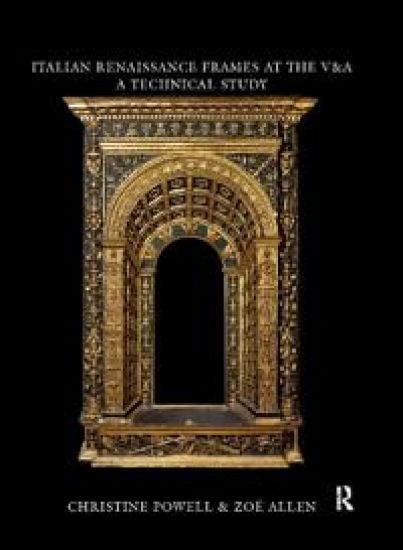
Italian Renaissance Frames at the V&A

Italian Renaissance Frames at the V&A

Christine Powell; Zoe Allen

Routledge
2020
nidottu
This visually stunning and technically detailed book is an in-depth analysis of the materials and techniques used on thirty eight of the V&A's Renaissance frames. The book will teach the reader to recognise frame style, structure and surface decoration of the period, as well as additions and alterations and later frames in the style. * First detailed technical analysis of the V&A's most important Renaissance frames * Highly illustrated with 100 + colour photos of front back and details, digital reconstructions, section profiles, and illustrations of frame types, joints and mouldings. * Provides a comparative reference for Renaissance frames in other publicationsChristine Powell has worked at the V&A since 1993. She is a Senior Furniture Conservator specialising in gilt wood European Furniture, mirror and picture frames. She has also worked at The National Gallery London for seven years as conservator working on European painted and gilt wood altarpieces and frames and The Wallace Collection for two years on European gilt wood frames and furniture. She has taught and published articles on the history, materials techniques and conservation of gilding. Christine studied furniture making and restoration of furniture at the London College of Furniture (latterly the Metropolitan University) including wood finishing, carving and gilding. Before this she worked in private practice for furniture restoration and special paint effects firms. She also attended Epsom School of Art and Design. Zoë Allen first joined the V&A in 2000 to work on gilt wooden objects for the British Galleries and returned to the V&A in 2003 where she has worked since as Frames and Gilded Furniture Conservator. Before joining the V&A full time she worked as a conservator for both public institutions, such as English Heritage, and private practices including projects at the Royal Academy, St Paul’s Cathedral and Somerset House. Zoë has published articles on her work. After a first degree in French Literature, Zoë studied conservation at the City & Guilds of London Art School. Her training covered the conservation of objects made from wood, stone and other sculptural materials, gilding and decorative surfaces. Internships included the National Institute for Restoration, Croatia, the Royal Collection, London and the Museum of London.
Triumph Over Abuse

Triumph Over Abuse

Christine E. Murray

Routledge
2020
sidottu
In this book Christine Murray carefully weaves her personal experiences as a survivor with her professional expertise as a counselor, community advocate, and researcher into a comprehensive guidebook for survivors of abuse.Moving forward after suffering abuse at the hands of someone who is supposed to love and care for you is no easy feat. And yet, healing and recovering from past abuse is possible, and the journey to get there can be an empowering opportunity for growth. Triumph Over Abuse provides a road map for doing more than simply moving on from the past. Filled with accessible case studies and exercises, the book offers extensive practical guidance on a range of topics, such as building coping skills, surrounding yourself with the right kinds of support, working through traumatic memories, and channeling your experience into helping others and making a difference in the world.The book will inspire and equip survivors of abuse to build full, meaningful lives despite the trauma they have faced, as well as being a tool for clinicians to use to support clients.
Triumph Over Abuse

Triumph Over Abuse

Christine E. Murray

Routledge
2020
nidottu
In this book Christine Murray carefully weaves her personal experiences as a survivor with her professional expertise as a counselor, community advocate, and researcher into a comprehensive guidebook for survivors of abuse.Moving forward after suffering abuse at the hands of someone who is supposed to love and care for you is no easy feat. And yet, healing and recovering from past abuse is possible, and the journey to get there can be an empowering opportunity for growth. Triumph Over Abuse provides a road map for doing more than simply moving on from the past. Filled with accessible case studies and exercises, the book offers extensive practical guidance on a range of topics, such as building coping skills, surrounding yourself with the right kinds of support, working through traumatic memories, and channeling your experience into helping others and making a difference in the world.The book will inspire and equip survivors of abuse to build full, meaningful lives despite the trauma they have faced, as well as being a tool for clinicians to use to support clients.
Virginia Woolf’s Good Housekeeping Essays
In the mid-twentieth century, Virginia Woolf published ‘Six Articles on London Life’ in Good Housekeeping magazine, a popular magazine where fashion, cookery and house decoration is largely featured. This first book-length study of what Woolf calls ‘little articles’ proposes to reassess the commissioned essays and read them in a chronological sequence in their original context as well as in the larger context of Woolf’s work. Drawing primarily on literary theory, intermedial studies, periodical studies and philosophy, this volume argues the essays which provided an original guided tour of London are creative and innovative works, combining several art forms while developing a photographic method. Further investigation examines the construct of Woolf’s essays as intermedial and as partaking both of theory and praxis; intermediality is closely connected here with her defense of a democratic ideal, itself grounded in a dialogue with her forebears. Far from being second-rate, the Good Housekeeping essays bring together aesthetic and political concerns and come out as playing a pivotal role: they redefine the essay as intermedial, signal Woolf’s turn to a more openly committed form of writing, and fit perfectly within Woolf’s essayistic and fictional oeuvre which they in turn illuminate.
The Self and the Quintessence

The Self and the Quintessence

Christine Driver

Routledge
2020
nidottu
The Self and the Quintessence explores Jung’s work on number symbolism and the alchemical journey and considers how they act as metaphors underpinning theories about the development of the self and individuation. It goes on to consider the implications of these dynamics in terms of the symbol of the quintessence and what this represents psychologically. Initially exploring number symbolism and the way numbers can express dimensionality and emergence, this book explores the theories which underpin Jung’s ideas about the self and its complexity, including the dynamics of opposites, the transcendent function, and the symbol of the quaternity (fourness). The book then explores the symbol of the quintessence from a theoretical and clinical perspective and also in relation to its use in alchemy and physics. It goes on to consider the symbolic and psychological significance of the quintessence in relation to complexity, emergence, individuation, wholeness, truth and the spirit of matter.Extending Jungian ideas to explore the archetypal symbol of the quintessence and its psychological significance, The Self and the Quintessence will be of great interest to Jungian academics, researchers and clinicians, and anyone looking to expand their knowledge and understanding of Jungian psychology.
Trauma in Children and Young People

Trauma in Children and Young People

Christine Bradley; Francia Kinchington

TAYLOR FRANCIS LTD
2023
nidottu
This book offers a unique combination of an in-depth examination of attachment, a refined and tested model of Needs Assessment and Therapeutic Treatment plans and applies it to specific contexts including those of children in residential/foster care, young offenders, and unaccompanied asylum-seeking minors.Trauma in Children and Young People, the culmination of 40 years of experience in the field, focuses on the lives of children and young people who have experienced and live with the repercussion of early trauma. Accompanied with case studies, it examines how therapeutic intervention can enable children and young people to connect with their inner world of fragmented feelings and emotions and to develop a sense of ‘self’ that is real and has meaning.This book is intended for professionals working therapeutically with traumatised children, such as therapists, psychologists, psychiatrists, mental health workers, social pedagogues, child and youth care workers, social workers, residential care workers and foster carers, teachers, youth justice workers, and child refugee agencies.