Kirjahaku
Etsi kirjoja tekijän nimen, kirjan nimen tai ISBN:n perusteella.
1000 tulosta hakusanalla Christoph Müller
But God marches forward in history, and whoever stands still is in danger of losing God. Here the son, Christoph Friedrich Blumhardt, writes as nowhere else about his father, Johann Christoph Blumhardt, clarifying the unity and continuity in their thought, but also his own painful though necessary points of departure. In particular, he takes a critical look at the role of faith healing, exorcism, and spiritual warfare in “The Awakening” that thrust his father into the limelight, as well as his father’s reluctance to step beyond the walls of the Christianity he inherited. God wants to renew the whole world, to pour out his Spirit on humankind again, and around the world Christians are praying for renewal and revival. Are we standing in the way? Blumhardt calls out obstacles or “false crutches” that he believes thwarted the movement of the Spirit in his father’s time and his own, all of which are still with us today: a focus on piety and personal salvation, misconceptions about mission and evangelism, and the institutional church with its human structures, dogmas, and traditions. If the religion of our churches is too small for God, are we ready to step outside and live in accordance with his great future?
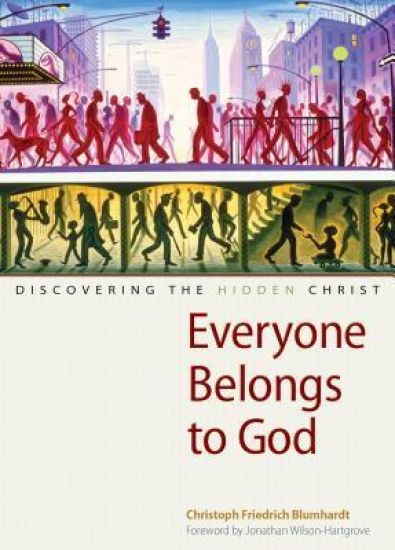
Everyone Belongs to God
Christoph Friedrich Blumhardt; Jonathan Wilson-Hartgrove
Plough Publishing House
2015
pokkari
A pastor’s frank advice for Christians who want to bring the gospel to their neighbors. Gold Medal Winner, 2016 Illumination Book Award in ministry/mission, Independent Publishers How can Christians represent the love of Christ to their neighbors (let alone people in foreign countries) in an age when Christianity has earned a bad name from centuries of intolerance and cultural imperialism? Is it enough to love and serve them? Can you win their trust without becoming one of them? Can you be a missional Christian without a church? This provocative book, based on a recently uncovered collection of 100-year-old letters from a famous pastor to his nephew, a missionary in China, will upend pretty much everyone’s assumptions about what it means to give witness to Christ. Blumhardt challenges us to find something of God in every person, to befriend people and lead them to faith without expecting them to become like us, and to discover where Christ is already at work in the world. This is truly good news: No one on the planet is outside the love of God. At a time when Christian mission has too often been reduced to social work or proselytism, this book invites us to reclaim the heart of Jesus’ great commission, quietly but confidently incarnating the love of Christ and trusting him to do the rest.
"Blumhardt’s conviction that God is present and powerful and able to still work his will in the world today breathes through every prayer. These are as striking, moving, and provocative now as they surely were when Blumhardt prayed them." — John E. Phelan, Jr., The Covenant CompanionEnd each day of the year peacefully by turning to God with a prayer and a Bible passage. We want to turn to God at the end of each day, but often don’t find the words to express our deepest feelings and longing. This collection of prayers is one of the few daily devotionals especially intended for use in the evening.Blumhardt’s words bespeak a certainty in God’s nearness. The peace that flows from them comes from an unshakeable conviction that God’s kingdom is indeed on the way. In stormy and challenging times like our own, most of us need this reassurance frequently, if not daily.
There’s a saying that each child is a thought in the mind of God. But even if we believe this, and approach the children entrusted to us with the reverence that such a belief ought to instill, we may often feel helpless – whether in the face of a two-year-old’s tantrum or a teenager’s silence. In this little book, two fathers (themselves a father and son) share their thoughts on the essence of bringing up children. What’s more, the authors are the Blumhardts, whose huge contribution to 20th century theology, especially Karl Barth, is now being more widely recognized.
A message to stir the embers of a dying faith.Given the number of people who’ve been “saved,” you’d think the world was becoming a brighter place. It could be, too, if more people would grasp the joy of losing themselves in service to God and each other. People like Christoph Blumhardt, who, in his quest to get to the essentials of faith, burns away the religious trappings of modern piety like so much chaff.Blumhardt writes with unabashed fervor, but his passion encourages rather than intimidates. His witness influenced theological giants like Dietrich Bonhoeffer and Karl Barth. But Action in Waiting is not theology; it is too blunt, too earthy, too real. Its “active expectation” of God’s kingdom shows us that the object of our hope is not relegated to some afterlife. Today, in our world, it can come into its own – if only we are ready.
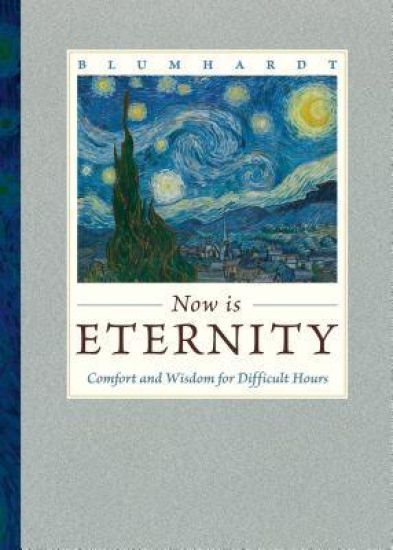
Now Is Eternity
Christoph Friedrich Blumhardt; Johann Christoph Blumhardt
Plough Publishing House
2014
pokkari
Bad days are one thing – everyone has them now and then. But what about the darker clouds that settle over a life for weeks or even months at a time? What about separation and divorce, prolonged illness and hospitalization? What about the loss of a friend or a parent, the absence of a child or a spouse? For the friend or family member who just isn’t coping, no matter what you say, the sturdy simplicity of this little volume offers something most well-meaning sympathy cards forget: a gentle insistence that there is still a God who watches over all, and a stubborn faith that the worst trials of life’s “difficult hours” will one day be overshadowed by his comfort and peace. In reminding us of the power conferred by hope, Now Is Eternity is a source of daily strength.
This beautifully illustrated volume presents baskets woven from natural fibers over a long period of time and from diverse American, European and International cultures. Specialized baskets for work places, as architectural elements and for domestic and farm chores are shown in over 400 black and white and 31 color pictures. The text explores the origins of the plants which produce weavable fibres, localized preparation techniques, and a wide variety of weaving styles and forms. The extensive picture captions identify the use, origin, material and size of each basket and reflect the cultural styles. Detailed drawings of many weaves will enable craftsmen today to duplicate and experiment with a variety of materials and patterns.
Mathematics of Social Choice
Christoph Borgers
Society for Industrial Applied Mathematics,U.S.
2009
pokkari
How do you select a winner from a field of candidates? How do you rank a field of candidates? How do you share a divisible resource like a cake, or an indivisible one like a pet or a house? These are the questions addressed in this fun and accessible book that takes an entertaining look at the choices made by groups of people with different preferences, needs, and interests. Divided into three parts, the text first examines voting methods for selecting or ranking candidates. A brief second part addresses compensation problems wherein an indivisible item must be assigned to one of several people who are equally entitled to ownership of the item, with monetary compensation paid to the others. The third part discusses the problem of sharing a divisible resource among several people. Mathematics of Social Choice can be used by mathematics majors as well as students whose only mathematical background is elementary algebra. Material geared toward more sophisticated readers can be skipped without any loss of continuity. The book includes many elementary and usually simple, but rigorous mathematical proofs appropriate for beginning mathematics majors.Students will also find appendices with background material on set notation, logic, and mathematical induction and solutions to many of the homework exercises.
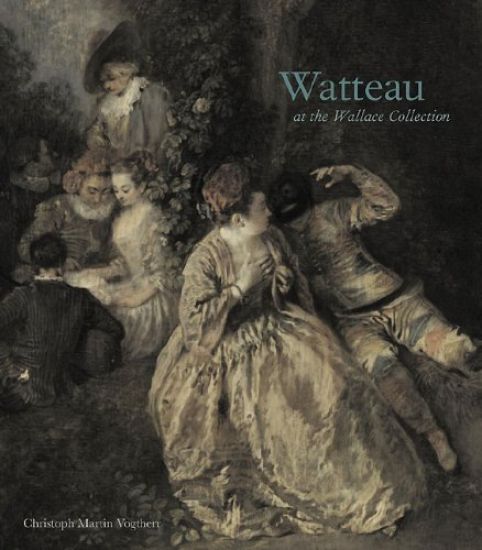
Watteau at the Wallace Collection
Christoph Martin Vogtherr
Trustees of the Wallace Collection
2011
pokkari
One of the most famous and influential artists of the eighteenth century, Jean-Antoine Watteau (c. 1684–1721) fundamentally changed the course of French painting. With masterpieces such as Les charmes de la vie, Lady at her Toilet and Les Champs Élisées, the Wallace Collection preserves one of the three outstanding collections of his paintings worldwide (together with Paris and Berlin) but it has never before been the subject of a special exhibition or a separate study. Continuing the series of monographs highlighting important works by masters in the Wallace Collection, this book discusses in depth all eight paintings by Watteau in the Collection and two of his lesser-known works at the Soane Museum and in York. Each of the paintings, which together span his entire career and represent many aspects of his work, will form the starting point for a chapter of the book. Among the topics discussed will be: Watteau and Theater, Watteau and the Art Market, The Artist at Work, Watteau – the Academician, The Erotic and the Indecent in Watteau’s Work, and Watteau in London.
The approach to history in Waldorf schools is unique and looks to characteristic biographies and symptomatology to bring a memorable thread of stories to the course of history and human development over time. The book is an invaluable resource for building these pictures from students from grades five and through the twelfth grade on practical and creative ways to think about history and to follow the threads of activity and the influence of decisions and events in one part of the world on other parts of the world and on the course of human endeavor.The author is an experienced historian and teacher and brings insight into his explanations. A must for every serious history teacher in elementary and secondary grades, looking for creative approaches to teaching history
Assertion is the central vehicle for the sharing of knowledge. Whether knowledge is shared successfully often depends on the quality of assertions: good assertions lead to successful knowledge sharing, while bad ones don't. In Sharing Knowledge, Christoph Kelp and Mona Simion investigate the relation between knowledge sharing and assertion, and develop an account of what it is to assert well. More specifically, they argue that the function of assertion is to share knowledge with others. It is this function that supports a central norm of assertion according to which a good assertion is one that has the disposition to generate knowledge in others. The book uses this functionalist approach to motivate further norms of assertion on both the speaker and the hearer side and investigates ramifications of this view for other questions about assertion.
Defeat is the loss of justification for believing something in light of new information. This Element mainly aims to work towards developing a novel account of defeat. It distinguishes among three broad views in the epistemology of defeat: scepticism, internalism, and externalism and argues that that sceptical and internalist accounts of defeat are bound to remain unsatisfactory. As a result, any viable account of defeat must be externalist. While there is no shortage of externalist accounts, the Element provides reason to think that extant accounts remain unsatisfactory. The Element also explains the constructive tasks of developing an alternative account of defeat and showing that it improves on the competition.
Practices of Reparations in International Criminal Justice
Christoph Sperfeldt
Cambridge University Press
2022
sidottu
Combining interdisciplinary techniques with original ethnographic fieldwork, Christoph Sperfeldt examines the first attempts of international criminal courts to provide reparations to victims of mass atrocities. The observations focus on two case studies: the Extraordinary Chambers in the Courts of Cambodia, where Sperfeldt spent over ten years working at and around, and the International Criminal Court's interventions in the Democratic Republic of Congo. Enriched with first-hand observations and an awareness of contextual dynamics, this book directs attention to the 'social life of reparations' that too often get lost in formal accounts of law and its institutions. Sperfeldt shows that reparations are constituted and contested through a range of practices that produce, change, and give meaning to reparations. Appreciating the nature and effects of these practices provides us with a deeper understanding of the discrepancies that exist between the reparations ideal and how it functions imperfectly in different contexts.
Practices of Reparations in International Criminal Justice
Christoph Sperfeldt
Cambridge University Press
2023
pokkari
Combining interdisciplinary techniques with original ethnographic fieldwork, Christoph Sperfeldt examines the first attempts of international criminal courts to provide reparations to victims of mass atrocities. The observations focus on two case studies: the Extraordinary Chambers in the Courts of Cambodia, where Sperfeldt spent over ten years working at and around, and the International Criminal Court's interventions in the Democratic Republic of Congo. Enriched with first-hand observations and an awareness of contextual dynamics, this book directs attention to the 'social life of reparations' that too often get lost in formal accounts of law and its institutions. Sperfeldt shows that reparations are constituted and contested through a range of practices that produce, change, and give meaning to reparations. Appreciating the nature and effects of these practices provides us with a deeper understanding of the discrepancies that exist between the reparations ideal and how it functions imperfectly in different contexts.
The Procedural and Organisational Law of the European Court of Justice
Christoph Krenn
Cambridge University Press
2022
sidottu
How should judges of the European Court of Justice be selected, who should participate in the Court's proceedings and how should judgments be drafted? These questions have remained blind spots in the normative literature on the Court. This book aims to address them. It describes a vast, yet incomplete transformation: Originally, the Court was based on a classic international law model of court organisation and decision-making. Gradually, the concern for the effectiveness of EU law led to the reinvention of its procedural and organisational design. The role of the judge was reconceived as that of a neutral expert, an inner circle of participants emerged and the Court became more hierarchical. While these developments have enabled the Court to make EU law uniquely effective, they have also created problems from a democratic perspective. The book argues that it is time to democratise the Court and shows ways to do this.
Karl Marx and the Actualization of Philosophy
Christoph Schuringa
Cambridge University Press
2025
sidottu
It is indisputable that Marx began his intellectual trajectory as a philosopher, but it is often thought that he subsequently turned away from philosophy. In this book, Christoph Schuringa proposes a radically different reading of Marx's intellectual project and demonstrates that from his earliest writings his aim was the 'actualization' of philosophy. Marx, he argues, should be understood not as turning away from philosophy, but as seeking to make philosophy a practical force in the world. By analysing a series of texts from across Marx's output, Schuringa shows that Marx progressively overcame what he called 'self-sufficient philosophy', not in order to leave philosophy behind but to bring it into its own. This involves a major reinterpretation of Marx's relationship to his ancestors Aristotle, Kant and Hegel, and shows that philosophy, as it actualizes itself, far from being merely a body of philosophical doctrine, figures as an instrument of the revolution.
Human-Robot Interaction
Christoph Bartneck; Tony Belpaeme; Friederike Eyssel; Takayuki Kanda; Merel Keijsers; Selma Šabanovic
Cambridge University Press
2024
pokkari
The role of robots in society keeps expanding and diversifying, bringing with it a host of issues surrounding the relationship between robots and humans. This introduction to human–robot interaction (HRI) by leading researchers in this developing field is the first to provide a broad overview of the multidisciplinary topics central to modern HRI research. Written for students and researchers from robotics, artificial intelligence, psychology, sociology, and design, it presents the basics of how robots work, how to design them, and how to evaluate their performance. Self-contained chapters discuss a wide range of topics, including speech and language, nonverbal communication, and processing emotions, plus an array of applications and the ethical issues surrounding them. This revised and expanded second edition includes a new chapter on how people perceive robots, coverage of recent developments in robotic hardware, software, and artificial intelligence, and exercises for readers to test their knowledge.
Defeat is the loss of justification for believing something in light of new information. This Element mainly aims to work towards developing a novel account of defeat. It distinguishes among three broad views in the epistemology of defeat: scepticism, internalism, and externalism and argues that that sceptical and internalist accounts of defeat are bound to remain unsatisfactory. As a result, any viable account of defeat must be externalist. While there is no shortage of externalist accounts, the Element provides reason to think that extant accounts remain unsatisfactory. The Element also explains the constructive tasks of developing an alternative account of defeat and showing that it improves on the competition.
Triage Bureaucracy
Christoph Knill; Yves Steinebach; Dionys Zink
Cambridge University Press
2026
sidottu
In an era of constant policy growth (known as policy accumulation), effective policy implementation is a growing challenge for democratic governance across the globe. Triage Bureaucracy explores how government agencies handle expanding portfolios of rules, programs, and regulations using 'policy triage' – a set of strategies for balancing limited resources across increasing implementation demands. Drawing on case studies from six diverse European countries, the authors show how organizations' vulnerability to overburdening and their ability to compensate for overload determine why policy implementation succeeds in some cases while it fails in others. Triage Bureaucracy offers a deeper understanding of the organizational dynamics behind effective governance and, by placing bureaucratic actors at the center of the policy process, shows why policy growth often outpaces our ability to implement it – shedding light on the consequences of an ever expanding policy state. This title is also available as Open Access on Cambridge Core.
Triage Bureaucracy
Christoph Knill; Yves Steinebach; Dionys Zink
Cambridge University Press
2026
pokkari
In an era of constant policy growth (known as policy accumulation), effective policy implementation is a growing challenge for democratic governance across the globe. Triage Bureaucracy explores how government agencies handle expanding portfolios of rules, programs, and regulations using 'policy triage' – a set of strategies for balancing limited resources across increasing implementation demands. Drawing on case studies from six diverse European countries, the authors show how organizations' vulnerability to overburdening and their ability to compensate for overload determine why policy implementation succeeds in some cases while it fails in others. Triage Bureaucracy offers a deeper understanding of the organizational dynamics behind effective governance and, by placing bureaucratic actors at the center of the policy process, shows why policy growth often outpaces our ability to implement it – shedding light on the consequences of an ever expanding policy state. This title is also available as Open Access on Cambridge Core.