Kirjojen hintavertailu. Mukana 12 492 701 kirjaa ja 12 kauppaa.

Kirjahaku

Etsi kirjoja tekijän nimen, kirjan nimen tai ISBN:n perusteella.

1000 tulosta hakusanalla D Thomas Muilenberg

Uncle Sam's War of 1898 and the Origins of Globalization

Uncle Sam's War of 1898 and the Origins of Globalization

Thomas D. Schoonover

The University Press of Kentucky
2003
sidottu
The roots of American globalization can be found in the War of 1898. Then, as today, the United States actively engaged in globalizing its economic order, itspolitical institutions, and its values. Thomas Schoonover argues that this drive to expand political and cultural reach -- the quest for wealth, missionary fulfillment, security, power, and prestige -- was inherited by the United States from Europe, especially Spain and Great Britain. Uncle Sam's War of 1898 and the Origins of Globalization is a pathbreaking work of history that examines U.S. growth from its early nationhood to its first major military conflict on the world stage, also known as the Spanish-American War. As the new nation's military, industrial, and economic strength developed, the United States created policies designed to protect itself from challenges beyond its borders. According to Schoonover, a surge in U.S. activity in the Gulf-Caribbean and in Central America in the late nineteenth and early twentieth centuries was catalyzed by the same avarice and competitiveness that motivated the European adventurers to seek a route to Asia centuries earlier. Addressing the basic chronology and themes of the first century of the nation's expansion, Schoonover locates the origins of the U.S. goal of globalization. U.S. involvement in the War of 1898 reflects many of the fundamental patterns in our national history -- exploration and discovery, labor exploitation, violence, racism, class conflict, and concern for security -- that many believe shaped America's course in the twentieth and twenty-first century.
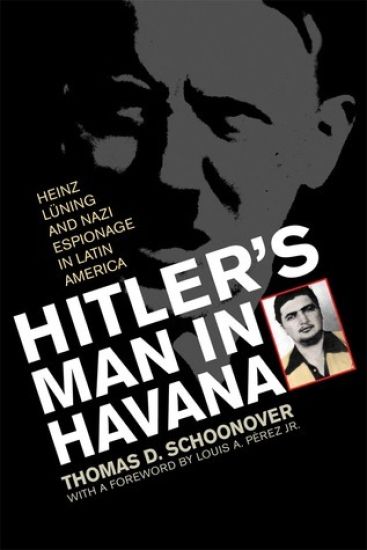
Hitler's Man in Havana

Hitler's Man in Havana

Thomas D. Schoonover; Louis A. Perez

The University Press of Kentucky
2008
sidottu
At the beginning of World War II, Heinz August Lüning, posing as a Jewish refugee, was sent to Cuba to spy for the Third Reich. Lüning's assignment was to collect information about the United States and its allies and report back to Abwehr, the German foreign intelligence agency. The Caribbean waters Lüning monitored were important to the Allies both for shipping and for deploying ships between the various fronts. Despite some early setbacks, Lüning provided information on naval activities to the Germans. Ultimately, however, Lüning was arrested and became the only Nazi spy executed in Latin America during World War II. For at least five months after Lüning's arrest, U.S. and Cuban leaders -- J. Edgar Hoover, Fulgencio Batista, Nelson Rockefeller, General Manuel Benítez, Ambassador Spruille Braden, and others -- treated Lüning as the dangerous, key spy for a Nazi espionage network in the Gulf-Caribbean.British counterintelligence agent Graham Greene, who oversaw one group supervising Nazi communications areas, picked up Lüning's story and made it into a seminal spy novel. In Hitler's Man in Havana, Thomas Schoonover investigates the true story of the life, career, and death of Heinz August Lüning. In the sixty years since Lüning worked in the Caribbean, very little has been written about Nazi espionage in Latin America because the U.S. government kept much of the material secret. Schoonover draws from extensive research to recreate Lüning's story and explore the significance of his life and capture.
Piping Hot Bees and Boisterous Buzz-Runners

Piping Hot Bees and Boisterous Buzz-Runners

Thomas D. Seeley

PRINCETON UNIVERSITY PRESS
2026
pokkari
A biologist’s up-close account of how he and fellow biologists cracked long-standing puzzles about honey bee behavior Piping Hot Bees and Boisterous Buzz-Runners takes readers inside a world seldom seen even by beekeepers, shedding light on twenty of the most compelling mysteries of honey bee behavior. Thomas Seeley has devoted a lifetime to the study of honey bees and their colonies, unraveling the secrets of these wondrous insects in a career spanning six decades. In this book, he weaves illuminating personal stories with the latest science, explaining such mysteries as how worker bees function as scouts to choose a home site for their colony, furnish their home with beeswax combs, and stock it with brood and food while keeping tens of thousands of colony inhabitants warm and defended from intruders. Along the way, he shares the experiences that drew him to these studies, the small observations that led to big breakthroughs, and the sense of excitement that came with probing each mystery. Richly illustrated, Piping Hot Bees and Boisterous Buzz-Runners provides a rare look at how a singularly passionate scientist and his colleagues deciphered the pipings, shakings, and puzzling tremble dances of honey bees, and how this journey of scientific discovery continues to shape our understanding of these remarkably intelligent and vitally important insects.
Written for Our Instruction

Written for Our Instruction

Thomas D. Stegman

Paulist Press International,U.S.
2017
nidottu
Today, Christians read Paul’s Letter to the Romans as divinely inspired, as part of the canon of the New Testament. Although penned nearly two thousand years ago to a specific group of believers, this letter was also written for our instruction; hence the title. As Sacred Scripture—along with the other writings attributed to the apostle—Romans is a living word that speaks with as much relevance today as when it was first written. It contains much food for thought, for theological and spiritual reflection. Written for Our Instruction gives a flavor of these theological and spiritual riches. †
A Behavioral Finance Approach to International Monetary and Financial Analysis
Efficient market theory has made an important contribution to economic and financial analysis, but markets do not always behave according to the theory's predictions. The behavioral finance approach advocated in this Element is a complement to efficient market theory. The Element stresses the effects of perverse incentives, complexity, and uncertainty, as well as the roles of mental models or narrative and behavioral biases. It emphasizes limits to arbitrage, suggesting that international capital mobility is often far from perfect. It reviews popular models and considers alternatives in areas such as currency crises, exchange rates and the balance of payments, the international monetary trilemma, capital flow surges and sudden stops, and the discipline effects of international financial markets. The behavioral approach of the Element also helps to explain why governments often fail to undertake necessary policy adjustments in time to head off currency and financial crises.
de l'Enseignement (de Magistro)

de l'Enseignement (de Magistro)

Thomas D'Aquin

Klincksieck
2003
nidottu
La pensee educative du Moyen Age s'etait ouverte avec le De Magistro de saint Augustin; elle s'acheve avec un autre De Magistro, celui de saint Thomas d'Aquin. Si l'inspiration n'est plus platonicienne, mais aristotelicienne, elle temoigne d'une rigueur et d'une vivacite remarquables. En s'appuyant sur une theorie pour partie empiriste de la connaissance, saint Thomas maintient l'idee qu'il n'y a qu'un maitre, le " maitre interieur "; mais pour que ce dernier revele sa verite au disciple, l'experience semble un passage oblige. Il a paru interessant de proposer au lecteur latiniste, le texte original a la suite de la traduction.
Commentaire Du Livre Des Causes

Commentaire Du Livre Des Causes

Thomas D'Aquin

Librarie Philosophique J. Vrin
2005
nidottu
Cet ouvrage propose la traduction de l'Expositio super librum de Causis de Thomas d'Aquin. Le Liber de Causis, entendu comme projet de traduire selon les categories de la procession plotino-proclienne, le creationnisme issu du message coranique, constitue une etape capitale dans la reflexion des Medievaux sur la nature de l'agir divin et, plus generalement, dans l'elaboration d'une doctrine de la causalite visant a reconcilier raison et foi: comment la toute-puissance divine, source de tout l'etre, peut-elle s'accorder avec la reconnaissance de l'autonomie et de l'efficience causale de la substance creee? En amont de la doctrine des causes secondes, n'en trouvons-nous pas ici le fondement? Le commentaire accompagnant la traduction vise a manifester, sans omettre leurs differences, la complementarite des lectures du Liber operees par Thomas d'Aquin et Albert le Grand, afin de montrer que l'association de leurs angles de vue respectifs rend possible une intelligence plus comprehensive de l'efficience du premier Principe.
Energy Analysis

Energy Analysis

Roger D K Thomas

Routledge
2019
sidottu
This book presents a collection of papers that provide a snapshot of ongoing research on energy analysis, a record of the growing pains of a fledgling subject. The collection of papers arose out of a series of articles devised and designed for the journal Energy Policy.
Energy Analysis

Energy Analysis

Roger D K Thomas

Routledge
2020
nidottu
This book presents a collection of papers that provide a snapshot of ongoing research on energy analysis, a record of the growing pains of a fledgling subject. The collection of papers arose out of a series of articles devised and designed for the journal Energy Policy.
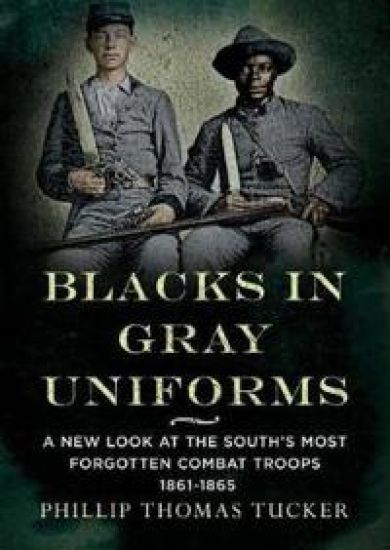
Blacks in Gray Uniforms: A New Look at the South's Most Forgotten Combat
This ground-breaking book takes an insightful and close "New Look" at one of the most fascinating subjects of the Civil War--the long-overlooked battlefield contributions of the most forgotten fighting men of the Civil War, Black Confederates. With the release of the popular 1989 film Glory, the American public first learned about the heroism of the black troops of the 54th Massachusetts Volunteer Infantry and their courageous assault on Fort Wagner, South Carolina, in July 1863. But what the American public failed to learn in viewing this popular film was the equally compelling saga of Black Confederates, including at least one defender, a free black soldier of the 1st South Carolina Artillery who defended Fort Wagner in July 1863. Significantly, large numbers of Black Confederates, slave and free, had already been fighting on battlefields across the South for more than two years before the famous assault of the 54th Massachusetts on Fort Wagner, including the war's first major battle at Bull Run. Although the vast of majority blacks served the Confederacy in menial and support roles, Black Confederates, free and slave, fought from 1861 to 1865 in regiments (infantry, cavalry, and artillery) that represented every Southern state.