Kirjojen hintavertailu. Mukana 11 627 373 kirjaa ja 12 kauppaa.

Kirjahaku

Etsi kirjoja tekijän nimen, kirjan nimen tai ISBN:n perusteella.

1000 tulosta hakusanalla Dale W Buhr

Spatial Linear Models for Environmental Data

Spatial Linear Models for Environmental Data

Dale L. Zimmerman; Jay M. Ver Hoef

TAYLOR FRANCIS LTD
2024
sidottu
Many applied researchers equate spatial statistics with prediction or mapping, but this book naturally extends linear models, which includes regression and ANOVA as pillars of applied statistics, to achieve a more comprehensive treatment of the analysis of spatially autocorrelated data. Spatial Linear Models for Environmental Data, aimed at students and professionals with a master’s level training in statistics, presents a unique, applied, and thorough treatment of spatial linear models within a statistics framework. Two subfields, one called geostatistics and the other called areal or lattice models, are extensively covered. Zimmerman and Ver Hoef present topics clearly, using many examples and simulation studies to illustrate ideas. By mimicking their examples and R code, readers will be able to fit spatial linear models to their data and draw proper scientific conclusions. Topics covered include:Exploratory methods for spatial data including outlier detection, (semi)variograms, Moran’s I, and Geary’s c.Ordinary and generalized least squares regression methods and their application to spatial data.Suitable parametric models for the mean and covariance structure of geostatistical and areal data.Model-fitting, including inference methods for explanatory variables and likelihood-based methods for covariance parameters.Practical use of spatial linear models including prediction (kriging), spatial sampling, and spatial design of experiments for solving real world problems.All concepts are introduced in a natural order and illustrated throughout the book using four datasets. All analyses, tables, and figures are completely reproducible using open-source R code provided at a GitHub site. Exercises are given at the end of each chapter, with full solutions provided on an instructor’s FTP site supplied by the publisher.

Age and the Reach of Sociological Imagination
The dominant narratives of both science and popular culture typically define aging and human development as self-contained individual matters, failing to recognize the degree to which they are shaped by experiential and contextual contingencies. Our understandings of age are thereby "boxed in" and constricted by assumptions of "normality" and naturalness that limit our capacities to explore possible alternative experiences of development and aging, and the conditions – both individual and social – that might foster such experiences.Combining foundational principles of critical social science with recent breakthroughs in research across disciplines ranging from biology to economics, this book offers a scientifically and humanly expanded landscape for apprehending the life course. Rejecting familiar but false dichotomies such as "nature vs. nurture" and "structure vs. agency", it clarifies the organismic fundamentals that make the actual content of experience so centrally important in age and development, and it also explores why attention to these fundamentals has been so resisted in studies of individuals and individual change, and in policy and practice as well.In presenting the basic principles and reviewing the current state of knowledge, Dale Dannefer introduces multi-levelled social processes that shape human development and aging over the life course and age as a cultural phenomenon – organizing his approach around three key frontiers of inquiry that each invite a vigorous exercise of sociological imagination: the Social-Structural Frontier, the Biosocial Frontier and the Critical-Reflexive Frontier.
Age and the Reach of Sociological Imagination
The dominant narratives of both science and popular culture typically define aging and human development as self-contained individual matters, failing to recognize the degree to which they are shaped by experiential and contextual contingencies. Our understandings of age are thereby "boxed in" and constricted by assumptions of "normality" and naturalness that limit our capacities to explore possible alternative experiences of development and aging, and the conditions – both individual and social – that might foster such experiences.Combining foundational principles of critical social science with recent breakthroughs in research across disciplines ranging from biology to economics, this book offers a scientifically and humanly expanded landscape for apprehending the life course. Rejecting familiar but false dichotomies such as "nature vs. nurture" and "structure vs. agency", it clarifies the organismic fundamentals that make the actual content of experience so centrally important in age and development, and it also explores why attention to these fundamentals has been so resisted in studies of individuals and individual change, and in policy and practice as well.In presenting the basic principles and reviewing the current state of knowledge, Dale Dannefer introduces multi-levelled social processes that shape human development and aging over the life course and age as a cultural phenomenon – organizing his approach around three key frontiers of inquiry that each invite a vigorous exercise of sociological imagination: the Social-Structural Frontier, the Biosocial Frontier and the Critical-Reflexive Frontier.
JOURNALISTIC ETHICS

JOURNALISTIC ETHICS

DALE JACQUETTE

TAYLORFRANCIS
2019
nidottu
Moral Responsibility in the Media. Journalistic Ethics Moral Responsibility in the Media examines the moral rights and responsibilities of journalists to provide what Dale Jacquette calls truth telling in the public interest. With 31 case studies from contemporary journalistic practice, the book demonstrates the immediate practical implications of ethics for working journalists as well as for those who read or watch the news. This case-study approach is paired with a theoretical grounding, and issues include freedom of the press, censorship and withholding sensitive information for the greater public
Fear, Society, and the Police

Fear, Society, and the Police

Dale L. June

Routledge
2019
sidottu
Fear, Society, and the Police examines elements of fear and how they can be controlled and turned into an effective and proper response in an emergency situation. Readers of this book will be exposed to ways fear can become an uncontrolled emotion, often leading to unnecessary acts of violence, and will examine ways and means of using reasoning to overcome unfounded fear.The author encourages readers to critically assess circumstances in today’s society that have caused fear, unrest, and division between the enforcers of law and the people they are sworn to protect. Providing examples of how violence in society has had an impact on police–community relations, this book examines the many facets of fear from several perspectives, including historical, personal, and institutional. Security management courses concentrate on the "how and why" of security, yet to become an effective professional security specialist it is recommended the practitioner become educated in the nuances of fear. This book presents a look into the how and why of fear, and will relate to security personnel as it does to police officers.The book brings perspectives based on reality and experience. It will be of interest not only to those who work in law enforcement, but also to students in criminal justice, management and leadership, psychology, and sociology courses. As violence in society escalates, professionalism will require more understanding of fear-based emotions.
Fear, Society, and the Police

Fear, Society, and the Police

Dale L. June

Routledge
2019
nidottu
Fear, Society, and the Police examines elements of fear and how they can be controlled and turned into an effective and proper response in an emergency situation. Readers of this book will be exposed to ways fear can become an uncontrolled emotion, often leading to unnecessary acts of violence, and will examine ways and means of using reasoning to overcome unfounded fear.The author encourages readers to critically assess circumstances in today’s society that have caused fear, unrest, and division between the enforcers of law and the people they are sworn to protect. Providing examples of how violence in society has had an impact on police–community relations, this book examines the many facets of fear from several perspectives, including historical, personal, and institutional. Security management courses concentrate on the "how and why" of security, yet to become an effective professional security specialist it is recommended the practitioner become educated in the nuances of fear. This book presents a look into the how and why of fear, and will relate to security personnel as it does to police officers.The book brings perspectives based on reality and experience. It will be of interest not only to those who work in law enforcement, but also to students in criminal justice, management and leadership, psychology, and sociology courses. As violence in society escalates, professionalism will require more understanding of fear-based emotions.
Ultrasonics

Ultrasonics

Dale Ensminger; Leonard J. Bond

TAYLOR FRANCIS LTD
2024
sidottu
Updated, revised, and restructured to reflect the latest advances in science and applications, the fourth edition of this best-selling industry and research reference covers the fundamental physical acoustics of ultrasonics and transducers, with a focus on piezoelectric and magnetostrictive modalities. It then discusses the full breadth of ultrasonics applications involving low power (sensing) and high power (processing) for research, industrial, and medical use. This book includes new content covering computer modeling used for acoustic and elastic wave phenomena, including scattering, mode conversion, transmission through layered media, Rayleigh and Lamb waves and flexural plates, modern horn design tools, Langevin transducers, and material characterization. There is more attention on process monitoring and advanced nondestructive testing and evaluation (NDT/NDE), including phased array ultrasound (PAUT), long-range inspection, using guided ultrasonic waves (GUW), internally rotary inspection systems (IRIS), time-of-flight diffraction (TOFD), and acoustic emission (AE). These methods are discussed and applied to both metals and nonmetals using illustrations in various industries, including now additionally for food and beverage products. The topics of defect sizing, capabilities, and limitations, including the probability of detection (POD), are introduced. Three chapters provide a new treatment of high-power ultrasonics, for both fluids and solids, and again, with examples of industrial engineering, food and beverage, pharmaceuticals, petrochemicals, and other process applications. Expanded coverage is given to medical and biological applications, covering diagnostics, therapy, and, at the highest powers, surgery.Key FeaturesProvides an overview of fundamental analysis and transducer technologies needed to design and develop both measurement and processing systemsConsiders applications in material characterization and metrologyCovers ultrasonic nondestructive testing and evaluation and high-power ultrasonics, which involves interactions that change the state of materialHighlights medical and biomedical applications of ultrasound, focusing on the physical acoustics and the technology employed for diagnosis, therapy, surgery, and researchThis book is intended for both the undergraduate and graduate scientists and engineers, as well as the working professional, who seeks to understand the fundamentals together with a holistic treatment of the field of ultrasonics and its diversity of applications.
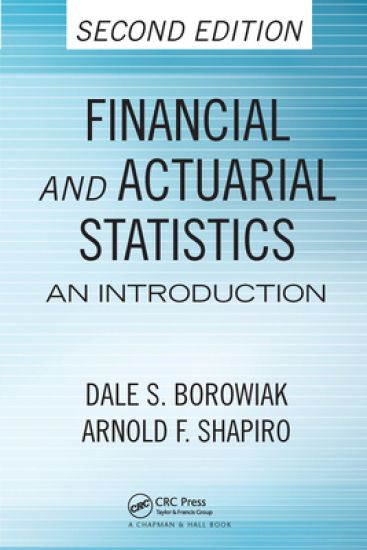
Financial and Actuarial Statistics

Financial and Actuarial Statistics

Dale S. Borowiak; Arnold F. Shapiro

CRC Press
2020
nidottu
Understand Up-to-Date Statistical Techniques for Financial and Actuarial ApplicationsSince the first edition was published, statistical techniques, such as reliability measurement, simulation, regression, and Markov chain modeling, have become more prominent in the financial and actuarial industries. Consequently, practitioners and students must acquire strong mathematical and statistical backgrounds in order to have successful careers.Financial and Actuarial Statistics: An Introduction, Second Edition enables readers to obtain the necessary mathematical and statistical background. It also advances the application and theory of statistics in modern financial and actuarial modeling. Like its predecessor, this second edition considers financial and actuarial modeling from a statistical point of view while adding a substantial amount of new material.New to the Second Edition Nomenclature and notations standard to the actuarial fieldExcel exercises with solutions, which demonstrate how to use Excel functions for statistical and actuarial computationsProblems dealing with standard probability and statistics theory, along with detailed equation links A chapter on Markov chains and actuarial applications Expanded discussions of simulation techniques and applications, such as investment pricing Sections on the maximum likelihood approach to parameter estimation as well as asymptotic applications Discussions of diagnostic procedures for nonnegative random variables and Pareto, lognormal, Weibull, and left truncated distributionsExpanded material on surplus models and ruin computations Discussions of nonparametric prediction intervals, option pricing diagnostics, variance of the loss function associated with standard actuarial models, and Gompertz and Makeham distributions Sections on the concept of actuarial statistics for a collection of stochastic status models The book presents a unified approach to both financial and actuarial modeling through the use of general status structures. The authors define future time-dependent financial actions in terms of a status structure that may be either deterministic or stochastic. They show how deterministic status structures lead to classical interest and annuity models, investment pricing models, and aggregate claim models. They also employ stochastic status structures to develop financial and actuarial models, such as surplus models, life insurance, and life annuity models.
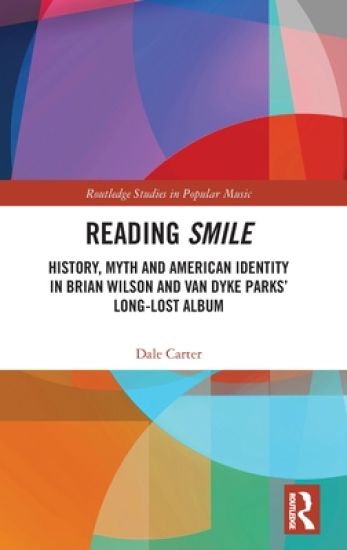
Reading Smile

Reading Smile

Dale Carter

Routledge
2021
sidottu
First conceived in 1966 but only completed in 2004, Brian Wilson Presents Smile has been called "the best-known unreleased album in pop music history" and "an American Sergeant Pepper." Reading Smile offers a close analysis of the recording in its social, cultural and historical contexts.It focuses in particular on the finished work’s subject matter as embodied in Van Dyke Parks’ contentious yet little understood lyrics, with their low-resolution, highly allusive portrayals of western expansion’s archetypes, from Plymouth Rock, Massachusetts to Diamond Head, Hawaii. Documenting their multiple references and connotations, it argues that their invocations of national self-definition are part of a carefully crafted vision of American identity, society and culture both in tune and at odds with the times. Critical of the republic’s past practices but convinced that its ideals, values and myths still provided resources to redeem it, the recording is interpreted as a creative musical milestone, an enduring product of its volatile, radical, countercultural times, and an American pop art classic.Of particular relevance to American Studies and popular culture scholars, Reading Smile will also appeal to those interested in 1960s popular music, not least to fans of Brian Wilson, Van Dyke Parks and the Beach Boys.
Reading Smile

Reading Smile

Dale Carter

TAYLOR FRANCIS LTD
2023
nidottu
First conceived in 1966 but only completed in 2004, Brian Wilson Presents Smile has been called "the best-known unreleased album in pop music history" and "an American Sergeant Pepper." Reading Smile offers a close analysis of the recording in its social, cultural and historical contexts.It focuses in particular on the finished work’s subject matter as embodied in Van Dyke Parks’ contentious yet little understood lyrics, with their low-resolution, highly allusive portrayals of western expansion’s archetypes, from Plymouth Rock, Massachusetts to Diamond Head, Hawaii. Documenting their multiple references and connotations, it argues that their invocations of national self-definition are part of a carefully crafted vision of American identity, society and culture both in tune and at odds with the times. Critical of the republic’s past practices but convinced that its ideals, values and myths still provided resources to redeem it, the recording is interpreted as a creative musical milestone, an enduring product of its volatile, radical, countercultural times, and an American pop art classic.Of particular relevance to American Studies and popular culture scholars, Reading Smile will also appeal to those interested in 1960s popular music, not least to fans of Brian Wilson, Van Dyke Parks and the Beach Boys.
The Power of Identity Claims

The Power of Identity Claims

Dale T. Miller

Routledge
2020
nidottu
This book draws on research in psychology and behavioral economics to show how striving to live up to our identity claims profoundly affects our daily lives. The author argues the claims we make about who we are and what we stand for powerfully influence us, and our social world. Asking questions such as: Why do people resist the temptation to cheat when cheating would benefit them greatly and no one would find out? Why do people express different beliefs about climate change when they are first reminded of their political affiliation? Why do people prefer to be compensated for donating blood with cholesterol screening than with money? Miller puts forth a novel and compelling argument regarding how strongly our identity claims affect our daily lives. The book provides explanations for many forms of puzzling behavior, such as why people sometimes act against their economic self-interest, how they avoid situations that test their moral identities, and how they respond to failures to live up to their moral identities. It paints an intriguing picture of people’s investment in their identity claims by showing how they seek opportunities to demonstrate their validity, avoid actions and circumstances that challenge their legitimacy, and employ psychological defenses when others challenge their legitimacy. Based on extensive research in the fields of psychology, economics, and political science, this book is fascinating reading for students and academics interested in identity and the self. It also provides an expanded tool kit for those who seek behavioral change in their organization or community.
The Power of Identity Claims

The Power of Identity Claims

Dale T. Miller

Routledge
2020
sidottu
This book draws on research in psychology and behavioral economics to show how striving to live up to our identity claims profoundly affects our daily lives. The author argues the claims we make about who we are and what we stand for powerfully influence us, and our social world. Asking questions such as: Why do people resist the temptation to cheat when cheating would benefit them greatly and no one would find out? Why do people express different beliefs about climate change when they are first reminded of their political affiliation? Why do people prefer to be compensated for donating blood with cholesterol screening than with money? Miller puts forth a novel and compelling argument regarding how strongly our identity claims affect our daily lives. The book provides explanations for many forms of puzzling behavior, such as why people sometimes act against their economic self-interest, how they avoid situations that test their moral identities, and how they respond to failures to live up to their moral identities. It paints an intriguing picture of people’s investment in their identity claims by showing how they seek opportunities to demonstrate their validity, avoid actions and circumstances that challenge their legitimacy, and employ psychological defenses when others challenge their legitimacy. Based on extensive research in the fields of psychology, economics, and political science, this book is fascinating reading for students and academics interested in identity and the self. It also provides an expanded tool kit for those who seek behavioral change in their organization or community.
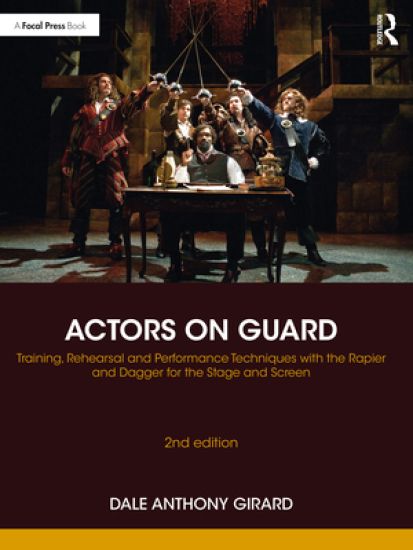
Actors on Guard

Actors on Guard

Dale Anthony Girard

Routledge
2021
sidottu
Actors on Guard, Second Edition is the most comprehensive book covering the current practices in learning, rehearsing and performing safe and dynamic swordfights with the single rapier and the rapier and dagger for both stage and screen.Focusing specifically on the Elizabethan rapier and dagger – the most popular weapons used in stage fights – Actors on Guard provides actors, directors, teachers, stage managers and technicians the skills and knowledge essential to presenting safe and effective swordfights. The book takes the reader through the complex process of selecting safe stage weapons, learning the basic handling and management of the rapier and dagger, as well as how to safely move and interact in the potentially dangerous process of learning, rehearsing and performing choreographed swordplay. This new edition has been revised with current industry practices, featuring hundreds of step-by-step practical exercises in the care and handling of prop swords, footwork, guards, parries, cutting and thrusting techniques, blade taking actions, disarms, wounds and kills using the rapier and dagger, with revised diagrams and photographs.An excellent sourcebook for university stage combat classes as well as self-learners, Actors on Guard provides the reader with the historical, theoretical and practical basis for mastering the art of sword fighting for the stage and screen.The book includes access to a wealth of online resources, with additional information that expands upon specific mechanics, techniques and concepts covered in the text as well as some video demonstrations of solo and partnered techniques and exercises.
Actors on Guard

Actors on Guard

Dale Anthony Girard

Routledge
2021
nidottu
Actors on Guard, Second Edition is the most comprehensive book covering the current practices in learning, rehearsing and performing safe and dynamic swordfights with the single rapier and the rapier and dagger for both stage and screen.Focusing specifically on the Elizabethan rapier and dagger – the most popular weapons used in stage fights – Actors on Guard provides actors, directors, teachers, stage managers and technicians the skills and knowledge essential to presenting safe and effective swordfights. The book takes the reader through the complex process of selecting safe stage weapons, learning the basic handling and management of the rapier and dagger, as well as how to safely move and interact in the potentially dangerous process of learning, rehearsing and performing choreographed swordplay. This new edition has been revised with current industry practices, featuring hundreds of step-by-step practical exercises in the care and handling of prop swords, footwork, guards, parries, cutting and thrusting techniques, blade taking actions, disarms, wounds and kills using the rapier and dagger, with revised diagrams and photographs.An excellent sourcebook for university stage combat classes as well as self-learners, Actors on Guard provides the reader with the historical, theoretical and practical basis for mastering the art of sword fighting for the stage and screen.The book includes access to a wealth of online resources, with additional information that expands upon specific mechanics, techniques and concepts covered in the text as well as some video demonstrations of solo and partnered techniques and exercises.
Rapacia: The Second Circle of Heck

Rapacia: The Second Circle of Heck

Dale E. Basye

Yearling (imprint of Random House Children's Books)
2010
pokkari
In his second novel in the popular series Heck, Dale E. Basye takes Milton and Marlo Fauster on a journey that is as full of clever, dark humor and laugh-out-loud silliness as the first. Welcome to Rapacia, where the greedy kids go. When her brother, Milton, escapes the otherworldly reform school Heck in a soul balloon made of old clothes, Marlo is the only Fauster child left to take the blame. Bea Elsa Bubb, the Principal of Darkness, sends her straight to Rapacia, the circle of Heck where greedy kids are tormented by glimpses of a just-out-of-reach, glittering shoppers' paradise called Mallvana. Marlo soon falls under the sway of Rapacia's vice principal, a grinning metal rabbit known as the Grabbit that seems to have plans of its own. Marlo is torn between wanting to find a way out and wanting to do . . . whatever the Grabbit asks her to do.Meanwhile, back on the Surface, Milton has his own problems. He is determined to get in touch with Marlo and help her find a way out of Heck. But it's hard to concentrate when his body and soul don't seem to hold together the way they used to. Will Milton ever reach Marlo? And if he does, will they both end up as pawns in the Grabbit's mysterious game?
Blimpo: The Third Circle of Heck

Blimpo: The Third Circle of Heck

Dale E. Basye

Random House Inc
2011
pokkari
With more clever, dark humor and zany silliness, Dale E. Basye sends Milton and Marlo Fauster back for thirds in another laugh-out-loud installment of the popular series Heck. After his second escape from Bea "Elsa" Bubb, the Principal of Darkness, Milton Fauster makes his way to Blimpo--the circle of the otherworldly reform school, Heck, where he's sure his friend Virgil is sentenced. Virgil's only crime is being, well, plump. Milton has to wonder if that's really enough to justify eternal darnation. And what Milton finds in Blimpo horrifies him. The overweight dead kids spend most of their time running on giant human hamster wheels called DREADmills that detect and exploit their deepest fears. The rest they spend eating Hambone Hank's barbecue--mystery meat that is delicious, but suspiciously (to Milton, anyway) haunting. Every classroom has a huge TV screen showing happy thin people who taunt Blimpo residents with a perfection they will never attain. Meanwhile, at her new job in the devil's Infernship program, Milton's sister, Marlo, knows all about trying to achieve perfection. And failing miserably. Can Milton get himself and Virgil out of Blimpo in time to rescue Marlo, too? Or is Fauster the next delicacy on Bea "Elsa" Bubb's menu?
Fibble: The Fourth Circle of Heck

Fibble: The Fourth Circle of Heck

Dale E. Basye

Random House Inc
2012
pokkari
Dale E. Basye's most over-the-top (the Big Top, that is) adventure yet is now available in paperback. When Marlo Fauster claims she has switched souls with her brother, she gets sent straight to Fibble, the circle of Heck reserved for liars. But it's true--Milton and Marlo have switched places, and Marlo finds herself trapped in Milton's gross, gangly body. She also finds herself trapped in Fibble, a three-ring media circus run by none other than P. T. Barnum, an insane ringmaster with grandiose plans and giant, flaming pants. Meanwhile Milton, as Marlo, is working at the devil's new television network, T.H.E.E.N.D. But there's something strange about these new shows. Why do they all air at the same time? And are they really broadcasting to "the Surface"? Soon Milton and Marlo realize that they need each other to sort through the lies and possibly prevent the end of the world--if Bea "Elsa" Bubb doesn't catch them first.
Fibre Bundles

Fibre Bundles

Dale Husemöller

Springer-Verlag New York Inc.
1993
sidottu
Fibre bundles play an important role in just about every aspect of modern geometry and topology. Basic properties, homotopy classification, and characteristic classes of fibre bundles have become an essential part of graduate mathematical education for students in geometry and mathematical physics. In this third edition two new chapters on the gauge group of a bundle and on the differential forms representing characteristic classes of complex vector bundles on manifolds have been added. These chapters result from the important role of the gauge group in mathematical physics and the continual usefulness of characteristic classes defined with connections on vector bundles.
Elliptic Curves

Elliptic Curves

Dale Husemöller

Springer-Verlag New York Inc.
2003
sidottu
There are three new appendices, one by Stefan Theisen on the role of Calabi– Yau manifolds in string theory and one by Otto Forster on the use of elliptic curves in computing theory and coding theory. In the third appendix we discuss the role of elliptic curves in homotopy theory. In these three introductions the reader can get a clue to the far-reaching implications of the theory of elliptic curves in mathematical sciences. During the ?nal production of this edition, the ICM 2002 manuscript of Mike Hopkins became available. This report outlines the role of elliptic curves in ho- topy theory. Elliptic curves appear in the form of the Weierstasse equation and its related changes of variable. The equations and the changes of variable are coded in an algebraic structure called a Hopf algebroid, and this Hopf algebroid is related to a cohomology theory called topological modular forms. Hopkins and his coworkers have used this theory in several directions, one being the explanation of elements in stable homotopy up to degree 60. In the third appendix we explain how what we described in Chapter 3 leads to the Weierstrass Hopf algebroid making a link with Hopkins’ paper.
Kingsley Amis

Kingsley Amis

Dale Salwak

Barnes Noble,Inc
1992
sidottu
This is a fascinating critical study of the life, work and milieu of one of Britain's best known and most popular novelists. Starting with a biographical overview of the influences on the developing writer while at home, at school, at Oxford, and at war, Dale Salwak goes on to offer the general reader a lively interpretation of all of Amis's novels, from Lucky Jim (1954) through to The Folks That Live on the Hill (1990), set against the ever-changing backdrop of the twentieth century. Dale Salwak makes extensive use of the major Amis archives, and draws on material from Amis's notebooks, letters, juvenilia and manuscripts, as well as upon his own discussions with Amis and many of his friends. Waving these sources with his own critical appraisal, Salwak plots each step in the development of Amis's imaginative vision throughout his writing career. This illustrated study, which includes a selective chronology and a complete primary bibliography, will be read with pleasure by those who are interested in learning more about Kingsley Amis, modern novelist.