This two-part, eight-volume, reset edition draws together a range of sources from the early modern era through to the industrial age, to show the changes and continuities in responses to the social, political, legal and spiritual problems that self-murder posed.
This two-part, eight-volume, reset edition draws together a range of sources from the early modern era through to the industrial age, to show the changes and continuities in responses to the social, political, legal and spiritual problems that self-murder posed.
This two-part, eight-volume, reset edition draws together a range of sources from the early modern era through to the industrial age, to show the changes and continuities in responses to the social, political, legal and spiritual problems that self-murder posed.
This book is a step-by-step guide to using deliberate practice as an individualized professional development plan for psychotherapists to improve the quality of their service using client outcome data. Deliberate practice is a systematic approach for improving psychotherapy outcomes, one clinician at a time. This step-by-step guide to deliberate practice demonstrates how to collect and use client outcome data to create an individualized professional development plan to improve the quality of your service. Your goal is to help more of your psychotherapy clients get better. For those who do realize gains, your goal is to help them experience a greater degree of improvement as a result of working with you. In this book you will learn how to conduct routine outcome measurements to gather data from your own practice. Detailed instructions and examples walk you through the process of determining your baseline performance, identifying and addressing your strengths and deficits as a practitioner, and assessing your progress. Richly-drawn case studies and stories from the business world and popular culture illustrate how research from the field of expert performance offers a different paradigm for professional development that departs from the field amp rsquo s traditional emphasis on learning therapy models and techniques.
Learning how to do research well is not easy, and for newer scholars the process can feel overwhelming. Using clear and supportive language, this book is designed to help graduate students and early career professionals in psychology develop skills to effectively work through the research process. Chapters cover the essential character traits and skills that are necessary to become an effective researcher, walk through the main steps for completing a research project from start to finish, and discuss considerations when building a career and research program. Rather than the nitty-gritty of research methods, authors Joshua N. Hook, Don E. Davis, and Daryl R. Van Tongeren focus on the big picture of what is required in research. Chapters in the first section address overarching principles-the personal growth, attributes, and habits that are important to develop to become a successful researcher. The second section illustrates the key steps in completing a research project from start to finish, from formulating an idea for a project, to completing a literature review, collecting data, analyzing data, and writing up the results. The third section discusses developing a research program and transitioning from graduate student to professional-topics such as collaborating with others in research and mentoring students. This section is full of practical advice the authors learned from mentors and from personal experience. Written for people with a broad range of career goals, and with the mentoring relationship in mind, the book helps mentors and students form productive relationships that feel mutually beneficial and rewarding. Each chapter aims to help students and professionals along their research journey, and teaches them not just how to survive the process, but thrive.
This book explains why suicide can be alluring to a person aiming to stop his or her traumatic pain—whether its source is bullying, sexual assault, war combat, or other PTSD-invoking events—and details approaches that can prevent suicide.Suicide has been a taboo topic in Western culture. The mere mention of suicide sparks reactive responses that include medical, moral, spiritual, and religious debates. As a result, the authors open an important discussion here, offering an honest and non-judgmental examination of the many aspects involved in the nature of suicide, explaining that above all, people need to learn how to support those struggling with suicidal thoughts or to intercept their own suicidal thinking. The book also includes an extensive review and evaluation of the many available mental health treatments.Special consideration is given to military suicides. U.S. soldier suicides exceed one per day and continue to rise in all military branches, while veteran suicide rates are even higher, averaging 17 per day. Communities, families, veterans, and service members are in need of tools and insights for coping with, navigating, and exposing the suicidal attitudes affecting many current and former members of the military.
This updated third edition of Legal Aspects of Corrections Management provides a current, informative, and reader-friendly discussion of the contemporary legal issues impacting corrections management. Through the use of case law, this text provides readers with a practical understanding of how the First, Fourth, Fifth, Eighth and Fourteenth Amendments relate to the day-to-day issues of running a prison, jail, and other corrections programs, such as probation and parole. The authors' combined corrections experience included such positions as General Counsel, Regional Counsel, and Correctional Program Officer, as well as working within corrections facilities. Their work involved advising corrections staff and management on the legal issues associated with policies and procedures. The authors also have extensive teaching experience in corrections law, the criminal justice system, and criminology. The benefits of such experiences are reflected in the comprehensive coverage of topics in this accessible and updated Third Edition. New to the Third Edition: -Cases and statistical information have been thoroughly updated. -Contains many new photos and figures throughout -New sections include: *Religious Land Use and Institutionalized Persons Act of 2000 (RLUIPA) *Double Jeopardy *DNA Collection *Searches of Non-Inmates *Legal Challenges to the Method of Execution *Standards of Employee Conduct *Fair Labor Standards Act *Portal-to-Portal Act *Title VII and Inmate-Created Hostile Work Environment *The Americans with Disabilities Act *Death Penalty for Juvenile Offenders Key Features: -Includes engaging real-world examples of common problems and occurrences in corrections to provide students and practitioners with a good understanding of the legal aspects of corrections management. -Provides insight into the legal steps that should be anticipated in a correctional lawsuit. -Provides an accessible and easy-to-understand collection of Supreme Court and significant lower court rulings on key issues in corrections. With the focus on Supreme Court cases, the text has applicability nationwide. -Focuses on constitutional issues affecting such areas as inmate correspondence, visiting, and religion (First Amendment); search and seizure, privacy (Fourth Amendment); due process (Fifth and Fourteenth Amendments); equal protection (Fourteenth Amendment); and the death penalty, conditions of confinement (cruel and unusual punishment), and health care (Eighth Amendment). -Includes coverage of statutory and administrative law, as well as chapters on probation and parole, jails, juveniles, privatization, and the loss of rights of convicted persons. -Includes examples of relevant documents, such as a civil complaint; a sample presentence investigation report; a listing of inmate rights and responsibilities; of misconduct charges; and of mission statements for departments of corrections.
This distinguishes Paul’s letters from others attributed to him in the canon; disentangles component pieces of correspondence from the composite letters; places the authentic letters in their chronological order and historical context; and restores Paul’s voice in a fresh translation from the original Greek.
There were four different portraits of Paul in the early church: the non-authoritarian Paul of the great Letters, the authoritarian, misogynist Paul of the Pastoral Epistles, the frenetic missionary who single-handedly introduced Christianity to the Mediterranean world, and the proto- Gnostic Paul of Marcion and the Gnostic commentaries on Paul s letters. Which is the real Paul? The Christian church opted for the Pastoral Epistles, and so read Paul letters through that lens. But that image has become so problematic in the modern world that many contemporary readers are either put off by Paul or simply ignore him. But was Paul really such a frightful figure? In providing a fresh reading of Paul s authentic letters, the SV translators have attempted to liberate his words from those of Augustine, and later Martin Luther, who used Paul to cover their own guilty consciences. This Augustinian-Lutheran tradition of interpreting Paul s discourses about justification by faith as a way of dealing with their own sense of moral failure, for instance, represents but one way of translating Paul s letters. The Greek of Paul s writings can be understood rather differently so that Paul s message is not about personal guilt, but about the trustworthiness of God, and Jesus courageous faith in God as a role model for others. This is how Paul s letters are translated in this book. Here readers will encounter a very different view of Paul and his message.
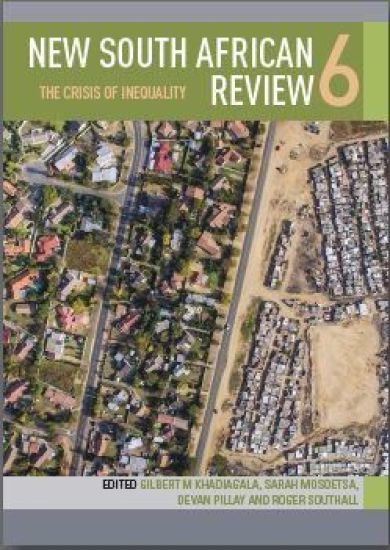
Despite the transition from apartheid to democracy, South Africa is the most unequal country in the world. Its extremes of wealth and poverty undermine intensifying struggles for a better life for all.The wide-ranging essays in this sixth volume of the New South African Review demonstrate how the consequences of inequality extend throughout society and the political economy, crippling the quest for social justice, polarising the politics, skewing economic outcomes and bringing devastating environmental consequences in their wake.Contributors survey the extent and consequences of inequality across fields as diverse as education, disability, agrarian reform, nuclear geography and small towns, and tackle some of the most difficult social, political and economic issues. How has the quest for greater equality affected progressive political discourse? How has inequality reproduced itself, despite best intentions in social policy, to the detriment of the poor and the historically disadvantaged? How have shifts in mining and the financialisation of the economy reshaped the contours of inequality? How does inequality reach into the daily social life of South Africans, and shape the way in which they interact? How does the extent and shape of inequality in South Africa compare with that of other major countries of the global South which themselves are notorious for their extremes of wealth and poverty? South African extremes of inequality reflect increasing inequality globally, and The Crisis of Inequality will speak to all those – general readers, policy makers, researchers and students – who are demanding a more equal world.
Michael Onyebuchi Eze; Lawrence Hamilton; Laurence Piper; Gideon van Riet; Paula Ensor; Daryl Glaser; Christine Hobden; Billy Keniston; Ayesha Omar; John Sodiq Sanni; Tendayi Sithole; Crain Soudien
Revisits the work of Rick Turner, a South African political theorist, and addresses contemporary debates Rick Turner was a South African academic and anti-apartheid activist who rebelled against the apartheid state at the height of its power. For this he was assassinated in 1978, at just 32 years of age, but his life and work are testimony to the power of philosophical thinking for humans everywhere. Turner chose to live freely in an unfree time and argued for a non-racial, socialist future in a context where this seemed unimaginable. This book takes seriously Rick Turner's challenge that political theorising requires thinking in a utopian way. Turner's seminal book The Eye of the Need: Towards a Participatory Democracy laid out some of his most potent ideas on a radically different political and economic system. His demand was that we work to escape the limiting ideas of the present, carefully design a just future based on shared human values, and act to make it a reality, both politically and in our daily lives. The contributors to this volume engage critically with Turner's work on race relations, his relationship with Steve Biko, his views on religion, education and gender oppression, his participatory model of democracy, and his critique of enduring forms of poverty and economic inequality. They show how, in his life and work, Turner modeled how we can dare to be free and how hope can return, as the future always remains open to human construction. This book makes an important contribution to contemporary thinking and activism where the need for South Africans to define their understanding of their greater common good is of crucial importance.
Michael Onyebuchi Eze; Lawrence Hamilton; Laurence Piper; Gideon van Riet; Paula Ensor; Daryl Glaser; Christine Hobden; Billy Keniston; Ayesha Omar; John Sodiq Sanni; Tendayi Sithole; Crain Soudien
Revisits the work of Rick Turner, a South African political theorist, and addresses contemporary debates Rick Turner was a South African academic and anti-apartheid activist who rebelled against the apartheid state at the height of its power. For this he was assassinated in 1978, at just 32 years of age, but his life and work are testimony to the power of philosophical thinking for humans everywhere. Turner chose to live freely in an unfree time and argued for a non-racial, socialist future in a context where this seemed unimaginable. This book takes seriously Rick Turner's challenge that political theorising requires thinking in a utopian way. Turner's seminal book The Eye of the Need: Towards a Participatory Democracy laid out some of his most potent ideas on a radically different political and economic system. His demand was that we work to escape the limiting ideas of the present, carefully design a just future based on shared human values, and act to make it a reality, both politically and in our daily lives. The contributors to this volume engage critically with Turner's work on race relations, his relationship with Steve Biko, his views on religion, education and gender oppression, his participatory model of democracy, and his critique of enduring forms of poverty and economic inequality. They show how, in his life and work, Turner modeled how we can dare to be free and how hope can return, as the future always remains open to human construction. This book makes an important contribution to contemporary thinking and activism where the need for South Africans to define their understanding of their greater common good is of crucial importance.
Shireen Hassim; Tawana Kupe; Eric Worby; Paul Verryn; Alex Eliseev; Rolf Maruping; Daryl Glaser; Noor Nieftagodien; Stephen Gelb; Devan Pillay; Loren Landau; David Coplan; Julia Hornberger; Melinda Silverman; Tanya Zack; Anton Harber; Cathi Albertyn; Andile Mngxitama; Pumla Dineo Gqola; Véronique Tadjo
The xenophobic attacks that started in Alexandra, Johannesburg in May 2008 before quickly spreading around the country caused an outcry across the world and raised many fundamental questions: Of what profound social malaise is xenophobia – and the violence that it inspires – a symptom? Have our economic and political choices created new forms of exclusion that fuel anger and distrust? What consequences does the emergence of xenophobia hold for the idea of an equal, non-racial society as symbolised by a democratic South Africa? On 28 May 2008 the Faculty of Humanities in the University of the Witwatersrand, Johannesburg convened an urgent colloquium that focused on searching for short and long-term solutions. Nearly twenty individuals – mostly Wits academics from a variety of disciplines, but also two student leaders, a journalist and a bishop – addressed the unfolding violence in ways that were conversant with the moment, yet rooted in scholarship and ongoing research. Go Home or Die Here emanates directly from the colloquium. It hopes to make sense of the nuances and trajectories of building a democratic society out of a deeply divided and conflictual past, in the conditions of global recession, heightening inequalities and future uncertainty. The authors hoped to pose questions that would lead both to research and to more informed, reflective forms of public action. With extensive photographs by award-winning photographer Alon Skuy, who covered the violence for The Times newspaper, the volume is passionate and engaged, and aims to stimulate reflection, debate and activism among concerned members of a broad public.
Calland Richard; Jane Duncan; Friedman Steven; Gevisser Mark; Glaser Daryl; Heywood Mark; Peter Hudson; Chris Landsberg; McKaiser Eusebius; Chris Oxtoby; Vale Peter
For nearly ten years - indeed more if we include his period of influence under Mandela's presidency - Thabo Mbeki bestrode South Africa's political stage. Despite attempts by some in the new ANC leadership to airbrush out his role, there can be little doubt that Mbeki was a seminal figure in South Africa's new democracy, one who left a huge mark in many fields, perhaps most controversially in state and party management, economic policy, public health intervention, foreign affairs and race relations. If we wish to understand the character and fate of post-1994 South Africa, we must therefore ask: What kind of political system, economy and society has the former President bequeathed to the government of Jacob Zuma and to the citizens of South Africa generally? This Question is addressed head-on here by a diverse range of analysts, commentators and participants in the political process. Amongst the specific questions they seek to answer: What is Mbeki's legacy for patterns of inclusion and exclusion based on race, class and gender? How, if at all, did his presidency reshape relations within the state, between the state and the ruling party and between the state and society? How did he reposition South Africa on the continent and in the world? This book will be of interest to anyone wishing to understand the current political landscape in South Africa, and Mbeki's role in shaping it.
This is the first publication in the Democratic Marxism Series, which seeks to elaborate the social theorising and politics of Democratic Marxism. Marx’s writings on and ideas about social transformation have figured prominently in the global Left imagination for more than 150 years. At the end of the twentieth century a number of factors seemed to converge to mark the end of Marxism’s influence on the world and, as a result, by the late twentieth century the relevance of Marxism was under question by both the Left (including Marxists) and Right. The decline was relatively short-lived, however, as the 2008 economic crisis brought into sharp relief the catastrophic effects of financialised capitalism and the need to (re)find alternatives. In the second decade of the twenty-first century, the revival of Marxism is finding new sources of inspiration that revolve around four primary factors: the importance of democracy for an emancipatory project; the ecological limits of capitalism; the crisis of global capitalism; and learning lessons from the failures of Marxist-inspired experiments. This is not simply a return to nineteenth and twentieth century understandings of Marxism. Rather, the twenty-first century has seen enormous creativity from movements that seek to overcome the weaknesses of the past by forging fundamentally new approaches to politics that draw inspiration from Marxism along with many other anti-capitalist traditions such as feminism, ecology, anarchism and indigenous traditions. The Marxism of many of these movements is not dogmatic or prescriptive, but rather open, searching, dialectical, humanist, utopian and inspirational. This edited volume introduces some contemporary approaches to Marxism and explores some of the ways in which Marxism has been used in Africa.
"Persistence and determination alone are omnipotent. The slogan 'Press On' has solved and always will solve the problems of the human race." Calvin Coolidge Coolidge was on to something when he pointed out that talent and education had far less to do with success than most people thought. Coolidge, something of a self-made man himself, understood that talent and education only get you so far - when, in fact, quitting will rob you of all of the benefits of your "head start." There is only one true human superpower we possess. It's not the power of flight. It certainly isn't the power of invincibility - anyone who's ever failed can tell you that It's determination. The ability to press on when you are tempted to quit. That is the one and only superpower you will ever have. And the good news is that it's free. It's just not easy. Especially when the world around you doesn't seem like it wants to accommodate your determination - which, let's be honest, is most of the time. You'll find the inspiration and encouragement to "press on" from the real-life stories inside. Regardless of where you find yourself today, "Rest If You Must, But Don't You Quit "
Anthony Julius; Nicholas Lemann; Alfred Brendel; Paul Berman; Jorie Graham; Fouad Ajami; Jack Goldsmith; Edward Luttwak; Roberto Calasso; Ishion Hutchinson; Walter Sheidel; Helen Vendler; Robert Alter; Daryl Michael Scott; Rosanna Warren; Alastair Macaulay; David Greenberg
Liberties – A Journal of Culture and Politics features original essays and poetry from some of today’s best writers and artists to inspire and impact the intellectual and creative lifeblood of culture and politics. This issue of Liberties includes: Anthony Julius on censorship of the arts; Nicholas Lemann on rescuing capitalism; Alfred Brendel on playing Beethoven; Paul Berman on the George Floyd uprising; Fouad Ajami’s story of an honor killing; Jack Goldsmith on conservatives and the courts; Edward Luttwak on understanding China; Roberto Calasso on when journals mattered; Walter Scheidel on life after covid; Helen Vendler on the poet Robert Hayden; Robert Alter on Lolita today; Daryl Michael Scott on the 13th Amendment; Alastair Macaulay on Balanchine; David Greenberg on renaming our heritage; new poetry from Jorie Graham, Ishion Hutchinson, and Rosanna Warren; and, Leon Wieseltier (editor) and Celeste Marcus (managing editor).
Webster Edward; John Mawbey; Cronin Jeremy; Alex Mohubetswane Mashilo Mohubetswane Mashilo; Robert van Niekerk van Niekerk; Luli Callinicos Callinicos; B G Brown; M P Giyose; H. J. Peterson; C A Thomas; A R Zinn; Zondi Siphamandla; T Dunbar Moodie; Motala Enver; Vally Salim; Gerhard Maré; Mangcu Xolela; Hassim Shireen; Erwin Alec; Sian Byrne; Nicole Ulrich; Walt Lucien; Legassick Martin; Glaser Daryl
The re-emergence of debates on the decolonisation of knowledge has revived interest in the National Question, which began over a century ago and remains unresolved. Tensions that were suppressed and hidden in the past are now being openly debated. Despite this, the goal of one united nation living prosperously under a constitutional democracy remains elusive. This volume examines the way in which various strands of left thought have addressed the National Question, especially during the apartheid years, and goes on to discuss its relevance for South Africa today and in the future. Contributors have defined the question as they believe appropriate, which has resulted in a rich tapestry of interweaving perceptions about the unresolved National Question. The volume is structured in two parts. The first examines four foundational traditions – Marxism-Leninism (the Colonialism of a Special Type thesis); the Congress tradition; the Trotskyist tradition; and Africanism. The second part explores the various shifts in the debate from the 1960s onwards, and includes chapters on Afrikaner nationalism, ethnic issues, Black Consciousness, feminism, workerism and constitutionalism. By revisiting these debates, the volume will become a catalyst for an enriched debate on our identity and our future.
Wonderfully illustrated, Darryl the Dinosaur tell the introductory story of a dinosaur stuffy who longs for a child to take him home. An error in manufacturing was left him unwanted and unloved, until one day a special boy comes into his life to show him love and acceptance. A story of accepting and appreciating the differences in each of us.