Kirjahaku
Etsi kirjoja tekijän nimen, kirjan nimen tai ISBN:n perusteella.
1000 tulosta hakusanalla David a. Edwards
Stand Pat Or Poker Stories From The Mississippi
David A. Curtis; Henry (INT) Roth
Kessinger Pub
2007
pokkari
Wells's Natural Philosophy: For The Use Of Schools, Academies, And Private Students (1860)
David A. Wells
KESSINGER PUBLISHING, LLC
2008
sidottu
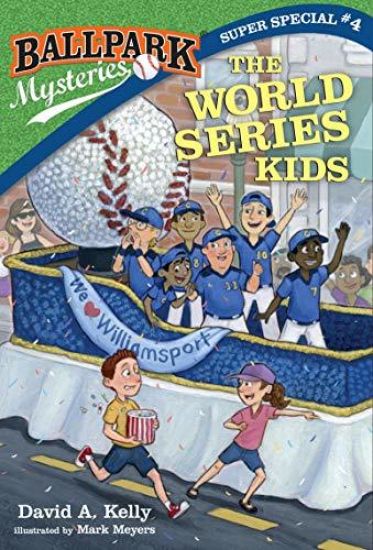
From the author of the Ballpark Mysteries comes the coolest sports club around--the Most Valuable Players The MVP kids can't wait to play in the big football game. That is, until they catch a glimpse of their opponents The team from Hamilton Elementary School seems bigger and--even worse--just plain mean. Taking on a tough opponent is never easy. Will this bully blitz keep the MVPs off their game? Or can they find a way to huddle together and win the day? Perfect for kids who love to compete in all kinds of contests and have fun with great friends, David A. Kelly's series teaches readers that when you're a most valuable player, you love sports, always show spirit, and never give up And don't miss sports facts in every book.
From the author of the Ballpark Mysteries comes the coolest sports club around--the Most Valuable Players The MVP club needs to raise money for their basketball tournament. At first, they think selling popcorn will be easy . . . but then Luke eats more popcorn than he sells Plus there's a new kid at school who might need the money even more than the team does. Can the MVP kids raise enough money, win the tournament, and help their friend? Perfect for kids who love to compete in all kinds of contests and have fun with great friends, David A. Kelly's series teaches readers that when you're a most valuable player, you love sports, always show spirit, and never give up Don't miss bonus sports facts in every MVP book.
Baruch and the Epistle of Jeremiah
David A Teeter
Continuum International Publishing Group Ltd.
2015
sidottu
The International Critical Commentaries has now been extended to cover the Biblical 'Apocrypha', incorporating Baruch and the Epistle of Jeremiah. Upholding the traditions of the ICC series this volume will examine all the evidence and traditions available to scholars, incorporating both historical and new methods of study. David A. Teeter provides the commentary on Baruch, covering also the Epistle of Jeremiah. As befits an ICC, Teeter focuses on matters textual and philological. However, he also examines literary shaping and development of these two compositions as well as the dynamics of scriptural allusion and exegesis in these texts. Finally Teeter turns his attention to the purpose of these texts, and examines the implications of this for the study of early Judaism. For over one hundred years International Critical Commentaries have had a special place among works on the Bible. They bring together all the relevant aids to exegesis - linguistic, textual, archaeological, historical, literary, and theological - to help the reader understand the meaning of the books of the Old and New Testaments.
Text, Context and the Johannine Community adopts a new approach to the social context of the Johannine writings by drawing on modern sociolinguistic theory. Sociolinguistics emphasizes language as a social phenomenon, which can be analysed with reference not only to its broad context of culture, but also, through the use of register analysis, to its narrower context of situation. The Johannine writings have increasingly been seen as the product of a distinct Johannine Community, depicted by some scholars as a sectarian group, opposed both to wider Jewish society and to other Christian groups. This model has largely been constructed on historical-critical grounds, yet given our lack of reliable external information about the origin of the Johannine writings, a more fruitful approach may be to examine their lexico-grammatical and discourse features to determine what these imply about interpersonal relationships. This study compares selected 'narrative asides' from the Gospel of John with a passage section from 1 John and with the two shorter Johannine Epistles. It concludes that register analysis of these texts does not support the idea of a close-knit sectarian group.
Text, Context and the Johannine Community adopts a new approach to the social context of the Johannine writings by drawing on modern sociolinguistic theory. Sociolinguistics emphasizes language as a social phenomenon, which can be analysed with reference not only to its broad context of culture, but also, through the use of register analysis, to its narrower context of situation.The Johannine writings have increasingly been seen as the product of a distinct Johannine Community, depicted by some scholars as a sectarian group, opposed both to wider Jewish society and to other Christian groups. This model has largely been constructed on historical-critical grounds, yet given our lack of reliable external information about the origin of the Johannine writings, a more fruitful approach may be to examine their lexico-grammatical and discourse features to determine what these imply about interpersonal relationships. This study compares selected 'narrative asides' from the Gospel of John with a passage section from 1 John and with the two shorter Johannine Epistles. It concludes that register analysis of these texts does not support the idea of a close-knit sectarian group.
Ideas of kinship play a significant role in structuring everyday life, and yet kinship has been neglected in Christian ethics, moral philosophy and bioethics. Attention has been paid in these disciplines to the ethics of ‘family,’ but with little regard to the evidence that kinship varies widely from culture-to-culture, suggesting that it is, in fact, culturally constructed.Surveying notions of shared substance (e.g. blood ties), house, gender and personhood, as theorised and practiced in the Christian tradition, Torrance critiques the special privileging of the ‘blood tie’. In the place of European and American cultural assumptions to the contrary, it is kinship in Christ that is presented as the basis of a truly Christian account for social ties. Torrance also aims to stimulate the moral imagination to consider Christian kinship might be lived out in miniature, in everyday life.
In this debut collection of 32 stories you will encounter people in situation which are not always what they seem. There's a good bit of humor, some shocks, and always twists and turns that lead to 'ah hah' conclusions.Here you will meet a bullied parochial school student who gets his revenge. An elderly widower is about to leave his beloved home until his memories keep him there. A well-heeled lawyer decides to take an evening walk through Central Park and greets a man he fears is a mugger for an O'Henry-esque meeting. A couple planning to climb Kilimanjaro on an eco tour reveal political-correctness gone awry. Another couple go out on the wrong day for a sail. An loner in the backwoods of Maine