Kirjojen hintavertailu. Mukana 11 699 587 kirjaa ja 12 kauppaa.

Kirjahaku

Etsi kirjoja tekijän nimen, kirjan nimen tai ISBN:n perusteella.

1000 tulosta hakusanalla Donald Rayfield

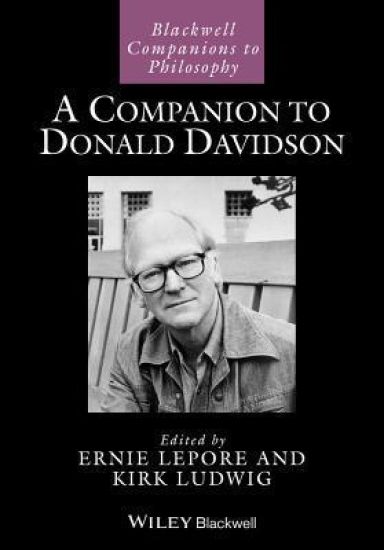
A Companion to Donald Davidson
A Companion to Donald Davidson presents newly commissioned essays by leading figures within contemporary philosophy. Taken together, they provide a comprehensive overview of Davidson’s work across its full range, and an assessment of his many contributions to philosophy. Highlights the breadth of Davidson's work across philosophyDemonstrates the continuing influence his work has on the philosophical communityIncludes newly commissioned contributions from leading figures in contemporary philosophyProvides an in-depth exposition and analysis of Davidson's work across the range of areas to which he contributed, including philosophy of action, epistemology, metaphysics, philosophy of language, and philosophy of mind
Life Of Donald G. Mitchell, Ik Marvel (1922)
This book, "The Life Of Donald G. Mitchell, Ik Marvel (1922)", by Waldo H. Dunn, is a replication of a book originally published before 1922. It has been restored by human beings, page by page, so that you may enjoy it in a form as close to the original as possible. This book was created using print-on-demand technology. Thank you for supporting classic literature.
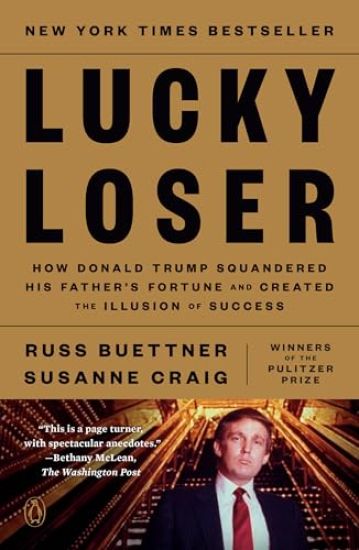
Lucky Loser: How Donald Trump Squandered His Father's Fortune and Created the Illusion of Success
An Instant New York Times Bestseller - A Washington Post Notable Book - A Financial Times Best Business Book of the Year "A first-rate financial thriller . . . Lucky Loser is one of those rare Trump books that deserve, even demand, to be read." -Alexander Nazaryan, The New York Times From the Pulitzer Prize-winning reporters behind the 2018 bombshell New York Times expos of then-President Trump's finances, an explosive investigation into the history of Donald Trump's wealth, revealing how one of the country's biggest business failures lied his way into the White House Soon after announcing his first campaign for the US presidency, Donald J. Trump told a national television audience that life "has not been easy for me. It has not been easy for me." Building on a narrative he had been telling for decades, he spun a hardscrabble fable of how he parlayed a small loan from his father into a multi-billion-dollar business and real estate empire. This feat, he argued, made him singularly qualified to lead the country. Except: None of it was true. Born to a rich father who made him the beneficiary of his own highly lucrative investments, Trump received the equivalent of more than $500 million today via means that required no business expertise whatsoever. Drawing on over twenty years' worth of Trump's confidential tax information, including the tax returns he tried to conceal, alongside business records and interviews with Trump insiders, New York Times investigative reporters Russ Buettner and Susanne Craig track Trump's financial rise and fall, and rise and fall again. For decades, he squanders his fortunes on money losing businesses, only to be saved yet again by financial serendipity. He tacks his name above the door of every building, while taking out huge loans he'll never repay. He obsesses over appearances, while ignoring threats to the bottom line and mounting costly lawsuits against city officials. He tarnishes the value of his name by allowing anyone with a big enough check to use it, and cheats the television producer who not only rescues him from bankruptcy but casts him as a business savant - the public image that will carry him to the White House. A masterpiece of narrative reporting, Lucky Loser is a meticulous examination spanning nearly a century, filled with scoops from Trump Tower, Mar-a-Lago, Atlantic City, and the set of The Apprentice. At a moment when Trump's tether to success and power is more precarious than ever, here for the first time is the definitive true accounting of Trump and his money - what he had, what he lost, and what he has left - and the final word on the myth of Trump, the self-made billionaire.
Lucky Loser: How Donald Trump Squandered His Father's Fortune and Created the Illusion of Success
An Instant New York Times Bestseller - A Washington Post Notable Book - A Financial Times Best Business Book of the Year "A first-rate financial thriller . . . Lucky Loser is one of those rare Trump books that deserve, even demand, to be read." -Alexander Nazaryan, The New York Times From the Pulitzer Prize-winning reporters behind the 2018 bombshell New York Times expos of then-President Trump's finances, an explosive investigation into the history of Donald Trump's wealth, revealing how one of the country's biggest business failures lied his way into the White House Soon after announcing his first campaign for the US presidency, Donald J. Trump told a national television audience that life "has not been easy for me. It has not been easy for me." Building on a narrative he had been telling for decades, he spun a hardscrabble fable of how he parlayed a small loan from his father into a multi-billion-dollar business and real estate empire. This feat, he argued, made him singularly qualified to lead the country. Except: None of it was true. Born to a rich father who made him the beneficiary of his own highly lucrative investments, Trump received the equivalent of more than $500 million today via means that required no business expertise whatsoever. Drawing on over twenty years' worth of Trump's confidential tax information, including the tax returns he tried to conceal, alongside business records and interviews with Trump insiders, New York Times investigative reporters Russ Buettner and Susanne Craig track Trump's financial rise and fall, and rise and fall again. For decades, he squanders his fortunes on money losing businesses, only to be saved yet again by financial serendipity. He tacks his name above the door of every building, while taking out huge loans he'll never repay. He obsesses over appearances, while ignoring threats to the bottom line and mounting costly lawsuits against city officials. He tarnishes the value of his name by allowing anyone with a big enough check to use it, and cheats the television producer who not only rescues him from bankruptcy but casts him as a business savant - the public image that will carry him to the White House. A masterpiece of narrative reporting, Lucky Loser is a meticulous examination spanning nearly a century, filled with scoops from Trump Tower, Mar-a-Lago, Atlantic City, and the set of The Apprentice. At a moment when Trump's tether to success and power is more precarious than ever, here for the first time is the definitive true accounting of Trump and his money - what he had, what he lost, and what he has left - and the final word on the myth of Trump, the self-made billionaire.
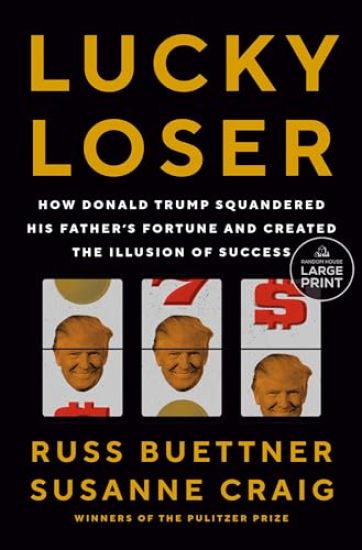
Lucky Loser: How Donald Trump Squandered His Father's Fortune and Created the Illusion of Success
An Instant New York Times Bestseller - A Washington Post Notable Book - A Financial Times Best Business Book of the Year "A first-rate financial thriller . . . Lucky Loser is one of those rare Trump books that deserve, even demand, to be read." --Alexander Nazaryan, The New York Times From the Pulitzer Prize-winning reporters behind the 2018 bombshell New York Times expos of President Trump's finances, an explosive investigation into the history of Donald Trump's wealth, revealing how one of the country's biggest business failures lied his way into the White House Soon after announcing his first campaign for the U.S. presidency, Donald J. Trump told a national television audience that life "has not been easy for me. It has not been easy for me." Building on a narrative he had been telling for decades, he spun a hardscrabble fable of how he parlayed a small loan from his father into a multibillion-dollar business and real estate empire. This feat, he argued, made him singularly qualified to lead the country. Except none of it was true. As his wealthy father's chosen successor, Trump received the equivalent today of more than $500 million in family money. He collected a second windfall thanks to Mark Burnett, the revolutionary television producer who made Trump a star. In truth, Trump's empire was underwritten, and at times saved, by the equivalent of more than $1 billion that came his way without any of the business expertise he claimed. Drawing on more than twenty years' worth of Trump's confidential tax information, including the tax returns he tried to conceal, alongside business records and interviews with Trump insiders, New York Times investigative reporters Russ Buettner and Susanne Craig track Trump's financial rise and fall, and rise and fall again. A masterpiece of narrative reporting, Lucky Loser is a meticulous examination spanning nearly a century, filled with scoops from Trump Tower, Mar-a-Lago, Atlantic City, and the set of The Apprentice. Here for the first time is the definitive true accounting of Trump and his money--what he had, what he lost, and what he has left--and the myth of Trump, the self-made billionaire, exposed.
The Case Of Donald Huse

The Case Of Donald Huse

Edward Schwartz

iUniverse
2003
pokkari
"THE CASE OF DONALD HUSE" is an old-fashioned who-done-it that gives the reader surprising twists at every turn. Who is stealing vital Board information? Who is killing beautiful ballet dancers--and why? What begins as a simple case of industrial espionage for private investigator Bob Stotland, a lonely bachelor, quickly plunges him and his newly hired partner Ron Barton into more than they bargained for.Suspense builds as pages are turned in "THE CASE OF DONALD HUSE."
The Presidency of Donald J. Trump

The Presidency of Donald J. Trump

PRINCETON UNIVERSITY PRESS
2022
sidottu
Leading historians provide perspective on Trump’s four turbulent years in the White HouseThe Presidency of Donald J. Trump presents a first draft of history by offering needed perspective on one of the nation’s most divisive presidencies. Acclaimed political historian Julian Zelizer brings together many of today’s top scholars to provide balanced and strikingly original assessments of the major issues that shaped the Trump presidency.When Trump took office in 2017, he quickly carved out a loyal base within an increasingly radicalized Republican Party, dominated the news cycle with an endless stream of controversies, and presided over one of the most contentious one-term presidencies in American history. These essays cover the crucial aspects of Trump’s time in office, including his administration’s close relationship with conservative media, his war on feminism, the solidification of a conservative women’s movement, his response to COVID-19, the border wall, growing tensions with China and NATO allies, white nationalism in an era of Black Lives Matter, and how the high-tech sector flourished.The Presidency of Donald J. Trump reveals how Trump was not the cause of the political divisions that defined his term in office but rather was a product of long-term trends in Republican politics and American polarization more broadly.With contributions by Kathleen Belew, Angus Burgin, Geraldo Cadava, Merlin Chowkwanyun, Bathsheba Demuth, Gregory Downs, Jeffrey Engel, Beverly Gage, Nicole Hemmer, Michael Kazin, Daniel C. Kurtzer, James Mann, Mae Ngai, Margaret O’Mara, Jason Scott Smith, Keeanga-Yamahtta Taylor, and Leandra Zarnow.
The Presidency of Donald J. Trump

The Presidency of Donald J. Trump

PRINCETON UNIVERSITY PRESS
2022
pokkari
Leading historians provide perspective on Trump’s four turbulent years in the White HouseThe Presidency of Donald J. Trump presents a first draft of history by offering needed perspective on one of the nation’s most divisive presidencies. Acclaimed political historian Julian Zelizer brings together many of today’s top scholars to provide balanced and strikingly original assessments of the major issues that shaped the Trump presidency.When Trump took office in 2017, he quickly carved out a loyal base within an increasingly radicalized Republican Party, dominated the news cycle with an endless stream of controversies, and presided over one of the most contentious one-term presidencies in American history. These essays cover the crucial aspects of Trump’s time in office, including his administration’s close relationship with conservative media, his war on feminism, the solidification of a conservative women’s movement, his response to COVID-19, the border wall, growing tensions with China and NATO allies, white nationalism in an era of Black Lives Matter, and how the high-tech sector flourished.The Presidency of Donald J. Trump reveals how Trump was not the cause of the political divisions that defined his term in office but rather was a product of long-term trends in Republican politics and American polarization more broadly.With contributions by Kathleen Belew, Angus Burgin, Geraldo Cadava, Merlin Chowkwanyun, Bathsheba Demuth, Gregory Downs, Jeffrey Engel, Beverly Gage, Nicole Hemmer, Michael Kazin, Daniel C. Kurtzer, James Mann, Mae Ngai, Margaret O’Mara, Jason Scott Smith, Keeanga-Yamahtta Taylor, and Leandra Zarnow.
Desperate Voyage: Donald Crowhurst, the London Sunday Times Golden Globe Race, and the Tragedy of Teignmouth Electron
Now filmed as The Mercy starring Colin Firth & Rachel Weisz Windcheck Magazine (Nov/Dec 2016): Absorbing and insightful ... utterly unforgettable. Practical Sailor (Jan 2017): Adds a new depth of storytelling to a tale of madness that many sailors are familiar with. Points East Magazine (July 2017): Crowhurst made his own bed, and unfortunately he lay in it, too. He flew too close to the sun, and his story done right, as it is in Desperate Voyage, never grows old. Praise from Steven Callahan, New York Times bestselling author of Adrift Desperate Voyage provides readers precious insights through concentration on the backstory and how Crowhurst's basic personality drove him inexorably towards disaster, and like a dangerous vortex, dragged his family, friends, and supporters into his sphere. ... Simply fascinating. More Praise: Ed Renehan's Desperate Voyage, the retelling of Donald Crowhurst's tragic voyage during the 1968/69 Golden Globe Race, is a finely honed account of what has become offshore sailing's most enduring story. Drawing on an array of sources, Renehan's Crowhurst is Shakespearean: narcissistic and reviled but also sympathetic, a flawed human consumed by ambition. Although I've known this story forever, Renehan's fresh, haunting narrative had me hoping for a new ending, a better outcome this time around. Alas, it's not to be. You just keep reading until it breaks your heart. - John Kretschmer, author of Sailing a Serious Ocean, At the Mercy of the Sea, Flirting With Mermaids, and Cape Horn to Starboard Edward Renehan's Desperate Voyage is incisive, haunting, and absorbing. For those, like me, initially unfamiliar with this great sea drama, it is a perfect introduction to the story of Donald Crowhurst and the Golden Globe Race of 1968. Crowhurst is flawed and complicated, a tragic and captivating figure, and Renehan's retelling, Shakespearean in scope, is wonderfully crafted and endlessly fascinating.- William Boyle, author of the critically-acclaimed Gravesend and Death Don't Have No Mercy On a dismal day at the end of October, 1968, a weekend sailor by the name of Donald Crowhurst set out from England in a flimsy trimaran, hoping to win the London Sunday Times "Golden Globe" race and become the first solo sailor to circumnavigate the world nonstop. His was an exercise in over-arching ambition, delusion, and tragedy such as the world has seldom known. Before it was over, the world media would be subject to a fraud of enormous proportions, and Crowhurst would die a madman in the middle of the Atlantic. What he left behind was a shattered boat, a shattered family, and this incredible story. Includes exclusive photos by Eric Loss.Further illustrations by Tricia Highsmith.
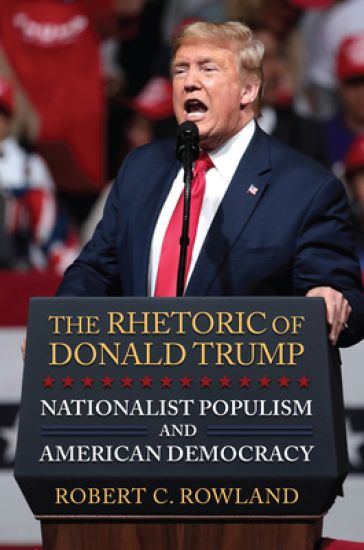
The Rhetoric of Donald Trump

The Rhetoric of Donald Trump

Robert C. Rowland

University Press of Kansas
2021
sidottu
The Rhetoric of Donald Trump identifies and analyzes the nationalist and populist themes that dominate the rhetoric of President Trump and links those themes to a persona that has evolved from celebrity outsider to presidential strongman. In the process Robert C. Rowland explains how the nationalist populism and strongman persona in turn demands a vernacular rhetorical style unlike any previous modern president-a style that makes no attempt to lay out a case, requires constant lies, and breaks every norm for how a presidential candidate or president should talk. In stark contrast, our most effective presidents have used rhetoric to present a positive vision of what the nation could achieve. The three most effective presidential uses of rhetoric in the past century-FDR, Reagan, and Obama-all presented a coherent ideological message that, while focused on problems of the moment, was also rooted in a fundamental optimism. In contrast, Trump's message is fundamentally negative.The Rhetoric of Donald Trump explores how the nation could so abruptly shift from a president such as Barack Obama, who emphasized the audacity of hope, to one who in his inaugural address spoke about 'American carnage.' At its core Trump's message is well designed to appeal to voters with an authoritarian personality structure, especially in the white working-class, who feel threatened by the pace of societal change, especially demographic change. Rowland's work illustrates how President Trump's ceremonial speeches violate norms calling for a message of national unity and instead present a divisive message designed to create strongly negative emotions, especially fear and hate. It further reveals how Trump sustains those strong visceral reactions with his use of Twitter to make the rally atmosphere a daily reality for his supporters, a prime example being the Coronavirus Task Force briefings which he transformed from an exercise in desperately needed public health education into a partisan rally.The Rhetoric of Donald Trump is essential reading for scholars, students, and the informed citizen to understand how Trump's rhetoric of nationalist populism with a strongman persona undermines basic principles at the heart of American democracy.
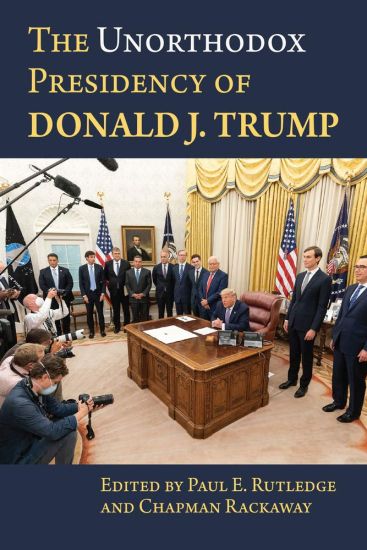
The Unorthodox Presidency of Donald J. Trump

The Unorthodox Presidency of Donald J. Trump

Paul Rutledge; Chapman Rackaway

University Press of Kansas
2021
sidottu
The Unorthodox Presidency of Donald J. Trump explores the myriad ways in which candidate, and then president, Trump exemplifies a nontraditional version of US politics. As a candidate he eschewed the norms of campaign procedure, and, in the worst cases, human decency, in favor of a rough-and-tumble, take-no-prisoners approach that appealed to those who felt marginalized in a changing society. Though the constitutional design of the presidency has seen political outsiders rise to the office of the presidency before and maintain stability, never before has a candidate so alien to political norms risen to the highest office. The presidency of Donald Trump represents the most significant challenge in the history of the United States to whether the constitutional design and boundaries on the office of the presidency can survive the test of an occupant who is antithetical to everything in its past. The editors and their contributors highlight how Trump's actions present direct challenges to the US presidency that have fully exposed and exacerbated long-held problems with checks and balances and led to questions regarding the potential for permanent effects of the Trump presidency on the Oval Office.The Unorthodox Presidency of Donald J. Trump is organized into three sections. The first section analyzes the Trump presidency in the context of US elections, including Trump as a candidate, the 2016 presidential election, the 2018 midterm elections, and the right-wing populism that helped him get elected. The second section focuses on the how the election results and the associated political context have affected President Trump's opportunity to govern and the effect Trump has had on US political institutions: the legislative branch, the federal courts, the bureaucracy, the media, and organized interest groups. The final section examines Trump and public policy, with a focus on his disruptive version of foreign policy and his use of the domestic budget as a political football, such as the constitutionally questionable sequestration and redirection of budgetary funds provided for defense to the building of the border wall and his penchant for deficit spending that was kicked into overdrive with the COVID-19 stimulus package, making Trump the greatest deficit spender in the history of the republic.
The Unorthodox Presidency of Donald J. Trump

The Unorthodox Presidency of Donald J. Trump

Paul Rutledge; Chapman Rackaway

University Press of Kansas
2021
nidottu
The Unorthodox Presidency of Donald J. Trump explores the myriad ways in which candidate, and then president, Trump exemplifies a nontraditional version of US politics. As a candidate he eschewed the norms of campaign procedure, and, in the worst cases, human decency, in favor of a rough-and-tumble, take-no-prisoners approach that appealed to those who felt marginalized in a changing society. Though the constitutional design of the presidency has seen political outsiders rise to the office of the presidency before and maintain stability, never before has a candidate so alien to political norms risen to the highest office. The presidency of Donald Trump represents the most significant challenge in the history of the United States to whether the constitutional design and boundaries on the office of the presidency can survive the test of an occupant who is antithetical to everything in its past. The editors and their contributors highlight how Trump's actions present direct challenges to the US presidency that have fully exposed and exacerbated long-held problems with checks and balances and led to questions regarding the potential for permanent effects of the Trump presidency on the Oval Office.The Unorthodox Presidency of Donald J. Trump is organized into three sections. The first section analyzes the Trump presidency in the context of US elections, including Trump as a candidate, the 2016 presidential election, the 2018 midterm elections, and the right-wing populism that helped him get elected. The second section focuses on the how the election results and the associated political context have affected President Trump's opportunity to govern and the effect Trump has had on US political institutions: the legislative branch, the federal courts, the bureaucracy, the media, and organized interest groups. The final section examines Trump and public policy, with a focus on his disruptive version of foreign policy and his use of the domestic budget as a political football, such as the constitutionally questionable sequestration and redirection of budgetary funds provided for defense to the building of the border wall and his penchant for deficit spending that was kicked into overdrive with the COVID-19 stimulus package, making Trump the greatest deficit spender in the history of the republic.
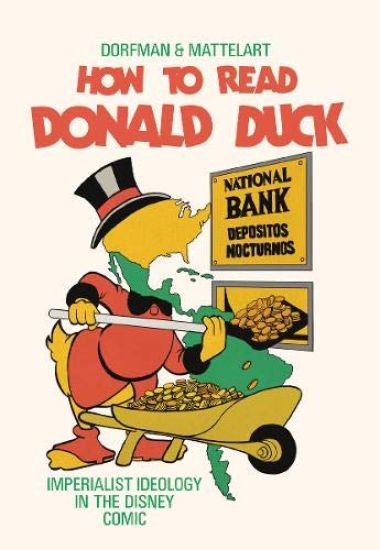
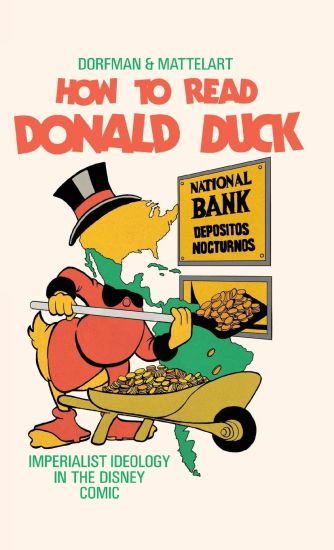
How to Read Donald Duck

How to Read Donald Duck

Ariel Dorfman; Armand Mattelart

Pluto Press
2019
pokkari
First published in 1971, How to Read Donald Duck shocked readers by revealing how capitalist ideology operates in our most beloved cartoons. Having survived bonfires, impounding and being dumped into the ocean by the Chilean army, this controversial book is once again back on our shelves. Written and published during the blossoming of Salvador Allende's revolutionary socialism, the book examines how Disney comics not only reflect capitalist ideology, but are active agents working in this ideology's favour. Focusing on the hapless mice and ducks of Disney, curiously parentless, marginalised and always short of cash, Ariel Dorfman and Armand Mattelart expose how these characters established hegemonic ideas about capital, race, gender and the relationship between developed countries and the Third World. A devastating indictment of a media giant, a document of twentieth-century political upheaval, and a reminder of the dark undercurrent of pop culture, How to Read Donald Duck is once again available, together with a new introduction by Ariel Dorfman.
How to Read Donald Duck

How to Read Donald Duck

Ariel Dorfman; Armand Mattelart

Pluto Press
2019
sidottu
First published in 1971, How to Read Donald Duck shocked readers by revealing how capitalist ideology operates in our most beloved cartoons. Having survived bonfires, impounding and being dumped into the ocean by the Chilean army, this controversial book is once again back on our shelves. Written and published during the blossoming of Salvador Allende's revolutionary socialism, the book examines how Disney comics not only reflect capitalist ideology, but are active agents working in this ideology's favour. Focusing on the hapless mice and ducks of Disney, curiously parentless, marginalised and always short of cash, Ariel Dorfman and Armand Mattelart expose how these characters established hegemonic ideas about capital, race, gender and the relationship between developed countries and the Third World. A devastating indictment of a media giant, a document of twentieth-century political upheaval, and a reminder of the dark undercurrent of pop culture, How to Read Donald Duck is once again available, together with a new introduction by Ariel Dorfman.
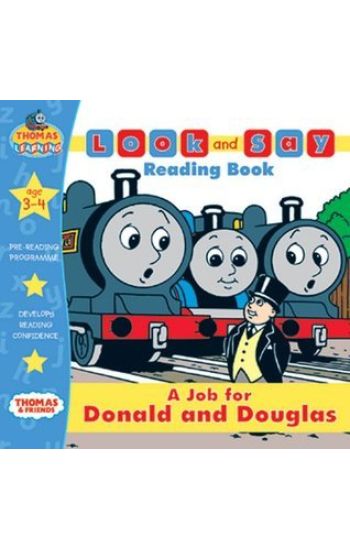
Job for Donald and Douglas

Job for Donald and Douglas

Based On W. Awdry

Egmont UK Ltd
2003
sidottu
Contains a sixteen page story, some picture puzzles and a 'spot the difference' spread designed to engage the child's interest and confidence in reading. The vocabulary used is taken from the National Curriculum word list plus key words from the TTE Learning programme.