Kirjojen hintavertailu. Mukana 11 699 587 kirjaa ja 12 kauppaa.

Kirjahaku

Etsi kirjoja tekijän nimen, kirjan nimen tai ISBN:n perusteella.

1000 tulosta hakusanalla Edmund Edel

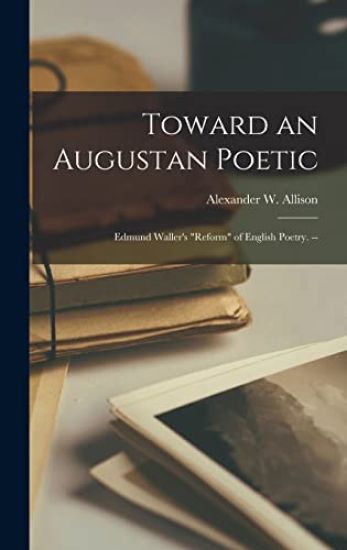
Toward an Augustan Poetic: Edmund Waller's "reform" of English Poetry. --

Toward an Augustan Poetic: Edmund Waller's "reform" of English Poetry. --

Alexander W. (Alexander Ward) Allison

Hassell Street Press
2021
sidottu
This work has been selected by scholars as being culturally important and is part of the knowledge base of civilization as we know it.This work is in the public domain in the United States of America, and possibly other nations. Within the United States, you may freely copy and distribute this work, as no entity (individual or corporate) has a copyright on the body of the work.Scholars believe, and we concur, that this work is important enough to be preserved, reproduced, and made generally available to the public. To ensure a quality reading experience, this work has been proofread and republished using a format that seamlessly blends the original graphical elements with text in an easy-to-read typeface.We appreciate your support of the preservation process, and thank you for being an important part of keeping this knowledge alive and relevant.
The Saga of Edmund Burke

The Saga of Edmund Burke

Mark Hulliung

TAYLOR FRANCIS LTD
2024
nidottu
This book offers an examination of responses to Edmund Burke from the last decades of the eighteenth century to the present day, ending with the question whether there is still a role for him to play in post-Thatcher England. It includes a chapter asking the same question about America. The sharp focus on Burke’s legacy permits the author to cover a great many years while remaining quite concise. Written in an accessible style, modest in length, covering major debates in England over the course of two centuries and more, this book aims to reach out to as many potential readers as possible.
The Saga of Edmund Burke

The Saga of Edmund Burke

Mark Hulliung

TAYLOR FRANCIS LTD
2023
sidottu
This book offers an examination of responses to Edmund Burke from the last decades of the eighteenth century to the present day, ending with the question whether there is still a role for him to play in post-Thatcher England. It includes a chapter asking the same question about America. The sharp focus on Burke’s legacy permits the author to cover a great many years while remaining quite concise. Written in an accessible style, modest in length, covering major debates in England over the course of two centuries and more, this book aims to reach out to as many potential readers as possible.
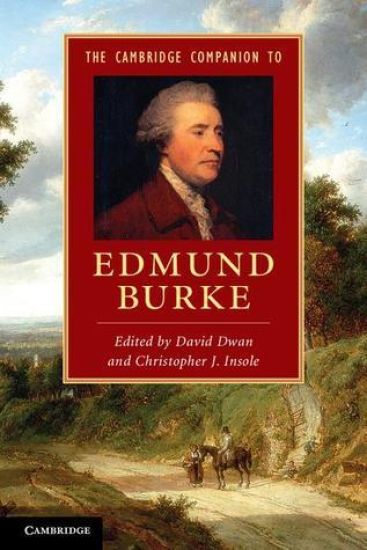
The Cambridge Companion to Edmund Burke
Edmund Burke prided himself on being a practical statesman, not an armchair philosopher. Yet his responses to specific problems - rebellion in America, the abuse of power in India and Ireland, or revolution in France - incorporated theoretical debates within jurisprudence, economics, religion, moral philosophy and political science. Moreover, the extraordinary rhetorical force of Burke's speeches and writings quickly secured his reputation as a gifted orator and literary stylist. This Companion provides a comprehensive assessment of Burke's thought, exploring all his major writings from his early treatise on aesthetics to his famous polemic, Reflections on the Revolution in France. It also examines the vexed question of Burke's Irishness and seeks to determine how his cultural origins may have influenced his political views. Finally, it aims both to explain and to challenge interpretations of Burke as a romantic, a utilitarian, a natural law thinker and founding father of modern conservatism.
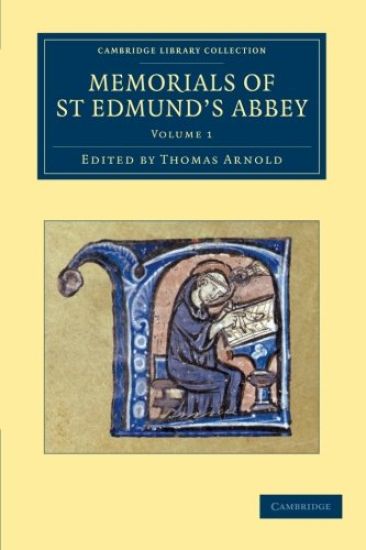
Memorials of St Edmund's Abbey

Memorials of St Edmund's Abbey

Cambridge University Press
2012
pokkari
Bury St Edmunds possessed one of the wealthiest abbeys in England. This three-volume collection of Latin documents relating to the abbey was edited with English side-notes by Thomas Arnold (1823–1900) and published between 1890 and 1896. Volume 1 contains lives of the Saxon king Edmund (martyred by the Vikings), the miracles attributed to him, and Jocelyn de Brakelond's late twelfth-century chronicle of the abbey. In the preface, Arnold examines the manuscript sources that survive from Bury, analyses the legend of St Edmund, and discusses similarities between the cult of Edmund and that of St Cuthbert at Durham. Jocelyn's biography of Abbot Samson (d.1211) is one of the best-known manuscripts. Abbo of Fleury's Passio Sancti Eadmundi was commissioned by Ramsey Abbey around 985 and describes Edmund's death and sainthood. The accounts of his miracles were written by Herman the archdeacon around 1090 and by Abbot Samson a century later.
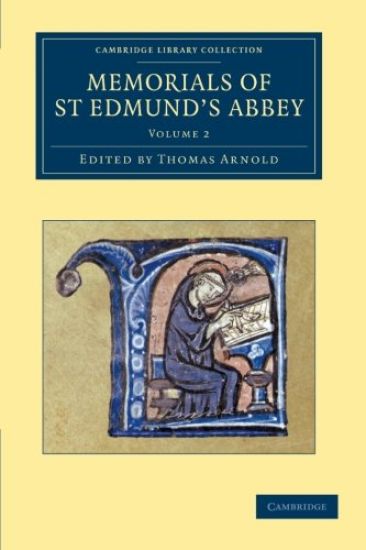
Memorials of St Edmund's Abbey

Memorials of St Edmund's Abbey

Cambridge University Press
2012
pokkari
Bury St Edmunds possessed one of the wealthiest abbeys in England. This three-volume collection of Latin documents relating to the abbey was edited by Thomas Arnold (1823–1900) and published between 1890 and 1896. Volume 2 contains a chronicle terminating in 1212, accounts of building works, narratives of abbatial elections in 1215, 1257 and 1302, and an early thirteenth-century Anglo-Norman metrical biography of St Edmund by Denis Pyramus, a monk of the abbey. There is also an account of the expulsion of the Franciscans from Bury by the Benedictines in 1257 and 1263. More serious were the ongoing disputes between the abbey and town that led to the Great Riot of 1327, in which the abbey was sacked, the abbot deported, and monks and civilians killed in a succession of attacks throughout the year. The settlement of 1331 is included in the appendix, and English side-notes are provided throughout.
Memorials of St Edmund's Abbey

Memorials of St Edmund's Abbey

Cambridge University Press
2012
pokkari
Bury St Edmunds possessed one of the wealthiest abbeys in England. This three-volume collection of Latin documents relating to the abbey was edited by Thomas Arnold (1823–1900) and published between 1890 and 1896. Volume 3 contains a variety of records. The Cronica Buriensis covers the years 1020–1346 in a manuscript of c.1400, and the Brevis Cronica, possibly by Thomas Croftis, c.1479, covers 1020–1471. There is also a collection of fifteenth-century letters, excerpts from Cambridge manuscripts relating to Bury St Edmunds, an account of the fourteenth-century dispute between the abbey and Bishop Bateman of Norwich, and a description of the fire of 1465 that completely gutted the church. The appendices include by-laws of 1477 concerning the town weavers, a charter of privileges of 1447, and another life of St Edmund. A glossary and index to all three volumes are also provided, along with English side-notes throughout.
Commerce and Manners in Edmund Burke's Political Economy

Commerce and Manners in Edmund Burke's Political Economy

Gregory M. Collins

Cambridge University Press
2020
sidottu
Although many of Edmund Burke's speeches and writings contain prominent economic dimensions, his economic thought seldom receives the attention it warrants. Commerce and Manners in Edmund Burke's Political Economy stands as the most comprehensive study to date of this fascinating subject. In addition to providing rigorous textual analysis, Collins unearths previously unpublished manuscripts and employs empirical data to paint a rich historical and theoretical context for Burke's economic beliefs. Collins integrates Burke's reflections on trade, taxation, and revenue within his understanding of the limits of reason and his broader conception of empire. Such reflections demonstrate the ways that commerce, if properly managed, could be an instrument for both public prosperity and imperial prestige. More importantly, Commerce and Manners in Edmund Burke's Political Economy raises timely ethical questions about capitalism and its limits. In Burke's judgment, civilizations cannot endure on transactional exchange alone, and markets require ethical preconditions. There is a grace to life that cannot be bought.
Commerce and Manners in Edmund Burke's Political Economy

Commerce and Manners in Edmund Burke's Political Economy

Gregory M. Collins

Cambridge University Press
2024
pokkari
Although many of Edmund Burke's speeches and writings contain prominent economic dimensions, his economic thought seldom receives the attention it warrants. Commerce and Manners in Edmund Burke's Political Economy stands as the most comprehensive study to date of this fascinating subject. In addition to providing rigorous textual analysis, Collins unearths previously unpublished manuscripts and employs empirical data to paint a rich historical and theoretical context for Burke's economic beliefs. Collins integrates Burke's reflections on trade, taxation, and revenue within his understanding of the limits of reason and his broader conception of empire. Such reflections demonstrate the ways that commerce, if properly managed, could be an instrument for both public prosperity and imperial prestige. More importantly, Commerce and Manners in Edmund Burke's Political Economy raises timely ethical questions about capitalism and its limits. In Burke's judgment, civilizations cannot endure on transactional exchange alone, and markets require ethical preconditions. There is a grace to life that cannot be bought.