
Kirjahaku
Etsi kirjoja tekijän nimen, kirjan nimen tai ISBN:n perusteella.
1000 tulosta hakusanalla Edna Healey




Awarded a Silver Medal in the category Human Resources and Employee Training from the 2014 Axiom Business Book Awards • Create the inclusive, high performance workforce needed to succeed in an increasing multicultural society and global marketplace• Learn how global organizations and leading professional associations develop integrated HR/diversity talent strategies, and the specific challenges they face• Get practical tools to assess integrated HR/diversity strategic planning, and see why organizations are not making more diversity progress• Develop specific performance indicators to track your progress in implementing synergistic HR/diversity approaches• Case studies of SHRM, federal and state government, global corporations, and higher education illustrate systematic, integrated HR/diversity effortsFor HR professionals and leaders, chief diversity officers, line managers, and executives in the private and public sectors and higher education, this book presents a systematic approach to integrating HR practices and strategic diversity initiatives to create the inclusive, high performance workforce that every enterprise and institution needs to succeed in an increasingly multicultural society and global marketplace.The authors’ point of departure is that talent is the primary strategic asset necessary for organizational survival and success in a demographically diversifying and globally interconnected world. Organizations seeking to attain their full potential in this new talent frontier must optimize their human capital resources by the deliberate development of synergy between human resource (HR) and diversity programs. Failure to integrate and coordinate these two functions will erode organizational competitiveness, whether it is in developing new markets, products, programs, or services.As the first book to provide a concrete roadmap to integrated HR and diversity strategy, the authors identify two critical practices: talent management through the orchestration of HR and diversity programs to enhance organizational capability by unleashing, mobilizing, nurturing, and sustaining the contributions of a diverse and talented workforce; and talent sustainability through the close integration of HR and diversity to continuously develop systems, structures, processes, and a culture that heighten employee commitment, engagement, and inclusion. They further believe that there should be a commonality of practice across all types of organizations, and that each sector can learn from the others to accelerate its adaptation to today’s rapidly shifting national and global realities.Based on the most current research and on interviews with HR and diversity leaders in major organizations, this book provides the reader with concrete strategies and practical tools for implementing a successful and sustainable talent management program. It also addresses common barriers to the development of synergistic HR and diversity strategy, and how to overcome them.Given the evolutionary nature of the integration of HR and diversity, the authors present nine extensive case studies from all organizational sectors, as well as from the two leading Human Resource professional associations – the Society for Human Resource Management (SHRM) and the College and University Professional Association for Human Resources (CUPA-HR) – to illustrate the dynamic intersection between HR and diversity practices.

The Department Chair as Transformative Diversity Leader
Edna Chun; Alvin Evans
Stylus Publishing
2015
sidottu
With the imminent demographic shifts in our society and the need to prepare students for citizenship in a global, knowledge-based society, the role of the academic department chair in creating diverse and inclusive learning environments is arguably the most pivotal position in higher education today. In the United States, increasing minority student enrollment coupled with the emergence of a minority majority American nation by 2042 demands that academic institutions be responsive to these changing demographics. The isolation of the ivory tower is no longer an option. This is the first book to address the role of the department chair in diversity and addresses an unmet need by providing a research-based, systematic approach to diversity leadership in the academic department based upon survey findings and in-person interviews. The department chair represents the nexus between the faculty and the administration and is positioned uniquely to impact diversity progress. Research indicates that more than 80 percent of academic decisions regarding appointment, curriculum, tenure and promotion, classroom pedagogy, and student outcomes are made by the department chair in consultation with the faculty. This book examines the multidimensional contributions that chairs make in advancing diversity within their departments and institutions in the representation of diverse faculty and staff; in tenure and promotion; curricular change; student learning outcomes; and departmental climate. The scope and content of the book is not limited to institutions in the United States but is applicable to academic institutions globally in their efforts to address the access and success of increasingly diverse student populations. It addresses institutional power structures and the role of the dean in relation to the appointment of chairs and their impact on the success of chairs from non-dominant groups, including female, minority, and lesbian/gay/transgendered individuals who serve in predominantly white male departments. Using qualitative and quantitative research methods, the book analyzes predominant structural and behavioral barriers that can impede diversity progress within the academic department. It then focuses upon the opportunities and challenges chairs face in their collaborative journey with faculty and administration toward inclusive departmental and institutional practices. Each chapter provides concrete strategies that chairs can use to strengthen diversity in the academic department.Addressed to department chairs, deans, faculty, and administrative leaders in higher education in all Western societies facing demographic change and global challenges, this book offers a critical road map to creating the successful academic institutions that will meet the needs of our changing populations.

The Department Chair as Transformative Diversity Leader
Edna Chun; Alvin Evans
Stylus Publishing
2015
nidottu
With the imminent demographic shifts in our society and the need to prepare students for citizenship in a global, knowledge-based society, the role of the academic department chair in creating diverse and inclusive learning environments is arguably the most pivotal position in higher education today. In the United States, increasing minority student enrollment coupled with the emergence of a minority majority American nation by 2042 demands that academic institutions be responsive to these changing demographics. The isolation of the ivory tower is no longer an option. This is the first book to address the role of the department chair in diversity and addresses an unmet need by providing a research-based, systematic approach to diversity leadership in the academic department based upon survey findings and in-person interviews. The department chair represents the nexus between the faculty and the administration and is positioned uniquely to impact diversity progress. Research indicates that more than 80 percent of academic decisions regarding appointment, curriculum, tenure and promotion, classroom pedagogy, and student outcomes are made by the department chair in consultation with the faculty. This book examines the multidimensional contributions that chairs make in advancing diversity within their departments and institutions in the representation of diverse faculty and staff; in tenure and promotion; curricular change; student learning outcomes; and departmental climate. The scope and content of the book is not limited to institutions in the United States but is applicable to academic institutions globally in their efforts to address the access and success of increasingly diverse student populations. It addresses institutional power structures and the role of the dean in relation to the appointment of chairs and their impact on the success of chairs from non-dominant groups, including female, minority, and lesbian/gay/transgendered individuals who serve in predominantly white male departments. Using qualitative and quantitative research methods, the book analyzes predominant structural and behavioral barriers that can impede diversity progress within the academic department. It then focuses upon the opportunities and challenges chairs face in their collaborative journey with faculty and administration toward inclusive departmental and institutional practices. Each chapter provides concrete strategies that chairs can use to strengthen diversity in the academic department.Addressed to department chairs, deans, faculty, and administrative leaders in higher education in all Western societies facing demographic change and global challenges, this book offers a critical road map to creating the successful academic institutions that will meet the needs of our changing populations.

Conducting an Institutional Diversity Audit in Higher Education
Edna Chun; Alvin Evans
Stylus Publishing
2019
sidottu
Implementing systematic diversity transformation requires embracing all aspects of diversity—gender, sexual orientation, disability, gender identification, and other salient characteristics of difference—as well as race and ethnicity.This book lays out a framework for a systematic and sustained diversity process that first recognizes that too many diversity initiatives have generated more statements of intent than actual change, and that audits conducted by outside bodies frequently fail to achieve buy-in or long-term impact, and are costly endeavors. The authors’ framework identifies nine dimensions that need to be addressed to achieve a comprehensive audit that leads to action, describes the underlying research-based practices, and offers guidance on ensuring that all relevant voices are heard. The process is designed to be implemented by and within the institution, saving the considerable expense of outside consulting and design. In addition, it offers flexibility in the timing and sequence of implementation, and provides the means for each institution to interrogate its unique circumstances, context, and practices. This book provides a concrete process for data gathering, analysis, and evaluation of institution-wide diversity efforts through a progressive, modular approach to diversity transformation. It gives campuses the ability to audit, evaluate, and analyze diversity progress on the nine dimensions and prioritize areas of focus. Its systematic, research-based approach supports continuous improvement and proactively addresses accreditation criteria. The book is designed as a collaborative tool that will enable every constituency on campus—from boards of trustees, presidents, provosts, executive officers, diversity officers, deans, department heads and chairs, administrators, HR officers, faculty senates and staff councils, diversity taskforces, multicultural centers, faculty, and researchers—to identify processes and relationships that need to change and implement practices that value and support the diversity on their campuses, and undertake the transformation necessary for institutional success in a changing world.The questions and guidelines set out in this book will enable all stakeholders to:• Audit the progress on each diversity dimension• Identify gaps between research-based practices and current approaches• Tie diversity benchmarks to accreditation frameworks and strategic plans• Chart the organization’s overall progress in the development of comprehensive diversity initiatives leading toward Inclusive Excellence• Prioritize institutional diversity initiatives based upon a comparison of the current state and the desired state, availability of resources, and the importance of each dimension in relation to institutional diversity goals• Create a long-term strategy for diversity transformation that provides a concrete, research-based method for auditing progress and future planning
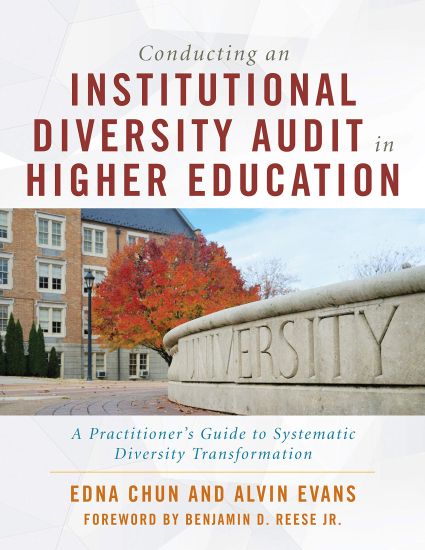
Conducting an Institutional Diversity Audit in Higher Education
Edna Chun; Alvin Evans
Stylus Publishing
2019
nidottu
Implementing systematic diversity transformation requires embracing all aspects of diversity—gender, sexual orientation, disability, gender identification, and other salient characteristics of difference—as well as race and ethnicity.This book lays out a framework for a systematic and sustained diversity process that first recognizes that too many diversity initiatives have generated more statements of intent than actual change, and that audits conducted by outside bodies frequently fail to achieve buy-in or long-term impact, and are costly endeavors. The authors’ framework identifies nine dimensions that need to be addressed to achieve a comprehensive audit that leads to action, describes the underlying research-based practices, and offers guidance on ensuring that all relevant voices are heard. The process is designed to be implemented by and within the institution, saving the considerable expense of outside consulting and design. In addition, it offers flexibility in the timing and sequence of implementation, and provides the means for each institution to interrogate its unique circumstances, context, and practices. This book provides a concrete process for data gathering, analysis, and evaluation of institution-wide diversity efforts through a progressive, modular approach to diversity transformation. It gives campuses the ability to audit, evaluate, and analyze diversity progress on the nine dimensions and prioritize areas of focus. Its systematic, research-based approach supports continuous improvement and proactively addresses accreditation criteria. The book is designed as a collaborative tool that will enable every constituency on campus—from boards of trustees, presidents, provosts, executive officers, diversity officers, deans, department heads and chairs, administrators, HR officers, faculty senates and staff councils, diversity taskforces, multicultural centers, faculty, and researchers—to identify processes and relationships that need to change and implement practices that value and support the diversity on their campuses, and undertake the transformation necessary for institutional success in a changing world.The questions and guidelines set out in this book will enable all stakeholders to:• Audit the progress on each diversity dimension• Identify gaps between research-based practices and current approaches• Tie diversity benchmarks to accreditation frameworks and strategic plans• Chart the organization’s overall progress in the development of comprehensive diversity initiatives leading toward Inclusive Excellence• Prioritize institutional diversity initiatives based upon a comparison of the current state and the desired state, availability of resources, and the importance of each dimension in relation to institutional diversity goals• Create a long-term strategy for diversity transformation that provides a concrete, research-based method for auditing progress and future planning

ISBN 978-1-63227-057-3 Published by New World Poetry (New World Books Series No. 36) Yunyu Qing: Clouds & Rain 《云雨情》is a groundbreaking novel about a Chinese woman's sensual journey into American life, a fascinating story of Yun who wades through numerous cultural shocks such as obesity, plagiarism and homophobia, and explores life's enigma on sex and love. Does sex = love or ? love? Erotic and playful. Amazingly frank and disturbing... It contains five chapters, totaling 248 pages.

Published by New World Poetry (New World Books Series No. 36). First Chinese translation of the great book known as Clouds and Rain: A China-to America Memoir. With fantastic reviews and comments from famous scholars and critic and collected by major libraries. The translation reads beautiful and sensational. Yunyu Qing: Clouds & Rain is a groundbreaking novel about a Chinese woman's sensual journey into American life, a fascinating story of Yun who wades through numerous cultural shocks such as obesity, plagiarism and homophobia, and explores life's enigma on sex and love. Does sex = love or ? love? Erotic and playful. Amazingly frank and disturbing...

"I write to sense the sound / of my own breath, to hear / even the silences." That tiny poem concludes Listening Still, and it could stand as the epigraph for the entire collection. Using a dazzling array of verse forms ranging from free verse and concrete poetry to villanelle, sestina and pantoum, Small demonstrates how she was shaped by the tragedies and triumphs of her life. Like Robert Frost, Small is a believer in synecdoche-smaller things touching larger things. Some of the most moving poems in Listening Still deal with the significance of the most quotidian things-a little boy asleep on a bus, a bunch of Shasta daisies... --Miles David Moore, author of The Bears of Paris and Rollercoaster "Sparrows sing me into day," says Edna Small's sturdy, synaesthetic, often witty and always lovely voice. The many tributes to the winged choir members that populate her mornings soar and serenade. Throughout, there are glimpses of a gracefully aging, sensuous person facing dusk -and beyond. Longer meditative poems reflect losses - there is earned grief in this collection populated by noisy birds, conversations between lovers, messages from the dead. But mostly there is delight. One chuckles at the sly turns of simple words. One gasps at the stunning wham of a last inexorable line. And one simply enjoys the wildly fun poems in the final section. Small's poems, whether a complex villanelle or a terse word picture, are a tribute to a sensibility working, with all senses and cylinders, "to hear, even the silences." --Eleanor Elson Heginbotham, Professor Emerita, Concordia University; author of Reading Fascicles of Emily Dickinson: Dwelling in Possibilities. "A love of shapes, surfaces, and depths" characterizes Edna Small's collection Listening Still. Each of the poems, like the stones in "My Father's Gardens", seem to arrive by serendipity, their idioms and endings both polished and remarkably casual. Small is a miraculist of the everyday, a tilter at rainbows. That said, she spurns the cheap revelation, recognizing the inexorable conflict between desire and satisfaction. In the ragged lines of "Elegy for Jason" ("a silent surge roars within / the comet gone from view") or in the hushed ferocity of "Queens in the Garden", Small reveals the bittersweet amber of her verbal power. -- Karl O'Hanlon, Poet, Co-editor of Eborakon

The Taubman Approach to Piano Technique: A Comprehensive Guide to Overcome Physical Limitations and Unlock Your Full Pianistic Potential
Edna Golandsky
Mascot Books
2024
nidottu
Edna Golandsky is a world-renowned piano pedagogue, the leading authority on the Taubman Approach, and the co-founder of The Taubman Institute and The Golandsky Institute. She is a graduate of the Juilliard School, where she studied under Jane Carlson, Rosina Lh vinne, and Adele Marcus. After graduating from Juilliard, she studied with Dorothy Taubman for several decades. Ms. Golandsky has earned worldwide acclaim for her pedagogical expertise, extraordinary ability to solve technical problems, and her penetrating musical insight. She has been featured in publications such as the New York Times, the Strad, Piano Magazine, Classical Music, Jazz Times, and the Clavier Companion, among others. To learn more about Ms. Golandsky and the Taubman Approach, visit ednagolandsky.com.


The Ballad of the Harp-Weaver and Other Poems
Edna St Vincent Millay
Indoeuropeanpublishing.com
2019
pokkari
Edna St. Vincent Millay, (born February 22, 1892, Rockland, Maine, U.S.--died October 19, 1950, Austerlitz, New York), American poet and dramatist who came to personify romantic rebellion and bravado in the 1920s.Millay was reared in Camden, Maine, by her divorced mother, who recognized and encouraged her talent in writing poetry. Her first published poem appeared in the St. Nicholas Magazine for children in October 1906. She remained at home after her graduation from high school in 1909, and in four years she published five more poems in St. Nicholas. Her first acclaim came when "Renascence" was included in The Lyric Year in 1912; the poem brought Millay to the attention of a benefactor who made it possible for her to attend Vassar College. She graduated in 1917.In that year Millay published her first book, Renascence and Other Poems, and moved to Greenwich Village in New York City. There she became a lively and admired figure among the avant garde and radical literary set. To support herself Millay, under the pseudonym "Nancy Boyd," submitted hackwork verse and short stories to magazines, and while her ambition to go on the stage was short-lived, she worked with the Provincetown Players for a time and later wrote the one-act Aria da Capo (1920) for them. The same year she published the verse collection A Few Figs from Thistles, from which the line "My candle burns at both ends" derives. The poem was taken up as the watchword of the "flaming youth" of that era and brought her a renown that she came to despise. In 1921 she published Second April and two more plays, Two Slatterns and a King and The Lamp and the Bell. She also began a two-year European sojourn, during which she was a correspondent for Vanity Fair.Millay won a Pulitzer Prize in 1923 for Ballad of the Harp-Weaver (1922) and married Eugen Jan Boissevain, a Dutch businessman with whom from 1925 she lived in a large, isolated house in the Berkshire foothills near Austerlitz, New York. In 1925 the Metropolitan Opera Company commissioned her to write an opera with Deems Taylor. The resulting work, The King's Henchman, first produced in 1927, became the most popular American opera up to its time and, published in book form, sold out four printings in 20 days.Millay's youthful appearance, the independent, almost petulant tone of her poetry, and her political and social ideals made her a symbol of the youth of her time. In 1927 she donated the proceeds from her poem "Justice Denied in Massachusetts" to the defense of Sacco and Vanzetti and personally appealed to the governor of the state for their lives. Her major later works include The Buck in the Snow (1928), which introduced a more somber tone to her poetry; Fatal Interview (1931), a highly acclaimed sonnet sequence; and Wine from These Grapes (1934). Her letters were edited by A.R. Macdougall in 1952.The bravado and stylish cynicism of much of Millay's early work gave way in later years to more personal and mature writing, and she produced, particularly in her sonnets and other short poems, a considerable body of intensely lyrical verse. A final collection of her verse appeared posthumously as Mine the Harvest in 1954. (britannica.com)

The Ballad of the Harp-Weaver and Other Poems
Edna St Vincent Millay
Indoeuropeanpublishing.com
2019
sidottu
Edna St. Vincent Millay, (born February 22, 1892, Rockland, Maine, U.S.--died October 19, 1950, Austerlitz, New York), American poet and dramatist who came to personify romantic rebellion and bravado in the 1920s.Millay was reared in Camden, Maine, by her divorced mother, who recognized and encouraged her talent in writing poetry. Her first published poem appeared in the St. Nicholas Magazine for children in October 1906. She remained at home after her graduation from high school in 1909, and in four years she published five more poems in St. Nicholas. Her first acclaim came when "Renascence" was included in The Lyric Year in 1912; the poem brought Millay to the attention of a benefactor who made it possible for her to attend Vassar College. She graduated in 1917.In that year Millay published her first book, Renascence and Other Poems, and moved to Greenwich Village in New York City. There she became a lively and admired figure among the avant garde and radical literary set. To support herself Millay, under the pseudonym "Nancy Boyd," submitted hackwork verse and short stories to magazines, and while her ambition to go on the stage was short-lived, she worked with the Provincetown Players for a time and later wrote the one-act Aria da Capo (1920) for them. The same year she published the verse collection A Few Figs from Thistles, from which the line "My candle burns at both ends" derives. The poem was taken up as the watchword of the "flaming youth" of that era and brought her a renown that she came to despise. In 1921 she published Second April and two more plays, Two Slatterns and a King and The Lamp and the Bell. She also began a two-year European sojourn, during which she was a correspondent for Vanity Fair.Millay won a Pulitzer Prize in 1923 for Ballad of the Harp-Weaver (1922) and married Eugen Jan Boissevain, a Dutch businessman with whom from 1925 she lived in a large, isolated house in the Berkshire foothills near Austerlitz, New York. In 1925 the Metropolitan Opera Company commissioned her to write an opera with Deems Taylor. The resulting work, The King's Henchman, first produced in 1927, became the most popular American opera up to its time and, published in book form, sold out four printings in 20 days.Millay's youthful appearance, the independent, almost petulant tone of her poetry, and her political and social ideals made her a symbol of the youth of her time. In 1927 she donated the proceeds from her poem "Justice Denied in Massachusetts" to the defense of Sacco and Vanzetti and personally appealed to the governor of the state for their lives. Her major later works include The Buck in the Snow (1928), which introduced a more somber tone to her poetry; Fatal Interview (1931), a highly acclaimed sonnet sequence; and Wine from These Grapes (1934). Her letters were edited by A.R. Macdougall in 1952.The bravado and stylish cynicism of much of Millay's early work gave way in later years to more personal and mature writing, and she produced, particularly in her sonnets and other short poems, a considerable body of intensely lyrical verse. A final collection of her verse appeared posthumously as Mine the Harvest in 1954. (britannica.com)


Follow the Watkins family through their lives as they move through adulthood, marriage, love, and loss. With the love of God and the support from Christianity helping them through, the family makes difficult decisions that ultimately bring them closer together.

George and Lynda Watkins have always followed God's light and direction, a light that ultimately leads to their miraculous meeting with a young orphan boy named Peter. Join Peter and his new family as they grow together in faith and in love for one another.