
Kirjahaku
Etsi kirjoja tekijän nimen, kirjan nimen tai ISBN:n perusteella.
1000 tulosta hakusanalla Erica Silverman

Patient Care Information Systems
Erica L. Drazen; Jane B. Metzger; Jami L. Ritter; Mark K. Schneider
Springer-Verlag New York Inc.
2012
nidottu
In the current era of health care reform, the pressures to truly manage patient care and to build effective integrated delivery systems are generating intense interest in patient care information systems. Health care institutions cannot provide seamlees access to care without seamless access to information, and they cannot manage and improve care without improved information management. Patient Care Information Systems examines how to design and implement these systems so they successfully meet the needs of physicians, nurses, and other health care providers. In one convenient reference, the authors summarize and synthesize previously disparate research and case experiences on these systems and suggest future directions based on the evolving demands of administrators and caregivers.


The Ultimate Guide to SAT Grammar
Erica L. Meltzer
Createspace Independent Publishing Platform
2011
nidottu
For the most recent (2013) edition of this book, see: http: //www.amazon.com/2nd-Edition-Ultimate-Guide-Grammar/dp/1492353299/ The most comprehensive guide to SAT grammar available. Thorough explanations cover virtually every concept tested, from the most common to the most obscure, and dozens of cumulative exercises teach you not only to recognize and correct errors but also to predict them. Includes an extensive list of idioms as well as a complete index of Writing questions in the Official College Board Guide, grouped by both error type and by test. Intended to be used in conjunction with the Official College Board Guide and with Eight Multiple Choice SAT Writing Tests: The Companion Workbook to The Ultimate Guide to SAT Grammar .

A great country for men and dogs, but hell on women and horses. - Old Texas Proverb. The town of M dia is inhabited by scoundrels and in the midst, Dannah Marshall, a woman of limitless strength stands alone. As she fights to hold tight to both her ranch and her pride, she is forced to endure her family crumbling around her. Dannah's headstrong demeanor makes her the perfect game for Henry Edwards, a dastardly businessman. As Edwards struggles to control his own family and his own town, he crashes fists first into the Marshalls. The game comes to a halt as Dannah finds herself falling in love with Cole, her childhood playmate and Henry Edwards' eldest son. The Daisy Chain, is a suspenseful story woven with rich characters - a modern classic and a must read




I Used to Live in a Place Like This
Erica Thomas; Catherine Powell Thomas
Createspace Independent Publishing Platform
2012
nidottu


Chemistry of love and the power of God
Erica Womack-Coldmon
Createspace Independent Publishing Platform
2012
nidottu
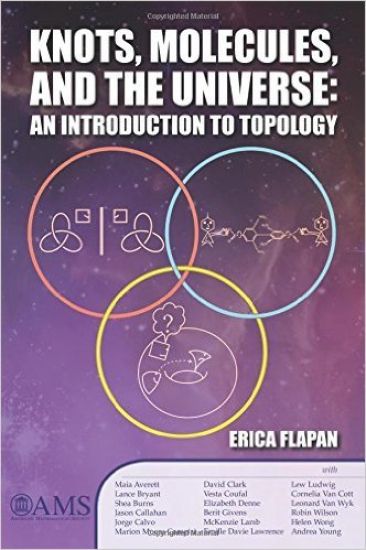
Knots, Molecules, and the Universe
Erica Flapan; Maia (CON) Averett; Lance (CON) Bryant
Amer Mathematical Society
2016
sidottu

Knots, Links, Spatial Graphs, and Algebraic Invariants
Erica Flapan; Allison Henrich; Aaron Kaestner
Amer Mathematical Society
2017
pokkari

Topology and Geometry of Biopolymers
Erica (EDT) Flapan; Helen (EDT) Wong
Amer Mathematical Society
2020
pokkari


Braving the dusty trails of the Wild West, cowgirl Dorothy and her horse Toto are riding to see the wonderful Wiz Kid of Oz! The legendary entertainer is auditioning new acts for his Emerald Circus, and Dorothy and her friends, Tinny, Crow and Leo, hope they can impress him with their talents. But when Dorothy's lucky silver spurs are stolen by a wicked rival, will Dorothy be able to believe in her own grit and still give her best performance? With Far Out Classic Stories, experience The Wonderful Wizard of Oz like never before in this twisted graphic novel retelling for kids.
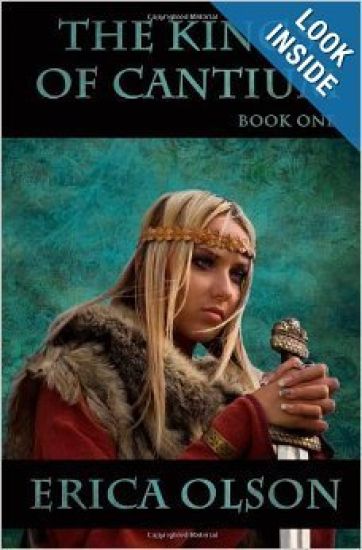
In the Iron Age, the world is changing. At night, Isa Uliac lays down her scythe and dances by the fire, her reward for long hours in the fields. The land of June never changes - until the Remi come. These strangers solve problems that should have taken years to unravel. Soon they build roads through the fields and demand tribute. The people of June no longer dance and sing. When the Remi nearly kill Isa's brother, she knows that she must act. She sets off for Cantium, an old ally of June that no one has visited for generations. Only this legendary kingdom could defeat the Remi. But Cantium isn't what Isa expected. Can she overcome her horror at what she finds there and convince the Cantians to help June, before it's too late? Fiction / Fantasy / Historical Approximately 27,000 words (Novella) Book 1 of The Kings of Cantium quartet www.erica-olson.com From Author's End Note: Cantium, though fictionalized here, was a real place: the present-day county of Kent in southeast England. I took the name from Julius Caesar's Gallic Wars, which mentions four kings of Cantium who ruled at the time of Caesar's expedition to Britain in 54 BC. These were Iron Age kings, each ruling from a hill-fort - a fortified center of population, production, and culture. Of all the British tribes, Caesar says, the Cantians were the most civilized. The Remi in The Kings of Cantium are rather like the Romans: foreign invaders with superior weapons and equipment and more systematized ways of doing things. Rome had conquered Iron Age Britain by the end of the first century AD. The real-life Remi were a people of northeastern Gaul (modern France). Allying themselves with Julius Caesar, they fought other Gallic tribes when most of the tribes rebelled against Rome. The Remi were a warlike people, famous for their horses. Later, after they were absorbed into the Roman Empire, Remi troops fought in many of Rome's campaigns, including, probably, the conquest of Britain. The events of this book, though, are entirely of my own invention. I could have written a strictly historical novel, but wanted to allow my imagination free room to play.

In 1969, Supreme Court Justice Abe Fortas called free speech in public schools a "hazardous freedom," but one well worth the risk. A half-century later, with technology enabling students to communicate in ways only dreamed about in Fortas' time, that freedom seems more hazardous than ever. Yet still worth the risk, given equal respect for students' First Amendment rights and for the requirements of an orderly educational institution. This book provides educators, administrators, school board members and parents a starting point in creating student speech policies that encourage the responsible exercise of constitutional freedoms, while respecting the learning environment. The author discusses the history, sociology, law and philosophy surrounding student speech, demonstrating that free speech and effective teaching and administration in public schools are not mutually exclusive.