--This is a collection of letters (held in the institutions mentioned below) sent by Frederick Victor Dickins, a pioneer British scholar of Japanese literature, to Ernest Mason Satow, Kumagusu Minakata and other correspondents, with the addition of five letters written by him and published in The Times between 28 February 1880 and 10 May 1904.72 letters to Ernest Mason Satow in the National Archives in London49 letters to Kumagusu Minakata in the Minakata Kumagusu Archives in Tanabe, Wakayama Prefecture6 letters to Sir Harry Parkes and others in the Jardine Matheson Archives at the University Library, Cambridge--All letters are transcribed from the original manuscripts with full Japanese translations.--Based on the editors’ thorough research, detailed annotations and introductions are added in both English and Japanese which provides scholars and students with valuable information on the early days of Japanese studies in England.
This book has been considered important throughout the human history, and so that this work is never forgotten Alpha Editions has made efforts in its preservation by republishing this book in a modern format for the present and future generations. This whole book has been re-formatted, re-typed and re-designed. These books are not made of scanned copies of their original work, and hence the text is clear and readable.
A tour of France, presented through the writings of thirty-three British and American authors, past and present, including Peter Mayle, Mark Twain, Edith Wharton, M. F. K. Fisher, Paul Theroux, and Ernest Hemingway, celebrates the country's food, people, cultures, and areas of interest. Original. 20,000 first printing.
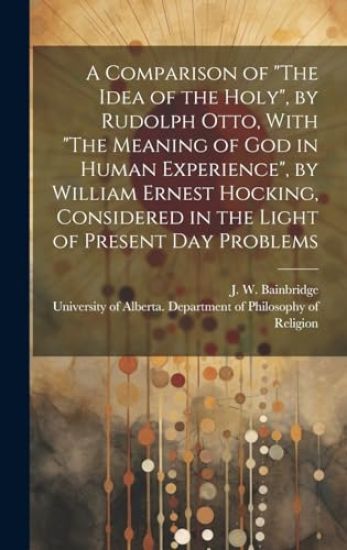
This book is an academic work that compares two influential theories of religious experience. Author J.W. Bainbridge analyzes the works of Rudolph Otto and William Ernest Hocking, examining their similarities and differences and considering their relevance to contemporary religious and philosophical debates. This book is a must-read for anyone interested in the philosophy of religion.This work has been selected by scholars as being culturally important, and is part of the knowledge base of civilization as we know it.This work is in the "public domain in the United States of America, and possibly other nations. Within the United States, you may freely copy and distribute this work, as no entity (individual or corporate) has a copyright on the body of the work.Scholars believe, and we concur, that this work is important enough to be preserved, reproduced, and made generally available to the public. We appreciate your support of the preservation process, and thank you for being an important part of keeping this knowledge alive and relevant.








![Stubble Farm; Or, Three Generations of English Farmers. [A Novel.] by the Author of "Ernest Struggles," Etc. [H. Simmons.]](/covers/9781241070823.jpg)
![Stubble Farm; Or, Three Generations of English Farmers. [A Novel.] by the Author of "Ernest Struggles," Etc. [H. Simmons.]](/covers/9781241071455.jpg)