Kirjojen hintavertailu. Mukana 11 699 587 kirjaa ja 12 kauppaa.

Kirjahaku

Etsi kirjoja tekijän nimen, kirjan nimen tai ISBN:n perusteella.

1000 tulosta hakusanalla G. W. Ross

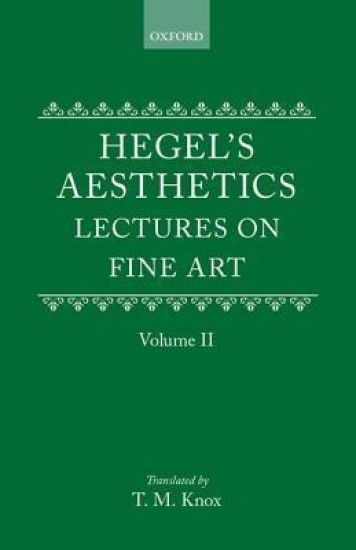
Hegel's Aesthetics: Volume 2

Hegel's Aesthetics: Volume 2

G. W. F. Hegel

Clarendon Press
1988
sidottu
This is the first of two volumes of the only English edition of Hegel's Aesthetics, the work in which he gives full expression to his seminal theory of art. The substantial Introduction is his best exposition of his general philosophy of art. In Part I he considers the general nature of art as a spiritual experience, distinguishes the beauty of art and the beauty of nature, and examines artistic genius and originality. Part II surveys the history of art from the ancient world through to the end of the eighteenth century, probing the meaning and significance of major works. Part III (in the second volume) deals individually with architecture, sculpture, painting, music, and literature; a rich array of examples makes vivid his exposition of his theory.
Hegel's Logic

Hegel's Logic

G. W. F. Hegel; J. N. Findlay

Clarendon Press
1975
nidottu
What I think remains sustainable and valid in Hegel's thought is the attempt to regard the ongoing crisis of reason as itself constitutive of self-consciousness. |s Revue Internationale de Philosophie |d 01/10/1996
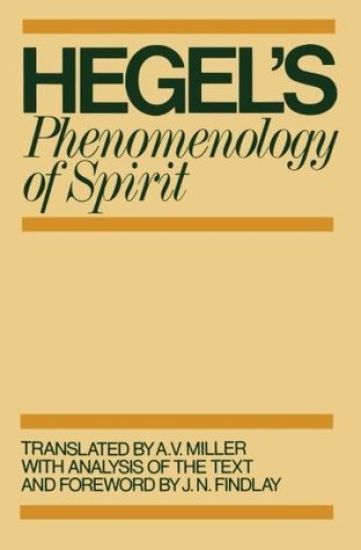
Phenomenology of Spirit

Phenomenology of Spirit

G. W. F. Hegel; J. N. Findlay

Oxford University Press Inc
1979
nidottu
This brilliant study of the stages in the mind's necessary progress from immediate sense-consciousness to the position of a scientific philosophy includes an introductory essay and a paragraph-by-paragraph analysis of the text to help the reader understand this most difficult and most influential of Hegel's works.
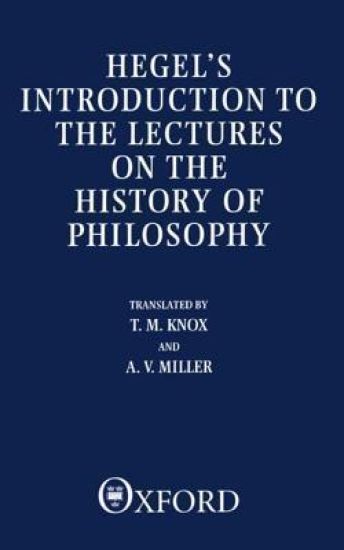
Introduction to the Lectures on the History of Philosophy
This new translation of the first volume of Hegel's Lectures on the History of Philosophy is a welcome and valuable addition to the new translations of Hegel's works, and now appears in paperback for the first time. Hegel's History of Philosophy has been described as perhaps one of his greatest achievements, and also as the first systematic history of philosophy since Aristotle. The translation included material from lecture notes taken by Hegel's pupils in 1923-4, 1925-6, and 1927-8. This material was not available to Haldane and Simson when they made their translation nearly 100 years ago. The present volume, which supersedes that earlier one, besides being indispensable for the professional student, will also introduce those unfamiliar with Hegel to his conception of philosophy.
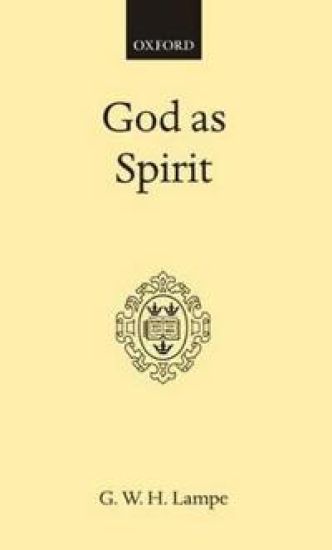
God as Spirit

God as Spirit

G. W. H. Lampe

Clarendon Press
1977
sidottu
This book sets out to present a Christian understanding of God in terms of the fundamental category of 'God as Spirit'. It shows that such an approach offers an alternative and preferable way of interpreting the biblical revelations as compared with the traditional account in terms of orthodox trinitarian and incarnational theology.
Lake Tanganyika and its Life

Lake Tanganyika and its Life

G. W. Coulter

Oxford University Press
1991
sidottu
Lake Tanganyika, situated in the western rift system of East Africa, is the largest in volume of the African Great Lakes and the second deepest lake in the world. It is extremely ancient in comparison with most lakes. The aquatic flora and fauna are remarkable for their diversity and high degree of endemicity, as well as for the numbers of species and genera present. The lake has attracted international interest and much has been written about it. With its comprehensive bibliography, this book should provide a foundation of information that will be useful in further studies.
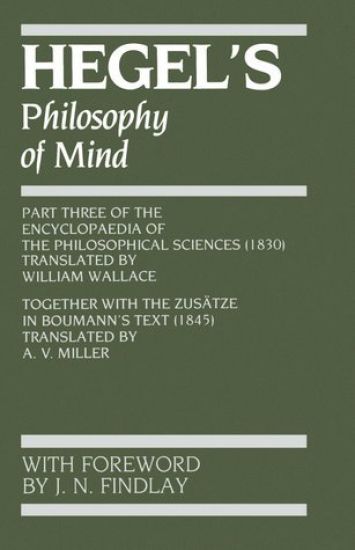
Hegel's Philosophy of Mind

Hegel's Philosophy of Mind

G. W. F. Hegel; J. N. Findlay

Clarendon Press
1970
nidottu
The present reissue of Wallace's translation of Hegel's Philosophy of Mind includes the Zusatze or lecture-notes which, in the collected works, accompany the first section entitled "Subjective Mind" and which Wallace omitted from his translation. Professor J. N. Findlay has written a Foreword and this replaces Wallace's introductory essays.
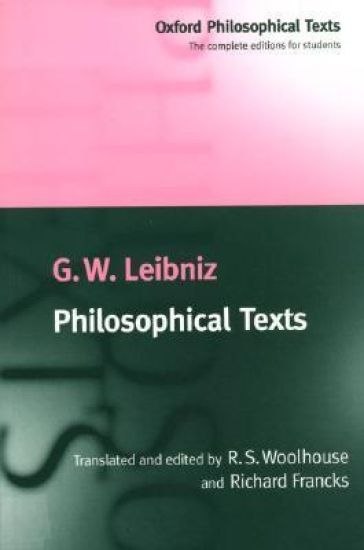
Philosophical Texts

Philosophical Texts

G. W. Leibniz

Oxford University Press
1998
nidottu
The Oxford Philosophical Texts series consists of authoritative teaching editions of canonical texts in the history of philosophy from the ancient world down to modern times. Each volume provides a clear, well laid out text together with a comprehensive introduction by a leading specialist, giving the student detailed critical guidance on the intellectual context of the work and the structure and philosophical importance of the main arguments. Endnotes are supplied which provide further commentary on the arguments and explain unfamiliar references and terminology, and a full bibliography and index are also included. The series aims to build up a definitive corpus of key texts in the Western philosophical tradition, which will form a reliable and enduring resource for students and teachers alike. This volume contains Leibniz's most important texts, starting with the Discourse on Metaphysics (1686), which marks the beginning of maturity in Leibniz's ideas and ending with the Monadology (1714), written in response to requests for a systematic, organized account of his overall philosophy. In between fall other key works including the New System of Nature (1695), the Specimen of Dynamics (1695), Nature Itself (1698), and the Principles of Nature and Grace (1714). Also included in the volume are critical reactions to the Discourse and the New System by Leibniz's contemporaries, Antoine Arnauld, Pierre Bayle, and Simon Foucher, together with Leibniz's responses. All the texts are newly translated into English for this edition, and each is preceded by a summary explaining its background, structure, and content. Also containing a substantial introduction, notes, and bibliography, the volume offers a comprehensive introduction to Leibniz's philosophy.
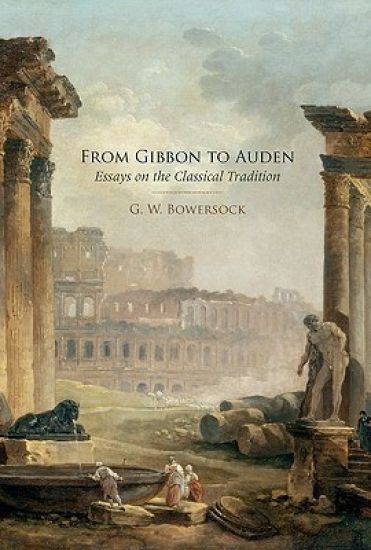
From Gibbon to Auden: Essays on the Classical Tradition

From Gibbon to Auden: Essays on the Classical Tradition

G. W. Bowersock

Oxford University Press
2011
nidottu
For several decades G. W. Bowersock has been one of our leading historians of the classical world. This volume collects seventeen of his essays, each illustrating how the classical past has captured the imagination of some of the greatest figures in modern historiography and literature. The essays here range across three centuries, the eighteenth to the twentieth, and are divided chronologically. The great Enlightenment historian Edward Gibbon is in large part the unifying force of this collection as he appears prominently in the first four essays, beginning with Bowersock's engaging introduction to the methods and genius behind The Decline and Fall of the Roman Empire. Gibbon's profound influence is revealed in subsequent essays on Jacob Burckhardt, the nineteenth-century scholar famous for his history of the Italian Renaissance but whose work on late antiquity is only now being fully appreciated; the modern Greek poet Constantine Cavafy, whose annotations on Gibbon's Decline and Fall tell us much about his own historical poems; and finally W. H. Auden, whose poem and little known essay "The Fall of Rome" were, in quirky ways, tributes to Gibbon. The collection reprints Auden's poem and essay in full. The result is a rich survey of the early modern and modern uses of the classical past by one of its most important contemporary commentators.
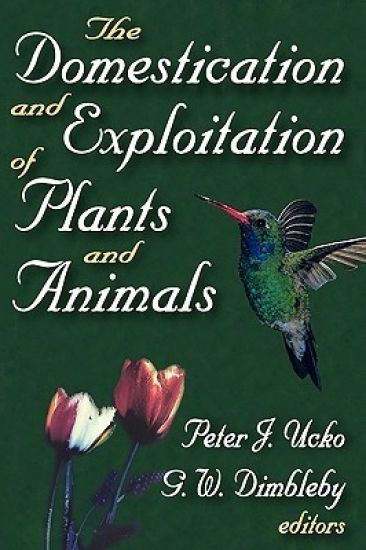
The Domestication and Exploitation of Plants and Animals
The domestication of plants and animals was one of the greatest steps forward taken by mankind. Although it was first achieved long ago, we still need to know what led to it and how, and even when, it took place. Only when we have this understanding will we be able to appreciate fully the important social and economic consequences of this step. Even more important, an understanding of this achievement is basic to any insight into modern man's relationship to his habitat. In the last decade or two a change in methods of investigating these events has taken place, due to the mutual realization by archaeologists and natural scientists that each held part of the key and neither alone had the whole. Inevitably, perhaps, the floodgate that was opened has resulted in a spate of new knowledge, which is scattered in the form of specialist reports in diverse journals.This volume results from presentations at the Institute of Archaeology, London University, discussing the domestication and exploitation of plants and animals. Workers in the archaeological, anthropological, and biological fields attempted to bridge the gap between their respective disciplines through personal contact and discussion. Modern techniques and the result of their application to the classical problems of domestication, selection, and spread of cereals and of cattle were discussed, but so were comparable problems in plants and animals not previously considered in this context.Although there were differing opinions on taxonomic classification, the editors have standardized and simplified the usage throughout this book. In particular, they have omitted references to authorities and adopted the binomial classification for both botanical and zoological names. They followed this procedure in all cases except where sub-specific differences are discussed and also standardized orthography of sites.
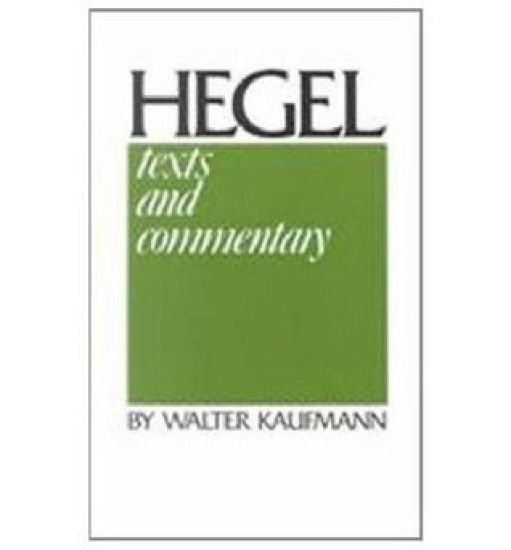
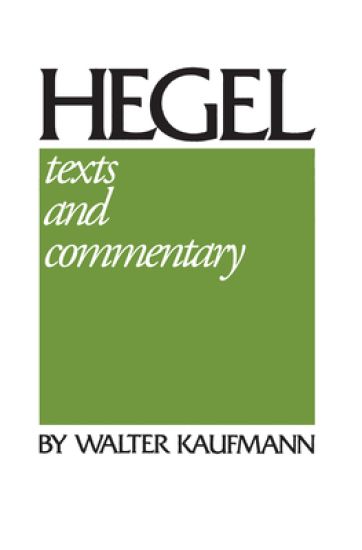
Hegel

Hegel

G. W. F. Hegel

University of Notre Dame Press
1977
nidottu
Herbert Marcuse called the preface to Hegel's Phenomenology "one of the greatest philosophical undertakings of all times." This summary of Hegel's system of philosophy is now available in English translation with commentary on facing pages. While remaining faithful to the author's meaning, Walter Kaufmann has removed many encumbrances inherent in Hegel's style.
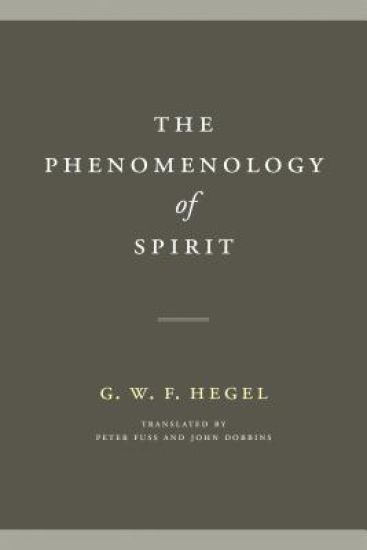
The Phenomenology of Spirit

The Phenomenology of Spirit

G. W. F. Hegel

University of Notre Dame Press
2019
sidottu
The Phenomenology of Spirit, first published in 1807, is G. W. F. Hegel's remarkable philosophical text that examines the dynamics of human experience from its simplest beginnings in consciousness through its development into ever more complex and self-conscious forms. The work explores the inner discovery of reason and its progressive expansion into spirit, a world of intercommunicating and interacting minds reconceiving and re-creating themselves and their reality. The Phenomenology of Spirit is a notoriously challenging and arduous text that students and scholars have been studying ever since its publication. In this long-awaited translation, Peter Fuss and John Dobbins provide a succinct, highly informative, and readily comprehensible introduction to several key concepts in Hegel's thinking. This edition includes an extensive conceptual index, which offers easy reference to specific discussions in the text and elucidates the more subtle nuances of Hegel's concepts and word usage. This modern American English translation employs natural idioms that accurately convey what Hegel means. Throughout the book, the translators adhered to the maxim: if you want to understand Hegel, read him in the English. This book is intended for intellectuals with a vested interest in modern philosophy and history, as well as students of all levels, seeking to access or further engage with this seminal text.
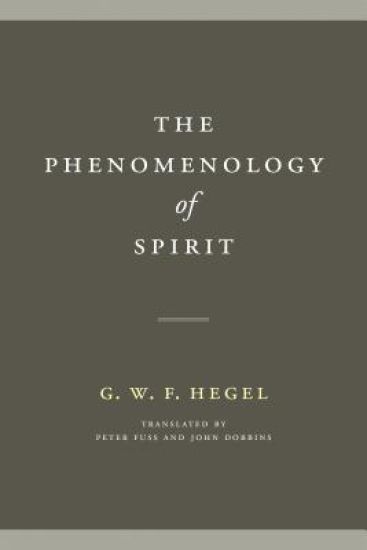
The Phenomenology of Spirit

The Phenomenology of Spirit

G. W. F. Hegel

University of Notre Dame Press
2019
nidottu
The Phenomenology of Spirit, first published in 1807, is G. W. F. Hegel's remarkable philosophical text that examines the dynamics of human experience from its simplest beginnings in consciousness through its development into ever more complex and self-conscious forms. The work explores the inner discovery of reason and its progressive expansion into spirit, a world of intercommunicating and interacting minds reconceiving and re-creating themselves and their reality. The Phenomenology of Spirit is a notoriously challenging and arduous text that students and scholars have been studying ever since its publication. In this long-awaited translation, Peter Fuss and John Dobbins provide a succinct, highly informative, and readily comprehensible introduction to several key concepts in Hegel's thinking. This edition includes an extensive conceptual index, which offers easy reference to specific discussions in the text and elucidates the more subtle nuances of Hegel's concepts and word usage. This modern American English translation employs natural idioms that accurately convey what Hegel means. Throughout the book, the translators adhered to the maxim: if you want to understand Hegel, read him in the English. This book is intended for intellectuals with a vested interest in modern philosophy and history, as well as students of all levels, seeking to access or further engage with this seminal text.
Hegel

Hegel

G. W. F. Hegel

UNIVERSITY OF NOTRE DAME PRESS
2022
sidottu
Herbert Marcuse called the preface to Hegel's Phenomenology "one of the greatest philosophical undertakings of all times." This summary of Hegel's system of philosophy is now available in English translation with commentary on facing pages. While remaining faithful to the author's meaning, Walter Kaufmann has removed many encumbrances inherent in Hegel's style.
Confessio Philosophi

Confessio Philosophi

G. W. Leibniz

Yale University Press
2006
sidottu
This volume contains papers that represent Leibniz’s early thoughts on the problem of evil, centering on a dialogue, the Confessio philosophi, in which he formulates a general account of God’s relation to sin and evil that becomes a fixture in his thinking.How can God be understood to be the ultimate cause, asks Leibniz, without God being considered as the author of sin, a conclusion incompatible with God’s holiness? Leibniz’s attempts to justify the way of God to humans lead him to deep discussion of related topics: the nature of free choice, the problems of necessitarianism and fatalism, the nature of divine justice and holiness. All but one of the writings presented here are available in English for the first time.
The Leibniz-Des Bosses Correspondence

The Leibniz-Des Bosses Correspondence

G. W. Leibniz

Yale University Press
2007
sidottu
This volume is a critical edition of the ten-year correspondence (1706-1716) between Gottfried Wilhelm Leibniz, one of Europe’s most influential early modern thinkers, and Bartholomew Des Bosses, a Jesuit theologian who was keen to bring together Leibniz’s philosophy and the Aristotelian philosophy and religious doctrines accepted by his order. The letters offer crucial insights into Leibniz’s final metaphysics and into the intellectual life of the eighteenth century.Brandon C. Look and Donald Rutherford present seventy-one of Leibniz’s and Des Bosses’s letters in the original Latin and in careful English translation. Few of the letters have been translated into English before. The editors also provide extensive annotations, deletions, and marginalia from Leibniz’s various drafts, and a substantial introduction setting the context for the correspondence and analyzing the main philosophical issues.
The Labyrinth of the Continuum

The Labyrinth of the Continuum

G. W. Leibniz

Yale University Press
2013
pokkari
This book gathers together for the first time an important body of texts written between 1672 and 1686 by the great German philosopher and polymath Gottfried Leibniz. These writings, most of them previously untranslated, represent Leibniz’s sustained attempt on a problem whose solution was crucial to the development of his thought, that of the composition of the continuum.The volume begins with excerpts from Leibniz’s Paris writings, in which he tackles such problems as whether the infinite division of matter entails “perfect points,” whether matter and space can be regarded as true wholes, whether motion is truly continuous, and the nature of body and substance. Comprising the second section is Pacidius Philalethi, Leibniz’s brilliant dialogue of late 1676 on the problem of the continuity of motion. In the selections of the final section, from his Hanover writings of 1677–1686, Leibniz abandons his earlier transcreationism and atomism in favor of the theory of corporeal substance, where the reality of body and motion is founded in substantial form or force. Leibniz’s texts (one in French, the rest in Latin) are presented with facing-page English translations, together with an introduction, notes, appendixes containing related excerpts from earlier works by Leibniz and his predecessors, and a valuable glossary detailing important terms and their translations.
China In World Affairs

China In World Affairs

G. W. Choudhury

Routledge
2019
sidottu
This up-to-date textbook reviews China's foreign policy goals since the PRC's active reemergence in world affairs following the Cultural Revolution of 1966-1969. Drawing on original sources and firsthand experience, as well as on a broad academic background, Dr. Choudhury examines China's global policy, diplomatic options, and strategy in the context of the triangular relationship of Washington, Moscow, and Beijing. His discussion-offering numerous unexpected insights-covers China's quest for security, the breakthrough in China-U.S. relations, the course of Sino-Soviet rivalry (particularly in the Asia-Pacific region), the PRC's role in the United Nations since 1971, how China has championed Third World countries, and the new, dynamic elements in post-Mao Chinese foreign policy. The book is current through the summer of 1981.