Kirjojen hintavertailu. Mukana 11 699 587 kirjaa ja 12 kauppaa.

Kirjahaku

Etsi kirjoja tekijän nimen, kirjan nimen tai ISBN:n perusteella.

1000 tulosta hakusanalla Gregory Gaines

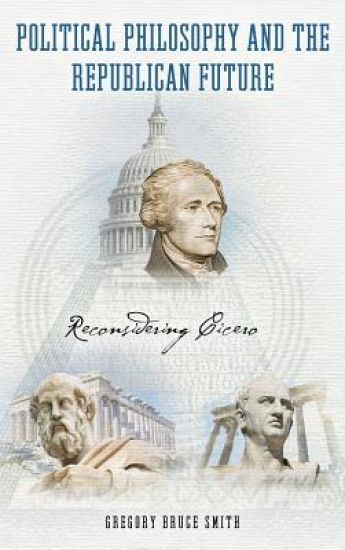
Political Philosophy and the Republican Future

Political Philosophy and the Republican Future

Gregory Bruce Smith

University of Notre Dame Press
2018
sidottu
Are we moving inevitably into an irreversible era of postnationalism and globalism? In Political Philosophy and the Republican Future, Gregory Bruce Smith asks, if participation in self-government is not central to citizens' vision of the political good, is despotism inevitable? Smith's study evolves around reconciling the early republican tradition in Greece and Rome as set out by authors such as Aristotle and Cicero, and a more recent tradition shaped by thinkers such as Machiavelli, Locke, Montesquieu, Adam Smith, Madison, and Rousseau. Gregory Smith adds a further layer of complexity by analyzing how the republican and the larger philosophical tradition have been called into question by the critiques of Nietzsche, Heidegger, and their various followers. For Smith, the republican future rests on the future of the tradition of political philosophy. In this book he explores the nature of political philosophy and the assumptions under which that tradition can be an ongoing tradition rather than one that is finished. He concludes that political philosophy must recover its phenomenological roots and attempt to transcend the self-legislating constructivism of modern philosophy. Forgetting our past traditions, he asserts, will only lead to despotism, the true enemy of all permutations of republicanism. Cicero's thought is presented as a classic example of the phenomenological approach to political philosophy. A return to the architectonic understanding of political philosophy exemplified by Cicero is, Smith argues, the key to the republican future.
Sin

Sin

Gregory Mellema

University of Notre Dame Press
2021
sidottu
This book brings clarification to our understanding of the nature of sin and will be of interest to nonphilosophers as well as philosophers. Most of the scholarly literature on sin has focused on theological issues, making book-length philosophical treatments of the topic hard to find. Sin, the newest contribution by Gregory Mellema, fills the gap by providing a short and lively summary of what contemporary philosophers are saying about the relationship between the traditional theological category of sin and contemporary philosophical ethics. Mellema brings together contributions by a number of philosophers, including Marilyn Adams, Robert Adams, Rebecca DeYoung, Alvin Plantinga, Michael Rea, Eleonore Stump, and Richard Swinburne, into a coherent discussion that clarifies our understanding of the nature of sin. The topics covered include the doctrine of original sin, accessory sins, mortal (or cardinal) sins, and venial sins. Mellema also examines Islamic codes of ethics, which include a category of acts that are "discouraged," some of which qualify as sins, and the final chapter surveys the teachings of six major world religions concerning sin. The overarching link between the chapters is that sin is fundamentally connected to the subject matter of morality. Analyzing the points of connection is profitable not just to enhance our theoretical understanding of sin but to provide a greater depth of knowledge as to how the moral choices we make can more effectively help us avoid sin and contribute to lives that are satisfying and authentically worthwhile. This concise introduction to sin and moral wrongdoing will have a wide readership and is intended for use in introductory level philosophy, philosophy of religion, or theological ethics courses.
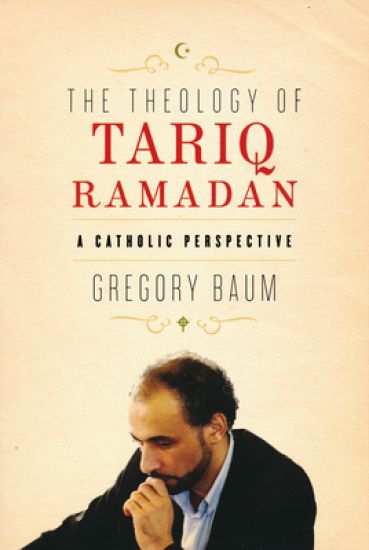
The Theology of Tariq Ramadan: A Catholic Perspective

The Theology of Tariq Ramadan: A Catholic Perspective

Gregory Baum

UNIVERSITY OF NOTRE DAME PRESS
2022
sidottu
Tariq Ramadan has emerged as one of the most influential Muslim theologians in the world today. In this important book, Gregory Baum presents for the first time an introduction to several key aspects of Ramadan's theological enterprise. Baum examines Ramadan's work historically within an interfaith perspective, drawing several parallels between Islamic and Catholic encounters with modernity. His comparison of the debates in the two traditions suggests that reform and renewal are compatible with the substance of both Catholic and Muslim traditions. After a brief account of the evolution of Catholic theology up to the Second Vatican Council, Baum introduces Ramadan's published work and theological orientation, examining both within the historical development of Islam. He outlines Ramadan's theology of God, humanity, and the universe and discusses Ramadan's interpretation of sharia, the divinely revealed Islamic way of life. The book then addresses what fidelity to Islam means for Western Muslims and contrasts Ramadan's theology with the theological liberalism advocated by some Muslim authors. Throughout, Baum makes helpful connections between Islam and Vatican II Catholicism. Both belief systems are steeped in ancient traditions, rely on a sacred book, and find themselves confronting a modern context. Reformist Islam shares much with Catholic social thought in showing a regard for the poor and marginalized. Baum concludes by examining points of difference between Muslim and Catholic theology that support further conversation. This readable introduction to Ramadan's work is accessible to non-Muslim students, teachers, clergy, and general readers interested in Islam and interfaith dialogue.
The Iliad, the Ramaya?a, and the Work of Religion

The Iliad, the Ramaya?a, and the Work of Religion

Gregory D. Alles

Pennsylvania State University Press
1994
pokkari
One often reads that literature works to construct worlds of meaning. This book argues that the Iliad and the Ramayana did not construct worlds so much as address them. It argues further that the worlds the Iliad and the Ramayana addressed were worlds in which words did not mean so much as persuade. In both ancient Greece and India, persuasion was central to harmonious social interaction. The failure of persuasion marked the limits of the patterns that configured human society; it also threatened social chaos. The work of the Iliad and the Ramayana was to transcend the limits and mystify the threat. In performing this work, the two poems made the configurations of social order fundamentally tenable. They also enabled them to endure up to the present day. Gregory Alles seeks to bring an awareness of some of the limits of significant ideological practices in the academic study of religions, especially the pursuit known as the history of religions. In the twentieth century, the history of religions has been formulated as a hermeneutical discipline. Its task has been to understand religious meanings, in whatever way the process of understanding meanings has been conceived. This investigation suggests, however, that a hermeneutical history of religions is too narrow. Among other things, it overlooks the religious work that these two poems perform. This study proposes that historians of religions conceive of their task not as hermeneutics but as history, that is, as a principled investigation of events in which religion occurs.
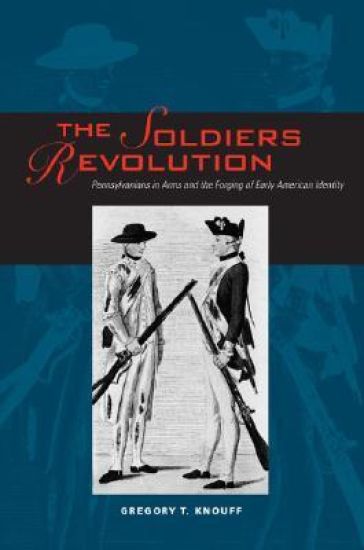
The Soldiers’ Revolution

The Soldiers’ Revolution

Gregory T. Knouff

Pennsylvania State University Press
2003
sidottu
What did the American Revolution mean to the ordinary soldiers who fought in it? Were they inspired by high-minded ideals of liberty and democracy, or were they seeking the material and practical rewards—bounties, land, and political advancement—that victory might bring them? We know much about the philosophical positions expressed by America’s Founding Fathers, but the common people did not necessarily share the Founders’ ideas. The Soldiers’ Revolution looks to those who took up arms in Pennsylvania to reveal the rich tapestry of local interests that led a nation to war. Many rank-and-file Revolutionaries left behind records of their experiences—everything from letters and journals to pension applications and loyalist claims. These records bring to light the soldiers’ widely ranging ideas and opinions about the war, about themselves, about the enemy, and about the American nation. In Pennsylvania enlisted men defined their communities through various local interests. This general localism was, ironically, one of the few shared popular Revolutionary ideals. Moreover, the experience of military violence was critical in defining broader ideologies of citizenship that contributed to ideas of an emerging American identity—an identity that privileged white men above Indians, African Americans, and women. "Tories," meanwhile, were forced to shed their local perspectives and embrace other ideas in keeping with imperial interests. The Soldiers’ Revolution offers us a rare glimpse into the everyday world of the American Revolution. We see how the common experience of war drew soldiers together as they began the long process of forging an identity for a fledgling nation.
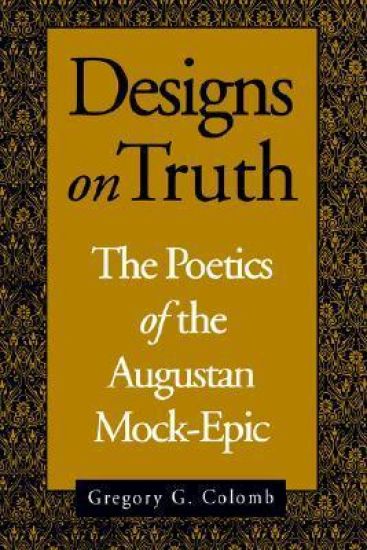
Designs on Truth

Designs on Truth

Gregory Colomb

Pennsylvania State University Press
1992
pokkari
Designs on Truth provides a reinterpretation of Augustan poetry, not as works to be defended before the court of Matthew Arnold and the Romantic tradition but as works that examine the rich relationships among text, culture, and world.In Designs on Truth, Gregory Colomb identifies the characteristics of the mock-epic and argues that the form had developed formal expectations. In making this argument, he explains the intentions of the writers of mock-epics, and expands our conception of the interest and significance of such poems. By demonstrating how these poems are supported by the genre's poetics, he brings out ways these poems differ from other "Augustan" poems such as the Horatian epistles that are often discussed with them.Designs on Truth puts into question the distinction between history and poetry in the mock-epic, examining it at three levels of poetic structure: fable (global narrative structure), and portraits (characterological narrative structure). Focusing chiefly on the mock-epic's representations in terms of class and "kind," this study returns historical particulars to the central role that the poets had always given them and seeks to understand how they are made poetic. Designs on Truth shows how the poems themselves subvert any easy distinction between historical and poetic particulars. This often philosophical genre is itself a reconsideration of the role of reference (fact) and judgment (value) in representation. This study shows how representation and judgment work in the mock-epic, and how together they stand at the heart of the dominant Augustan poetic. Colomb also provides new readings of the mock-epic, including the first comprehensive reading of The Dispensary since the eighteenth century.
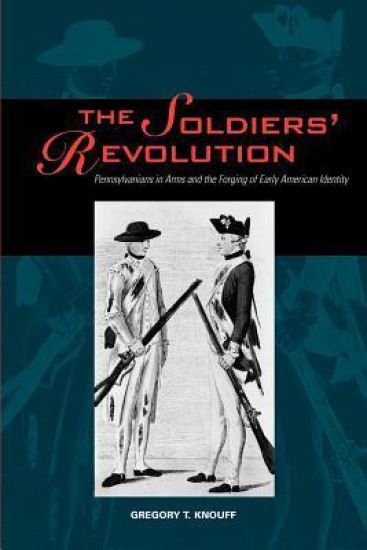
The Soldiers’ Revolution

The Soldiers’ Revolution

Gregory T. Knouff

Pennsylvania State University Press
2012
pokkari
What did the American Revolution mean to the ordinary soldiers who fought in it? Were they inspired by high-minded ideals of liberty and democracy, or were they seeking the material and practical rewards—bounties, land, and political advancement—that victory might bring them? We know much about the philosophical positions expressed by America’s Founding Fathers, but the common people did not necessarily share the Founders’ ideas. The Soldiers’ Revolution looks to those who took up arms in Pennsylvania to reveal the rich tapestry of local interests that led a nation to war. Many rank-and-file Revolutionaries left behind records of their experiences—everything from letters and journals to pension applications and loyalist claims. These records bring to light the soldiers’ widely ranging ideas and opinions about the war, about themselves, about the enemy, and about the American nation. In Pennsylvania enlisted men defined their communities through various local interests. This general localism was, ironically, one of the few shared popular Revolutionary ideals. Moreover, the experience of military violence was critical in defining broader ideologies of citizenship that contributed to ideas of an emerging American identity—an identity that privileged white men above Indians, African Americans, and women. "Tories," meanwhile, were forced to shed their local perspectives and embrace other ideas in keeping with imperial interests. The Soldiers’ Revolution offers us a rare glimpse into the everyday world of the American Revolution. We see how the common experience of war drew soldiers together as they began the long process of forging an identity for a fledgling nation.
Soviet Aims in Central America

Soviet Aims in Central America

Gregory W. Sand

Praeger Publishers Inc
1989
sidottu
Using Nicaragua as a case study, this book demonstrates how Soviet foreign policy has been the instrument for projecting Moscow's power and influence in a region that has been in the U.S. sphere of influences since 1898. Soviet Aims in Central America lays down the facts about the Soviets' drive since the 1950s to undermine U.S. influence in Central America by fueling guerrilla wars. G. W. Sand examines key Sandinista, Castroite, and Guatemalan Communist documents and reveals how Soviet military power is being used by the Sandinistas and their Cuban allies to consolidate power, threaten Nicaragua's neighbors, and ultimately revolutionize all of Central America. This, Sand claims, threatens the future of the United States itself.The foreword by former ambassador to Costa Rica, Lewis A. Tambs, chillingly describes the unprecedented threat to U.S. security by Soviet satellization of Central American countries. Sand begins the book with a detailed review of Soviet aims and strategies in the Americas. The book offers a history of the Sandinista movement as well as Soviet foreign policy toward Nicaragua. Further chapters explore the Sandinistas' record with regard to human rights and the current civil war in Nicaragua. Sand's detailed reading of Central American Communist documents reveals Soviet aims for the region. Finally, the book offers a possible strategy for averting Moscow's incursion into the United States' sphere of influence. Students of political science and scholars of Central America, or anyone interested in this volatile region, will find Soviet Aims in Central America provocative reading.
Jupiter's Ghost

Jupiter's Ghost

Gregory Zentz

Praeger Publishers Inc
1991
sidottu
The why's and what-if's of scientific inquiry constitute the core of science fiction, the purpose of which is to further explore these questions from every imaginable angle. Gregory L. Zentz affirms this connection between science and fiction, showing how integral a grasp of the theoretical and practical sciences is to an understanding of science fiction. Zentz provides a holistic, rather than a literary or a sociological analysis, thereby focussing on the genre of science fiction as a reflection of scientific and philosophical paradigms, both past and present.By outlining the history of science fiction literature from the ancients to the present, Zentz parallels the changes in its scope and vision with the progress of scientific research and discovery. Central to the text is the rapidly shifting and increasingly intricate nature of modern scientific knowledge and how difficult it is for science fiction writers to incorporate that knowledge into their works. These problems are addressed, and possible solutions are suggested. Jupiter's Ghost is an excellent resource for teachers and students of science fiction as well as devoted science fiction readers interested in exploring the conceptual framework in which the genre is grounded.
Blind-Sided

Blind-Sided

Gregory K. Moffatt

Praeger Publishers Inc
2000
sidottu
While print and broadcast media are filled every day with homicide accounts, the general public seems most disturbed by crimes attributed to individuals who otherwise seem normal. Murders by those perceived to be historically non-violent often appear to erupt with no warning whatsoever. Moffatt argues that certain key predictors of a predisposition to violence are usually present. Citing case studies of workplace, school, and domestic homicides, he debunks the myth that these murders happen out of the blue. He also includes valuable information on predicting and preventing future tragedies. This book explains why friends and colleagues who knew the perpetrators of violence overlooked or misunderstood warning signs, and it addresses the role that mental illness often plays in such crimes. Chapters are devoted to homicide in the workplace, domestic homicide, stalkers who kill, and homicide by children, including an entire chapter on the Columbine High School shooting. Using his experience as an educator, researcher, and clinician, Moffatt demonstrates how to identify the historically non-violent murderer through a process of risk assessment before a crime is committed. He also describes seven common mistakes people make that have resulted in one or more deaths.
A Violent Heart

A Violent Heart

Gregory K. Moffatt

Praeger Publishers Inc
2002
sidottu
Why are some people violent and aggressive while others are not? Where do these negative emotions and actions come from? What can be done to prevent dangerous behavior? Drawing upon years of research and experience as a therapist, lecturer, and consultant to law enforcement and business, Moffatt presents a broad perspective on the psychological and sociological roots of aggression. Using both case studies and theoretical constructs from several different fields, this work provides an overview of the diverse mix of factors that create individuals with a propensity to resort to violence. Topics include domestic violence, the violent child, mass murder, terrorism, serial killing, murder for hire, and hate crimes. Moffatt also details the growing phenomena of road rage, air rage, and sports rage.Avoiding complex psychological jargon, Moffatt helps the general reader to understand and easily apply these concepts. He also addresses intervention techniques and deterrents to criminal behavior, ranging from rehabilitation, to revised prison sentencing, to the death penalty. Stories of successful intervention and recovery round out the volume.
The Hanging of Old Brown

The Hanging of Old Brown

Gregory Toledo

Praeger Publishers Inc
2002
sidottu
Captured by United States Marines at Harper's Ferry, Virginia, a fifty-nine year old farmer was quickly brought to trial in nearby Charlestown and convicted of three capital crimes: treason against the Commonwealth of Virginia; conspiring with slaves to rebel; and murder. In a field on the outskirts of town he was hanged before fifteen hundred soldiers. Colonel Robert E. Lee, Professor Thomas J. Jackson, and John Wilkes Booth stood watching. The Hanging of Old Brown attempts to remove the veils that separate the contemporary observer from an understanding of the events and the convictions that brought John Brown to a Virginia scaffold ready to die.Brown struggled to find redemption for himself and his nation. His war on slavery and eventual execution would reap the whirlwinds that would herald the destruction of slavery. Beginning with events of 1776, Toledo provides the historical context of John Brown's war, enabling readers to approach this abolitionist visionary with a better understanding of the period that defined him. Toledo hopes to dispel notions that Brown was a mere fanatic or deranged militant. This work invites readers to become acquainted with a man who is, in the end, both flawed and heroic, always deliberate, and ultimately triumphant.
Wounded Innocents and Fallen Angels

Wounded Innocents and Fallen Angels

Gregory K. Moffatt

Praeger Publishers Inc
2003
sidottu
Violence of any kind is hard for most people to understand, but crimes against children and crimes committed by children are perhaps the most difficult to comprehend. Child abuse and neglect is a problem with generational effects. Women who were sexually abused in childhood, for example, are more likely than non-abused women to be harsh with their children, withhold affection, or even accept the sexual abuse of their own children by a spouse or lover. Yet children are not always merely the victims of aggression. They also perpetrate violent crimes in the form of bullying, assault, and homicide, as well as crimes on property, such as vandalism. Moffatt addresses the two sides of this cycle of violence, including examples from clinical case studies and treatment options.Moffatt details crimes against children, ranging from Munchausen Syndrome by Proxy, sexual and physical abuse, neglect, filicide, and infanticide. He addresses aggression committed by children against other people, property, and self, including self-mutilation and suicide. Written for both professional and lay audiences, counselors, teachers, psychologists, law enforcement, medical professionals, and therapists will benefit from the psychological discussions about causes and effects of aggression.
Moveable Feasts

Moveable Feasts

Gregory McNamee

Praeger Publishers Inc
2006
sidottu
Food has functioned both as a source of continuity and as a subject of adaptation in the course of human history. Onions have been a staple of the European diet since the Paleolithic era, while the orange is once again being cultivated in great quantities in Southern China, where it was originally cultivated. Other foods—such as the apple and pear in Central Asia, the tomato in Mexico, the chili pepper in South America, and rice in South Asia—remain staples of their original regions and of the world diet today.Still other items are now grown in places that would have seemed impossible in the past-bananas in geothermally heated greenhouses in Iceland, corn on the fringes of the Gobi, and tomatoes in space. But how did humans discover how to grow and consume these foods in the first place? How were they chosen over competing foods? How did they come to be so important to us? In this charming and frequently surprising compendium, Gregory McNamee gathers revelations from history, anthropology, chemistry, biology, and many other fields, and spins them into entertaining tales of discovery, complete with delicious recipes from many culinary traditions around the world. Among the 30 types of food discussed in the course of this alphabetically-arranged work are: the apple, the banana, chocolate, coffee, corn, garlic, honey, millet, the olive, the peanut, the pineapple, the plum, rice, the soybean, the tomato, and the watermelon. All of the recipes included with these diverse food histories have been adapted for recreation in the modern kitchen.
How to Protect Your Children on the Internet

How to Protect Your Children on the Internet

Gregory S. Smith

Praeger Publishers Inc
2007
sidottu
Parents and teachers are often ill-equipped to deal with the variety of devices and applications such as email, instant messaging, browsing, blogs, cell phones, and personal digital assistant devices (PDAs) that can facilitate the dangers lurking online. How to Protect Your Children on the Internet offers a comprehensive overview of the ways in which youth use such technologies and exposes the risks they represent. At the same time, it provides a roadmap that will enable parents and teachers to become more engaged in children's online activities, arming them with techniques and tips to help protect their children. Smith underscores his arguments through chilling, real-life stories, revealing approaches people are using to deceive and to conceal their activities online. Filled with practical advice and recommendations, his book is indispensable to anyone who uses the Internet and related technologies, and especially to those charged with keeping children safe.This book shares the risks of the Internet by detailing recent, real-world tragedies and revealing some of the secrets of online activities. It provides a pragmatic approach to help parents and teachers protect children against the threats of going online.
Words for Silence

Words for Silence

Gregory Fruehwirth

SPCK Publishing
2008
pokkari
Originating from weekly talks given to a contemplative community of monks and nuns, the meditations in this book aim to help the reader live as profoundly as possible, in deepening desire for union with God. Arranged according to the liturgical year, from Advent through to Pentecost, some of the meditations deal with practical issues, some offer guideposts for spiritual discernment, and others are lyrical evocations of the transformative power of the contemplative way. Underlying all is the basic assumption that God has drawn near to each one of us, and that our fulfilment is found in surrendering our lives to that Enfolding Presence and Creative Love. Fr Gregory Fruehwirth, OJN is a monk of the Order of Julian of Norwich, Wisconsin. For five years he has been serving as the Guardian, or Superior of the Order: before that, he was the groundskeeper. A published poet, he regularly leads retreats and quiet days all over the United States and in the United Kingdom. Like his patron, Julian of Norwich, his ministry is that of awakening in others a sense of God's love and encouraging an on-going response to that love as the meaning of all true life. He enjoys playing the flute, writing poems and gardening.
The Evangelical Universalist

The Evangelical Universalist

Gregory MacDonald

SPCK Publishing
2012
nidottu
Can an orthodox Christian, committed to the historic faith of the Church and the authority of the Bible, be a universalist? Is it possible to believe that salvation is found only by grace, through faith in Christ, and yet to maintain that in the end all people will be saved? Can one believe passionately in mission if one does not think that anyone will be lost forever? Could universalism be consistent with the teachings of the Bible? This book argues that the answer is 'yes' to all of these questions. Weaving together philosophical, theological and biblical considerations, the author shows that being a universalist is consistent with the central teachings of the Bible and of historic Christian theology.
Homeric Responses

Homeric Responses

Gregory Nagy

University of Texas Press
2004
pokkari
The Homeric Iliad and Odyssey are among the world's foremost epics. Yet, millennia after their composition, basic questions remain about them. Who was Homer-a real or an ideal poet? When were the poems composed-at a single point in time, or over centuries of composition and performance? And how were the poems committed to writing? These uncertainties have been known as The Homeric Question, and many scholars, including Gregory Nagy, have sought to solve it. In Homeric Responses, Nagy presents a series of essays that further elaborate his theories regarding the oral composition and evolution of the Homeric epics. Building on his previous work in Homeric Questions and Poetry as Performance: Homer and Beyond and responding to some of his critics, he examines such issues as the importance of performance and the interaction between audience and poet in shaping the poetry; the role of the rhapsode (the performer of the poems) in the composition and transmission of the poetry; the "irreversible mistakes" and cross-references in the Iliad and Odyssey as evidences of artistic creativity; and the Iliadic description of the shield of Achilles as a pointer to the world outside the poem, the polis of the audience.
Homeric Questions

Homeric Questions

Gregory Nagy

University of Texas Press
1996
pokkari
A Choice Outstanding Academic BookThe "Homeric Question" has vexed Classicists for generations. Was the author of the Iliad and the Odyssey a single individual who created the poems at a particular moment in history? Or does the name "Homer" hide the shaping influence of the epic tradition during a long period of oral composition and transmission?In this innovative investigation, Gregory Nagy applies the insights of comparative linguistics and anthropology to offer a new historical model for understanding how, when, where, and why the Iliad and the Odyssey were ultimately preserved as written texts that could be handed down over two millennia. His model draws on the comparative evidence provided by living oral epic traditions, in which each performance of a song often involves a recomposition of the narrative.This evidence suggests that the written texts emerged from an evolutionary process in which composition, performance, and diffusion interacted to create the epics we know as the Iliad and the Odyssey. Sure to challenge orthodox views and provoke lively debate, Nagy's book will be essential reading for all students of oral traditions.