Kirjojen hintavertailu. Mukana 11 627 469 kirjaa ja 12 kauppaa.

Kirjahaku

Etsi kirjoja tekijän nimen, kirjan nimen tai ISBN:n perusteella.

1000 tulosta hakusanalla Hamid Yusof

Al-Ghazali on Love, Longing, Intimacy & Contentment

Al-Ghazali on Love, Longing, Intimacy & Contentment

Abu Hamid al-Ghazali

The Islamic Texts Society
2016
nidottu
"Al-Ghazali on Love, Longing, Intimacy and Contentment" is the thirty-sixth chapter of Abu Hamid al-Ghazali's "Revival of the Religious Sciences" (Ihya Ulum al-Din), which is widely regarded as the greatest work of Muslim spirituality. "Al-Ghazali on Love, Longing, Intimacy and Contentment" is of fundamental importance in the history of Islamic thought and in the development of Sufism, being the first treatise to establish not merely the possibility but the necessity for the love of God.---In "Al-Ghazali on Love, Longing, Intimacy and Contentment", Ghazali argues that all the virtues and spiritual stages that precede love, like repentance, patience and thankfulness, lead to love; and all the spiritual stages that follow on from love are a result of it. Using proof texts from the Qur'an, the Traditions of the Prophet Muhammad and Sufi precepts, Ghazali succeeds in marshalling forceful arguments to make his case. Out of Ghazali's pioneering treatment would emerge not only new trends in Sufi theory and practice, but an entire body of mystical poetry including that of the great Persian poets Rumi and Hafiz.---Professor Eric Ormsby's fully annotated translation brings out all the beauty and lyricism of the text. The translation is preceded by an extensive introduction which sets the work in its historical and spiritual context.---In this new edition, the Islamic Texts Society has included the translation of Abu Hamid al-Ghazali's own Introduction to the "Revival of the Religious Sciences" which gives the reasons that caused him to write the work, the structure of the whole of the "Revival" and places each of the chapters in the context of the others.

Al-Ghazali on Invocations and Supplications

Al-Ghazali on Invocations and Supplications

Abu Hamid al-Ghazali

The Islamic Texts Society
2016
nidottu
The 4th edition of Nakamura's acclaimed translation of Book IX of the "Revival of the Religious Sciences" now including Ghazali's Introduction. Probably the most widely read compendium of prayers in the Muslim world. Popular for its comprehensiveness and for its exploration of the psychological and spiritual effects of prayer. With Arabic text.
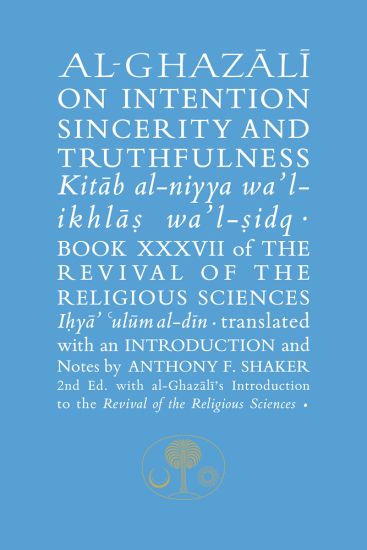
Al-Ghazali on Intention, Sincerity and Truthfulness

Al-Ghazali on Intention, Sincerity and Truthfulness

Abu Hamid al-Ghazali

The Islamic Texts Society
2016
nidottu
Al-Ghazali on Intention, Sincerity & Truthfulness is the thirty-seventh chapter of the Revival of the Religious Sciences. It falls in the section dealing with the virtues. Here Ghazali deals with the very important subject of intention which is of crucial importance in Islam. He asks: 'How can someone ignorant of the meaning of intention verify his own intention; or how can someone ignorant of the meaning of sincerity verify his own sincerity; or how can someone sincerely claim truthfulness if he has not verified its meaning?' In the Book of Intention, Sincerity & Truthfulness, Ghazali gives a response to each of these questions by expounding the reality and levels of intention, sincerity and truthfulness, those acts which affirm them and those acts which mar them. As in all his writings, Ghazali bases his arguments on the Qur'an, the example of the Prophet and the sayings of numerous scholars and Sufis.
Al-Ghazali on Disciplining the Soul & on Breaking the Two Desires

Al-Ghazali on Disciplining the Soul & on Breaking the Two Desires

Abu Hamid al-Ghazali

The Islamic Texts Society
2016
nidottu
"Al-Ghazali on Disciplining the Soul" is a translation of the twenty-third book of the "Revival of the Religious Sciences" (Ihya Ulum al-Din), which is widely regarded as the greatest work of Muslim spirituality. In "Al-Ghazali on Disciplining the Soul", Abu Hamid al-Ghazali illustrates how the spiritual life in Islam begins with `riyadat al-nafs', the inner warfare against the ego. The two chapters translated here detail the sophisticated spiritual techniques adopted by classical Islam in disciplining the soul. In Chapter One, "Disciplining the Soul", Ghazali focuses on how the sickness of the heart may be cured and how good character traits can be acquired. In Chapter Two, "Breaking the Two Desires", he discusses the question of gluttony and sexual desire-being the greatest of mortal vices-concluding, in the words of the Prophet, that "the best of all matters is the middle way". The translator, T. J. Winter, has added an introduction and notes which explore Ghazali's ability to make use of Greek as well as Islamic ethics.---In this new edition, the Islamic Texts Society has included the translation of Abu Hamid al-Ghazali's own Introduction to the "Revival of the Religious Sciences" which gives the reasons that caused him to write the work, the structure of the whole of the "Revival" and places each of the chapters in the context of the others.
Al-Ghazali on the Lawful and the Unlawful

Al-Ghazali on the Lawful and the Unlawful

Abu Hamid al-Ghazali

The Islamic Texts Society
2017
nidottu
Al-Ghazali's Book of the Lawful and the Unlawful is the fourteenth chapter of The Revival of the Religious Sciences, which is widely considered as the greatest work of Islamic spirituality. Written by one of the most famous of theologian-mystics of all time, The Book of the Lawful and the Unlawful is unlike other Islamic works concerned with legal issues.Here, Abu Hamid al-Ghazali aims to teach his readers firstly the theory of what is lawful and what is unlawful and how to deal with dubious or ambiguous issues, and secondly how to apply the knowledge they have gained to their everyday lives. The main support for this application, especially in matters that are unclear, is caution or prudence (wara) and Ghazali explains the degrees of prudence necessary beginning with the prudence of the upright and ending with the prudence of the saintly. Thus the sincere practice of what is lawful and desisting from what is unlawful become integrated into one's spiritual life. As in his other works, Ghazali bases himself on the Qur'an and narrations from the Prophet Muhammad, followed by examples from the Companions, the Successor generations and the pious Predecessors.
The New Digital World Order

The New Digital World Order

Khurram Hamid

MARKOSIA ENTERPRISES LTD
2022
nidottu
A pandemic is a biological war with an invisible enemy. COVID-19 is World War 3, where a biological holocaust is occurring on our social media feeds in real time.After every world war there is a period of post-war reconstruction. The New Digital World Order, presents a post-pandemic reconstruction guide on how the world can build back better; politically, socially, economically, culturally and environmentally.COVID-19 has been the best Chief Digital Officer the world has ever seen, it has accelerated the digitization of all aspects of humanity. Providing ideas on post-pandemic reconstruction, The New Digital World Order provides future foresight and disruptive ideas on how governments and businesses can build back better in the new normal.
How to Teach Economics

How to Teach Economics

Yousuf Hamid

Hachette Learning
2022
nidottu
Economics teachers often work by themselves or in small departments. This can mean they are forced to plan a lot of lessons from scratch with limited scope for shared planning or collaboration.Even as teaching becomes more research-informed, there is still the problem of having to work out how this best applies when teaching Economics, especially when there has been limited training in this.This can mean teachers are forced to adopt a trial-and-error approach, attempting to implement generic teaching and learning tips into economics lessons.Teachers plan each explanation individually, only learning what common misconceptions are through the painstaking experience of seeing puzzled expressions on multiple pupils' faces over the years. This book aims to change that.By looking at what the latest cognitive science research tells us about how pupils learn and crucially how that can be implemented in economics lessons, this book provides a short-cut to that trial-and-error approach.While the book summarises what the research tells us about pupil learning, this is fundamentally a ‘doing’ book.It is packed with practical examples of how research can be implemented in Economics lessons looking at explanations, misconceptions, assessment, curriculum and much more.
Book of Piety and Islamic Manners

Book of Piety and Islamic Manners

Abu Hamid Al-Ghazali

Light Publishing
2020
pokkari
Know that the beginning of guidance is outward piety (taqwa) and the end of guidance is inward piety (ihsan). Only through piety is anything really achieved; only the pious are guided. Piety designates carrying out the commands of God most high and turning aside from what He prohibits, and thus has two parts.In this book Imam Al-Ghazali sets out his ideal of how the religious man should order his life from hour to hour and day to day. The book is divided into three parts, obedience, avoidance of sins and the relationship between God and man and between His creation. This is one of Imam Al-Ghazali's final works, it embodies his life, spirituality and experience.
Swimming on the Lawn

Swimming on the Lawn

Yasmin Hamid

Fremantle Press
2017
pokkari
Told through the eyes of Farida, as well as her inquisitive siblings, this is a beautiful story about growing up in Sudan. Sudanese culture and customs are brought to life, from the ubiquitous tea service and hearty breakfasts to the commemoration of Muslim holidays and the rites of birth and death. But a happy childhood spent in the capital and the rural villages of 1960s Sudan ends startlingly with a sudden military coup that changes the make-up of Farida's family forever. Told in short, standalone chapters in direct and unadorned prose, the book is perfect for teachers to use as excerpts in the classroom.
The Book of Knowledge

The Book of Knowledge

Abu Hamid Al-Ghazali

Fons Vitae,US
2016
nidottu
The Book of Knowledge is the foundation of the forty books of the Revival of the Religious Sciences, Imam al-Ghazali's magnum opus. In the Book of Knowledge, he defines knowledge, its relation to faith, theology, and jurisprudence. The book deals with the virtue of knowledge from both rational and traditional points of view. It elucidates the types of knowledge and the nature of people's obligation to seek knowledge. Imam al-Ghazali defines jurisprudence and theology as branches of Islamic knowledge, then outlines those fields that people incorrectly consider to be Islamic disciplines, and distinguishes the praiseworthy from the blameworthy. He describes in detail the perils of disputation and the reasons people engage in debate and dialectics. He also considers the conduct incumbent on the teacher and student, and warns of the perils that can befall those pursuing knowledge. Finally, Imam al-Ghazali discusses the virtues and categories of the intellect and the prophetic traditions related to it.
The Mysteries of Purification

The Mysteries of Purification

Abu Hamid Al-Ghazali

Fons Vitae,US
2017
nidottu
In The Mysteries of Purification (Kitab asrar al tahara), the third of the forty books of the Revival of the Religious Sciences (Ihya' 'ulum al-din), Abu Hamid al-Ghazali explains the fundamentals of the purification that is necessary in order to perform the five daily prayers.
The Censure of This World Volume 26

The Censure of This World Volume 26

Abu Hamid Muhammad al-Ghazali

FONS VITAE,US
2023
nidottu
Being the twenty-sixth book of The Revival of the Religious Sciences (Ihya' 'ulum al-din), The Book of the Censure of This World (Kitab Dhamm al-dunya) seeks to persuade its reader of the folly of worldly pleasures and possessions.To do so, al-Ghazali begins with a collection of Islamic primary-source texts that speak to the dangers of this world from a variety of angles. He then adds to this collection fourteen metaphors for this world that illustrate its perfidious nature. In a third subsection, al-Ghazali provides an original rationale for renouncing worldly enjoyments, and he furnishes his reader with a blueprint for determining what constitutes 'this world' in its most dangerous sense. In a fourth and final subsection, al-Ghazali applies a sociological theory to enumerate the essential human vocations and identify the mechanisms through which these lead people away from God.
The Bane of the Tongue

The Bane of the Tongue

Abu Hamid Muhammad Al-Ghazali

FONS VITAE,US
2024
pokkari
The Bane of Tongue (Kitab afat al-lisan) is Book 24 of the Imam al-Ghazali’s magnum opus, I?ya? ?ulum al-din, The Revival of the Religious Sciences. Within the architecture of this monumental work, Afat al-lisan is the fourth book of the third quarter, The Ways to Perdition (Rub al-muhlikat), in which al-Ghazali sums up in ten books (or chapters) all the human shortcomings and vices traditionally believed to lead a person into a state of loss in this world and the Next, and which in certain respects overlap with the Judeo-Christian notion of the seven deadly sins. In Book 24, al-Ghazali divides the banes (afat) or defects of the tongue, from the least to the most offensive, into twenty short chapters, each of which comprises a psychological/spiritual analysis of how and why the particular defect might exist in a person's soul, examples of how it manifests itself in behavior, and practical suggestions for eliminating it from one's personality. The misuse of the gift of speech and language is certainly not something new, as this work, composed nearly 950 years ago, amply shows, but in this age of internet-based communication, it has taken on a new and more destructive dimension.