Kirjojen hintavertailu. Mukana 11 244 527 kirjaa ja 12 kauppaa.

Kirjahaku

Etsi kirjoja tekijän nimen, kirjan nimen tai ISBN:n perusteella.

1000 tulosta hakusanalla Henry Kitchell Webster

Henry Plantagenet

Henry Plantagenet

Barber Richard

The Boydell Press
2003
nidottu
Henry II is the most imposing figure among the medieval kings of England. His fiefs and domains extended from the Atlantic to the Mediterranean, and his court was frequented by the greatest thinkers and men of letters of his time, besides ambassadors from all over Europe. This readable and accessible biography offers both a study of his character, and an estimate of his work as a ruler, work which is in a sense the history of his life, since it occupied his entire energies from his accession at the age of twenty-one to his death thirty-five years later. Nor is this the mere routine of government; from the desolate and lawless anarchy of Stephen's reign, and against the opposition of the great magnates and the Church, he built in England a stable and prosperous realm, and welded his diverse inheritance overseas into a single, and by the standards of the time, peaceful, unit. Only the folly of John dispersed his empire, and his work in England left an enduring mark on the institutions by which we are governed today.RICHARD BARBER's other books include Tournaments, with Juliet Barker, Edward Prince of Wales and Aquitaine, The Life and Campaigns of the Black Prince, The Knight and Chivalry and books on King Arthur; he is currently working on a study of the legend of the Holy Grail. 1154-1189
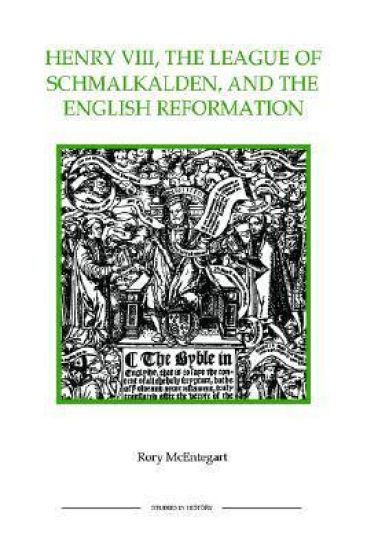
Henry VIII, the League of Schmalkalden, and the English Reformation
England's first Protestant foreign policy initiative, an alliance with German Protestants, is shown to have been a significant influence on the Henrician Reformation. England's first Protestant foreign policy venture took place under Henry VIII, who in the wake of the break with Rome pursued diplomatic contacts with the League of Schmalkalden, the German Protestant alliance. This venture was supported by evangelically-inclined counsellors such as Thomas Cromwell and Thomas Cranmer, while religiously conservative figures such as Cuthbert Tunstall, John Stokesley and Stephen Gardiner sought to limit such contacts. The king's own involvement reflected these opposed reactions: he was interested in the Germans as alliance partners and as a consultative source in establishing the theology of his own Church, but at the same time he was reluctant to accept all the religious innovations proposed by the Germans and their English advocates. This study breaks new ground in presenting religious ideology, rather than secular diplomacy, as the motivation behind Anglo-Schmalkaldicnegotiations. Relations between England and the League exerted a considerable influence on the development of the king's theology in the second half of the reign, and hence affected the redirection of religious policy in 1538, thepassing of the Act of Six Articles, the marriage of Henry to Anne of Cleves and the fall of Thomas Cromwell. The examination of the development of Henry's religious thinking is set in the wider context of the foreign policy imperatives of the German Protestants, the ministerial priorities of Thomas Cromwell and factional politics at the court of Henry VIII. RORY McENTEGART is Academic Director of American College Dublin.
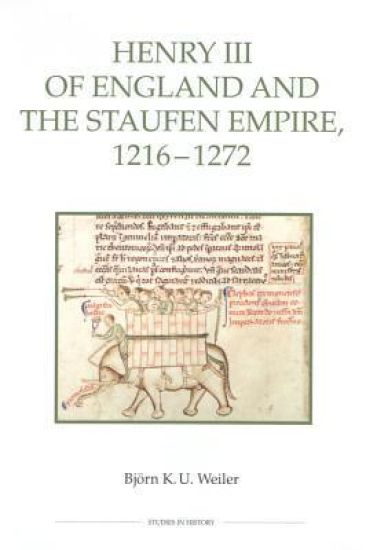
Henry III of England and the Staufen Empire, 1216-1272

Henry III of England and the Staufen Empire, 1216-1272

Björn Weiler

Royal Historical Society
2012
pokkari
Reassessment of the foreign policies and activities of Henry III, revealing them to be more successful than hitherto thought. Modern historians have frequently maligned Henry III of England (1216-1272) for his entanglements in European affairs. However, this book moves past orthodox opinion to offer a reappraisal of his activities. Using Henry's dealingswith the rulers of the Staufen Empire (Germany, Northern France, Northern Italy and Sicily) as a case study to explore the broader international context within which he acted, the author offers a more varied reading of Henry's "European adventures"; he shows that far from being an expensive aberration, they reveal the English king as acting within the same parameters and according to the same norms as his peers and contemporaries. Moreover, they provide new insights into the structures and mechanisms, the ideals and institutions which defined the conduct of relations between rulers and realms in the medieval West; medieval politics, it is argued, cannot be understood in isolationfrom wider movements, ideals and concepts. The book will be of value not only for historians of medieval England, but also for those with a more general interest in the wider political structures of the pre-modern West. Dr BJORN K. U. WEILER is Lecturer in Medieval History at the University of Wales, Aberystwyth.
Henry V

Henry V

William Shakespeare; Lloyd Suh

Arizona Center for Medieval Renaissance Studies,US
2022
nidottu
Playwright Lloyd Suh reimagines the political intrigue and high drama of Henry V for twenty-first-century audiences. Shakespeare’s Henry V is a play about nationalism, war, and how we remember history. Known for its rousing speeches and miraculous outcomes, the play has long had a life beyond the stage and page, its themes and rhetoric common points of reference in politics. In this modern translation of Henry V, Lloyd Suh has created a new interpretation that is distinctly his own while protecting the mystery of Shakespeare’s drama. Suh’s translation focuses on the actors and the staging, channeling the theatrical nature of Shakespeare’s play for a new audience. This translation of Henry V was written as part of the Oregon Shakespeare Festival’s Play On! project, which commissioned new translations of thirty-nine Shakespeare plays. These translations present the Bard’s work in language accessible to modern audiences while never losing the beauty of Shakespeare’s verse. Enlisting the talents of a diverse group of contemporary playwrights, screenwriters, and dramaturges from diverse backgrounds, this project reenvisions Shakespeare for the twenty-first century. These volumes make these works available for the first time in print—a new First Folio for a new era.
Henry VI, Part 1

Henry VI, Part 1

William Shakespeare

Arizona Center for Medieval Renaissance Studies,US
2022
nidottu
In his three Henry VI plays, Shakespeare tackles the infamous Wars of the Roses and the fall of the House of Lancaster. In this translation of Henry VI, Part 1, Douglas Langworthy explores the initial unrest as a young Henry VI becomes king. Langworthy’s translation takes a deep dive into the language of Shakespeare. With a fine-tooth comb, he updates passages that are archaic and difficult to the modern ear and matches them with the syntax and lyricism of the rest of the play, essentially translating archaic Shakespeare to match contemporary Shakespeare. This translation of Henry VI, Part 1 was written as part of the Oregon Shakespeare Festival’s Play On! project, which commissioned new translations of thirty-nine Shakespeare plays. These translations present the work of "The Bard" in language accessible to modern audiences while never losing the beauty of Shakespeare’s verse. Enlisting the talents of a diverse group of contemporary playwrights, screenwriters, and dramaturges from diverse backgrounds, this project reenvisions Shakespeare for the twenty-first century. These volumes make these works available for the first time in print—a new First Folio for a new era.
Henry IV Part 1

Henry IV Part 1

William Shakespeare; Yvette Nolan

Arizona Center for Medieval Renaissance Studies,US
2022
nidottu
The two-part tale of King Henry IV, rewritten with new language for the twenty-first century. Shakespeare’s two Henry IV plays follow the exploits of King Henry IV after usurping the crown from his cousin Richard II. Featuring some of Shakespeare’s most recognizable characters such as Prince Hal and the roguish Sir John Falstaff, Henry IV, Part 1 delves into complicated questions of loyalty and kingship on and off the battlefield. Henry IV, Part 2 follows Prince Hal as he grapples with his eventual ascent to the throne and his increasingly strained relationship with Falstaff. As the king falls sick and Hal’s ascent appears imminent, Hal’s decisions hold significant implications for all those around him. Modernizing the language of the two plays, Yvette Nolan’s translation carefully works at the seeds sown by Shakespeare—bringing to new life the characters and dramatic arcs of the original. These translations of Henry IV were written as part of the Oregon Shakespeare Festival’s Play On! project, which commissioned new translations of thirty-nine Shakespeare plays. These translations present work from “The Bard” in language accessible to modern audiences while never losing the beauty of Shakespeare’s verse. Enlisting the talents of a diverse group of contemporary playwrights, screenwriters, and dramaturges from diverse backgrounds, this project reenvisions Shakespeare for the twenty-first century. These volumes make these works available for the first time in print—a new First Folio for a new era.