Kirjojen hintavertailu. Mukana 12 398 956 kirjaa ja 12 kauppaa.

Kirjahaku

Etsi kirjoja tekijän nimen, kirjan nimen tai ISBN:n perusteella.

1000 tulosta hakusanalla Irving P. Herman

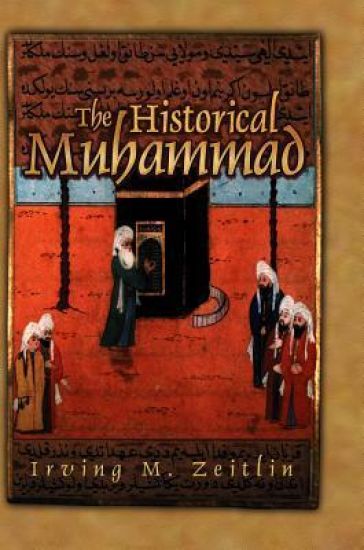
The Historical Muhammad

The Historical Muhammad

Irving M. Zeitlin

Polity Press
2007
sidottu
In his quest for the historical Muhammad, Zeitlin's chief aim is to catch glimpses of the birth of Islam and the role played by its extraordinary founder. Islam, as its Prophet came to conceive it, was a strict and absolute monotheism. How Muhammad had arrived at this view is not a problem for Muslims, who believe that the Prophet received a revelation from Allah or God, mediated by the Angel Gabriel. For scholars, however, interested in placing Muhammad in the historical context of the seventh-century Arabian Peninsula, the source of the Prophets inspiration is a significant question. It is apparent that the two earlier monotheisms, Judaism and Christianity, constituted an influential presence in the Hijaz, the region comprising Mecca and Medina. Indeed, Jewish communities were salient here, especially in Medina and other not-too-distant oases. Moreover, in addition to the presence of Jews and Christians, there existed a third category of individuals, the Hanifs, who, dissatisfied with their polytheistic beliefs, had developed monotheistic ideas. Zeitlin assesses the extent to which these various influences shaped the emergence of Islam and the development of the Prophets beliefs. He also seeks to understand how the process set in motion by Muhammad led, not long after his death, to the establishment of a world empire.
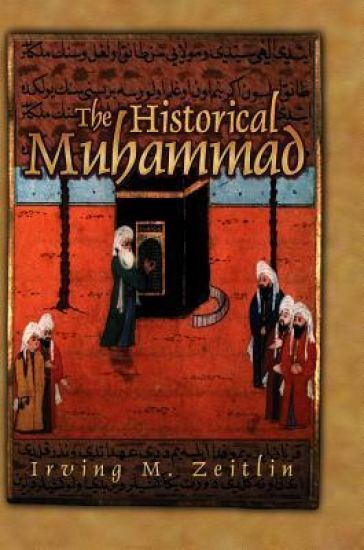
The Historical Muhammad

The Historical Muhammad

Irving M. Zeitlin

Polity Press
2007
nidottu
In his quest for the historical Muhammad, Zeitlin's chief aim is to catch glimpses of the birth of Islam and the role played by its extraordinary founder. Islam, as its Prophet came to conceive it, was a strict and absolute monotheism. How Muhammad had arrived at this view is not a problem for Muslims, who believe that the Prophet received a revelation from Allah or God, mediated by the Angel Gabriel. For scholars, however, interested in placing Muhammad in the historical context of the seventh-century Arabian Peninsula, the source of the Prophets inspiration is a significant question. It is apparent that the two earlier monotheisms, Judaism and Christianity, constituted an influential presence in the Hijaz, the region comprising Mecca and Medina. Indeed, Jewish communities were salient here, especially in Medina and other not-too-distant oases. Moreover, in addition to the presence of Jews and Christians, there existed a third category of individuals, the Hanifs, who, dissatisfied with their polytheistic beliefs, had developed monotheistic ideas. Zeitlin assesses the extent to which these various influences shaped the emergence of Islam and the development of the Prophets beliefs. He also seeks to understand how the process set in motion by Muhammad led, not long after his death, to the establishment of a world empire.
Jews

Jews

Irving M. Zeitlin

Polity Press
2012
sidottu
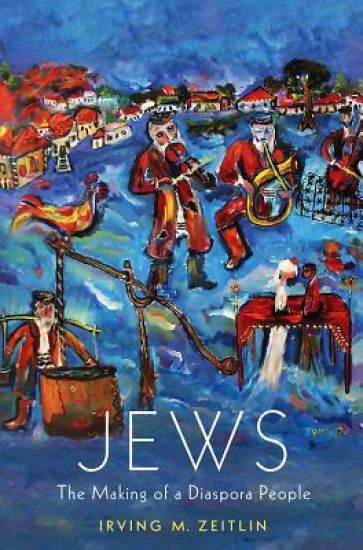
This book is a comprehensive account of how the Jews became a diaspora people. The term 'diaspora' was first applied exclusively to the early history of the Jews as they began settling in scattered colonies outside of Israel-Judea during the time of the Babylonian exile; it has come to express the characteristic uniqueness of the Jewish historical experience. Zeitlin retraces the history of the Jewish diaspora from the ancient world to the present, beginning with expulsion from their ancestral homeland and concluding with the Holocaust and the Israeli-Palestinian conflict. In mapping this process, Zeitlin argues that the Jews' religious self-understanding was crucial in enabling them to cope with the serious and recurring challenges they have had to face throughout their history. He analyses the varied reactions the Jews encountered from their so-called 'host peoples', paying special attention to the attitudes of famous thinkers such as Luther, Hegel, Nietzsche, Wagner, Montesquieu, Voltaire, Rousseau, the Left Hegelians, Marx and others, who didn't shy away from making explicit their opinions of the Jews. This book will be of interest to students and scholars of Jewish studies, diaspora studies, history and religion, as well as to general readers keen to learn more about the history of the Jewish experience.
Jews

Jews

Irving M. Zeitlin

Polity Press
2012
nidottu
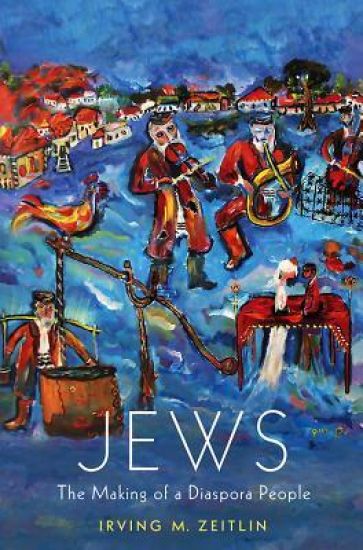
This book is a comprehensive account of how the Jews became a diaspora people. The term 'diaspora' was first applied exclusively to the early history of the Jews as they began settling in scattered colonies outside of Israel-Judea during the time of the Babylonian exile; it has come to express the characteristic uniqueness of the Jewish historical experience. Zeitlin retraces the history of the Jewish diaspora from the ancient world to the present, beginning with expulsion from their ancestral homeland and concluding with the Holocaust and the Israeli-Palestinian conflict. In mapping this process, Zeitlin argues that the Jews' religious self-understanding was crucial in enabling them to cope with the serious and recurring challenges they have had to face throughout their history. He analyses the varied reactions the Jews encountered from their so-called 'host peoples', paying special attention to the attitudes of famous thinkers such as Luther, Hegel, Nietzsche, Wagner, Montesquieu, Voltaire, Rousseau, the Left Hegelians, Marx and others, who didn't shy away from making explicit their opinions of the Jews. This book will be of interest to students and scholars of Jewish studies, diaspora studies, history and religion, as well as to general readers keen to learn more about the history of the Jewish experience.
Jean Harlow: An Intimate Biography
Jean Harlow's stunning blonde looks and shockingly blatant sexuality made her Hollywood's first and most sensational sex goddess. In all the wild, free-wheeling history of Hollywood since her death in 1937, no star has made such an impression. Despite her dubious talents as an actress, Harlow won the hearts of the movie-going public. But, like many of the stars that followed her, she found no happiness in her private life. Her husband committed suicide within a month of their wedding, creating endless material for gossip. This book reveals the truth behind this, as well as many other rumours, which surrounded Harlow, including the circumstances behind her premature and needless death at the age of twenty-six.
Hypnosis

Hypnosis

Irving Kirsch

Ashgate Publishing Limited
2006
sidottu
Modern hypnosis can be traced back to the 18th century and during this period mesmerism, as it was then known, was a healing practice which spread throughout Europe and North America. Since then hypnosis has been treated primarily as a psychological phenomenon and theories about hypnosis are grounded in mainstream psychology and its related disciplines. Most recently it has been subject to extensive clinical trials to investigate its therapeutic effectiveness. In their comprehensive introduction to this invaluable collection the editors trace the historical development of hypnosis, providing an excellent review of the theories that have tried to explain how hypnosis works and reflecting on the cultural and scientific attitudes and practices that prevailed at various times. They have selected the most important previously published papers that reveal how a scientific approach to understanding hypnosis as a psychological phenomenon has emerged over the last 70 years. They have also included a selection of reports on clinical applications and on legal and forensic issues. As such this volume will prove an invaluable reference resource for researchers and students already in the field and new scholars interested in learning more about hypnosis.
Reducing Youth Gang Violence

Reducing Youth Gang Violence

Irving A. Spergel

AltaMira Press,U.S.
2007
sidottu
In this book, Irving Spergel details the efforts of his Chicago youth gang project, a comprehensive, community-based model designed to reduce gang problems, including violence and illegal drug activity. He offers an in-depth description of the Little Village Gang Violence Reduction Project, revealing the successes and failures of intervention at each level: individual youths, the gang itself, and the community at large. Spergel relates how a coalition of criminal justice, neighborhood, and academic organizations_along with a team of tactical officers, probation officers, former gang leaders, and a neighborhood organization_developed strategies for dealing with hardcore violent male youths from two gangs: the Latin Kings and Two Six. This well-known project has become the model for a series of national initiatives. Policymakers, criminologists, and gang researchers will find this model valuable for assessing gang programs and reducing gang violence.
Reducing Youth Gang Violence

Reducing Youth Gang Violence

Irving A. Spergel

AltaMira Press,U.S.
2007
nidottu
In this book, Irving Spergel details the efforts of his Chicago youth gang project, a comprehensive, community-based model designed to reduce gang problems, including violence and illegal drug activity. He offers an in-depth description of the Little Village Gang Violence Reduction Project, revealing the successes and failures of intervention at each level: individual youths, the gang itself, and the community at large. Spergel relates how a coalition of criminal justice, neighborhood, and academic organizations_along with a team of tactical officers, probation officers, former gang leaders, and a neighborhood organization_developed strategies for dealing with hardcore violent male youths from two gangs: the Latin Kings and Two Six. This well-known project has become the model for a series of national initiatives. Policymakers, criminologists, and gang researchers will find this model valuable for assessing gang programs and reducing gang violence.
The Jewish Way

The Jewish Way

Irving Greenberg

Jason Aronson Inc. Publishers
1998
sidottu
The author writes: "The focus of this book is on Judaism as it expresses itself in the Jewish holidays. Through these days Judaism is most visible and most easily accessible. But this is meant to be more than a book about the holidays; rather, it is a book about the Jewish way through life and history. To celebrate the holidays is to relive by reliving the Jewish way. Over the centuries Jewish thought and values have been crystallized in religious behavior. Judaism's underlying structures of meaning—the understanding of the world, the direction of history, the values of life—have come to their classic expression in the holidays. This book seeks to uncover those patterns. "All halachic behaviors are dramatic/mimetic gestures articulating a central metaphor of living. Grasping the metaphor adds depth to action and joy to life. Entering into the holidays with this understanding widens the range of emotion and brings a whole new set of roles and personae into even the most conventional life. Living the Jewish way calls for a highly developed capacity for fantasy and playacting. If you will, one must be a bit of a ham to be a kosher Jew. I hope that by pointing out the roles we are summoned to play, this book will help release the creative imagination for religious living present in every person. "This is not to suggest that practice of the Jewish faith is all play, all fun and games. There have been times when this religion has brought painful memories, moral problematic conflicts with others, oppressive minutiae, and obligations so great I felt guilty no matter what I accomplished. Yet on balance the overwhelming effect has been to fill my life with a sense of Divine Presence and human continuity, bondedness, joy, textured living experiences full of love that make everything worthwhile. No wonder that over the course of history millions of Jews were willing to die, if necessary, for this faith. Through this book, I hope to show others why it is worth living for this faith. "This book is written for different types of readers: nonobservant Jews who seek new experiences to deepen their Jewish identity; observant Jews who wish to avoid the pitfall of practicing the details while missing the overarching goal; those lacking Jewish education who search for more information; learned Jews who search for new insights; and non-Jews who wish to understand the underlying visions of Judaism and who may find that it resonates in their own religious living."
Taking Lives

Taking Lives

Irving Louis Horowitz

Transaction Publishers
2001
sidottu
Taking Lives is a pivotal effort to reconstruct the social and political contexts of twentieth century, state-inspired mass murder. Irving Louis Horowitz re-examines genocide from a new perspective-viewing this issue as the defining element in the political sociology of our time. The fifth edition includes approximately 30 percent new materials with five new chapters. The work is divided into five parts: "Present as History Past as Prologue," "Future as Memory," "Toward A General Theory of State-Sponsored Crime," "Studying Genocide." The new edition concludes with chapters reviewing the natural history of genocide studies from 1945 to the present, along with a candid self-appraisal of the author's work in this field over four decades.Taking Lives asserts that genocide is not a sporadic or random event, nor is it necessarily linked to economic development or social progress. Genocide is a special sort of mass destruction conducted with the approval of the state apparatus. Life and death issues are uniquely fundamental, since they alone serve as a precondition for the examination of all other issues. Such concerns move us beyond abstract, formalist frameworks into new ways of viewing the social study of the human condition. Nearly all reviewers of earlier editions have recognized this. Taking Lives is a fundamental work for political scientists, sociologists, and all those concerned with the state's propensity toward evil.
Tributes

Tributes

Irving Horowitz

Transaction Publishers
2003
sidottu
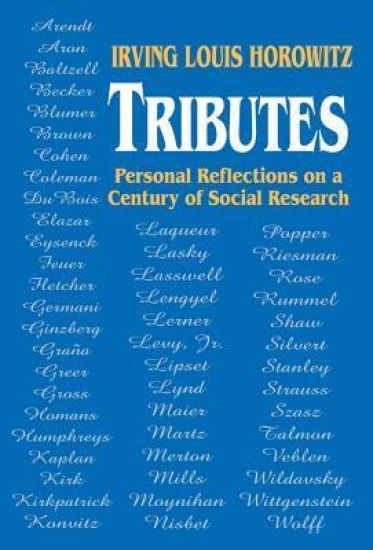
In one of his final works, Stephen Jay Gould spoke of the human race "as a wildly improbable evolutionary event well within the realm of contingency." Drawing on his personal knowledge of fifty figures from the world of twentieth-century social science, Irving Louis Horowitz offers commentaries drawn from a variety of public occasions to explain one segment of this improbable event. In the process he reveals how the past century was defined in substantial measure by the rise of social research.Commenting on Tributes, Daniel Mahoney observes, "some pieces are completely authoritative and detailed, others more conversational and informal. That diversity of approaches tied to the special character of these people increases the readability and interest in the book as a whole. In addition to illuminating the life and thought of these major figures, these essays and addresses reveal the impressive catholicity of Horowitz's concerns and his ability to remain open to the widest range of theoretical and practical approaches." In a certain sense, this book is also an intellectual autobiography in the form of an expression of Horowitz's debt to intellectual interlocutors and influences over the years. As a consequence, Tributes will be of the greatest interest to anyone who wishes to come to terms with the intellectual formation of the people who gave substance to new ways of experiencing as well as explaining society. The book is thus a thoughtful guide to the intellectual life of our times.From Arendt and Aron to Veblen and Wildavsky, these essays take shape as a systematic mosaic of the past century. Written by a central participant in social theory, Tributes is both an informal guide and a formal text for readers coming upon social science innovators for the first time. The book breaks the boundaries of conventional discourse and in so doing gives voice to the outstanding figures that helped make the twentieth century "the century of social research."
Once More Unto the Breach, Dear Friends

Once More Unto the Breach, Dear Friends

Irving Louis Horowitz; Andrew McIntosh; Patrick Ivins; Deborah Berger

Transaction Publishers
2005
nidottu
Candor, breadth, judiciousness-all these are attributes Irving Louis Horowitz possesses as a scholar. Under his leadership there is no academic publication from which I have learned as much as Transaction-Society."David Riesman, Harvard University "We are all happy benefi ciaries of Horowitz's acutely perceptive and (often) devas-tatingly plain-spoken self as sociologist and sage, broad-gauged scholar, dedicated teacher, tough-minded editor and publisher with an ingrained sense of fairness."Robert K. Merton, Columbia University.
Behemoth

Behemoth

Irving Horowitz

Transaction Publishers
1999
nidottu
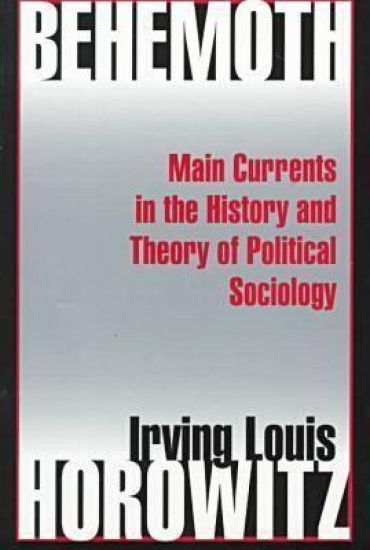
The title, Behemoth, derives from the Hebrew word Behemah-a beast, an enormous creature, monstrously huge and vast. It is an apt description of the State on the eve of the twenty-first century. Loved by few, vilified by many from all perspectives, it nonetheless continues to grow; by turns rivaling and co-opting that more pleasant-sounding word: Society. Political sociology aims to define and understand the interrelationship between these two huge terms: State and Society.Continuing in a path begun by Horowitz in the 1950s in The Idea of War and Peace in Contemporary Social and Philosophical Thought, expanded upon in the 1970s with Foundations of Political Sociology, this summing up in the late 1990s is an effort to extract and evolve the canon of political sociology. Starting with Montesquieu, Horowitz proceeds through the European experience of Rousseau, Tocqueville, Hegel, Marx, Durkheim, Sorel, and Weber. He then takes the field on its tangled migration to America with the Frankfurt School in exile, followed by searching chapters on Schumpeter, Mills, Arendt, and Huntington, among others.The result is a stunning revaluation of the intellectual sources of the present day divisions between statists and socialists, welfarists and individualists, advocates of dictatorship and of democracy, mandated rules and voluntary association, hard realists and soft utopians, a world without states and a world with a single state. Horowitz does not offer the usual evolutionary notion of doctrines, but a canon embedded in and embattled with the societies they aim to serve or overthrow in the present as in the past. The result is a major recasting of the theory and practice of social science and normative frameworks.The final chapter offers Horowitz's own prognosis of what we can expect in the recasting of the Welfare State to include the Welfare Society, and its growing nemesis the global economy which threatens to engulf State and Society alike in a return to civilizational concerns. This is an essential text for policy-makers and social scientists interested in macroscopic changes in the political order.
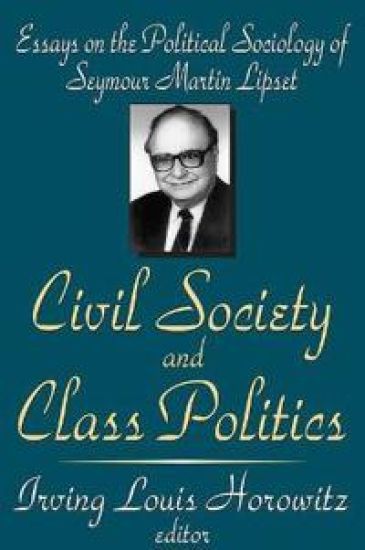
Civil Society and Class Politics

Civil Society and Class Politics

Irving Louis Horowitz

Transaction Publishers
2004
nidottu
Seymour Martin Lipset's work throughout a long and distinguished career has been stamped by several features: a powerful linkage of research data and social theory, innovative views of historical events, and a realization that politics is an activity native to all human beings, voters and non-voters, democratic and non-democratic systems, and advanced and developing economies. He has earned the right to be called a genuine pioneer in the field now recognized as political sociology. In this special collection of professional comment and personal tribute, some of Lipset's closest colleagues have gathered to review his life work in political sociology. This volume includes essays on sociology and socialism, the collapse of class politics, political leadership, the perpetuation of inequality across generations, political extremism, religion as a source of polarization, working-class authoritarianism, and an examination of civil life in the United States across the century. Among the contributors are Nathan Glazer, Terry Nichols Clark, Richard J. Samuels, Sidney Verba, Nancy Burns, Kay Lehman Schlozman, Robert B. Smith, William Schneider, Dick Houtman, and Marcella Ridlen Ray. The volume is further graced by two special features: an academic memoir entitled "Steady Work" written by Lipset, and a full-scale bibliography of his books, monographs and pamphlets. In short, this is a specialist volume for social scientists that can be easily enjoyed by readers outside the field. This volume was initially presented as a double issue of The American Sociologist. Horowitz was commissioned by the editor of the journal to serve as special editor for the volume. In turn, the contributions originated at a series of invited panels at the Eastern Sociological Society meetings in 2002.
Taking Lives

Taking Lives

Irving Louis Horowitz

Transaction Publishers
2001
nidottu
Taking Lives is a pivotal effort to reconstruct the social and political contexts of twentieth century, state-inspired mass murder. Irving Louis Horowitz re-examines genocide from a new perspective-viewing this issue as the defining element in the political sociology of our time. The fifth edition includes approximately 30 percent new materials with five new chapters. The work is divided into five parts: "Present as History Past as Prologue," "Future as Memory," "Toward A General Theory of State-Sponsored Crime," "Studying Genocide." The new edition concludes with chapters reviewing the natural history of genocide studies from 1945 to the present, along with a candid self-appraisal of the author's work in this field over four decades.Taking Lives asserts that genocide is not a sporadic or random event, nor is it necessarily linked to economic development or social progress. Genocide is a special sort of mass destruction conducted with the approval of the state apparatus. Life and death issues are uniquely fundamental, since they alone serve as a precondition for the examination of all other issues. Such concerns move us beyond abstract, formalist frameworks into new ways of viewing the social study of the human condition. Nearly all reviewers of earlier editions have recognized this. Taking Lives is a fundamental work for political scientists, sociologists, and all those concerned with the state's propensity toward evil.