Kirjojen hintavertailu. Mukana 11 244 527 kirjaa ja 12 kauppaa.

Kirjahaku

Etsi kirjoja tekijän nimen, kirjan nimen tai ISBN:n perusteella.

1000 tulosta hakusanalla Janet Koops

Project Girl

Project Girl

Janet McDonald

University of California Press
2000
pokkari
Selected by "The Los Angeles Times Book Review" as one of the best books of the year, "Project Girl" is the powerful account of a young woman's struggle to realize her dreams while remaining true to who she was before attending Ivy League schools and receiving impressive diplomas. It tells of the spectacular failures and unlikely comebacks of a ghetto kid whose academic talent opens doors onto a world of private schools, rich classmates, and plum jobs but who back home confronts a neighborhood of growing poverty, drug abuse, and crime. "Project Girl" is McDonald's story of her divided life and terrible battle to reconcile opposing worlds.
Hidden Heritage

Hidden Heritage

Janet Liebman Jacobs

University of California Press
2002
pokkari
This study of contemporary crypto-Jews--descendants of European Jews forced to convert to Christianity during the Spanish Inquisition--traces the group's history of clandestinely conducting their faith and their present-day efforts to reclaim their past. Janet Liebman Jacobs masterfully combines historical and social scientific theory to fashion a brilliant analysis of hidden ancestry and the transformation of religious and ethnic identity.
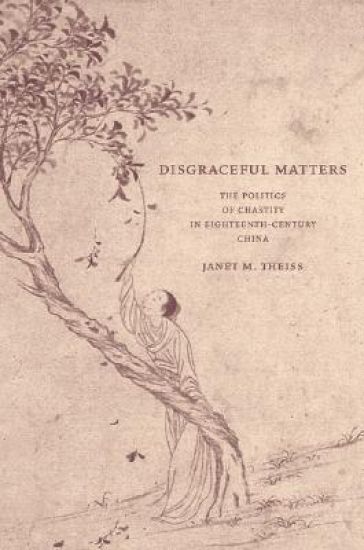
Disgraceful Matters

Disgraceful Matters

Janet Theiss

University of California Press
2005
sidottu
Looking beyond the familiar trappings of the cult of female chastity-such as hagiographies of widows and chastity shrines--in late imperial China, this book explores the cult's political significance and practical ramifications in everyday life during the eighteenth century. In the first full-length study of the subject, Janet Theiss examines a vast number of laws, legal cases, regulations, and policies to illustrate the social and political processes through which female virtue was defined, enforced, and contested. Along the way, she provides rich details of social life and cultural practices among ordinary Chinese people through narratives of criminal cases of sexual assault, harassment, adultery, and domestic violence.
Trauma Cinema

Trauma Cinema

Janet Walker

University of California Press
2005
pokkari
Trauma Cinema focuses on a new breed of documentary films and videos that adopt catastrophe as their subject matter and trauma as their aesthetic. Incorporating oral testimony, home-movie footage, and documentary reenactment, these documentaries express the havoc trauma wreaks on history and memory. Janet Walker uses incest and the Holocaust as a double thematic focus and fiction films as a point of comparison. Her astute and original examination considers the Hollywood classic Kings Row and the television movie Sybil in relation to vanguard nonfiction works, including Errol Morris's Mr. Death, Lynn Hershman's video diaries, and the chilling genealogy of incest, Just, Melvin. Both incest and the Holocaust have also been featured in contemporary psychological literature on trauma and memory. The author employs theories of post traumatic stress disorder and histories of the so-called memory wars to illuminate the amnesias, fantasies, and mistakes in memory that must be taken into account, along with corroborated evidence, if we are to understand how personal and public historical meaning is made. Janet Walker's engrossing narrative demonstrates that the past does not come down to us purely and simply through eyewitness accounts and tangible artifacts. Her incisive analysis exposes the frailty of memory in the face of disquieting events while her joint consideration of trauma cinema and psychological theorizing radically reconstructs the roadblocks at the intersection of catastrophe, memory, and historical representation.
Free for All

Free for All

Janet Poppendieck

University of California Press
2010
sidottu
How did our children end up eating nachos, pizza, and Tater Tots for lunch? Taking us on an eye-opening journey into the nation's school kitchens, this superbly researched book is the first to provide a comprehensive assessment of school food in the United States. Janet Poppendieck explores the deep politics of food provision from multiple perspectives - history, policy, nutrition, environmental sustainability, taste, and more. How did we get into the absurd situation in which nutritionally regulated meals compete with fast food items and snack foods loaded with sugar, salt, and fat? What is the nutritional profile of the federal meals? How well are they reaching students who need them? Opening a window onto our culture as a whole, Poppendieck reveals the forces - the financial troubles of schools, the commercialization of childhood, the reliance on market models - that are determining how lunch is served. She concludes with a sweeping vision for change: fresh, healthy food for all children as a regular part of their school day.
Free for All

Free for All

Janet Poppendieck

University of California Press
2010
pokkari
How did our children end up eating nachos, pizza, and Tater Tots for lunch? Taking us on an eye-opening journey into the nation's school kitchens, this superbly researched book is the first to provide a comprehensive assessment of school food in the United States. Janet Poppendieck explores the deep politics of food provision from multiple perspectives - history, policy, nutrition, environmental sustainability, taste, and more. How did we get into the absurd situation in which nutritionally regulated meals compete with fast food items and snack foods loaded with sugar, salt, and fat? What is the nutritional profile of the federal meals? How well are they reaching students who need them? Opening a window onto our culture as a whole, Poppendieck reveals the forces - the financial troubles of schools, the commercialization of childhood, the reliance on market models - that are determining how lunch is served. She concludes with a sweeping vision for change: fresh, healthy food for all children as a regular part of their school day.
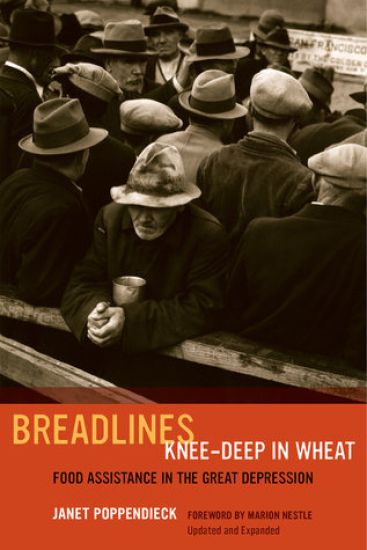
Breadlines Knee-Deep in Wheat

Breadlines Knee-Deep in Wheat

Janet Poppendieck; Marion Nestle

University of California Press
2014
sidottu
At no time during the Great Depression was the contradiction between agriculture surplus and widespread hunger more wrenchingly graphic than in the government's attempt to raise pork prices through the mass slaughter of miliions of "unripe" little pigs. This contradiction was widely perceived as a "paradox." In fact, as Janet Poppendieck makes clear in this newly expanded and updated volume, it was a normal, predictable working of an economic system rendered extreme by the Depression. The notion of paradox, however, captured the imagination of the public and policy makers, and it was to this definition of the problem that surplus commodities distribution programs in the Hoover and Roosevelt administrations were addressed. This book explains in readable narrative how the New Deal food assistance effort, originally conceived as a relief measure for poor people, became a program designed to raise the incomes of commercial farmers. In a broader sense, the book explains how the New Deal years were formative for food assistance in subsequent administrations; it also examines the performance - or lack of performance - of subsequent in-kind relief programs. Beginning with a brief survey of the history of the American farmer before the depression and the impact of the Depression on farmers, the author describes the development of Hoover assistance programs and the events at the end of that administration that shaped the "historical moment" seized by the early New Deal. Poppendieck goes on to analyze the food assistance policies and programs of the Roosevelt years, the particular series of events that culminated in the decision to purchase surplus agriculture products and distribute them to the poor, the institutionalization of this approach, the resutls achieved, and the interest groups formed. The book also looks at the takeover of food assistance by the U.S. Department of Agriculture and its gradual adaptation for use as a tool in the maintenance of farm income. Utliizing a wide variety of official and unofficial sources, the author reveals with unusual clarity the evolution from a policy directly responsive to the poor to a policy serving mainly democratic needs.
Breadlines Knee-Deep in Wheat

Breadlines Knee-Deep in Wheat

Janet Poppendieck; Marion Nestle

University of California Press
2014
pokkari
At no time during the Great Depression was the contradiction between agriculture surplus and widespread hunger more wrenchingly graphic than in the government's attempt to raise pork prices through the mass slaughter of miliions of "unripe" little pigs. This contradiction was widely perceived as a "paradox." In fact, as Janet Poppendieck makes clear in this newly expanded and updated volume, it was a normal, predictable working of an economic system rendered extreme by the Depression. The notion of paradox, however, captured the imagination of the public and policy makers, and it was to this definition of the problem that surplus commodities distribution programs in the Hoover and Roosevelt administrations were addressed. This book explains in readable narrative how the New Deal food assistance effort, originally conceived as a relief measure for poor people, became a program designed to raise the incomes of commercial farmers. In a broader sense, the book explains how the New Deal years were formative for food assistance in subsequent administrations; it also examines the performance--or lack of performance--of subsequent in-kind relief programs. Beginning with a brief survey of the history of the American farmer before the depression and the impact of the Depression on farmers, the author describes the development of Hoover assistance programs and the events at the end of that administration that shaped the "historical moment" seized by the early New Deal. Poppendieck goes on to analyze the food assistance policies and programs of the Roosevelt years, the particular series of events that culminated in the decision to purchase surplus agriculture products and distribute them to the poor, the institutionalization of this approach, the resutls achieved, and the interest groups formed. The book also looks at the takeover of food assistance by the U.S. Department of Agriculture and its gradual adaptation for use as a tool in the maintenance of farm income. Utliizing a wide variety of official and unofficial sources, the author reveals with unusual clarity the evolution from a policy directly responsive to the poor to a policy serving mainly democratic needs.
Unsettled

Unsettled

Janet McIntosh

University of California Press
2016
sidottu
In 1963, Kenya gained independence from Britain, ending decades of white colonial rule. While tens of thousands of whites relocated in fear of losing their fortunes, many stayed. But over the past decade, protests, scandals, and upheavals have unsettled families with colonial origins, reminding them that their belonging is tenuous. In this book, Janet McIntosh looks at the lives and dilemmas of settler descendants living in post-independence Kenya. From clinging to a lost colonial identity to pronouncing a new Kenyan nationality, the public face of white Kenyans has undergone changes fraught with ambiguity. Drawing on fieldwork and interviews, McIntosh focuses on their discourse and narratives to ask: What stories do settler descendants tell about their claim to belong in Kenya? How do they situate themselves vis-a-vis the colonial past and anti-colonial sentiment, phrasing and re-phrasing their memories and judgments as they seek a position they feel is ethically acceptable? McIntosh explores contradictory and diverse responses: moral double consciousness, aspirations to uplift the nation, ideological blind-spots, denials, and self-doubt as her respondents strain to defend their entitlements in the face of mounting Kenyan rhetorics of ancestry.
Unsettled

Unsettled

Janet McIntosh

University of California Press
2016
pokkari
In 1963, Kenya gained independence from Britain, ending decades of white colonial rule. While tens of thousands of whites relocated in fear of losing their fortunes, many stayed. But over the past decade, protests, scandals, and upheavals have unsettled families with colonial origins, reminding them that their belonging is tenuous. In this book, Janet McIntosh looks at the lives and dilemmas of settler descendants living in post-independence Kenya. From clinging to a lost colonial identity to pronouncing a new Kenyan nationality, the public face of white Kenyans has undergone changes fraught with ambiguity. Drawing on fieldwork and interviews, McIntosh focuses on their discourse and narratives to ask: What stories do settler descendants tell about their claim to belong in Kenya? How do they situate themselves vis-a-vis the colonial past and anti-colonial sentiment, phrasing and re-phrasing their memories and judgments as they seek a position they feel is ethically acceptable? McIntosh explores contradictory and diverse responses: moral double consciousness, aspirations to uplift the nation, ideological blind-spots, denials, and self-doubt as her respondents strain to defend their entitlements in the face of mounting Kenyan rhetorics of ancestry.
Contemporary Art and the Digitization of Everyday Life

Contemporary Art and the Digitization of Everyday Life

Janet Kraynak

University of California Press
2020
sidottu
Digitization is the animating force of everyday life. Rather than defining it as a technology or a medium, Contemporary Art and the Digitization of Everyday Life argues that digitization is a socio-historical process that is contributing to the erosion of democracy and an increase in political inequality, specifically along racial, ethnic, and gender lines. Taking a historical approach, Janet Kraynak finds that the seeds of these developments are paradoxically related to the ideology of digital utopianism that emerged in the late 1960s with the rise of a social model of computing, a set of beliefs furthered by the neo-liberal tech ideology in the 1990s, and the popularization of networked computing. The result of this ongoing cultural worldview, which dovetails with the principles of progressive artistic strategies of the past, is a critical blindness in art historical discourse that ultimately compromises art’s historically important role in furthering radical democratic aims.
King and Emperor

King and Emperor

Janet L Nelson

University of California Press
2020
sidottu
"King and Emperor takes on the compelling suspense of good detective work as well as good history."--The Wall Street Journal Charles I, often known as Charlemagne, is one of the most extraordinary figures ever to rule an empire. Driven by unremitting physical energy and intellectual curiosity, he was a man of many parts, a warlord and conqueror, a judge who promised "for each their law and justice," a defender of the Latin Church, a man of flesh and blood. In the twelve centuries since his death, warfare, accident, vermin, and the elements have destroyed much of the writing on his rule, but a remarkable amount has survived. Janet Nelson's wonderful new book brings together everything we know about Charles I, sifting through the available evidence, literary and material, to paint a vivid portrait of the man and his motives. Building on Nelson's own extraordinary knowledge, this biography is a sort of detective story, prying into and interpreting fascinating and often obdurate scraps of evidence, from prayer books to skeletons, gossip to artwork. Charles's legacy lies in his deeds and their continuing resonance, as he shaped counties, countries, and continents; founded and rebuilt towns and monasteries; and consciously set himself up not just as King of the Franks, but as the head of the renewed Roman Empire. His successors--even to the present day--have struggled to interpret, misinterpret, copy, or subvert his legacy. Janet Nelson gets us as close as we can hope to come to the real figure of Charles the man as he was understood in his own time.
Invisible Mothers

Invisible Mothers

Janet Garcia-Hallett

University of California Press
2022
sidottu
Drawing on interviews conducted throughout New York City, Black feminist criminologist Janet Garcia-Hallett shares the traditionally silenced voices of formerly incarcerated mothers of color and exposes the difficult realities they face when reentering the community and navigating motherhood. Patriarchy, misogyny, and systemic racism marginalize and criminalize these mothers, pushing them into the grasp of penal control and forcing them to live in a state of disempowerment and hypersurveillance after imprisonment. Armed with critical insight, Invisible Mothers demonstrates the paradox of visibility: social institutions treat mothers of color as invisible by restricting them from equal opportunities, and simultaneously as hypervisible by penalizing them for the ways they survive their marginalization. This thoughtful book reveals and contests their marginalization and highlights how mothers of color perform motherwork on their own terms.
Invisible Mothers

Invisible Mothers

Janet Garcia-Hallett

University of California Press
2022
pokkari
Drawing on interviews conducted throughout New York City, Black feminist criminologist Janet Garcia-Hallett shares the traditionally silenced voices of formerly incarcerated mothers of color and exposes the difficult realities they face when reentering the community and navigating motherhood. Patriarchy, misogyny, and systemic racism marginalize and criminalize these mothers, pushing them into the grasp of penal control and forcing them to live in a state of disempowerment and hypersurveillance after imprisonment. Armed with critical insight, Invisible Mothers demonstrates the paradox of visibility: social institutions treat mothers of color as invisible by restricting them from equal opportunities, and simultaneously as hypervisible by penalizing them for the ways they survive their marginalization. This thoughtful book reveals and contests their marginalization and highlights how mothers of color perform motherwork on their own terms.
Bronze and Iron

Bronze and Iron

Janet Lembke

University of California Press
2022
pokkari
Bronze and Iron: Old Latin Poetry from Its Beginnings to 100 B.C. offers an in-depth exploration of the fragments and traditions of early Roman poetry, tracing its evolution from archaic ritual chants to more developed literary forms. This volume situates Old Latin poetry within its historical and cultural context, posing profound questions about the nature of art, the role of poetry in society, and the symbolic shifts it underwent during Rome’s formative years. Through engaging with the surviving fragments—ranging from the mystical Salian hymns to the sophisticated works of Naevius and Ennius—this study illuminates the poetic transition from collective survival and state celebration to the exploration of individual possibilities. Divided into three sections—Historia, Mythos, and Plasmata—the book examines the factual preservation of Old Latin texts, proposes imaginative insights into their cultural and artistic significance, and offers a methodological approach to their translation. Through this framework, it investigates the maturation of poetic expression, the influence of early Roman deities like the Camenae, and the evolving purposes of poetry in the state and personal realms. Whether addressing questions about Ennius as a mathematical poet or the cinematic qualities of archaic epic, this work provides fresh perspectives on the foundations of Western poetic tradition, making it indispensable for classicists, literary historians, and anyone intrigued by the early origins of Roman art and thought. This title is part of UC Press's Voices Revived program, which commemorates University of California Press’s mission to seek out and cultivate the brightest minds and give them voice, reach, and impact. Drawing on a backlist dating to 1893, Voices Revived makes high-quality, peer-reviewed scholarship accessible once again using print-on-demand technology. This title was originally published in 1973.
Bronze and Iron

Bronze and Iron

Janet Lembke

University of California Press
2022
sidottu
Bronze and Iron: Old Latin Poetry from Its Beginnings to 100 B.C. offers an in-depth exploration of the fragments and traditions of early Roman poetry, tracing its evolution from archaic ritual chants to more developed literary forms. This volume situates Old Latin poetry within its historical and cultural context, posing profound questions about the nature of art, the role of poetry in society, and the symbolic shifts it underwent during Rome’s formative years. Through engaging with the surviving fragments—ranging from the mystical Salian hymns to the sophisticated works of Naevius and Ennius—this study illuminates the poetic transition from collective survival and state celebration to the exploration of individual possibilities. Divided into three sections—Historia, Mythos, and Plasmata—the book examines the factual preservation of Old Latin texts, proposes imaginative insights into their cultural and artistic significance, and offers a methodological approach to their translation. Through this framework, it investigates the maturation of poetic expression, the influence of early Roman deities like the Camenae, and the evolving purposes of poetry in the state and personal realms. Whether addressing questions about Ennius as a mathematical poet or the cinematic qualities of archaic epic, this work provides fresh perspectives on the foundations of Western poetic tradition, making it indispensable for classicists, literary historians, and anyone intrigued by the early origins of Roman art and thought. This title is part of UC Press's Voices Revived program, which commemorates University of California Press’s mission to seek out and cultivate the brightest minds and give them voice, reach, and impact. Drawing on a backlist dating to 1893, Voices Revived makes high-quality, peer-reviewed scholarship accessible once again using print-on-demand technology. This title was originally published in 1973.
King and Emperor

King and Emperor

Janet L Nelson

University of California Press
2021
pokkari
"King and Emperor takes on the compelling suspense of good detective work as well as good history."--The Wall Street Journal Charles I, often known as Charlemagne, is one of the most extraordinary figures ever to rule an empire. Driven by unremitting physical energy and intellectual curiosity, he was a man of many parts, a warlord and conqueror, a judge who promised "for each their law and justice," a defender of the Latin Church, a man of flesh and blood. In the twelve centuries since his death, warfare, accident, vermin, and the elements have destroyed much of the writing on his rule, but a remarkable amount has survived. Janet Nelson's wonderful new book brings together everything we know about Charles I, sifting through the available evidence, literary and material, to paint a vivid portrait of the man and his motives. Building on Nelson's own extraordinary knowledge, this biography is a sort of detective story, prying into and interpreting fascinating and often obdurate scraps of evidence, from prayer books to skeletons, gossip to artwork. Charles's legacy lies in his deeds and their continuing resonance, as he shaped counties, countries, and continents; founded and rebuilt towns and monasteries; and consciously set himself up not just as King of the Franks, but as the head of the renewed Roman Empire. His successors--even to the present day--have struggled to interpret, misinterpret, copy, or subvert his legacy. Janet Nelson gets us as close as we can hope to come to the real figure of Charles the man as he was understood in his own time.

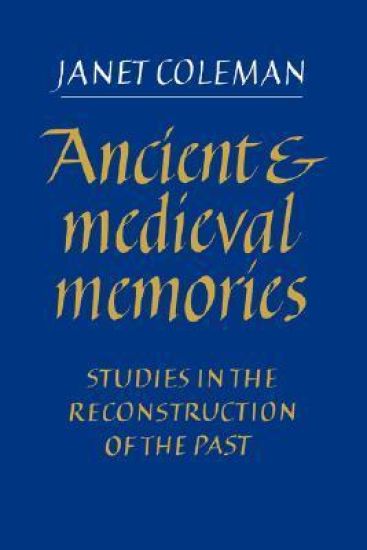
Ancient and Medieval Memories

Ancient and Medieval Memories

Janet Coleman

Cambridge University Press
2005
pokkari
This book is an analysis of thinking, remembering and reminiscing according to ancient authors, and their medieval readers. The author argues that behind the various medieval methods in interpreting texts of the past lie two apparently incompatible theories of human knowledge and remembering, as well as two differing attitudes to matter and intellect. The book comprises a series of studies which take ancient texts as evidence of the past, and show how medieval readers and writers understood them. The studies confirm that medieval and renaissance interpretations and uses of the past differ greatly from modern interpretation and yet betray many startling continuities between modern and ancient and medieval theories.
The Grammar of Empire in Eighteenth-Century British Writing

The Grammar of Empire in Eighteenth-Century British Writing

Janet Sorensen

Cambridge University Press
2005
pokkari
This study, first published in 2000, examines the complex role of language as an instrument of empire in eighteenth-century British literature. Focusing in particular on the relationship between England and one of its 'celtic colonies', Scotland, Janet Sorensen explores the tensions which arose during a period when the formation of a national standard English coincided with the need to negotiate ever widening imperial linguistic contacts. Close readings of poems, novels, dictionaries, grammars and records of colonial English instruction reveal the deeply conflicting relationship between British national and imperial ideologies. Moving from Scots Gaelic poet Alexander MacDonald to writers such as Adam Smith, Hugh Blair, and Tobias Smollett, Sorensen analyses British linguistic practices of imperial domination, including the enforcement of English language usage. The book also engages with the work of Samuel Johnson and Jane Austen to offer a wider understanding of the ambivalent nature of English linguistic identity.
The Governance of Corporate Groups

The Governance of Corporate Groups

Janet Dine

Cambridge University Press
2006
pokkari
Starting from a discussion of the theoretical underpinning of the place companies occupy in society, this book explores the consequences of adherence to free market contractualist theory, including the lack of regulatory control of a sufficiently robust nature. Professor Dine comments on the absence of a concept of governance of groups from a comparative perspective and considers the consequences of this absence for the conflict of laws. In particular, she highlights the tragic consequences of globalization by transnationals including polarization of income and environmental damage, and suggests a possible legal framework to prevent future damages.