Kirjojen hintavertailu. Mukana 11 244 527 kirjaa ja 12 kauppaa.

Kirjahaku

Etsi kirjoja tekijän nimen, kirjan nimen tai ISBN:n perusteella.

1000 tulosta hakusanalla Jeffrey Toobin

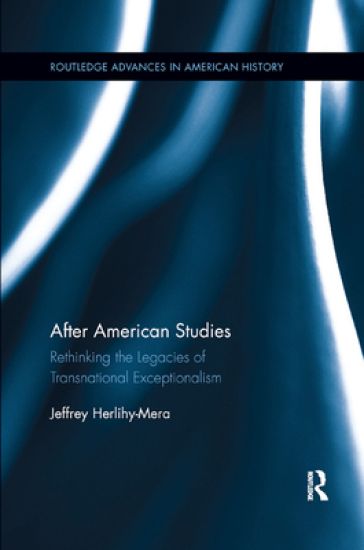
After American Studies

After American Studies

Jeffrey Herlihy-Mera

Routledge
2019
nidottu
After American Studies is a timely critique of national and transnational approaches to community, and their forms of belonging and trans/patriotisms. Using reports in multicultural psychology and cultural neuroscience to interpret an array of cultural forms—including literature, art, film, advertising, search engines, urban planning, museum artifacts, visa policy, public education, and ostensibly non-state media—the argument fills a gap in contemporary criticism by a focus on what makes cultural canons symbolically effective (or not) for an individual exposed to them. The book makes important points about the limits of transnationalism as a paradigm, evidencing how such approaches often reiterate presumptive and essentialized notions of identity that function as new dimensions of exceptionalism. In response to the shortcomings in trans/national criticism, the final chapter initiates a theoretical consideration of a postgeographic and postcultural form of community (and of cultural analysis).
The Big Book on Small Groups [Standard Large Print 16 Pt Edition]
What's so big about small groups? With proven results in drawing people into community and helping them grow to maturity in Christ, small groups have established themselves as a crucial ministry of the church to its members and its mission field. But whether leading a small group, coaching small group leaders or implementing a church wide ministry, you need vision, knowledge and skill to minister effectively through small groups. Jeffrey Arnold knows the pressures of small group ministry, but he has also seen the power of small groups in many ministry settings. In this revised edition of The Big Book on Small Groups, he breaks down small groups so that you can see them from all angles. The first four chapters focus on the structure and benefits of a small group ministry. Further chapters explore the basics of Christian community--prayer, worship, Bible study, outreach and mission, as well as how to multiply groups. Resources for further reading, ideas for coaches and trainers, and curriculum to photocopy for small group sessions are also included. A constant companion throughout your small group ministry, The Big Book on Small Groups will give you the basics to get you going--and the support and nurture you need to make small groups effective as a strategy for outreach and discipleship.
Assassins of Athens [Standard Large Print 16 Pt Edition]
When the body of a boy from one of Greece's most prominent families turns up in a dumpster in one of Athens' worst neighborhoods, Chief Inspector Andreas Kaldis of the Greek Police's Special Crimes Division is certain there's a message in the murder. But who sent it and why? Andreas' politically incorrect search for answers takes him deep into the sordid, criminal side of Athens nightlife and on to the glittering world of Athens society where age - old frictions between old money and new breed jealousy, murder, revenge, revolutionaries, and some very dangerous truths.
In Their Own Hands

In Their Own Hands

Jeffrey Ashe; Kyla Jagger Neilan

Readhowyouwant
2014
pokkari
Two and a half billion people worldwide, most of them desperately poor villagers, need a better way to save and to borrow. Even the most innovative banking institutions can't reach them; savings groups can. In savings groups, members save what they can in a communal pot and loan their growing fund to each other for their short - term needs. Jeffrey Ashe and Kyla Neilan illustrate how these savings groups form and function and how little ''outside'' support is actually required for their success. Drawing on decades of Ashe's personal experience, this book describes how he developed Saving for Change, which leveraged the wisdom and strength of group members to train and establish new groups. This model has impacted the lives of 680,000 people across five countries. Savings groups are a ''catalytic innovation'' that bypasses subsidies, dependency, and high costs while effectively reducing chronic hunger, building assets, and empowering the community. Today, saving groups have 9 million members around the globe - with minimal support, membership could grow to ten times this number.
Corporations Are Not People

Corporations Are Not People

Jeffrey D Clements

Readhowyouwant
2017
pokkari
Since the Supreme Court's Citizens United ruling that the rights of thingsmoney and corporationsmatter more than the rights of people, America has faced a crisis of democracy. In this timely and thoroughly updated second edition, Jeff Clements describes the strange history of this bizarre ruling, its ongoing destructive effects, and the growing movement to reverse it. He includes a new chapter, ';Do Something , ' showing howstate by state and community by communityAmericans are using creative strategies and tools to renew democracy and curb unbalanced corporate power. Since the first edition, 16 states, 160 members of Congress, and 500 cities and towns have called for a constitutional amendment to overturn Citizens United, and the list is growing. This is a fight we can win
The Man Who Ate Everything

The Man Who Ate Everything

Jeffrey Steingarten

Vintage Books
1998
nidottu
Winner of the Julia Child Book Award A James Beard Book Award FinalistWhen Jeffrey Steingarten was appointed food critic for Vogue, he systematically set out to overcome his distaste for such things as kimchi, lard, Greek cuisine, and blue food. He succeeded at all but the last: Steingarten is "fairly sure that God meant the color blue mainly for food that has gone bad." In this impassioned, mouth-watering, and outrageously funny book, Steingarten devotes the same Zen-like discipline and gluttonous curiosity to practically everything that anyone anywhere has ever called "dinner." Follow Steingarten as he jets off to sample choucroute in Alsace, hand-massaged beef in Japan, and the mother of all ice creams in Sicily. Sweat with him as he tries to re-create the perfect sourdough, bottle his own mineral water, and drop excess poundage at a luxury spa. Join him as he mounts a heroic--and hilarious--defense of salt, sugar, and fat (though he has some nice things to say about Olestra). Stuffed with offbeat erudition and recipes so good they ought to be illegal, The Man Who Ate Everything is a gift for anyone who loves food.
Prisoners: A Story of Friendship and Terror
An award-winning correspondent for The New Yorker and an American Jew describes his move to Israel as a student, his work as a prison guard at Ketziot, and his extended dialogue with a prisoner named Rafiq, a PLO leader, explaining how the two very different men forged a unique friendship despite their religious, cultural, and political differences. Reprint. 25,000 first printing.
It Must've Been Something I Ate: The Return of the Man Who Ate Everything
A new collection of provocative essays from the food critic of Vogue describes his remarkable love affair with food and his compulsive quest to find out how, why, and what we eat, in such pieces as "Who Is Having All the Fun?," "Don't Believe a Word of It," and "The Man Who Cooked for His Dog." By the author of The Man Who Ate Everything. Reprint. 30,000 first printing.
When Elephants Weep: The Emotional Lives of Animals

When Elephants Weep: The Emotional Lives of Animals

Jeffrey Moussaieff Masson

Random House Publishing Group
1996
nidottu
This national bestseller exploring the complex emotional lives of animals was hailed as "a masterpiece" by Elizabeth Marshall Thomas and as "marvelous" by Jane Goodall. The popularity of When Elephants Weep has swept the nation, as author Jeffrey Masson appeared on Dateline NBC, Good Morning America, and was profiled in People for his ground-breaking and fascinating study. Not since Darwin's The Expression of Emotions in Man and Animals has a book so thoroughly and effectively explored the full range of emotions that exist throughout the animal kingdom. From dancing squirrels to bashful gorillas to spiteful killer whales, Masson and coauthor Susan McCarthy bring forth fascinating anecdotes and illuminating insights that offer powerful proof of the existence of animal emotion. Chapters on love, joy, anger, fear, shame, compassion, and loneliness are framed by a provocative re-evaluation of how we treat animals, from hunting and eating them to scientific experimentation. Forming a complete and compelling picture of the inner lives of animals, When Elephants Weep assures that we will never look at animals in the same way again.
Lucy & Andy Neanderthal: The Stone Cold Age

Lucy & Andy Neanderthal: The Stone Cold Age

Jeffrey Brown

Random House Books for Young Readers
2017
sidottu
From the author of the New York Times bestselling Jedi Academy books comes book two in the laugh-out-loud graphic novel series about Neanderthal siblings Lucy and Andy. Fans of Big Nate, Diary of a Wimpy Kid, and The Terrible Two won't want to miss it "Lucy & Andy are Stone Age rock stars I loved this book " --Lincoln Peirce, author of the Big Nate series Neanderthal siblings Lucy and Andy are back to their paleo pranks. This time, they have to put up with more than just each other--the cave is feeling awfully cramped since the humans moved in. They're in the Ice Age, and legroom comes at a real premium Jeffrey Brown skillfully blends humor and history with paleontologist sections: Timeline of Key Discoveries, Ice Age Fact vs. Fiction, Silly Cavemen Myths, and more. "A fast, funny read" -Kirkus Reviews
1001 Things Everyone Should Know About African American History
Where can one go to get a comprehensive and entertaining account of the most significant events, individuals and social processes of African-American history? Fear not, because 1001 Things Everyone Should Know About African-American History is history at your fingertips-in a concise, accessible, easily-read format.Jeffrey C. Stewart, Associate Professor of History at George Mason University, takes the reader on an all-encompassing journey through the entirety of African-American history that is pithy, provocative, and encyclopedic in scope. Here are all the people, terms, ideas, events, and social processes that make African-American history such a fascinating and inspiring subject. 1001 Things Everyone Should Know About African-American History covers all the significant information in six broad sections: Great Migrations; Civil Rights and Politics; Science, Inventions and Medicine; Sports; Military; Culture and Religion. It will entertain as well as instruct, and it can be read from beginning to end as well as opened at random and read at any length without confusion.A necessary addition to every family's library, 1001 Things Everyone Should Know About African-American History presents African American history in a fun, engaging and intelligent way.
Analyzing Categorical Data

Analyzing Categorical Data

Jeffrey S. Simonoff

Springer-Verlag New York Inc.
2003
sidottu
Categorical data arise often in many fields, including biometrics, economics, management, manufacturing, marketing, psychology, and sociology. This book provides an introduction to the analysis of such data. The coverage is broad, using the loglinear Poisson regression model and logistic binomial regression models as the primary engines for methodology. Topics covered include count regression models, such as Poisson, negative binomial, zero-inflated, and zero-truncated models; loglinear models for two-dimensional and multidimensional contingency tables, including for square tables and tables with ordered categories; and regression models for two-category (binary) and multiple-category target variables, such as logistic and proportional odds models. All methods are illustrated with analyses of real data examples, many from recent subject area journal articles. These analyses are highlighted in the text, and are more detailed than is typical, providing discussion of the context and background of the problem, model checking, and scientific implications. More than 200 exercises are provided, many also based on recent subject area literature. Data sets and computer code are available at a web site devoted to the text. Adopters of this book may request a solutions manual from: [email protected]. From the reviews: "Jeff Simonoff's book is at the top of the heap of categorical data analysis textbooks...The examples are superb. Student reactions in a class I taught from this text were uniformly positive, particularly because of the examples and exercises. Additional materials related to the book, particularly code for S-Plus, SAS, and R, useful for analysis of examples, can be found at the author's Web site at New York University. I liked this book for this reason, and recommend it to you for pedagogical purposes." (Stanley Wasserman, The American Statistician, August 2006, Vol. 60, No. 3) "The book has various noteworthy features. The examples used are from a variety of topics, including medicine, economics, sports, mining, weather, as well as social aspects like needle-exchange programs. The examples motivate the theory and also illustrate nuances of data analytical procedures. The book also incorporates several newer methods for analyzing categorical data, including zero-inflated Poisson models, robust analysis of binomial and poisson models, sandwich estimators, multinomial smoothing, ordinal agreement tables…this is definitely a good reference book for any researcher working with categorical data." Technometrics, May 2004 "This guide provides a practical approach to the appropriate analysis of categorical data and would be a suitable purchase for individuals with varying levels of statistical understanding." Paediatric and Perinatal Epidemiology, 2004, 18 "This book gives a fresh approach to the topic of categorical data analysis. The presentation of the statistical methods exploits the connection to regression modeling with a focus on practical features rather than formal theory...There is much to learn from this book. Aside from the ordinary materials such as association diagrams, Mantel-Haenszel estimators, or overdispersion, the reader will also find some less-often presented but interesting and stimulating topics...[T]his is an excellent book, giving an up-to-date introduction to the wide field of analyzing categorical data." Biometrics, September 2004 "...It is of great help to data analysts, practitioners and researchers who deal with categorical data and need to get a necessary insight into the methods of analysis as well as practical guidelines for solving problems." International Journal of General Systems, August 2004 "The author has succeeded in writing a useful and readable textbook combining most of general theory and practice of count data." Kwantitatieve Methoden "The book especially stresses how to analyze and interpret data...In fact, the highly detailed multi-page descriptions of analysis and interpretation make the book stand out." Mathematical Geology, February 2005 "Overall, this is a competent and detailed text that I would recommend to anyone dealing with the analysis of categorical data." Journal of the Royal Statistical Society "This important work allows for clear analogies between the well-known linear models for Gaussian data and categorical data problems. … Jeffrey Simonoff’s Analyzing Categorical Data provides an introduction to many of the important ideas and methods for understanding counted data and tables of counts. … Some readers will find Simonoff’s style very much to their liking due to reliance on extended real data examples to illuminate ideas. … I think the extensive examples will appeal to most students." (Sanford Weisberg, SIAM Review, Vol. 47 (4), 2005) "It is clear that the focus of Simonoff’s book is different from other books on categorical data analysis. … As an introductory textbook, the book is comprehensive enough since all basic topics in categorical data analysis are discussed. … I think Simonoff’s book is a valuable addition to the literature because it discusses important models for counts … ." (Jeroen K. Vermunt, Statistics in Medicine, Vol. 24, 2005) "The author based this book on his notes for a class with a very diverse pool of students. The material is presented in such a way that a very heterogeneous group of students could grasp it. All methods are illustrated with analyses of real data examples. The author provides a detailed discussion of the context and background of the problem. … The book is very interesting and can be warmly recommended to people working with categorical data." (EMS - European Mathematical Society Newsletter, December,2004) "Categorical data arise often in many fields … . This book provides an introduction to the analysis of such data. … All methods are illustrated with analyses of real data examples, many from recent subject-area journal articles. These analyses are highlighted in the text and are more detailed than is typical … . More than 200 exercises are provided, including many based on recent subject-area literature. Data sets and computer code are available at a Web site devoted to this text." (T. Postelnicu, Zentralblatt MATH, Vol. 1028, 2003) "This book grew out of notes prepared by the author for classes in categorical data analysis. The presentation is fresh and compelling to read. Regression ideas are used to motivate the modelling presented. The book focuses on applying methods to real problems; many of these will be novel to readers of statistics texts … . All chapters end with a section providing references to books or articles for the inquiring reader." (C.M. O’Brien, Short Book Reviews, Vol. 23 (3), 2003)
Laparoscopic Colorectal Surgery

Laparoscopic Colorectal Surgery

Jeffrey W. Milsom; Bartholomäus Böhm; Kiyokazu Nakajima

Springer-Verlag New York Inc.
2006
sidottu
Laparoscopic Colorectal Surgery, Second Edition is fully revised and updated and reflects an authoritative, team-oriented approach to the latest state-of-the-art laparoscopic colorectal procedures and surgical techniques. Written by pioneers in the field, this text will supply surgeons with all the information necessary to accomplish advanced laparoscopic procedures. Comprehensive discussions of positioning, instrumentation, cannulas, surgical techniques, special considerations, and considerations in cancer surgery are featured for a wide variety of major operative procedures. This new Second Edition includes updated information on laparoscopic colorectal procedures, including hand-assisted laparoscopic procedures and new chapters on the physiology of pneumoperitoneum, laparoscopic anatomy of the colon and rectum, and evidence-based discussion of outcomes. The text is complemented by over 200 line drawings created exclusively for the textbook.
Shock Wave Interactions in General Relativity

Shock Wave Interactions in General Relativity

Jeffrey Groah; Joel Smoller; Blake Temple

Springer-Verlag New York Inc.
2006
sidottu
General relativity is the modern theory of the gravitational ?eld. It is a deep subject that couples ?uid dynamics to the geometry of spacetime through the Einstein equations. The subject has seen a resurgence of interest recently, partlybecauseofthespectacularsatellitedatathatcontinuestoshednewlight on the nature of the universe. . . Einstein’s theory of gravity is still the basic theorywehavetodescribetheexpandinguniverseofgalaxies. ButtheEinstein equations are of great physical, mathematical and intellectual interest in their own right. They are the granddaddy of all modern ?eld equations, being the ?rst to describe a ?eld by curvature, an idea that has impacted all of physics, and that revolutionized the modern theory of elementary particles. In these noteswedescribeamathematicaltheoryofshockwavepropagationingeneral relativity. Shock waves are strong fronts that propagate in ?uids, and across which there is a rapid change in density, pressure and velocity, and they can bedescribedmathematicallybydiscontinuitiesacrosswhichmass,momentum and energy are conserved. In general relativity, shock waves carry with them a discontinuity in spacetime curvature. The main object of these notes is to introduce and analyze a practical method for numerically computing shock waves in spherically symmetric spacetimes. The method is locally inertial in thesensethatthecurvatureissetequaltozeroineachlocalgridcell. Although it formally appears that the method introduces singularities at shocks, the arguments demonstrate that this is not the case. The third author would like to dedicate these notes to his father, Paul Blake Temple, who piqued the author’s interest in Einstein’s theory when he was a young boy, and whose interest and encouragement has been an inspirationthroughout his adult life.
Family Medicine

Family Medicine

Jeffrey G. Hirsch

Springer-Verlag New York Inc.
1996
nidottu
Studying for licensure examinations is like eating a twelve course meal: if you try and do it in five minutes, it will make you sick. As you prepare, pace yourself, don't memorize but review, and, most importantly, a few days before the examina­ tion, try and get some rest. I don't think I've ever heard of a soul who looked forward to this examination, and I can assure you no one has ever walked out saying "What a wonderful experi­ ence." Think of this ordeal as a rite of passage and try to remember that most of you will make it through. I'd like to thank Dr. Ron Krug for his continued support and guidance, not only in the preparation of this text, but through the years. Additional thanks to Dr. Rita Claudet for continued suggestions and editing of this text. Good luck in your studies and remember what Winston Churchill said, "Never, never, never, give up!" Jeffrey G. Hirsch, M.D.
Smoothing Methods in Statistics

Smoothing Methods in Statistics

Jeffrey S. Simonoff

Springer-Verlag New York Inc.
1996
sidottu
The existence of high speed, inexpensive computing has made it easy to look at data in ways that were once impossible. Where once a data analyst was forced to make restrictive assumptions before beginning, the power of the computer now allows great freedom in deciding where an analysis should go. One area that has benefited greatly from this new freedom is that of non parametric density, distribution, and regression function estimation, or what are generally called smoothing methods. Most people are familiar with some smoothing methods (such as the histogram) but are unlikely to know about more recent developments that could be useful to them. If a group of experts on statistical smoothing methods are put in a room, two things are likely to happen. First, they will agree that data analysts seriously underappreciate smoothing methods. Smoothing meth­ ods use computing power to give analysts the ability to highlight unusual structure very effectively, by taking advantage of people's abilities to draw conclusions from well-designed graphics. Data analysts should take advan­ tage of this, they will argue.
Nonparametric Smoothing and Lack-of-Fit Tests

Nonparametric Smoothing and Lack-of-Fit Tests

Jeffrey Hart

Springer-Verlag New York Inc.
1997
sidottu
The The primary primary aim aim of of this this book book is is to to explore explore the the use use of of nonparametric nonparametric regres­ regres­ sion sion (i. e. , (i. e. , smoothing) smoothing) methodology methodology in in testing testing the the fit fit of of parametric parametric regression regression models. models. It It is is anticipated anticipated that that the the book book will will be be of of interest interest to to an an audience audience of of graduate graduate students, students, researchers researchers and and practitioners practitioners who who study study or or use use smooth­ smooth­ ing ing methodology. methodology. Chapters Chapters 2-4 2-4 serve serve as as a a general general introduction introduction to to smoothing smoothing in in the the case case of of a a single single design design variable. variable. The The emphasis emphasis in in these these chapters chapters is is on on estimation estimation of of regression regression curves, curves, with with hardly hardly any any mention mention of of the the lack-of­ lack-of­ fit fit problem. problem. As As such, such, Chapters Chapters 2-4 2-4 could could be be used used as as the the foundation foundation of of a a graduate graduate level level statistics statistics course course on on nonparametric nonparametric regression. regression.
Evaluating a Large Group Awareness Training

Evaluating a Large Group Awareness Training

Jeffrey D. Fisher; Roxane C. Silver; Jack M. Chinsky; Barry Goff; Yechiel Klar

Springer-Verlag New York Inc.
1990
nidottu
Large Group Awareness Training: An Historical Context Groups associated with the human potential movement have been a controversial feature of American life during the last three decades. In the 1950's and 1960's, the movement was dominated by various types of small groups (SGs), which included sensitivity training groups, encounter groups, as well as several others (see Lieberman, Yalom, & Miles, 1973). Some people viewed SGs as an effective means for attaining personal and organizational growth, and Carl Rogers, one of the founders of this movement, labeled small groups as . . the most rapidly spreading social invention of the century, and probably the most potent" (Rogers, 1970). In contrast, others attacked SGs as "the most extreme exhibition thus far of man's talent for reducing, distorting, evading, and vulgarizing his own reality" (Koch, 1973, p. 639). Nevertheless, SGs generally became an accepted tool for personal development and were incorporated into university curricula and mana­ gerial training programs. During the 1970's the prevalence and appeal of SGs declined (cf. Back, 1978), and at about the same time, large group awareness training programs (LGATs) appeared. ' LGATs are offered to the general public by profit-making or­ ganizations and examine philosophical, psychological and ethical issues concern­ ing personal effectiveness, decision-making, personal responsibility and commit­ ment After addressing these topics, participants are encouraged to apply their recently attained insights to their lives.
Partial Differential Equations

Partial Differential Equations

Jeffrey Rauch

Springer-Verlag New York Inc.
1991
sidottu
This book is based on a course I have given five times at the University of Michigan, beginning in 1973. The aim is to present an introduction to a sampling of ideas, phenomena, and methods from the subject of partial differential equations that can be presented in one semester and requires no previous knowledge of differential equations. The problems, with hints and discussion, form an important and integral part of the course. In our department, students with a variety of specialties-notably differen­ tial geometry, numerical analysis, mathematical physics, complex analysis, physics, and partial differential equations-have a need for such a course. The goal of a one-term course forces the omission of many topics. Everyone, including me, can find fault with the selections that I have made. One of the things that makes partial differential equations difficult to learn is that it uses a wide variety of tools. In a short course, there is no time for the leisurely development of background material. Consequently, I suppose that the reader is trained in advanced calculus, real analysis, the rudiments of complex analysis, and the language offunctional analysis. Such a background is not unusual for the students mentioned above. Students missing one of the "essentials" can usually catch up simultaneously. A more difficult problem is what to do about the Theory of Distributions.