Kirjojen hintavertailu. Mukana 11 627 461 kirjaa ja 12 kauppaa.

Kirjahaku

Etsi kirjoja tekijän nimen, kirjan nimen tai ISBN:n perusteella.

1000 tulosta hakusanalla John Bruce

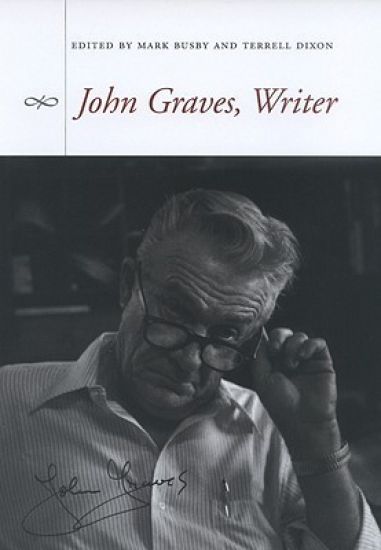
John Graves, Writer

John Graves, Writer

University of Texas Press
2007
sidottu
Runner-up, Violet Crown Award, Writer's League of Texas, 2008 Renowned for Goodbye to a River, his now-classic meditation on the natural and human history of Texas, as well as for his masterful ability as a prose stylist, John Graves has become the dean of Texas letters for a legion of admiring readers and fellow writers. Yet apart from his own largely autobiographical works, including Hard Scrabble, From a Limestone Ledge, and Myself and Strangers, surprisingly little has been written about Graves's life or his work. John Graves, Writer seeks to fill that gap with interviews, appreciations, and critical essays that offer many new insights into the man himself, as well as the themes and concerns that animate his writing. The volume opens with the transcript of a revealing, often humorous symposium session in which Graves responds to comments and stories from his old friend Sam Hynes, his former student and contemporary art critic Dave Hickey, and co-editor Mark Busby. Following this is a more formal interview of Graves by Dave Hamrick, who draws the author out on issues relating to each of his major works. John Graves's friends Bill Wittliff, Rick Bass, Bill Broyles, John R. Erickson, Bill Harvey, and James Ward Lee speak to the powerful influence that Graves has had on fellow writers. In addition to these personal observations, nine scholars analyze essential aspects of Graves's work. These include the place of Goodbye to a River within environmental literature and how its writing was a rite of passage for its author; Graves as a prose stylist and a literary, rather than polemical, writer; the ways in which Graves's major works present different aspects of a single narrative about our relationship to the land; the question of gender in Graves's work; and Graves's sometimes contentious relationship with Texas Monthly magazine. Mark Busby introduces the volume with a critical overview of Graves's life and work, and Don Graham concludes it with a discussion of Graves's reception and literary reputation. A bibliography of works by and about Graves rounds out the book. John Graves, Writer confirms Graves's stature not only within Texas letters, but also within American environmental writing, where Graves deserves to be more widely known.
A John Graves Reader

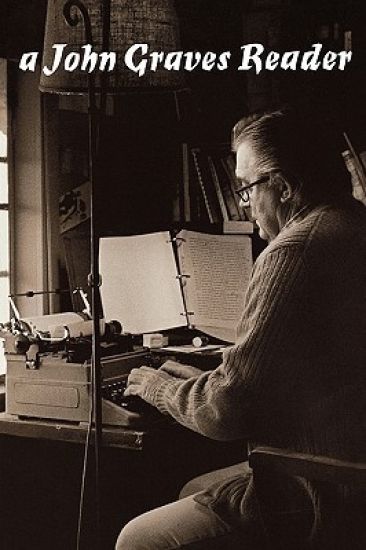
A John Graves Reader

John Graves

University of Texas Press
1996
pokkari
Since the publication of his haunting, elegiac Goodbye to a River in 1960, John Graves has become one of Texas' most beloved writers, whose circle of loyal readers extends far beyond the borders of his home state. A "regional" writer only by virtue of his gift for vividly evoking the spirit of the land and its people, Mr. Graves is also admired for the unerring craftsmanship of his prose.Now the University of Texas Press takes great pleasure in publishing A John Graves Reader to introduce his writing to a new generation of readers. This anthology contains selections from Goodbye to a River and his two other major books, Hard Scrabble (1974) and From a Limestone Ledge (1980). It also includes short stories and essays, some of which have never been published before and others that Mr. Graves has reworked especially for this book.All of the pieces in this anthology were chosen by Mr. Graves himself to be, in his words, "representative of my writing, for better or worse." They reflect various stages of his life and writing career-youth in Texas, World War II, sojourns in New York, Mexico, and Europe during the 1940s and 1950s, and his final return to Texas as home and as subject matter-as well as recurring themes in his writing, from the land and the people to fishing, traveling, and the enduring friendships that have enriched his life.For those who have never read John Graves, this anthology will be the perfect introduction to the range and excellence of his work. At the same time, those who have read him faithfully for many years will find new pieces to enjoy, as well as old favorites to savor once again.
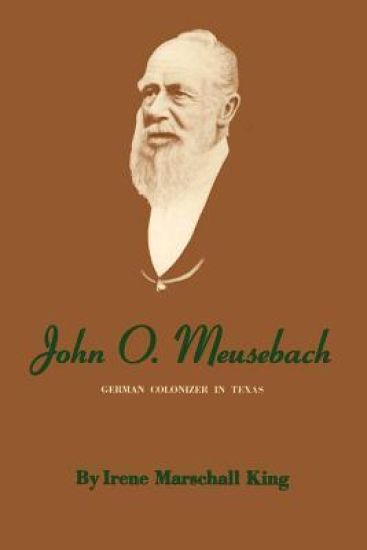
John O. Meusebach

John O. Meusebach

Irene Marschall King

University of Texas Press
1966
pokkari
Otfried Hans Freiherr von Meusebach chose a life of hardship and freedom in Texas rather than a life of comfort and influence in his native Germany, where he had lived his formative years within a framework of unconstitutional government. In 1845 the young liberal relinquished his hereditary German title, left behind his close family ties and his various intellectual and political associations, and arrived in Texas as John O. Meusebach, commissioner-general for the Society for the Protection of German Immigrants. His background enabled him to assume an enlightened leadership of fellow immigrants who were pouring in from Germany. Lacking adequate financial backing, he nevertheless led the settling of some five thousand people in a land that was largely occupied by Indians. Irene Marschall King presents the full sweep of Meusebach's vigorous life: Meusebach as the young liberal in Germany, as the colonizer in the 1840s, as a Texas senator and, later, an observer of the Civil War, and as a Texan who devoted his later years to bringing the Texas soil to fruition-all set against a background of the immigration movement and frontier life. "Freedom is not free; it is costly," Meusebach believed. In Texas he found for himself and others freedom worth the price he paid. Rich in historic detail, King's story recounts the founding of Fredericksburg, the crippling effect of the Mexican War upon the mass of immigrants huddled in illness on the coast, the signing of the Indian Treaty, which opened to settlement over three million acres of land, and the final collapse of the Society for the Protection of German Immigrants. Also depicted is the colonists' influence on the land-the gardens and orchards of south central Texas, the "Easter Fires" that blaze on the hills surrounding Fredericksburg, the mixture of German custom with American necessity that created a unique culture. Throughout the narrative Mrs. King presents a fascinating cast of characters: the noble Prince Solms, who tries to establish a German military outpost in Texas; Henry Fisher, who attempts by devious methods to control the colonists and their land and finally incites a mob which tries to hang Meusebach; Philip Cappes, a special commissioner and Meusebach's assistant, who plots through intriguing correspondence with Count Castell, the executive secretary in Germany, to overthrow Meusebach; and the colorful and courageous Indian fighter and Texas Ranger, Colonel Jack Hays. Primarily, however, this is the story of a man who found strength in his family's motto, "Perseverance in Purpose," and gave of his energies to build Texas.
John Okada

John Okada

University of Washington Press
2018
pokkari
No-No Boy, John Okada's only published novel, centers on a Japanese American who refuses to fight for the country that incarcerated him and his people in World War II and, upon release from federal prison after the war, is cast out by his divided community. In 1957, the novel faced a similar rejection until it was rediscovered and reissued in 1976 to become a celebrated classic of American literature. As a result of Okada's untimely death at age forty-seven, the author's life and other works have remained obscure.This compelling collection offers the first full-length examination of Okada's development as an artist, placing recently discovered writing by Okada alongside essays that reassess his lasting legacy. Meticulously researched biographical details, insight from friends and relatives, and a trove of intimate photographs illuminate Okada's early life in Seattle, military service, and careers as a public librarian and a technical writer in the aerospace industry. This volume is an essential companion to No-No Boy.
John Okada

John Okada

University of Washington Press
2018
sidottu
No-No Boy, John Okada's only published novel, centers on a Japanese American who refuses to fight for the country that incarcerated him and his people in World War II and, upon release from federal prison after the war, is cast out by his divided community. In 1957, the novel faced a similar rejection until it was rediscovered and reissued in 1976 to become a celebrated classic of American literature. As a result of Okada's untimely death at age forty-seven, the author's life and other works have remained obscure.This compelling collection offers the first full-length examination of Okada's development as an artist, placing recently discovered writing by Okada alongside essays that reassess his lasting legacy. Meticulously researched biographical details, insight from friends and relatives, and a trove of intimate photographs illuminate Okada's early life in Seattle, military service, and careers as a public librarian and a technical writer in the aerospace industry. This volume is an essential companion to No-No Boy.
John Donne's Marriage Letters in the Folger Shakespeare Library
This is a complete facsimile edition of fourteen autograph letters of John Donne that are among the greatest treasures of the Folger Library. The letters, dating from February and March 1602, relate to Donne's clandestine marriage to Anne More and are addressed to his father-in-law, Sir George More, and to Sir Thomas Egerton, the lord keeper, who was also Donne's employer.The text of a letter provides one part of the story, while its very tangibility -- the ancient folds, the grime and fingerprints deposited by the writer, deliverer, and readers, the broken seals, the ink blots, the idosyncratic spelling, the location of a signature -- tells another. An understanding of a letter's written and unwritten social signals brings into focus a fuller, grittier, and a clearer view of life in 17th century England.John Donne's Marriage Letters was recognized in the AIGA "50 books/50 Covers" competition as one of 100 examples of outstanding book and book cover design produced in 2005.
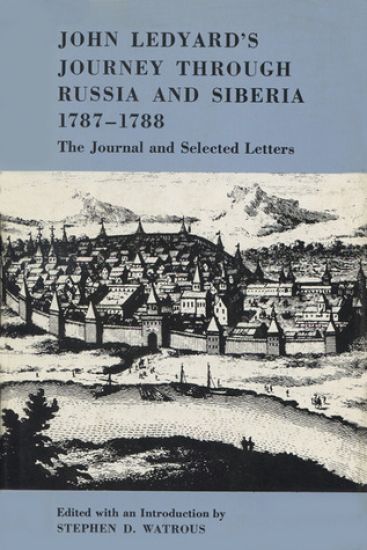
John Ledyard's Journey Through Russia and Siberia, 1787-1788

John Ledyard's Journey Through Russia and Siberia, 1787-1788

Stephen D. Watrous

University of Wisconsin Press
2011
nidottu
Provides a complete volume of pertinent information by and about John Ledyard, one of the most amazing explorers of all time. Including Ledyard’s own journal, letters between him and others, particularly Thomas Jefferson, and biographical information on eighteenth-century Siberia, this offers an exceptional look at history, geography, and travel.
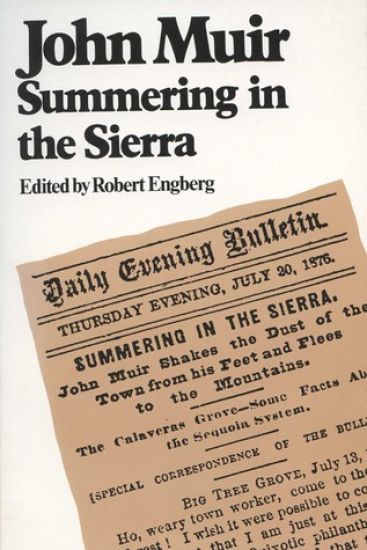
John Muir

John Muir

John Muir

University of Wisconsin Press
1984
nidottu
This is a collection of articles written by the pioneering naturalist for the San Francisco Evening Bulletin in 1874 and 1875. . . . In the course of his wanderings we hear Muir grow from a student of the wilderness to its professor and protector."--Sierra Magazine
John Williams's Film Music

John Williams's Film Music

Emilio Audissino

University of Wisconsin Press
2014
nidottu
John Williams is one of the most renowned film composers in history. He has penned unforgettable scores for Star Wars, the Indiana Jones series, E.T. the Extra-Terrestrial, Jaws, Superman, and countless other films. Fans flock to his many concerts, and with forty-nine Academy Award nominations as of 2014, he is the second-most Oscar-nominated person after Walt Disney. Yet despite such critical acclaim and prestige, this is the first book in English on Williams’s work and career.Combining accessible writing with thorough scholarship, and rigorous historical accounts with insightful readings, John Williams’s Film Music explores why Williams is so important to the history of film music. Beginning with an overview of music from Hollywood’s Golden Age (1933–58), Emilio Audissino traces the turning points of Williams’s career and articulates how he revived the classical Hollywood musical style. This book charts each landmark of this musical restoration, with special attention to the scores for Jaws and Star Wars, Williams’s work as conductor of the Boston Pops Orchestra, and a full film/music analysis of Raiders of the Lost Ark. The result is a precise, enlightening definition of Williams’s “neoclassicism” and a grounded demonstration of his lasting importance, for both his compositions and his historical role in restoring part of the Hollywood tradition.Best Special Interest Books, selected by the American Association of School Librarians, Best Books for General Audiences, selected by the Public Library Reviewers.
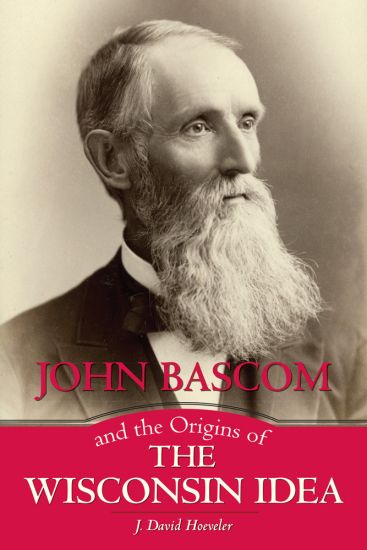
John Bascom and the Origins of the Wisconsin Idea

John Bascom and the Origins of the Wisconsin Idea

J. David Hoeveler

University of Wisconsin Press
2017
nidottu
In the Progressive Era of American history, the state of Wisconsin gained national attention for its innovative economic and political reforms. Amidst this ferment, the ""Wisconsin Idea"" was popularized?the idea that a public university should improve the lives of people beyond the borders of its campus.During his term as governor (1901?1906), Robert La Follette routinely consulted with University of Wisconsin researchers to devise groundbreaking programs and legislation. Although the Wisconsin Idea is often attributed to a 1904 speech by Charles Van Hise, then president of the University of Wisconsin, David Hoeveler argues that it originated decades earlier, in the creative and fertile mind of John Bascom.A philosopher, theologian, and sociologist, Bascom (1827?1922) deeply influenced a generation of students at the University of Wisconsin, including La Follette and Van Hise. Hoeveler documents how Bascom drew concepts from German idealism, liberal Protestantism, and evolutionary theory, transforming them into advocacy for social and political reform. He was a champion of temperance, women's rights, and labor, all of which brought him controversy as president of the university from 1874 to 1887. In a way unmatched by any of his peers at other institutions, Bascom outlined a social gospel that called for an expanded role for state governments and universities as agencies of moral improvement.Hoeveler traces the intellectual history of the Wisconsin Idea from the nineteenth century to such influential Progressive Era thinkers as Richard T. Ely and John R. Commons, who believed university researchers should be a vital source of expertise for government and citizens.
John Ruskin

John Ruskin

Tim Hilton

Yale University Press
1985
sidottu
This authoritative biography of John Ruskin, the most influential nineteenth-century critic of art and society, is the fruit of almost twenty years of research and the first to return to the original sources. It draws on the complete text of Ruskin’s diaries and many thousands of unpublished letters and other documents to provide fresh insight into the background and content of Ruskin’s numerous books. In this fascinating book, Hilton shows how the youthful art critic became a significant didactic writer, developing a unique voice that was to shape his future as the most eloquent and radical of all the great Victorian writers.
John Dewey and the Lessons of Art

John Dewey and the Lessons of Art

Philip W. Jackson

Yale University Press
2000
pokkari
What do the arts have to teach us about how to live our lives? How can teachers use art's "lessons" to improve their teaching? This provocative book examines John Dewey's thinking about the arts and explores the practical implications of that thinking for educators. Philip W. Jackson draws on Art as Experience, the philosopher's only book on the subject, and less well-known observations scattered throughout Dewey's writings to consider the nature and power of art and its relation to education. For those unacquainted with Dewey's thought as well as for Dewey specialists, this book provides rich insights into how the arts might inform educational practice.Jackson introduces the basics of Dewey's aesthetic theory and then looks at the ways in which single works of art can profoundly affect the individuals who either make them or come to them as readers, listeners, or spectators. He considers the experiences of many writers—music and art critics, authors of self-help books, poets, and philosophers—to explore the transformative power of the experience of art. In a concluding chapter on the educational relevance of Dewey's views, the author focuses on two instances of flawed educational practice, showing how a more conscientious application of Dewey's view of the arts could have improved the learning experience.
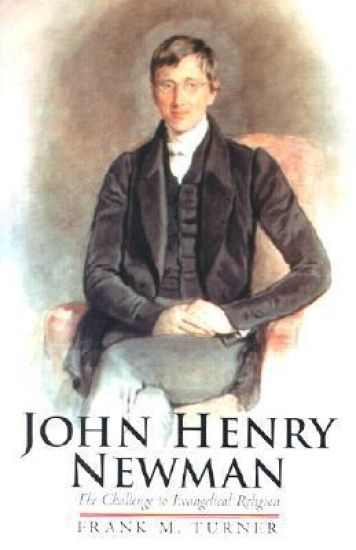
John Henry Newman

John Henry Newman

Frank M Turner

Yale University Press
2002
sidottu
One of the most controversial religious figures of the nineteenth century, John Henry Newman (1801-1890) began his career as a priest in the Church of England but converted to the Roman Catholic Church in 1845. He became a cardinal in 1879. Between 1833 and 1845 Newman, now best known for his autobiographical Apologia Pro Vita Sua and The Idea of a University, was the aggressive leader of the Tractarian Movement within Oxford University. Newman, along with John Keble, Richard Hurrell Froude, and E. B. Pusey, launched an uncompromising battle against the dominance of evangelicalism in early Victorian religious life. By 1845 Newman's radically outspoken views had earned him censure from Oxford authorities and sharp criticism from the English bishops. Departing from previous interpretations, Turner portrays Newman as a disruptive and confused schismatic conducting a radical religious experiment. Turner demonstrates that Newman's passage to Rome largely resulted from family quarrels, thwarted university ambitions, the inability to control his followers, and his desire to live in a community of celibate males.
John Payne Collier

John Payne Collier

Arthur Freeman; Janet Ing Freeman

Yale University Press
2004
sidottu
John Payne Collier (1789–1883), one of the most controversial figures in the history of literary scholarship, pursued a double career. A prolific and highly influential writer on the drama, poetry, and popular prose of Shakespeare’s age, Collier was at the same time the promulgator of a great body of forgeries and false evidence, seriously affecting the text and biography of Shakespeare and many others. This monumental two-volume work for the first time addresses the whole of Collier’s activity, systematically sorting out his genuine achievements from his impostures.Arthur and Janet Freeman reassess the scholar-forger’s long life, milieu, and relations with a large circle of associates and rivals while presenting a chronological bibliography of his extensive publications, all fully annotated with regard to their creditability. The authors also survey the broader history of literary forgery in Great Britain and consider why so talented a man not only yielded to its temptations but also persisted in it throughout his life.
John Talman

John Talman

Yale University Press
2009
sidottu
Contributions by Christopher Baker, Cristina Borgioli, Louisa M. Connor Bulman, Antonella Capitanio, Marco Collareta, Peter Davidson, Francisco Freddolini, Cristiano Giometti, John Harris, Elisabeth Kieven, and Cinzia Maria Sicca This handsome book is the only full-length study of John Talman (1677–1726), first director of the Society of Antiquaries and one of the most influential collectors of drawings in early 18th-century Britain. Prominent scholars discuss the history of Talman’s acquisitions, shedding light on the competitive nature, social practices, and aesthetic ideas of connoisseurship both in England and abroad. Talman’s collection, amassed in England, Florence, and Rome between the 1690s and 1719, focused on Italian medieval art, architecture, and textiles as well as Renaissance and Baroque architecture and sculpture. It reflected the tastes and preoccupations of artistic and intellectual élites in pre-enlightenment Europe. A vehicle for disseminating aesthetic and historical ideas, the collection became not only an extraordinary document of the state of ancient and modern Italian monuments but also a history of architecture and culture at large that provided visual evidence of buildings and rituals lost through time. Distributed for the Yale Center for British Art and the Paul Mellon Centre for Studies in British Art
John Wilkes

John Wilkes

Arthur Cash

Yale University Press
2007
pokkari
A highly entertaining biography of the incredible John Wilkes, champion of liberty and irrepressible libertine. "It is difficult to believe that John Wilkes, a notorious womanizer and scandal-monger, was a genuine hero of civil liberties and political democracy on both sides of the Atlantic in the late 18th century, but hero he was and in this engaging book Arthur Cash gives Wilkes the serious treatment he has long deserved."—Eric Foner, Columbia University “[A] superb biography. . . . After finishing the last page I turned back to the beginning in order to enjoy it all over again.”—Tom Hodgkinson, Independent on Sunday “Informative and enjoyable. . . . So well researched, so full of fascinating detail, . . . so delightfully buoyant.” - John Barrell, London Review of Books
John Brett

John Brett

Christiana Payne; Charles Brett

Yale University Press
2010
sidottu
Drawing on a wealth of unpublished sketchbooks, journals, and writings, this essential guide to John Brett (1831–1902) investigates the painter who was seen as the leader of the Pre-Raphaelite landscape school. In addition to exploring the familiar early works, including The Val d'Aosta and Stonebreaker, it provides rich information on his later, less-known coastal and marine paintings. Brett’s turbulent friendship with John Ruskin is discussed, as are his relations with his beloved sister, Rosa, and his partner Mary, with whom he had seven children. His fervent interest in astronomy, his love of the sea, and his lifelong pursuit of wealth and recognition are all examined in this reassessment, which concludes with a catalogue raisonné of his works, prepared by his descendent Charles Brett.Published for the Paul Mellon Centre for Studies in British Art