Kirjojen hintavertailu. Mukana 11 244 527 kirjaa ja 12 kauppaa.

Kirjahaku

Etsi kirjoja tekijän nimen, kirjan nimen tai ISBN:n perusteella.

1000 tulosta hakusanalla John Collier

John Stuart Mill on Economic Theory and Method
This book, the third in the series of Samuel Hollander's essays, covers twelve key studies on the economic theory and method of John Stuart Mill. This volume provides an accessible sourcebook on Mill's relationship with David Ricardo, and the 'Classical School', as well as confirming his relevance for modern economics and for the place of economics within the social sciences.
Collected Works of John Stuart Mill

Collected Works of John Stuart Mill

John Stuart Mill

Routledge
1996
sidottu
The Collected Works of John Stuart Mill took thirty years to complete and is acknowledged as the definitive edition of J.S. Mill and as one of the finest works editions ever completed. Mill's contributions to philosophy, economics, and history, and in the roles of scholar, politician and journalist can hardly be overstated and this edition remains the only reliable version of the full range of Mill's writings. Each volume contains extensive notes, a new introduction and an index. Many of the volumes have been unavailable for some time, but the Works are now again available, both as a complete set and as individual volumes.
John Maynard Keynes: Critical Responses
John Maynard Keynes, heralded in his own time by the press as "our greatest living economist", is acknowledged as one of the most influential thinkers of the 20th Century. This set presents contemporary responses to Keynes and provides a range of reviews, academic assessments and scholarly essays on Keynes' published works.This important collection draws upon an enormous range of sources, from the popular press to academic journals, and includes responses from Germany, Italy, and France as well as the UK and North America.* Volume One contains reviews of Indian Currency and Finance (1913), The Economic Consequences of Peace (1919), The Revision of the Treaty (1921), A Treatise on Probability (1921), A Tract on Monetary Reform (1923), The End of Laissez-Faire (1926) and Laissez-Faire and Communism (1926)* Volume Two contains reviews of A Treatise on Money (1930), Unemployment as a World Problem (1931), Essays in Persuasion (1931), Essays in Biography (1933) and The Means of Prosperity (1933)* Volume Three contains reviews of The General Theory of Unemployment, Interest and Money (1936) and How to Pay for the War (1940)* Volume Four includes obituaries and final assessments
Collected Works of John Locke
This first octavo edition of John Locke's Works has set the pattern for all subsequent English Works editions until the present time. It contains all the famous philosophical writings, as well as a life of the author based on that of Le Clerc but using a large number of unpublished letters. For the first time all correspondence is placed together, and the non-correspondence items in Desmaizeaux's Collection are repositioned to follow the relevant works. Set in context with a new introduction by Locke scholar John Yolton, this edition remains the preferred choice for many academics today.
John Dos Passos
This set comprises 40 volumes covering 19th and 20th century European and American authors. These volumes will be available as a complete set, mini boxed sets (by theme) or as individual volumes. This second set complements the first 68 volume set of Critical Heritage published by Routledge in October 1995.
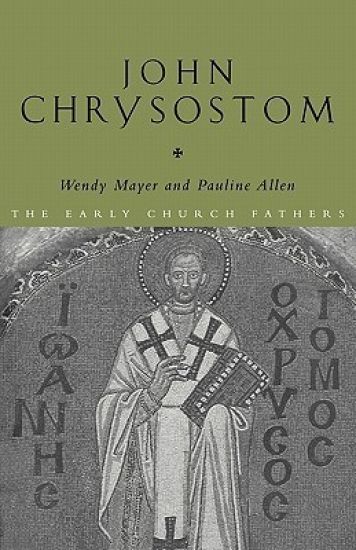
John Chrysostom

John Chrysostom

Pauline Allen; Wendy Mayer

Routledge
1999
sidottu
This book examines John Chrysostom's role as preacher and his pastoral activites as deacon, presbyter and bishop. It also provides fresh and lively translations of a key selection of sermons and letters.
John Chrysostom

John Chrysostom

Pauline Allen; Wendy Mayer

Routledge
1999
nidottu
This book examines John Chrysostom's role as preacher and his pastoral activites as deacon, presbyter and bishop. It also provides fresh and lively translations of a key selection of sermons and letters.
John Ruskin's Political Economy

John Ruskin's Political Economy

William Henderson

Routledge
1999
sidottu
This volume offers an exciting new reading of John Ruskin's economic and social criticism, based on recent research into rhetoric in economics. Willie Henderson uses notions derived from literary criticism, the rhetorical turn in economics and more conventional approaches to historical economic texts to reevaluate Ruskins economic and social criticism. By identifying Ruskin's rhetoric, and by reading his work through that of Plato, Xenophon, and John Stuart Mill, Willie Henderson reveals how Ruskin manipulated a knowledge base. Moreover in analysis of the writings of William Smart, John Bates Clark and Alfred Marshall, the author shows that John Ruskin's influence on the cultural significance of economics and on notions of economic well-being has been considerable.
John Milton

John Milton

Richard Bradford

Routledge
2001
sidottu
There is a crying need for an accessible, comprehensive guide to John Milton for the thousands of students who make their way through his poetry every year on literary survey and seventeenth century literature courses. Where many previous guides have dragged their way through Paradise Lost, Richard Bradford brings Milton to life with an overview of his life, contexts, work and the relationship between these, and of the main critical issues surrounding his work.
John Milton

John Milton

Richard Bradford

Routledge
2001
nidottu
There is a crying need for an accessible, comprehensive guide to John Milton for the thousands of students who make their way through his poetry every year on literary survey and seventeenth century literature courses. Where many previous guides have dragged their way through Paradise Lost, Richard Bradford brings Milton to life with an overview of his life, contexts, work and the relationship between these, and of the main critical issues surrounding his work.
John Rawls
John Rawls (1921-2002) is, arguably, the most important political philosopher of our time. It is commonly observed that the publication in 1971 of his treatise A Theory of Justice initiated a return to political questions among Anglo-American philosophers and is largely responsible for the vigorous health of contemporary political philosophy. Rawls' ideas and approach have transformed philosophical inquiry in this area, and political theorists nowadays are obliged to make clear where they stand in relation to Rawls if they wish to be involved in mainstream discussions. Yet Rawls' influence has also extended beyond philosophy and has had a substantial impact on work in law, economics, and political science. Since the publication of A Theory of Justice, Rawls has written two other major works: Political Liberalism (1993) and The Law of Peoples (1999) and also issued a collection of his essays: Collected Papers (1999).This collection provides a thorough analysis of Rawls' work. In addition to a general introduction, the set includes introductions to each volume which help guide the reader through the material.
John Stuart Mill and Freedom of Expression
The arguments advanced in the second chapter of On Liberty (1859) have become the touchstone for practically every discussion of freedom of speech, yet the broader development of John Stuart Mill's ideas concerning intellectual liberty has generally been neglected. This work attempts to fill that lacuna by looking beyond On Liberty, in order to understand the evolution of Mill's ideas concerning freedom of thought and discussion.
John Milton's Paradise Lost
John Milton's epic poem Paradise Lost (1667) is a literary landmark. His reworking of Biblical tales of the loss of Eden constitutes not only a gripping literary work, but a significant musing on fundamental human concerns ranging from freedom and fate to conscience and consciousness.Designed for students new to Milton's complex, lengthy work, this sourcebook:* outlines the often unfamiliar contexts of seventeenth-century England which are so crucial to Paradise Lost* completes the contextual study with a chronology and reprinted documents from the period* examines and reprints a broad range of responses to the poem, from early reactions to recent criticism* reprints the most frequently studied passages of the poem, along with extensive commentary and annotation of unfamiliar or significant terms used in Milton's work* provides cross-references between the textual, contextual and critical sections of the sourcebook, to show how all the materials can be called upon in an individual reader's encounter with the text* suggests further reading for those facing the huge array of critical work on the poem.With an emphasis on enjoying as well as understanding what can be a somewhat daunting work, this sourcebook will be a welcome resource for anyone new to Paradise Lost.
John Milton's Paradise Lost
John Milton's epic poem Paradise Lost (1667) is a literary landmark. His reworking of Biblical tales of the loss of Eden constitutes not only a gripping literary work, but a significant musing on fundamental human concerns ranging from freedom and fate to conscience and consciousness.Designed for students new to Milton's complex, lengthy work, this sourcebook:* outlines the often unfamiliar contexts of seventeenth-century England which are so crucial to Paradise Lost* completes the contextual study with a chronology and reprinted documents from the period* examines and reprints a broad range of responses to the poem, from early reactions to recent criticism* reprints the most frequently studied passages of the poem, along with extensive commentary and annotation of unfamiliar or significant terms used in Milton's work* provides cross-references between the textual, contextual and critical sections of the sourcebook, to show how all the materials can be called upon in an individual reader's encounter with the text* suggests further reading for those facing the huge array of critical work on the poem.With an emphasis on enjoying as well as understanding what can be a somewhat daunting work, this sourcebook will be a welcome resource for anyone new to Paradise Lost.
John A. Hobson
John Atkinson Hobson was a controversial figure in the history of economic thought. His first book (The Physiology of Industry ) lost him two university lecturing posts, which Hobson later describes as due to 'an Economics Professor who had read my book and considered it as equivalent to an attempt to prove the flatness of the earth'. Hobson received a similar reception from the rest of his peers. As an advocate of an apparently fallacious theory of over-saving, a critic of the orthodox theory of distribution, and a proponent of a theory of imperialism which was later taken up by Lenin, Hobson was generally condemned as a heretic by the rest of the economic establishment. His fortunes changed, rather belatedly, in 1936, when Keynes paid tribute to Hobson's work in The General Theory as anticipating his own theory that society can, under some circumstances, save too large a proportion of its income - thrift then being a vice, not a virtue. Hobson's influence was international and the impact of his writings was widespread. This collection will provide scholars with an invaluable resource in their ongoing evaluation of Hobson's contribution to economic, social and political thought.
John Elliot Cairnes
This six-volume set contains virtually all of the published work of Cairnes; it brings together, for the first time, all of his major works and almost all his uncollected articles, pamphlets and published letters. It is an essential resource for those studying the man himself, the tradition of Classical economy, and Irish intellectual history in the nineteenth century.
The Writings of John Greenwood 1587-1590, together with the joint writings of Henry Barrow and John Greenwood 1587-1590
Henry Barrow and John Greenwood are the fathers of Elizabethan Separatism. Unlike Robert Browne, they refused to compromise their beliefs or conform to Anglicanism and as a consequence they died in 1593 - as martyrs for their steadfast adherence to the principles of English Congregationalism. Volumes three and four include c. 40 items derived from manuscripts, surreptitiously printed books and very rare pamphlets and documents which allow evaluation of the teachings of the Separatists, in relation to the activities of the Elizabethan hierarchy, to the Puritans, to the Pilgrims in the Netherlands and the New World and to the Independents and Congregationalists. (16 of the pieces are by Barrow, 6 by Greenwood and 5 by both men, in addition to 13 related Barrowist items in the Appendix).
John P. Kotter
John P. Kotter (b. 1947), a leading authority on business leadership and change, is the subject of this new collection from Routledge’s acclaimed Critical Evaluations in Business and Management series. It brings together in two volumes the best critical evaluations of his work. The collection is supplemented with the editors’ expert introduction which places the gathered scholarship in its historical and intellectual context.
John Stuart Mill

John Stuart Mill

R J Halliday; R. J. Halliday

Routledge
2003
sidottu
First published in 1976, this volume offers a significant new interpretation of Mill's political thought, Mill's ambivalent attitude to democracy is carefully examined. The implications for modern democracy of Mill's views on consensus and leadership, bureaucracy and participation, equality and liberty emerge from a deep understanding of Mill's place in 19th century ideas.