Kirjojen hintavertailu. Mukana 11 627 463 kirjaa ja 12 kauppaa.

Kirjahaku

Etsi kirjoja tekijän nimen, kirjan nimen tai ISBN:n perusteella.

1000 tulosta hakusanalla John David Petty

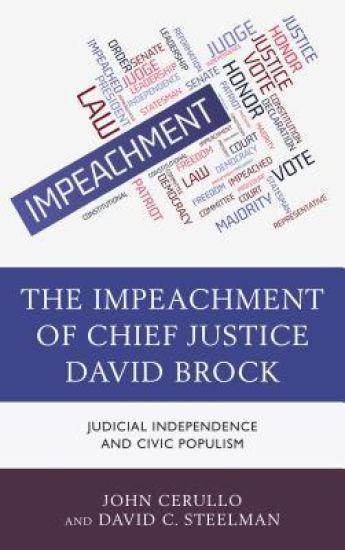
The Impeachment of Chief Justice David Brock

The Impeachment of Chief Justice David Brock

John Cerullo; David C. Steelman

Lexington Books
2017
sidottu
At this juncture in American history, some of our most hard-fought state-level political struggles involve control of state supreme courts. New Hampshire witnessed one of the most dramatic of these, culminating in the impeachment of Chief Justice David Brock in 2000, but the issues raised by the case are hardly confined to New Hampshire. They involved the proper nature and operation of judicial independence within a “populist” civic culture that had long assumed the primacy of the legislative branch, extolled its “citizen legislators” over insulated and professionalized elites, and entrusted those legislators to properly supervise the judiciary. In the last few decades of the 20th Century, New Hampshire’s judiciary had been substantially reconfigured: constitutional amendments and other measures endorsed by the national judicial-modernization movement had secured for it a much higher level of independence and internal unification than it had historically enjoyed. However, a bipartisan body of legislators remained committed to the principle of legislative supremacy inscribed in the state constitution of 1784. The 1980s and 1990s witnessed a series of clashes over court administration, allegations of judicial corruption, and finally a bitter and protracted battle over Court decisions on educational funding. Chief Justice Brock publicly embodied the judicial branch's new status and assertiveness. When information came to light regarding some of his administrative actions on the high court, deepening antipathy toward him exploded into an impeachment crisis. The struggle over Brock’s conduct raised significant questions about the meaning and proper practice of impeachment itself as a feature of democratic governance. When articles of impeachment were voted by the House of Representatives, the state Senate faced the difficult task of establishing trial protocols that would balance the political and juridical responsibilities devolved on them, simultaneously, by the state constitution. Having struck that balance, the trial they conducted would finally acquit Brock of all charges. Nevertheless, David Brock’s impeachment was a highly consequential ordeal that provided a needed catalyst for reforms intended to produce a productive recalibration of legislative-judicial relations.
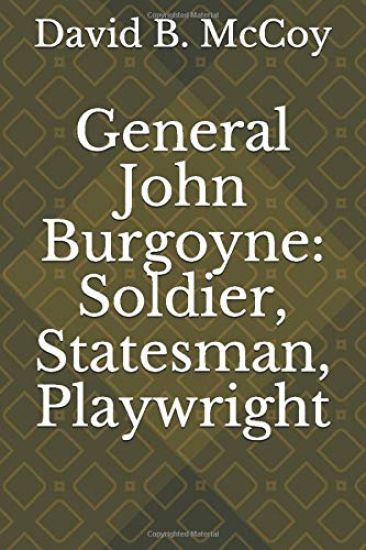
General John Burgoyne

General John Burgoyne

David B McCoy

Independently Published
2017
pokkari
As noted by historian George Billias, "Of the British generals in the American Revolution, none has been ridiculed more than John Burgoyne." He has been depicted as "a playboy general-a card-playing, wine-loving, "bon vivant" who had a winning way with women in the boudoir but a losing style on the battlefield; a buffoon in uniform who bungled his assignments badly; and a dilettante who pursued three careers-those of soldier, politician, and playwright-and mastered none." The cause of such crude stereotypes can be traced back to hostile sources during his lifetime. First, the Parliamentary Debates which records the attacks by Secretary of State for the Colonies, Lord George Germain, on Burgoyne (in his role of protecting the honor of King George III), the memoirs of Baroness von Riedesel (wife of General Friedrich Adolf Riedesel of Brunswick, Germany, who accompanied Burgoyne during the Saratoga Campaign), and Horace Walpole (a man of letters and Whig politician who amused himself by exaggerating Burgoyne's foibles). A second realm where Burgoyne has been ill-treated can be found in written history. Those who supported the war against America denounced him as the cause of Britain's defeat. Those who opposed the war condemned him as an instrument of tyranny. And many American writers are more than happy to present Burgoyne as a pompous buffoon. While this is a brief biography of General John Burgoyne, it is hoped readers will be left with the impression that he was a man of considerate military talent, and as a politician and playwright, attained a more than average position among his contemporaries.
The Biblical Saga of King David

The Biblical Saga of King David

John Van Seters

Eisenbrauns
2009
sidottu
The biblical story of King David has been interpreted in many different ways, arising from the variety of methods used in and the intended objectives of the studies: Does the narrative contain insight into and information about the early history of the Judean monarchy, or is it merely a legendary tale about a distant past? Can we identify the story’s literary genre, it sociohistorical setting, and the intention of its author(s)? Is an appreciation for the wonderful literary qualities of the story compatible with a literary-critical investigation of the narrative’s compositional and text-critical history? Van Seters reviews past scholarship on the David story and in the course of doing so unravels the history of these questions and then presents an extended appraisal of the debate about the social and historical context of the biblical story. From this critical foundation, Van Seters proceeds to offering a detailed literary analysis of the story of David from his rise to power under Saul to his ultimate succession by Solomon.
In High Places with Henry David Thoreau

In High Places with Henry David Thoreau

John Gibson

Countryman Press Inc.
2013
nidottu
This is the essential guide for modern-day walkers and hikers eager to retrace Thoreau’s routes on New England’s peaks. Insights about Thoreau’s mountain journeys, excerpts from his trip narratives, detailed topographical maps, and precise trail directions pave the way—figuratively—for hikers who want to cover the same ground that Thoreau explored in the mid-19th century. With this inventive guide in hand, history and literature buffs and outdoors enthusiasts alike can enjoy a dozen hikes and at least as many stories of what the trails were like in Thoreau’s day. Thoreau was drawn to these high places because they are the natural world amplified, the world thrust upward. Not to go there was unthinkable. “We must go out and re-ally ourselves to Nature every day,” he wrote in 1856. “I am sensible that I am imbibing health when I open my mouth to the wind...Alone in distant woods or fields, I come to myself, I once more feel myself grandly related, and that cold and solitude are friends of mine.” John Gibson is the author of several books, including Explorer’s Guides 50 Hikes in Coastal and Southern Maine and Weekend Walks along the New England Coast (both Countryman). He lives in Hallowell, ME.