John Stuart Mill es que las acciones que son correctas son las que se extienden y que tienden a promover la felicidad, y las malas para extender entonces que a su vez producen infelicidad, en donde la felicidad significa placer y la infelicidad significa dolor. Un punto clave aqu es que Mill est hablando de la felicidad total o la mayor felicidad para un mayor n mero de personas. Sin embargo, Mill no estaba completamente feliz de dejar esta formulaci n (expresi n de algo de forma clara y precisa) en su forma actual, ya que permit a la posibilidad de que tal vez ser a mejor pasar la vida ocupados en asuntos hedonistas, en lugar de participar de los frutos de la civilizaci n humana. En consecuencia, se introduce la idea de que ciertos tipos de placer son mejores que otros.
El presente ensayo de John Stuart Mill (1806-1873) pertenece a la breve galer a de obras de combate pol tico que, aun d cadas o siglos despu s de ser escritas, siguen determinando los comportamientos de los hombres. John Stuart Mill marc de forma decisiva el pensamiento democr tico liberal. Sobre la libertad fue b sicamente concebido como una protesta contra el moralismo coercitivo que imperaba en la Inglaterra victoriana. Mill trat de defender una concepci n de la vida pol tica caracterizada por la libertad individual, un gobierno m s responsable y una administraci n eficiente, libre de pr cticas corruptas. En las nuevas tendencias democr ticas propias de la sociedad del siglo XIX Mill ve a numerosos peligros. Tem a, como Tocqueville, la tiran a de las mayor as. Su temor se dirig a no tanto al uso coercitivo del aparato estatal, sino m s bien a la correcci n de la opini n p blica que, dominada por el perjuicio y la costumbre, pod a ser claramente intolerante con las actitudes o comportamientos de car cter disidente, exc ntrico o simplemente diferente.
One of history's most important political works. Mill declares that "over himself, over his own body and mind, the individual is sovereign". If you are interested in political philosophy - this is a must read
On Liberty is a philosophical work by 19th century English philosopher John Stuart Mill, first published in 1859. To the Victorian readers of the time it was a radical work, advocating moral and economic freedom of individuals from the state.
John Stuart Mill's book Utilitarianism is a philosophical defense of utilitarianism in ethics. The essay first appeared as a series of three articles published in Fraser's Magazine in 1861; the articles were collected and reprinted as a single book in 1863. It went through four editions during Mill's lifetime with minor additions and revisions. Although Mill includes discussions of utilitarian ethical principles in other works such as On Liberty and The Subjection of Women, Utilitarianism contains Mill's only major discussion of the fundamental grounds for utilitarian ethical theory.
Full text.John Stuart Mill, one of the most influential thinkers in the history, was convinced that the moral and intellectual advancement of humankind would result in greater happiness for everybody. He asserted that the higher pleasures of the intellect yielded far greater happiness than the lower pleasure of the senses. He conceived of human beings as morally and intellectually capable of being educated and civilised. Mill believed everyone should have the right to vote, with the only exceptions being barbarians and uneducated people.Mill argues that people should be able to vote to defend their own rights and to learn to stand on their two feet, morally and intellectually. This argument is applied to both men and women. Mill often used his position as a member of Parliament to demand the vote for women, a controversial position for the time.In Mill's time a woman was generally subject to the whims of her husband and/or father due to social norms which said women were both physically and mentally less able than men and therefore needed to be "taken care of." Contributing to this view were both hierarchical religious views of men and women within the family and social theories based on biological determinism. The archetype of the ideal woman as mother, wife and homemaker was a powerful idea in 19th century society.
Full text.Clear, eloquent and profound, Mill's Utilitarianism has had an enormous influence on moral philosophy and is the idea introduction to ethics.Mill balanced the claims of reason and the imagination, justice and expediency, individuality and social well-being in a system of ethics that is as relevant to today's intellectua and moral dilemmas it was to the nineteenth century's.
On Liberty is a philosophical work by the English philosopher John Stuart Mill, originally intended as a short essay. The work, published in 1859, applies Mill's ethical system of utilitarianism to society and the state. Mill attempts to establish standards for the relationship between authority and liberty. He emphasizes the importance of individuality, which he conceived as a prerequisite to the higher pleasures-the summum bonum of Utilitarianism. Furthermore, Mill criticizes the errors of past attempts to defend individuality where, for example, democratic ideals resulted in the "tyranny of the majority". Among the standards established in this work are Mill's three basic liberties of individuals, his three legitimate objections to government intervention, and his two maxims regarding the relationship of the individual to society. On Liberty was a greatly influential and well received work, although it did not go without criticism. Some attacked it for its apparent discontinuity with Utilitarianism, while others criticized its vagueness. The ideas presented in On Liberty have remained the basis of much liberal political thought. It has remained in print continuously since its initial publication. To this day, a copy of On Liberty is passed to the president of the British Liberal Democrats as a symbol of office. A copy of the same book is also presented to and then held by the president of the Liberal Party as a symbol of office. Mill's marriage to his wife Harriet Taylor Mill greatly influenced the concepts in On Liberty, which was largely finished prior to her death, and published shortly after she died.
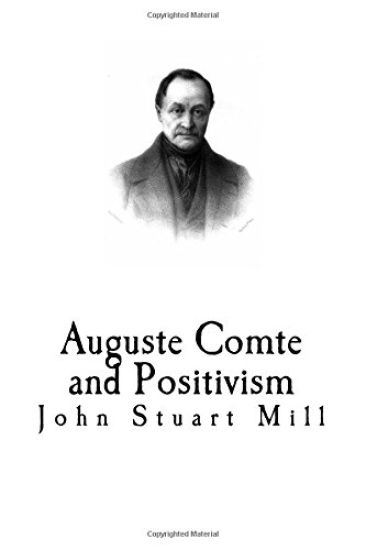
Auguste Comte and PositivismBy John Stuart MillIsidore Marie Auguste Fran ois Xavier Comte was a French philosopher who founded the discipline of praxeology and the doctrine of positivism. He is sometimes regarded as the first philosopher of science in the modern sense of the term.Influenced by the utopian socialist Henri Saint-Simon, Comte developed the positive philosophy in an attempt to remedy the social malaise of the French Revolution, calling for a new social doctrine based on the sciences. Comte was a major influence on 19th-century thought, influencing the work of social thinkers such as Karl Marx, John Stuart Mill, and George Eliot. His concept of sociologie and social evolutionism set the tone for early social theorists and anthropologists such as Harriet Martineau and Herbert Spencer, evolving into modern academic sociology presented by Emile Durkheim as practical and objective social research.
On Liberty is a philosophical work of the English philosopher John Stuart Mill, conceived as a short essay. The work, published in 1859, applies the ethical system of utilitarianism of Mile society and the state. Mill tries to establish standards for the relationship between authority and freedom. He emphasizes the importance of individuality, which he conceived as a prerequisite for the highest places: the summum bonum of utilitarianism. In addition, Mill criticizes the errors of the defenders of individuality where, for example, democratic ideals resulted in the "tyranny of the majority". The groups established in this paper are in the three basic freedoms of Mill for individuals, their three legitimate objections to government intervention and their two maxims regarding the individual's relationship with society.
El utilitarismo obliga a repetir constantemente los juicios eticos, que seran relativos al uso que se haga de las cosas, es decir, a las practicas o conductas que se desarrollen con ellas. La religion o la energia atomica no son ni buenas ni malas, no puede establecerse para siempre la bondad o maldad de algo, sino que depende, en cada caso, de los resultados practicos. Resultara, las mas de las veces, que el utilitaristas calificara a las cosas, vinculadas siempre a conductas, de buenas si resultan beneficiosas y malas si resultan perjudiciales; resultando algunas de ellas buenas y malas a un mismo tiempo, al depender de la utilizacion que se haga de ellas. Asi, la energia atomica es buena (util, benefica) en la medida en que proporciona iluminacion a las grandes ciudades y mala (perjudicial) en la medida en que permite fabricar bombas atomicas o desechar residuos radiactivos al mar. Esta consideracion etica perdura en nuestros dias con el nombre de pragmatismo el cual se caracteriza por hacer depender el juicio etico de los resultados practicos y asi medir la conducta bajo el criterio de su eficacia social.
Published in 1859, John Stuart Mill's On Liberty presented one of the most eloquent defenses of individual freedom in nineteenth-century social and political philosophy and is today perhaps the most widely-read liberal argument in support of the value of liberty. Mill's passionate advocacy of spontaneity, individuality, and diversity, along with his contempt for compulsory uniformity and the despotism of popular opinion, has attracted both admiration and condemnation.
"Sobre la libertad" es una vibrante defensa de la libertad de pensamiento y expresi n, una apasionada apolog a de la tolerancia y el respeto debido a las creencias o minor as disidentes, una audaz reivindicaci n de la espontaneidad y singularidad humana frente a la opresi n ejercida por las autoridades, la costumbre o la opini n. Precedido por un esclarecedor pr logo de Isaiah Berlin, el presente ensayo de John Stuart Mill (1806-1873) pertenece a la breve galer a de obras de combate pol tico que, aun d cadas o siglos despu s de ser escritas, siguen determinando los comportamientos de los hombres.
This expanded edition of John Stuart Mill's Utilitarianism includes the text of his 1868 speech to the British House of Commons defending the use of capital punishment in cases of aggravated murder. The speech is significant both because its topic remains timely and because its arguments illustrate the applicability of the principle of utility to questions of large-scale social policy.