Kirjojen hintavertailu. Mukana 11 244 527 kirjaa ja 12 kauppaa.

Kirjahaku

Etsi kirjoja tekijän nimen, kirjan nimen tai ISBN:n perusteella.

1000 tulosta hakusanalla Judith Toombs Gatch

Black Eye

Black Eye

Judith Strasser

University of Wisconsin Press
2004
sidottu
Fellows's first book for the Press, Farm Boys: Lives of Gay Men from the Rural Midwest, is one of our all-time and ongoing bestsellers and is the third bestseller at InsightOut Book Club. In A Passion to Preserve, Fellows expands upon the art of oral history he perfected in Farm Boys. Fellows' portraits of gay conservationists and preservationists should be eye opening and possibly controversial.
Russia's Rome

Russia's Rome

Judith Kalb

University of Wisconsin Press
2010
nidottu
A wide-ranging study of empire, religious prophecy, and nationalism in literature, Russia's Rome: Imperial Visions, Messianic Dreams, 1890-1940 provides the first examination of Russia's self-identification with Rome during a period that encompassed the revolutions of 1905 and 1917 and the rise of the Soviet state. Analyzing Rome-related texts by six writers--Dmitrii Merezhkovskii, Valerii Briusov, Aleksandr Blok, Viacheslav Ivanov, Mikhail Kuzmin, and Mikhail Bulgakov--Judith E. Kalb argues that the myth of Russia as the 'Third Rome' was resurrected to create a Rome-based discourse of Russian national identity that endured even as the empire of the tsars declined and fell and a new state replaced it. Russia generally finds itself beyond the purview of studies concerned with the ongoing potency of the classical world in modern society. Slavists, for their part, have only recently begun to note the influence of classical civilization not only during Russia's neo-classical eighteenth century but also during its modernist period. With its interdisciplinary scope, Russia's Rome fills a gap in both Russian studies and scholarship on the classical tradition, providing valuable material for scholars of Russian culture and history, classicists, and readers interested in the classical heritage.
The Apollonia Poems

The Apollonia Poems

Judith Vollmer

University of Wisconsin Press
2017
nidottu
Traversing time, cities, and voices, The Apollonia Poems finds its central aesthetic in place: physical and locational, perceptual and imagined. Judith Vollmer's poet-wanderer explores the layered terrains of urban environments from Pittsburgh to the Mediterranean to the Carpathians. Employing narratives and lyrics, songs and reports, and a short verse-play in three voices, Vollmer's meditations are by turns elegiac and celebratory, colloquial and lyrical.
The Sound Boat

The Sound Boat

Judith Vollmer

UNIVERSITY OF WISCONSIN PRESS
2022
nidottu
Judith Vollmer’s sixth collection explores human voices and geographies, stories and mysteries, and natural phenomena inside urban spaces. Her lyrical narratives, character portraits, locational investigations, and choral fragments often emerge from physical objects and from green and/or ruined cityscapes. Vollmer’s home city, Pittsburgh, and its sister-locations within Italy and Poland, undergird her attention to orientation and perception at work in her poems’ acutely visual studies. Featuring twenty-one new and fifty-seven selected poems from her earlier volumes—The Apollonia Poems, The Water Books, Reactor, The Door Open to the Fire, and Level Green—The Sound Boat reveals Vollmer’s devotion to examining place and space to uncover poetry that touches emotions related to wandering physical and emotional realms: some familial and deeply personal, some unknowable.Old city, I’ve come East for your long day and endless night: down in the street, between the turtle fountain and the iron head the party shouts and sings, sweats and snakes, swells into a throb or momentum of sound. —Excerpt from “The Sound Boat”
Gandhi

Gandhi

Judith M. Brown

Yale University Press
1991
pokkari
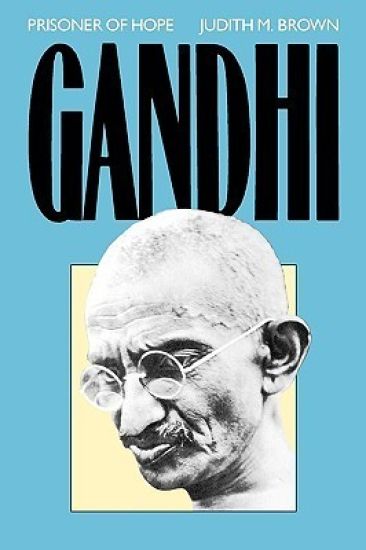
The definitive biography of one of this century’s most important—and controversial—figures. Drawing on sources only recently made available, Judith M. Brown sketches a fresh and surprising portrait of Gandhi within the context of his time, in which the Indian leader emerges as neither a plaster saint nor a wily politician, but as a complex man whose actions followed honorably from his convictions. "This is the best biography of Gandhi so far and deserves to be read by everyone interested in him and in modern India."—Bhikhu Parekh, New Statesman and Society "Judith Brown has written the most systematic, balanced, and clear biography of Gandhi I have yet seen."—Howard Spodek, Annals of the American Academy of Political and Social Science "In fascinating detail, Brown chronicles the fate of nonviolent tactics in South Africa and, after 1915, in India, where Gandhi—now clad in loincloth and sandals—quickly became a patriotic hero."—Jim Miller, Newsweek "It is a superb book, elegantly written, and I would recommend it to anyone who wants to know more about Gandhi as well as the social context which helped to mould him as a man and a politician."—Tariq Ali, Guardian "This is as fine an exposition of Gandhi’s religious beliefs as we are likely to get. … [Brown] has clearly established herself as [Gandhi’s] leading interpreter to her generation."—Antony Copley, History Today Judith M. Brown is Beit Professor of the History of the British Commonwealth at Oxford University.
The Faces of Injustice

The Faces of Injustice

Judith N. Shklar

Yale University Press
1992
pokkari
How can we distinguish between injustice and misfortune? What can we learn from the victims of calamity about the sense of injustice they harbor? In this book a distinguished political theorist ponders these and other questions and formulates a new political and moral theory of injustice that encompasses not only deliberate acts of cruelty or unfairness but also indifference to such acts. Judith N. Shklar draws on the writings of Plato, Augustine, and Montaigne, three skeptics who gave the theory of injustice its main structure and intellectual force, as well as on political theory, history, social psychology, and literature from sources as diverse as Rosseau, Dickens, Hardy, and E. L. Doctorow. Shklar argues that we cannot set rigid rules to distinguish instances of misfortune from injustice, as most theories of justice would have us do, for such definitions would not take into account historical variability and differences in perception and interest between the victims and spectators. From the victim's point of view—whether it be one who suffered in an earthquake or as a result of social discrimination—the full definition of injustice must include not only the immediate cause of disaster but also our refusal to prevent and then to mitigate the damage, or what Shklar calls passive injustice. With this broader definition comes a call for greater responsibility from both citizens and public servants. When we attempt to make political decisions about what to do in specific instances of injustice, says Shklar, we must give the victim's voice its full weight. This is in keeping with the best impulses of democracy and is our only alternative to a complacency that is bound to favor the unjust.
Young, Poor, and Pregnant

Young, Poor, and Pregnant

Judith S. Musick

Yale University Press
1995
pokkari
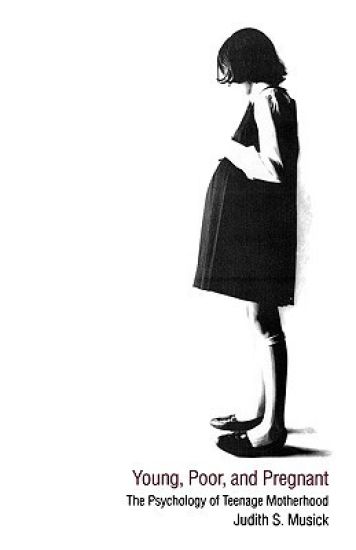
"I like it when people notice I'm having a baby. It gives me a good feeling inside and makes me feel important."—a teenage motherTeenage mothers are often poor young girls who define themselves through motherhood and who see getting pregnant as less frightening than finishing school or getting a job. In this book an expert on adolescent pregnancy discusses how psychological pressures of adolescence interact with the problems of being poor to create a situation in which early sexuality, pregnancy, and childbearing—often repeated childbearing—seem almost inevitable. Drawing on her experience as founding director of one of the nation's largest and most successful programs for teenage mothers, Judith Musick sheds new light on what is required to significantly improve the life chances of teenage mothers and their children. Frequently quoting from the diaries of teenage mothers themselves, Musick looks at the family and community problems that accompany poverty and shows how they influence the psychological development of young girls, examines the sexual socialization (and exploitation) of disadvantaged females, and analyzes the role played by mother-daughter relationships. She describes how adolescents feel about and raise their children. Musick concludes by recommending strategies for intervention programs that will help promote the developmental, psychological, and environmental conditions necessary for teenage mothers to change their lives.
Paradoxes of Gender

Paradoxes of Gender

Judith Lorber

Yale University Press
1995
pokkari
In this pathbreaking book, a well-known feminist and sociologist—who is also the Founding Editor of Gender & Society—challenges our most basic assumptions about gender. Judith Lorber views gender as wholly a product of socialization subject to human agency, organization, and interpretation. In her new paradigm, gender is an institution comparable to the economy, the family, and religion in its significance and consequences. Drawing on many schools of feminist scholarship and on research from anthropology, history, sociology, social psychology, sociolinguistics, and cultural studies, Lorber explores different paradoxes of gender:—why we speak of only two "opposite sexes" when there is such a variety of sexual behaviors and relationships; —why transvestites, transsexuals, and hermaphrodites do not affect the conceptualization of two genders and two sexes in Western societies;—why most of our cultural images of women are the way men see them and not the way women see themselves;—why all women in modern society are expected to have children and be the primary caretaker;—why domestic work is almost always the sole responsibility of wives, even when they earn more than half the family income;—why there are so few women in positions of authority, when women can be found in substantial numbers in many occupations and professions;—why women have not benefited from major social revolutions. Lorber argues that the whole point of the gender system today is to maintain structured gender inequality—to produce a subordinate class (women) that can be exploited as workers, sexual partners, childbearers, and emotional nurturers. Calling into question the inevitability and necessity of gender, she envisions a society structured for equality, where no gender, racial ethnic, or social class group is allowed to monopolize economic, educational, and cultural resources or the positions of power.
Freudian Analysts/Feminist Issues

Freudian Analysts/Feminist Issues

Judith M. Hughes

Yale University Press
1999
sidottu
In this important book Judith M. Hughes makes a highly original case for conceptualizing gender identity as potentially multiple. She does so by situating her argument within the history of psychoanalysis.Hughes traces a series of conceptual lineages, each descending from Freud. In the study Helene Deutsch, Karen Horney, and Melanie Klein occupy prominent places. So too do Erik H. Erikson and Robert J. Stoller. Among contemporary theorists Carol Gilligan and Nancy Chodorow are included in Hughes’s roster.In each lineage Hughes discerns an evolutionary narrative: Deutsch tells a story of retrogression; Erikson names his epigenesis, and Gilligan continues in that vein; Horney’s discussion recalls sexual selection; Stoller’s and Chodorow’s theorizing brings artificial selection to mind; and finally in Klein’s work Hughes sees a story of natural selection and adds to it her own notion of multiple gender identities.
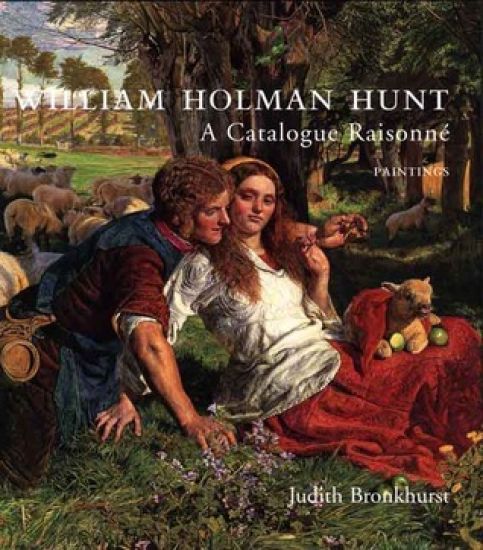
William Holman Hunt

William Holman Hunt

Judith Bronkhurst

Yale University Press
2006
sidottu
William Holman Hunt was one of the three major artistic talents of the Pre-Raphaelite brotherhood. Hunt’s work was always characterized by great seriousness of purpose, and his paintings include many of the most beautiful and powerful images of that midcentury explosion of creativity. This catalogue raisonée gives him the attention he deserves.The book includes an introduction that assesses Hunt’s life and artistic practice and discusses his aims, philosophy, and religious beliefs, which shed light on his works. While many of his paintings, with their extraordinary effects of light and color, are immediately accessible, his mature works incorporate symbolism that cannot be fully understood without a detailed knowledge of his intentions, and the catalogue entries thoroughly explore this. The volume presents Hunt’s oils and works on paper in two separate sections, and appendixes provide additional information on his illustrated letters, etchings, published illustrations, sculpture, and furniture. Published for the Paul Mellon Centre for Studies in British Art
Nehru

Nehru

Judith M. Brown

Yale University Press
2005
pokkari
The first Prime Minister of India after independence from British rule, Jawaharlal Nehru (1889-1964) was a major architect of India as a nation state. His dedication to politics led to imprisonment, a deeply disturbed family life, and eventually to nearly two decades in power. This compelling biography depicts the phases of Nehru's life and shows how each phase reflected ongoing developments in Indian politics. Drawing on new sources Judith M. Brown offers the most complete and penetrating account of Nehru yet written. The book also provides an array of insights into the complexity of constructing a new nation state in the aftermath of imperial rule. 'Brown's fine biography shows vividly how much the subcontinent and its first leader have in common.' Philip Ziegler, 'Literary Review' 'an absorbing, scrupulously researched and convincing assessment of one of the most important political figures of the 20th century.' Katherine Frank, 'New Statesman' 'A superb book, Judith Brown catches the spirit of Nehru's times as well as his own tribulations and achievements.' Wm. Roger Louis, University of Texas at Austin Judith M. Brown is Beit Professor of Commonwealth History, University of Oxford, and professorial fellow of Balliol College, Oxford.
American Modernism at the Art Institute of Chicago

American Modernism at the Art Institute of Chicago

Judith A. Barter; Jennifer M. Downs

Yale University Press
2009
sidottu
The first publication to focus on the Art Institute’s outstanding collection of American modernism, this volume includes over 175 important paintings, sculptures, decorative-art objects, and works on paper made in North America between World War II and 1955. Together they fully reflect the history of American art in these decades, including examples of early modernism, Social Realism, Surrealism, and Abstract Expressionism. Among the paintings are such iconic works as Hopper’s Nighthawks and Wood’s American Gothic, along with notable pieces by Davis, De Kooning, Hartley, Lawrence, Marin, O’Keeffe, Pollock, and Sheeler. Among the sculptors represented are Calder, Cornell, and Noguchi. Spectacular decorative artwork by the Eameses, Grotell, Neutra, Saarinen, F. L. Wright, and Zeisel are also featured. Reproduced in full color, each work is accompanied by an accessible and up-to-date text, complete with comparative illustrations. The introduction traces the formation of this important collection by a number of noted curators, collectors, and patrons.Distributed for the Art Institute of Chicago
The Cosmopolitan Interior

The Cosmopolitan Interior

Judith A. Neiswander

Yale University Press
2008
sidottu
Literature on domestic interior decoration first emerged as a popular genre in Britain during the 1870s and 1880s, as middle-class readers sought decorating advice from books, household manuals, women’s magazines, and professional journals. This intriguing book examines that literature and shows how it was influenced by the widespread liberalism of the middle class. Judith Neiswander explains that during these years liberal values—individuality, cosmopolitanism, scientific rationalism, the progressive role of the elite, and the emancipation of women—informed advice about the desirable appearance of the home. In the period preceding the First World War, these values changed dramatically: advice on decoration became more nationalistic in tone and a new goal was set for the interior—“to raise the British child by the British hearth.” Neiswander traces this evolving discourse within the context of current writing on interior decoration, writing that is much more detached from social and political issues of the day. Published for the Paul Mellon Centre for Studies in British Art
The New Eugenics

The New Eugenics

Judith Daar

Yale University Press
2017
sidottu
A provocative examination of how unequal access to reproductive technology replays the sins of the eugenics movement Eugenics, the effort to improve the human species by inhibiting reproduction of “inferior” genetic strains, ultimately came to be regarded as the great shame of the Progressive movement. Judith Daar, a prominent expert on the intersection of law and medicine, argues that current attitudes toward the potential users of modern assisted reproductive technologies threaten to replicate eugenics’ same discriminatory practices. In this book, Daar asserts how barriers that block certain people’s access to reproductive technologies are often founded on biases rooted in notions of class, race, and marital status. As a result, poor, minority, unmarried, disabled, and LGBT individuals are denied technologies available to well-off nonminority heterosexual applicants. An original argument on a highly emotional and important issue, this work offers a surprising departure from more familiar arguments on the issue as it warns physicians, government agencies, and the general public against repeating the mistakes of the past.
Nights Out

Nights Out

Judith Walkowitz

Yale University Press
2012
sidottu
London’s Soho district underwent a spectacular transformation between the late Victorian era and the end of the Second World War: its old buildings and dark streets infamous for sex, crime, political disloyalty, and ethnic diversity became a center of culinary and cultural tourism servicing patrons of nearby shops and theaters. Indulgences for the privileged and the upwardly mobile edged a dangerous, transgressive space imagined to be "outside" the nation. Treating Soho as exceptional, but also representative of London's urban transformation, Judith Walkowitz shows how the area's foreignness and porousness were key to the explosion of culture and development of modernity in the first half of the twentieth century. She draws on a vast and unusual range of sources to stitch together a rich patchwork quilt of vivid stories and unforgettable characters, revealing how Soho became a showcase for a new cosmopolitan identity.
Faulkner and Love

Faulkner and Love

Judith L. Sensibar

Yale University Press
2010
pokkari
The deeply moving, untold story of America’s greatest twentieth-century novelist and the three women at the center of his imaginative life This book is about the making of the writer William Faulkner. It is the first to inquire into the three most important women in his life—his black and white mothers, Caroline Barr and Maud Falkner, and the childhood friend who became his wife, Estelle Oldham. In this new exploration of Faulkner’s creative process, Judith L. Sensibar discovers that these women’s relationships with Faulkner were not simply close; they gave life to his imagination. Sensibar brings to the foreground—as Faulkner did—this “female world,” an approach unprecedented in Faulkner biography.Through extensive research in untapped biographical sources—archival materials and interviews with these women's families and other members of the communities in which they lived—Sensibar transcends existing scholarship and reconnects Faulkner’s biography to his work. She demonstrates how the themes of race, tormented love, and addiction that permeated his fiction had their origins in his three defining relationships with women. Sensibar alters and enriches our understanding not only of Faulkner, his art, and the complex world of the American South that came to life in his brilliant fiction but also of darknesses, fears, and unspokens that Faulkner unveiled in the American psyche.
Pivotal Decade

Pivotal Decade

Judith Stein

Yale University Press
2011
pokkari
In this fascinating new history, Judith Stein argues that in order to understand our current economic crisis we need to look back to the 1970s and the end of the age of the factory—the era of postwar liberalism, created by the New Deal, whose practices, high wages, and regulated capital produced both robust economic growth and greater income equality. When high oil prices and economic competition from Japan and Germany battered the American economy, new policies—both international and domestic—became necessary. But war was waged against inflation, rather than against unemployment, and the government promoted a balanced budget instead of growth. This, says Stein, marked the beginning of the age of finance and subsequent deregulation, free trade, low taxation, and weak unions that has fostered inequality and now the worst recession in sixty years. Drawing on extensive archival research and covering the economic, intellectual, political, and labor history of the decade, Stein provides a wealth of information on the 1970s. She also shows that to restore prosperity today, America needs a new model: more factories and fewer financial houses.
For Kith and Kin

For Kith and Kin

Judith A. Barter; Monica Obniski

Yale University Press
2012
sidottu
The Art Institute of Chicago is home to one of the world's finest collections of American folk art. For Kith and Kin provides an introduction to that collection through more than sixty of its most outstanding objects. Selected by premier American art scholar Judith A. Barter, the majority of these objects have never before been published.In a groundbreaking opening essay, Barter revisits the earliest days of folk-art collecting in Chicago, beginning in the 1890s. She pays special attention to the passionate individuals who sought out unique and expressive examples of American folk art, building private collections that they later donated to the Art Institute. Including beautiful reproductions and detailed entries for each of the sixty-one objects it features, this book highlights an array of masterworks such as "primitive" New England portraits, a face jug from South Carolina, New Mexican ceramics, a weathervane, and ship figureheads.Distributed for the Art Institute of Chicago
Handbags

Handbags

Judith Clark; Claire Wilcox; Adam Phillips; Caroline Evans; Amy de la Haye

Yale University Press
2012
sidottu
An exploration of the role of the handbag in the history of culture, fashion, and material production The history of the handbag—its design, how it has been made, used, and worn—reveals something essential about women's lives over the past 500 years. Perhaps the most universal item of fashionable adornment, it can also be elusive, an object of desire, secrecy, and even fear. Handbags explores these rich histories and multiple meanings.This book features specially commissioned photographs of an extraordinary, newly formed collection of fashionable handbags that date from the 16th century to the present day. It has been acquired for exhibition in the first museum devoted to the handbag, in Seoul, South Korea. The project is a commission undertaken by experimental exhibition-maker Judith Clark, whose innovative practices are revealed in Handbags.Essays by leading fashion historians and an acclaimed psychoanalyst investigate the history of gesture, the psychoanalysis of bags, and the museum's state-of-the-art mannequins and archive cabinets. In order to preserve the words that describe the unique qualities of each bag, a terminology of handbags has been compiled.Published in association with the Simone Handbag Museum, Seoul