Kirjojen hintavertailu. Mukana 11 627 463 kirjaa ja 12 kauppaa.

Kirjahaku

Etsi kirjoja tekijän nimen, kirjan nimen tai ISBN:n perusteella.

1000 tulosta hakusanalla Julian D Richards

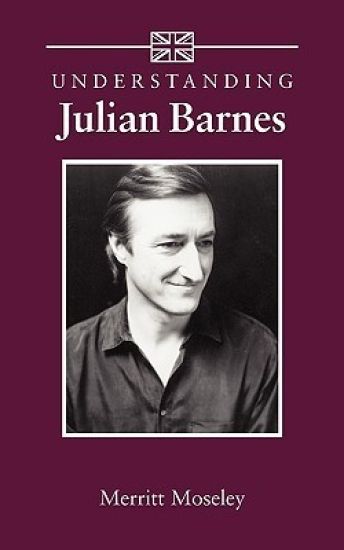
Understanding Julian Barnes

Understanding Julian Barnes

Merritt Moseley

University of South Carolina Press
2009
nidottu
This is a telling assessment of the divergent works of a daring British writer. ""Understanding Julian Barnes"" surveys the career of an innovative British novelist who has been shortlisted for the Man Booker Prize on three occasions. In this analysis of Barnes' distinctive qualities and of his place in the British literary establishment, Merritt Moseley suggests that Barnes' greatest achievement is his ability to resist summary and categorization by imagining each book in a dramatically original way. In evaluating Barnes' fiction, Moseley discusses the novelist's admiration for Gustave Flaubert, identifies his technical and thematic concerns, and explores the intrigue surrounding his divided career as a writer of serious novels, published under his own name, and of detective thrillers, published under the pseudonym Dan Kavanagh.
Zu Julian Bierwirths "Der Grabbeltisch der Erkenntnis" 2016: Polit-moralische Diskreditierung statt sachliche Kritik
Diese als Replik angelegte Ver ffentlichung bezieht sich auf eine bemerkenswerte Ver ffentlichung der Gruppe Krisis, und zwar einer ihrer Autoren, Julian Bierwirth - bemerkenswert in der Hinsicht, dass man an dieser studieren kann, wie eine theoretisch anspruchsvoll sich gebende Gruppierung bzw. einer ihrer Vertreter als leitendes Motiv der Einlassungen schlicht den Vorsatz polit-moralischer Diskreditierung offenbart.Ansonsten wird gebetsm hlenhaft der verkehrte, weil zirkul re Anwurf wiederholt, dass, wer nicht den theoretischen Ansatz "Kritik der gesellschaftlichen Formbestimmungen" teilt, der m sse "konservativ" und "positivistisch" gestrickt sein - was sich eben die immanente Kritik, Nachweis von Fehlern entlang anders erkl rter Sache erspart, sondern per Vergleich mit dem eigenen Theoriegeb ude differierende Aussagen an diesem desavouieren will.
The Julian Alps of Slovenia

The Julian Alps of Slovenia

Justi Carey; Roy Clark

CICERONE PRESS
2024
nidottu
A guidebook to 54 day walks and 2 multi-day treks in Slovenia. Exploring the beautiful Julian Alps, there’s something for both beginner and experienced walkers, from easy valley walks to scrambles and protected routes requiring mountaineering skills and a high level of fitness. Day walks range from 2 to 23km (1–14 miles) and can be enjoyed in 2–11 hours. Four 2-day walks with overnight mountain hut stays are described, including treks to Triglav’s summit and the Lakes valley. Sketch maps are includedDetailed information on refreshments, transport and accommodationRoutes are organised around 5 bases – Kranjska Gora, Bohinj, Bovec, Bled and KobaridHighlights include Lake Bled
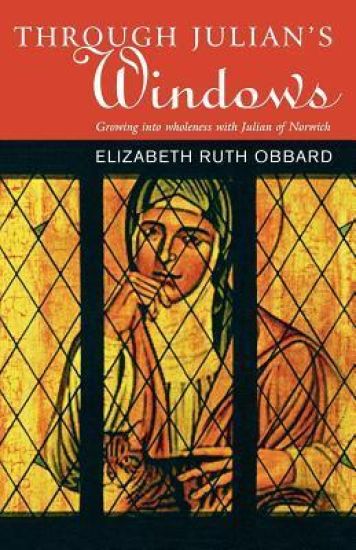
Through Julian's Window

Through Julian's Window

Elizabeth Ruth Obbard

Canterbury Press Norwich
2008
nidottu
Like her 14th century predecessor Julian of Norwich, Sr Elizabeth lives as a solitary attached to a religious community. Like Julian, she is available to all who come for help, advice or direction. In Julian's cell were three windows - one looking into the sanctuary of the church, one opening on to a secluded garden where she could attend to her own physical needs and a third where she conversed with all who came for help. Sr Elizabeth relates the three different aspects of these windows to the three things that Julian desired of God - contrition, compassion and longing for God. So deeply did she desire these qualities that she asked God to 'wound' her with them, but they became gifts of healing for herself and for others. Through contrition she learned her limitations and her need of others, compassion enabled her to become an effective spiritual guide and in longing for God she found purpose and meaning for her whole life.
John Julian

John Julian

Rod Julian

Moshpit Publishing
2019
pokkari
John Julian is a historical biography of an early pioneering farmer, John Julian, who married a young Elizabeth Keast in 1843. Soon after the wedding the couple left the green fields of Cornwall they knew so well to start a new life on the other side of the world - in Australia. John was twenty six years old, and Elizabeth only twenty three. At first they travelled to Sydney, and found work on a farm. A year later they sailed up the coast with a baby in Elizabeth's arms to the Macleay River. In the late 1840s the Macleay River was a dangerous, remote outpost where contracted farm workers lived and worked alongside convicts, and all survived on meagre rations given out by the squatter. Survival depended on being as self-sufficient as possible.The record starts with details on several generations of ancestors back in Cornwall, then the impressive life of John and Elizabeth Julian, including the many trials and disasters of life at the time.Following on are biographies of several generations of descendants. In one, that of John's son Joseph Julian, we discover how Joseph spent much of his life improving and beautifying the town of South West Rocks, and how he became a respected figure locally.The appendix includes military records of all the Julian family members from the Kempsey district who enlisted in the military during World War I and World War II, some of whom suffered terribly. All veterans were descendants of John and Elizabeth Julian.Every chapter has a detailed reference listing.In general the events portrayed give a deeper understanding of life in Australia, and especially the north coast of New South Wales, during the 1800s. This was a period of rapid development, when the majority of the thick coastal rainforest was progressively cleared for intensive farming, using only saws, picks and axes.The stories told also make it obvious that 'socially acceptable behaviour' in the 1800s was very strict, rigid, and clearly defined. In comparison, society today is very flexible, tolerant and forgiving.
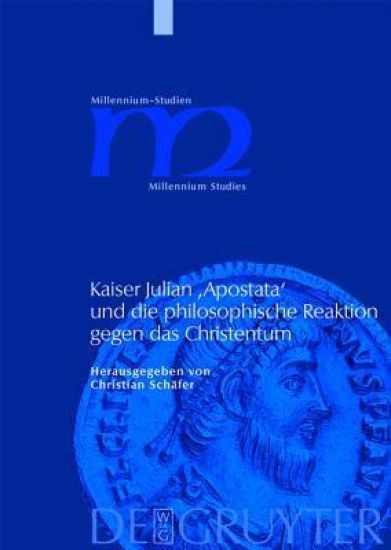
Kaiser Julian 'Apostata' Und Die Philosophische Reaktion Gegen Das Christentum
During his short reign in the 4th century, Emperor Julian II, known as the Apostate, attempted to combat Christianity philosophically and to set up a pagan Neo-Platonic doctrine as a counter-programme. The volume presents a collection of papers on the general relationship between Platonism and Christianity, on Julian's character and his philosophical programme and on individual writings in which the Emperor sets out his own position and his critique of Christian thought.
Gegen Julian. Buch 1-5
The first five books of Cyril of Alexandria’s (c. 378–444 CE) monumental work of refutation “Against Julian” are being published here for the first time in a modern critical edition with an extensive apparatus of sources and parallel texts. The general introduction outlines the direct and indirect transmission of the work and also presents brief essays on Julian’s polemic against the Christians and on Cyril’s rebuttal.
Gegen Julian. Buch 6-10 und Fragmente
Books 6–10 of Cyril of Alexandria’s (c. 380–444 CE) monumental work of refutation “Against Julian” are being published for the first time in a modern critical edition with an extensive apparatus of sources and parallel texts. In addition, the volume includes all known Greek and Syriac fragments from the lost volumes as well as an extensive introduction to the transmission of the fragments.
Kaiser Julian, Auf Die Göttermutter: Einleitung, Übersetzung Und Kommentar
Julian ist der erste und einzige r mische Kaiser (Regierungszeit 361-363), der sich nach der Konstantinischen Wende vom Christentum abwandte und reichsweit zur alten griechisch-r mischen Religion zur ckkehren wollte. Sein G ttermutter-Hymnos, verfasst zum Kybele-Attis-Fest im M rz 362, ist eine philosophische Allegorese des Mythos und Kults der G ttermutter und ihres Lieblings auf Grundlage des Neuplatonismus des Iamblichos. Das vorliegende Buch bettet den Text in den religionspolitisch-historischen Kontext von Julians erster Regierungszeit ein, in der er die Kulte der traditionellen griechisch-r mische Religion restituierte, Tempel wieder ffnete und Opfer wieder zulie . Durch eine umfassende philologische, literarturwissenschaftliche, philosophische, religions- und althistorische Kommentierung des Textes wird gezeigt, dass er ein paganes Konkurrenzangebot zur christlichen Passions- und Ostergeschichte machen und Attis und die G ttermutter Kybele als paganes Gegenmodell zu Christus und zur Gottesmutter Maria entwerfen wollte. Dieses sollte implizit eine in sich widerspruchsfreie philosophische Antwort auf zeitgen ssische innerchristliche Debatten geben, die Julian sp ter u. a. in Gegen die Galil er explizit kritisierte.