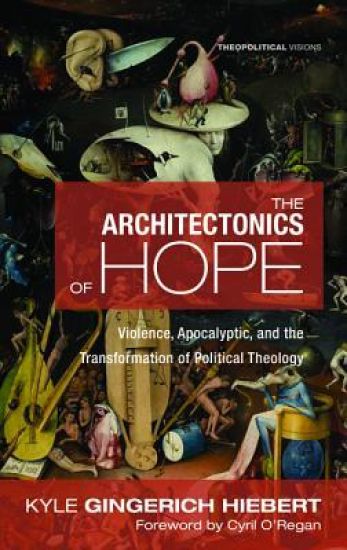
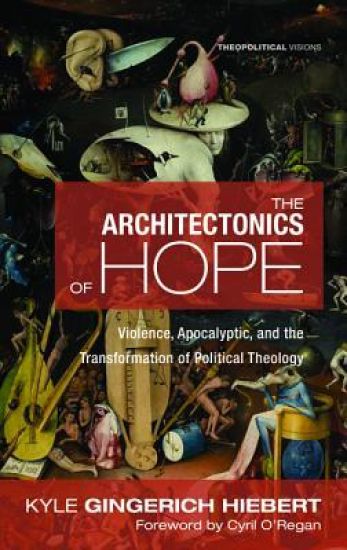
The Architectonics of Hope provides a critical excavation and reconstruction of the Schmittian seductions that continue to bedevil contemporary political theology. Despite a veritable explosion of interest in the work of Carl Schmitt, which increasingly recognizes his contemporary relevance and prescience, there nevertheless remains a curious and troubling reticence within the discipline of theology to substantively engage the German jurist and sometime Nazi apologist. By offering a genealogical reconstruction of the manner and extent to which recognizably Schmittian gestures are unwittingly repeated in subsequent debates that often only implicitly assume they have escaped the violent aporetics that characterize Schmitt's thought, this volume illuminates hidden resonances between ostensibly opposed political theologies. Using the complex relationship between violence and apocalyptic as a guide, the genealogy traces the transformation of political theology through the work of a surprising collection of figures, including Johann Baptist Metz, John Milbank, David Bentley Hart, and John Howard Yoder. ""Theologians must be political because they are embroiled in politics; and they are embroiled in politics because politics is saturated with religious resonances. So here is a new and courageous voice in political theology, taking on the giants--Schmitt, Metz, Radical Orthodoxy, and Yoder--and presenting them with a passionately argued freshness. The book courts controversy, and its dramatic genealogical unfolding of the apocalyptic and violent within political theology intensifies that controversy. But we need younger, confident, theologically astute thinkers to generate the right kind of contestation, and Gingerich Hiebert does that with well-crafted elegance and integrity. His vision of a new and hope-filled way of seeing opens a new chapter in political theology and isn't fearful of exposing the deficiencies of older accounts. The book deserves to be read widely, reviewed widely, and debated widely, because only that way might we move forward in a world steeped in violence with faith, hope, and what he calls 'charitable theological argument.'"" --Graham Ward, Regius Professor of Divinity, Christ Church Oxford, United Kingdom ""Kyle Gingerich Hiebert's compellingly-written, nuanced genealogical account of the connections between violence and apocalyptic in early and late twentieth century political theologies displays an intimate grasp of the relevant conceptual and critical theoretical issues and offers a constructive perspective on what is at stake in this contested terrain."" --Travis Kroeker, McMaster University, Hamilton, Ontario ""This well-argued book offers a fundamental contribution to the expanding field of political theology, by uncovering the influence of Carl Schmitt on a variety of thinkers like Metz, Yoder, and Milbank. In doing so, Gingerich Hiebert connects traditions of thought that seemed non-comparable before. Furthermore, he provides a way to retrieve Schmitt, who is the proverbial elephant in the room in many types of contemporary theology. In this way, Gingerich Hiebert shows an undercurrent in modern political theology that needed to be uncovered."" --Stephan Van Erp, Professor of Fundamental Theology at KU Leuven, Belgium ""Gingerich Hiebert creatively puts Schmitt, Metz, Milbank, Hart, and Yoder into conversation with the result that we not only understand each of them better, but more importantly we have a better grasp of what is at stake in political theology. This book is destined to become a key text for all concerned with political theology."" --Stanley Hauerwas, Duke Divinity School Kyle Gingerich Hiebert (University of Manchester) is Director of the Toronto Mennonite Theological Center at the University of Toronto.
As political units grow it becomes increasingly difficult to maintain a shared sense of humanity and to recognize people as individuals rather than anonymous beings. To overcome our most pressing political issues we need to develop a moral imagination so that we may renew our sense of connectedness and responsibility to one another. Bringing together politics and art is one way this can be accomplished. This book draws upon political sources as well as works in literature, film and theater to show the limits of politics and the need for a moral imagination.
Migration and Xenophobia: A Three Country Exploration examines issues of migration and xenophobia using the experiences of three nations: the United States, South Africa, and Malta. Through the cases, Kyle Farmbry builds a larger dialogue examining issues related to patterns of movement and the xenophobic realities encountered with such migrations. The book builds upon projections from the United Nations, the World Bank, and the International Organization for Migration that say the world will experience a continued wave of movement between people and place for the foreseeable future are true, then the lessons from the nations examined here have implications for a broader set of realities related to migration. The experiences of these nations represent a microcosm of what is happening globally in relation to nation-based questions on the migration realities of the early twenty-first century.
Migration and Xenophobia: A Three Country Exploration examines issues of migration and xenophobia using the experiences of three nations: the United States, South Africa, and Malta. Through the cases, Kyle Farmbry builds a larger dialogue examining issues related to patterns of movement and the xenophobic realities encountered with such migrations. The book builds upon projections from the United Nations, the World Bank, and the International Organization for Migration that say the world will experience a continued wave of movement between people and place for the foreseeable future are true, then the lessons from the nations examined here have implications for a broader set of realities related to migration. The experiences of these nations represent a microcosm of what is happening globally in relation to nation-based questions on the migration realities of the early twenty-first century.
In today’s rapidly changing business landscape, organizations are challenged not only to adapt to evolving market dynamics but to excel in the face of uncertainty. Continuous improvement emerges as a strategic imperative, offering a systematic approach to enhance processes, boost efficiency, and drive innovation. This book delves into the heart of continuous improvement, providing a roadmap for organizations to navigate their journey toward maturity. The continuous improvement maturity model (CIMM) described in this book is not just a framework, but a holistic guide designed to support organizations in assessing and advancing their continuous improvement capabilities. As the author embarks on this exploration, he presents an approach that spans from foundational practices to advanced strategies. CIMM is a versatile tool adaptable to diverse industries, sectors, and organizational sizes. The key components of CIMM are: Integration with Best Practices—CIMM is not designed in isolation. We highlight its compatibility with established continuous improvement methodologies such as Lean, Six Sigma, Change Management, and Leadership Attributes. Learn how to leverage existing best practices while embracing the unique contributions of CIMM. Practical Application—Real-world examples and practical insights illustrate how organizations have successfully applied CIMM to overcome challenges, drive innovation, and achieve sustainable excellence. These stories offer inspiration and guidance for your own journey.
Time is running out for humanity to defeat the encroaching forces of the Radaskim. As settlements fall and the Great Blight spreads, it falls on the New Angels to unite disparate factions before it is too late.But the dark Xenomind, Askala, has her own plans to end humanity before that can ever happen, and only the greatest sacrifice can stop her from achieving her aims...