Kirjojen hintavertailu. Mukana 11 699 587 kirjaa ja 12 kauppaa.

Kirjahaku

Etsi kirjoja tekijän nimen, kirjan nimen tai ISBN:n perusteella.

1000 tulosta hakusanalla LeRoy Percy

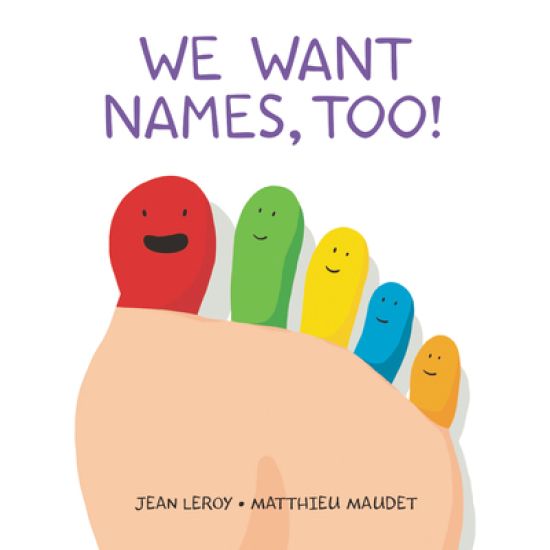
We Want Names, Too!

We Want Names, Too!

Jean Leroy

HarperFestival
2021
sidottu
The individual fingers have names like thumb and index, but the poor toes don't! It's time to brainstorm what the toes should be called. This board book is an excellent choice to share during homeschooling, in particular for children in preK. It’s a fun way to introduce classic concepts like colors and the alphabet. As the toes argue and advocate for their preferred name among themselves, kids will learn about concepts like letters, numbers, music notes, colors, and fruits, and celebrate individuality at the same time. This hilarious, chatty book is perfect for younger fans of The Day the Crayons Quit. Maybe your little one will decide what names to give to their own toes! The big toe wants to be called A, but not everyone agrees with the alphabet theme. The second toe argues they should go for numbers, while the last toe prefers fruits! How on earth will they resolve their disagreement?
Modeling Neuropsychiatric Disorders in Laboratory Animals

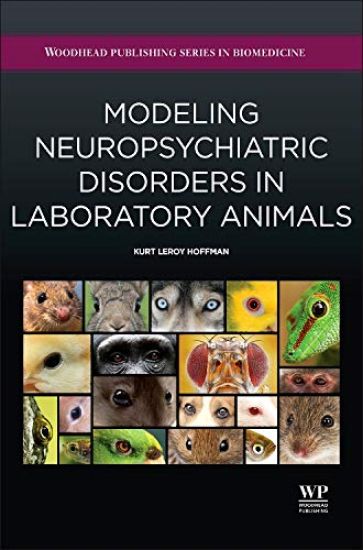
Modeling Neuropsychiatric Disorders in Laboratory Animals

Kurt Leroy Hoffman

Woodhead Publishing Ltd
2015
sidottu
Modeling Neuropsychiatric Disorders in Laboratory Animals serves as a guide for students and basic investigators in the fields of behavioral sciences, psychology, neuroscience, psychiatry, and other professionals interested in the use of animal models in preclinical research related to human neuropsychiatric disorders. The text focuses on the rationale and theory of using animal behavior, both pathological and normal, as a tool for understanding the neural underpinnings of neuropsychiatric disorders. Chapters contain discussions on both classical and modern views on the validation of animal models for neuropsychiatric disorders, also discussing the utility of endophenotypes in modeling neuropsychiatric disease. Subsequent chapters deal with four specific classes of disorders, including anxiety disorders, depressive disorders, obsessive-compulsive and related disorders. Final sections discuss the future for the development, validation, and use of animal models in basic and preclinical research.
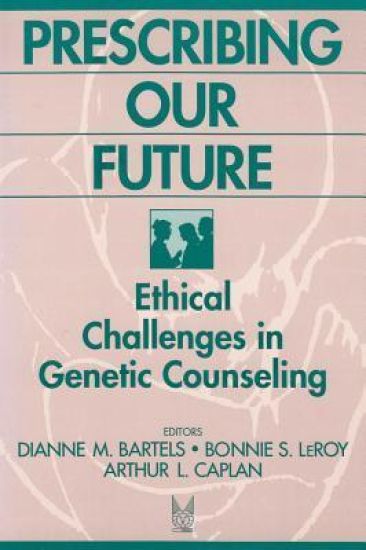
Prescribing Our Future

Prescribing Our Future

Bonnie LeRoy

AldineTransaction
1993
nidottu
Genetic counselors translate the findings of scientific investigation into meaningful accounts that enable individuals and families to make decisions about their lives. This collection of original papers explores the history, values, and norms of that process, with some focus on the value of nondirectiveness in counseling practice. The contributors; examination of genetic counseling issues serves as a foundation from which to address other ethical, legal, and policy considerations in the expanding universe of clinical genetics.
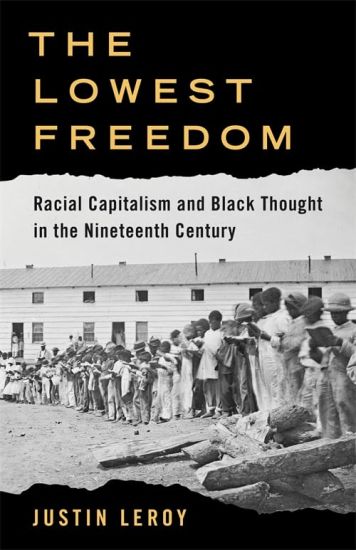
The Lowest Freedom

The Lowest Freedom

Justin Leroy

Columbia University Press
2026
sidottu
Throughout the nineteenth century, Black thinkers grappled with the material limits of freedom. They insisted that emancipation without economic self-determination would reproduce the inequalities of slavery, arguing that true freedom required not only civil rights and suffrage but also defending the rights of workers and curbing the power of capital. They concluded that free Black life could not flourish in conditions of labor exploitation and economic deprivation. The Lowest Freedom is an intellectual history of how economic dispossession shaped the meaning of freedom in Black thought from antebellum abolitionism to the rise of Jim Crow. Justin Leroy argues that figures such as Frederick Douglass, T. Thomas Fortune, Maria Stewart, David Walker, and Ida B. Wells developed a critique of racial capitalism that remains underappreciated. Their theories spanned the eras of slavery and freedom, connecting the North and the South, by illuminating the political economy of racial domination and the interwoven relationship between race and capitalism. By situating their work within broader debates about land, labor, and capital, Leroy provides a new framework for understanding how freedom was theorized, contested, and ultimately constrained in the aftermath of slavery. Bridging Black studies, intellectual history, and the history of capitalism, The Lowest Freedom offers a reinterpretation of African American political thought that places the struggle for economic justice at its core.
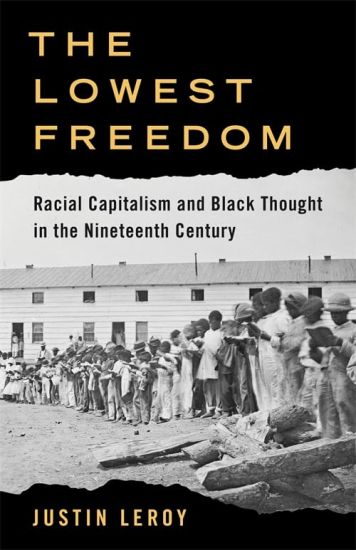
The Lowest Freedom

The Lowest Freedom

Justin Leroy

Columbia University Press
2026
pokkari
Throughout the nineteenth century, Black thinkers grappled with the material limits of freedom. They insisted that emancipation without economic self-determination would reproduce the inequalities of slavery, arguing that true freedom required not only civil rights and suffrage but also defending the rights of workers and curbing the power of capital. They concluded that free Black life could not flourish in conditions of labor exploitation and economic deprivation. The Lowest Freedom is an intellectual history of how economic dispossession shaped the meaning of freedom in Black thought from antebellum abolitionism to the rise of Jim Crow. Justin Leroy argues that figures such as Frederick Douglass, T. Thomas Fortune, Maria Stewart, David Walker, and Ida B. Wells developed a critique of racial capitalism that remains underappreciated. Their theories spanned the eras of slavery and freedom, connecting the North and the South, by illuminating the political economy of racial domination and the interwoven relationship between race and capitalism. By situating their work within broader debates about land, labor, and capital, Leroy provides a new framework for understanding how freedom was theorized, contested, and ultimately constrained in the aftermath of slavery. Bridging Black studies, intellectual history, and the history of capitalism, The Lowest Freedom offers a reinterpretation of African American political thought that places the struggle for economic justice at its core.
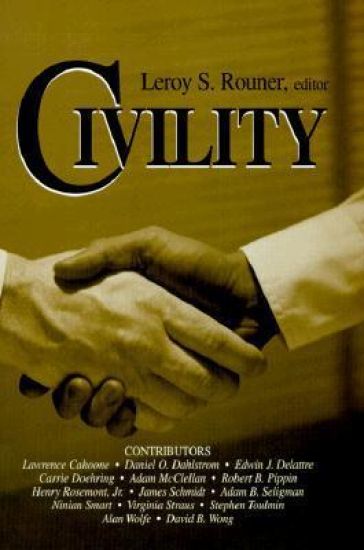
Civility

Civility

Rouner Leroy S.

University of Notre Dame Press
2000
sidottu
Are Americans less civil than they used to be? If so, is that a bad thing? Perhaps we are just learning to be more honest. And what does civility mean? Is it just good manners? It so, perhaps it is only the complaint of privileged classes, annoyed that taxi drivers are increasingly rude and that men no longer give up their seats to women on public transportation. Or is civility a question of morality? The philosopher Peter Bertocci once argued that promptness is a fundamental form of social justice. In this lively conversation on an increasingly significant theme, major philosophers and religious scholars argue the issue on three levels. The first is manners: Henry Rosemont argues the Confucian case that manners are the substance of social relations, while Edwin Delattre and Adam Seligman believe that the issue is deeper than that; and the sociologist Alan Wolfe is persuaded that we are not less civil or ill-mannered than our predecessors. Secondly, as a social issue, James Schmidt, Lawrence Cahoone, and Adam Seligman turn to questions of structure and meaning in a civil society; Ninian Smart, David Wong, and Virginia Straus put the issue in a cross-cultural context; and Carrie Doehring warns that civility may be a barrier to honest Communication in family life. Finally, the metaphysical and religious dimensions of civility are explored by Robert Pippin and Adam McClellan. There seems to be a consensus that the lack of civility is, indeed, an increasing problem, that it is more than a class issue of manners, and that its current loss is troubling for contemporary society.
Le Collectivisme

Le Collectivisme

Paul Leroy-Beaulieu

Wentworth Press
2018
sidottu
This work has been selected by scholars as being culturally important, and is part of the knowledge base of civilization as we know it. This work was reproduced from the original artifact, and remains as true to the original work as possible. Therefore, you will see the original copyright references, library stamps (as most of these works have been housed in our most important libraries around the world), and other notations in the work.This work is in the public domain in the United States of America, and possibly other nations. Within the United States, you may freely copy and distribute this work, as no entity (individual or corporate) has a copyright on the body of the work.As a reproduction of a historical artifact, this work may contain missing or blurred pages, poor pictures, errant marks, etc. Scholars believe, and we concur, that this work is important enough to be preserved, reproduced, and made generally available to the public. We appreciate your support of the preservation process, and thank you for being an important part of keeping this knowledge alive and relevant.
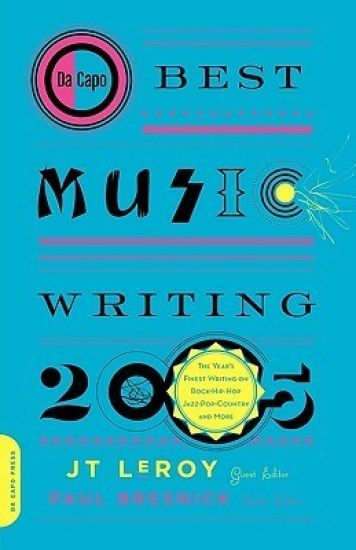
Da Capo Best Music Writing 2005

Da Capo Best Music Writing 2005

JT LeRoy

Da Capo Press Inc
2005
pokkari
Da Capo Best Music Writing has become one of the most eagerly awaited annuals of them all. Celebrating the year in music writing by gathering a rich array of essays, missives, and musings on every style of music from rock to hip-hop to R&ampB to jazz to pop to blues and more, it is essential reading for anyone who loves great music and accomplished writing. Scribes of every imaginable sort-novelists, poets, journalists, musicians-are gathered to create a multi-voiced snapshot of the year in music writing that, like the music it illuminates, is every bit as thrilling as it is riveting.Past writers have included:Elizabeth MEndez Berry * Ta-Nehisi Coates * Michael Corcoran * Robbie Fulks * Michaelangelo Matos * Alex Ross * Roni Sarig * Joel Selvin * Tour8E * Lynn Hirschberg * Chuck Klosterman * Elizabeth Gilbert * Jay McInerney * Elvis Costello * Susan Orlean * Jonathan Lethem * David Rakoff * Mike Doughty * Lorraine Ali * Greil Marcus * Richard Meltzer * Robert Gordon * Sarah Vowell * Nick Tosches * Anthony DeCurtis * William Gay * Whitney Balliett * Lester Bangs * Rosanne Cash * Eddie Dean * Selwyn Seyfu Hinds * Kate Sullivan * Alec Wilkinson * David Hadju * Lenny Kaye * The Onion * Mark Jacobson * Gary Giddins * John Leland * Luc Sante * Monica Kendrick * Kalefa Sanneh
Yes, My Darling Daughter

Yes, My Darling Daughter

Margaret Leroy

Picador USA
2010
nidottu
Every once in a blue moon, a masterful writer dives into gothic waters and emerges with a novel that--like Daphne du Maurier's Rebecca, Minette Walters's The Breaker, and Donna Tartt's The Little Friend--simultaneously celebrates and transcends the tradition. Welcome Margaret Leroy to the clan. What's the matter with Sylvie? Such a pretty girl. Four years old; well loved by her young mother, Grace. But there's something . . . off about the child. Her deathly fear of water; night terrors; most of all, her fixation with a photo of an Irish seaside town called Coldharbour. "Sylvie, tell me about your picture. Why's it so special, sweetheart?" My heart is racing, but I try to make my voice quite calm. "That's my seaside, Grace." Very matter-of-fact, as though this should be obvious. "I lived there, Grace. Before." Haunted and haunting, Yes, My Darling Daughter is a wonderfully original, deliciously suspenseful mystery, "a haunting book and a tantalizing read" (The Providence Journal).
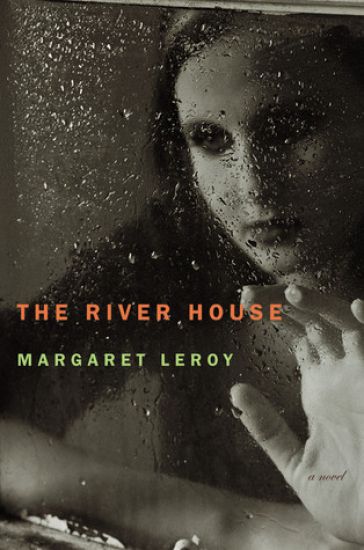
The River House

The River House

Margaret Leroy

Little Brown and Company
2005
sidottu
The novel's story line revolves around a single moment that threatens to unravel a woman's entire life and will appeal to readers of Jane Hamilton, Sue Miller and Ann Packet. Postcards from Berlin, Leroy's previous novel, was a New York Times Notable Book of the Year and is being developed by the BBC into a television drama.
Public Enterprise in Less Developed Countries

Public Enterprise in Less Developed Countries

Jones Leroy P.

Cambridge University Press
2009
pokkari
This volume consists of papers chosen from the Boston Area Public Enterprise Group Conference that was held in 1980 and concentrated on public enterprises in less-developed countries. The Boston Area Public Enterprise Group is composed of scholars dedicated to understanding the public enterprises operating in the world's mixed economies. Public enterprises are government-owned firms that sell goods or services in a market. Involved in public production for private consumption, they are a hybrid of government and private enterprise. Thus, an analysis of public enterprise requires insights from economics, management, political science and law. Each of these disciplines is represented in addressing the following questions: Why public enterprise? Who should control public enterprise? How are decisions made in practice? How do public enterprises behave in international markets? How does risk and uncertainty alter public enterprise decisions'? How are incentive structures to be designed'? How do public enterprises compare with other public policy tools for dealing with particular problems'? The contributions combine theory and practice in analysing a variety of less-developed countries.