The Gospel of Luke and the Acts of the Apostles were written by Luke, a companion of the Apostles. These books bring the Gospel story to the middle of the first century. Together they create a complete record of the beginning of the church. The translators of King James translated this text from Greek to English using what was then consider to be the most accurate Greek text available: the Textus Receptus. Here I have corrected their translation to be faithful to the Byzantine Majority Text of the Greek New Testament.
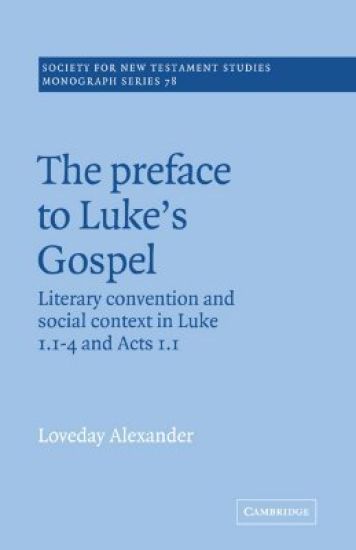
Luke's two-volume work begins with a formal preface unlike anything else in the New Testament, and it has long been academic orthodoxy that Luke's choice of style, vocabulary, and content in this short passage reveal a desire to present his work to contemporary readers as 'History' in the great tradition of Thucydides and Polybius. This study challenges that assumption: far from aping the classical historians, Dr Alexander argues, Luke was simply introducing his book in a style that would have been familiar to readers of the scientific and technical manuals which proliferated in the hellenistic world. The book contains a detailed study of these Greek 'scientific' prefaces as well as a word-by-word commentary on the Lucan texts. In her concluding chapters, Alexander seeks to explore the consequences of this alignment both for the literary genre of Luke-Acts (is it meant to be read as 'history'?) and for the social background of the author and the book's first readers.
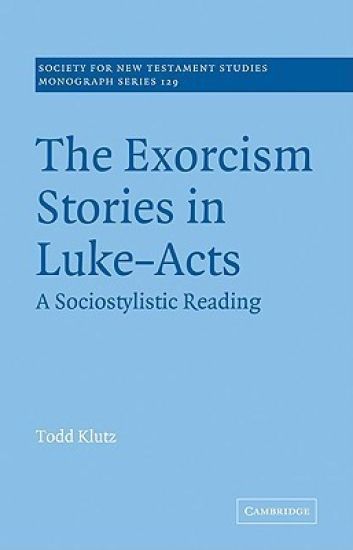
This 2004 book in English integrates detailed literary criticism of the exorcism stories in Luke-Acts with wide-ranging comparative study of ancient sources on demonology, spirit affliction and exorcistic healing. Methods from systemic functional linguistics and critical theory are explained and then applied to each story. Careful focus is placed on each narrative's linguistic functions and also on relevant aspects of its literary co-text and the wider context of culture. Implications of the analysis for the new perspective on Luke-Acts, especially the implied author's relationship with Judaism, are explored in relation to the Lukan stories' original context of reception. Largely neglected interfaces between Luke's narrative representation of exorcism and emerging academic discourse about religious experience, shamanism, health care in antiquity, ritual performance and ancient Jewish systems of impurity are probed in ways that shed fresh light on this supremely alien part of the Lukan writings.
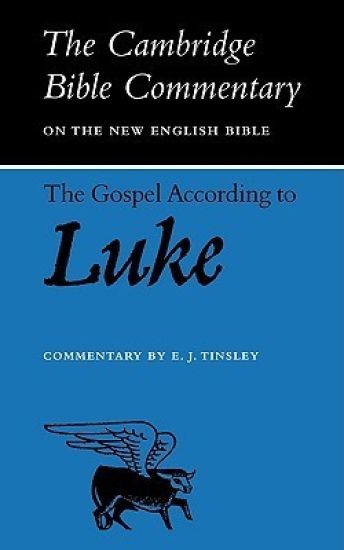
This series of commentaries on the New English Bible is designed for use in schools and colleges, and for the minister and the layman. Each volume comments on one book, or a few short books, of the Bible, and in each the text is given in full. Sections of text and commentary alternate, so that the reader does not have to keep two books open, or turn from one part of the book to the other, or refer to a commentary in small type at the foot of the page. Great care has been taken to see that the commentary is suitable for the student and the layman: there is no Greek or Hebrew, and no strings of biblical references, but the commentary does convey the latest and best scholarship. The general editors all have experience of teaching or examining in school and working with adults.
In this widely-acclaimed study, Dr Esler makes extensive use of sociology and anthropology to examine the author of Luke Acts' theology as a response to social and political pressures upon the Christian community for whom he was writing. As well as interesting those concerned with recent developments in New Testament scholarship, Esler's book offers a New Testament paradigm for those interested in generating a theology attuned to the social and political realities affecting contemporary Christian congregations.
This volume offers a comprehensive overview of one of the four New Testament gospels and brings a unique approach to the genre of Bible commentary. Featuring distinct Jewish and Christian voices in respectful conversation, Amy-Jill Levine and Ben Witherington, III methodologically break new ground in exploring why scholars disagree on questions of history (what actually happened, what is authorial invention, how do we address different versions of the same account), literature (what does this story tell us about Jesus and Peter, Mary Magdalene and Judas, among other characters), and theology (what can we say about resurrection and divine justice, or about Jesus as the Messiah). They show how Luke has been used to create both tragedy and hope, as well as to promote sexism, anti-semitism, and religious intolerance, thereby raising important questions regarding ethically responsible interpretation. This volume will be essential reading for theologians, clergy, and anyone interested in biblical studies and Jewish/Christian dialogue.
In Methods for Luke, four leading scholars demonstrate how different interpretive methods provide insight into the Gospel of Luke. Introducing contemporary perspectives on historical criticism, feminist criticism, narrative criticism, and Latino interpretation, they illustrate these approaches to New Testament study by examining either the Parable of the Rich Man and Lazarus (Luke 16:19-31) or Jesus' warning regarding the scribes and the story of the women with two small coins (Luke 20:45-21:4). The use of two 'set texts' enables readers to understand how method makes a difference in the reading of the same text.
This is the first book in English to integrate detailed literary criticism of the exorcism stories in Luke-Acts with wide-ranging comparative study of ancient sources on demonology, spirit affliction and exorcistic healing. Methods from systemic functional linguistics and critical theory are explained and then applied to each story. Careful focus is placed on each narrative's linguistic functions and also on relevant aspects of its literary co-text and the wider context of culture. Implications of the analysis for the new perspective on Luke-Acts, especially the implied author's relationship with Judaism, are explored in relation to the Lukan stories’ original context of reception. Largely neglected interfaces between Luke’s narrative representation of exorcism and emerging academic discourse about religious experience, shamanism, health care in antiquity, ritual performance and ancient Jewish systems of impurity are probed in ways that shed fresh light on this supremely alien part of the Lukan writings.
This volume offers a comprehensive overview of one of the four New Testament gospels and brings a unique approach to the genre of Bible commentary. Featuring distinct Jewish and Christian voices in respectful conversation, Amy-Jill Levine and Ben Witherington, III methodologically break new ground in exploring why scholars disagree on questions of history (what actually happened, what is authorial invention, how do we address different versions of the same account), literature (what does this story tell us about Jesus and Peter, Mary Magdalene and Judas, among other characters), and theology (what can we say about resurrection and divine justice, or about Jesus as the Messiah). They show how Luke has been used to create both tragedy and hope, as well as to promote sexism, anti-semitism, and religious intolerance, thereby raising important questions regarding ethically responsible interpretation. This volume will be essential reading for theologians, clergy, and anyone interested in biblical studies and Jewish/Christian dialogue.
In Methods for Luke, four leading scholars demonstrate how different interpretive methods provide insight into the Gospel of Luke. Introducing contemporary perspectives on historical criticism, feminist criticism, narrative criticism, and Latino interpretation, they illustrate these approaches to New Testament study by examining either the Parable of the Rich Man and Lazarus (Luke 16:19-31) or Jesus' warning regarding the scribes and the story of the women with two small coins (Luke 20:45-21:4). The use of two 'set texts' enables readers to understand how method makes a difference in the reading of the same text.
This book is warm, inviting and ticks you off, makes you laugh and will have you knodding, "Yeah I did that". Everyday stuff happening to people along the road to Christianity confusion and back again.
This Gospel of Luke is written in EasyEnglish Level A. EasyEnglish is plain, simple English, written in short sentences using a limited vocabulary. There are several levels of EasyEnglish to suit readers with different abilities. Level A (1,200 word vocabulary) and Level B (2,800 word vocabulary) are the ones most used for Bible translation. Luke did not belong to the group of the 12 special friends of Jesus. But he studied what other people had recorded about Jesus' life. And he talked with those people who had been with Jesus. Luke recorded some facts about the birth of Jesus and his life as a child. We think that only Mary, the mother of Jesus, could have known some of those things. So we think that Luke had spoken with Mary. He was a friend of the man that we call the Apostle Paul. Luke's purpose was to write a good and true report of the life of Jesus. He starts with the time just before Jesus was born. He finishes his book with the time when Jesus went back to be with God.
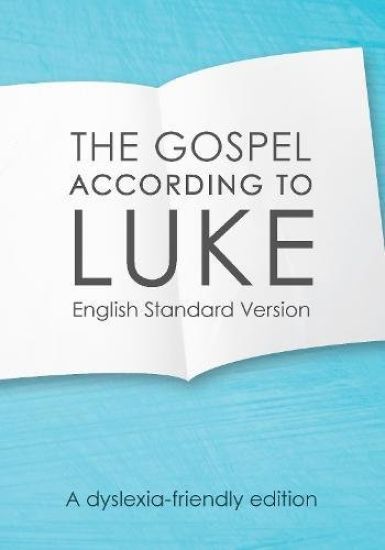
Luke's Gospel is a captivating portrait of the man who arguably shaped world history like no other: Jesus of Nazareth.This dyslexia-friendly edition:* Follows the principles for dyslexia-friendly formatting* Is printed on cream-coloured matt paper to minimise reflection* Uses the English Standard Version, an essentially literal translation which combines word-for-word precision and accuracy with literary excellence, beauty and readability.Key features* Short paragraphs* Increased line spacing* Larger type face* Cream coloured paper rather than bright white*Paper has high opacity so very little text shows through from the next page*Paper has matt finish rather than glossy paper limiting reflection*Follows formatting principles of British Dyslexia Association.