Kirjojen hintavertailu. Mukana 11 244 527 kirjaa ja 12 kauppaa.

Kirjahaku

Etsi kirjoja tekijän nimen, kirjan nimen tai ISBN:n perusteella.

1000 tulosta hakusanalla Marcel Proust

Marcel Mauss und die Theorie der Gabe

Marcel Mauss und die Theorie der Gabe

Arndt Schmidt

Grin Publishing
2012
nidottu
Essay aus dem Jahr 2010 im Fachbereich Geschichte - Allgemeines, Note: 1,7, Universit t Bielefeld (Fakult t f r Geschichte), Veranstaltung: Lesarten der konomie, Sprache: Deutsch, Abstract: "Der homo oeconomicus steht nicht hinter uns, sondern vor uns - wie der moralische Mensch, der pflichtbewusste Mensch, der wissenschaftliche Mensch und der vern nftige Mensch. Lange Zeit war der Mensch etwas anderes; und es ist noch nicht sehr lange her, seit er eine Maschine geworden ist - und gar eine Rechenmaschine." Marcel Mauss beschlie t sein ber hmtes Werk "Die Gabe" mit einigen "Sozial- und national konomischen Schlussfolgerungen," in denen er Kritik bt an der Privilegierung materieller N tzlichkeit, der Verfolgung individueller Zwecke und der reinen Pro-fitmaximierung, die seiner Ansicht zufolge dem Rationalismus der Moderne geschuldet sind und "dem Frieden, des Ganzen, dem Rhythmus unserer Arbeit und unserer Freuden und damit letztlich dem Einzelnen selbst" schaden. Nach einem kurzen berblick zur Person Marcel Mauss sollen im Folgenden die Kernaspekte seiner Kulturtheorie der Gabe Erl uterung finden. Im Vordergrund ste-hen dabei seine Ausf hrungen zur konomie des Gabentausches in Polynesien und dem S dpazifik. Mauss' Lesart der konomie zeigt den kontingenten Charakter der Wirtschaftsordnungen auf, die unser gesellschaftliches Zusammenleben ma geblich bestimmen. Vor dem Hintergrund derzeitiger wirtschaftlicher Krisen gelesen verdeut-licht seine Kritik an einem essentialistischen Verst ndnis vom homo oeconomicus, dass eine Orientierung am Primat der Gewinnmaximierung weder naturgegeben noch ohne Alternativen sein muss.
Marcel Duchamp Rrose Sélavy

Marcel Duchamp Rrose Sélavy

Lars Blunck

De Gruyter
2025
isokokoinen pokkari
Marcel Duchamp was one of the most enigmatic artists of the 20th century. In 1920 he invented an alter ego called Rrose Sélavy, who would become one of the most dazzling characters in modern art. This ground-breaking book is the first to fully explore the complex history of Rrose Sélavy in detail. It takes into account all the relevant works, reconstructs all the historical contexts, and sheds light on Duchamp’s artistic attitude in the 1920s. "Known also under the name Rrose Sélavy" (Duchamp), he playfully and ironically mocked the pretensions of the art and artists of his time, friends and foes alike. In Rrose Sélavy, he, who rejected all -isms, took the liberty of creating his own -ism: a self-proclaimed "au-culism". Rrose Sélavy was mocking art.
Marcel van Eeden

Marcel van Eeden

Kerber Verlag
2023
nidottu
The artist book Marcel van Eeden – 1898 is being published to coincide with the Hans Thoma Prize 2023. The prizewinner, Marcel van Eeden (b. 1965), explores Thoma’s little-known travels to the Netherlands in 1898. He reflects on Thoma’s analysis of Rembrandt van Rijn or Paulus Potter, under the problematic influence of the cultural theorist Julius Langbehn. Present-day gum bichromate images of the places Thoma visited alongside historical quotes by Thoma and Langbehn result in a multifaceted, critical consideration of nationalistic views on culture. Text in English and German.
Marcel Duchamp. La Patte
An ironic response to Marcel Duchampâ??s decision to free himself from any form of artistic signature. Accompanies exhibitions at museum Fluxus+, Potsdam 26 April 2024 - 23 June 2024West Den Haag, Den Haag 7 September - 10 November 2024. Text in English and German.
Marcel Duchamp

Marcel Duchamp

Peter Maaswinkel

tredition GmbH
2017
nidottu
On April 9th, 1917, a urinal was delivered as an art work to the First Annual Exhibition of the Independents in New York. The item received the title Fountain. It was signed R. Mutt, which turned out to be a pseudonym. About twenty years later, the authorship of this work was attributed to Marcel Duchamp. But over time, his authorship got questioned; the Baroness Elsa von Freytag-Loringhoven was cited as possible author. Essentially binary discussions followed, to which this book opposes a systematic approach in seven theses. Far from claiming to provide answers, it gathers elements that could potentially lead to a broader research plan. Le 9 avril 1917, un urinoir fut livr en tant qu'oeuvre d'art la Premi re Exposition Annuelle des Ind pendants New York. L'envoi re ut le titre Fontaine. Il portait la signature R. Mutt qui s'av rait tre un pseudonyme. Une vingtaine d'ann es plus tard, la paternit de cette oeuvre fut attribu e Marcel Duchamp. Mais au fil du temps, sa qualit d'auteur fut mise en doute; la baronne Elsa von Freytag-Loringhoven fut cit e comme possible auteure. Des discussions essentiellement binaires suivirent auxquelles ce livre oppose une approche syst matique en sept th ses. Loin de pr tendre donner des r ponses, il rassemble des l ments qui pourraient conduire un plan de recherche plus tendu.
Marcel Dzama

Marcel Dzama

Hatje Cantz
2013
sidottu
Marcel Dzama (*1974 in Winnipeg) is known for his prolific drawings, which are characterized by their distinctive palette and subject matter. He has recently expanded his practice to encompass film and three-dimensional works, thus developing an immediately recognizable language that draws from a diverse range of references and artistic influences, including Dada and Marcel Duchamp. Created in close collaboration with the artist, this publication presents his 2013 exhibition at David Zwirner in London, which included videos inspired by the game of chess and puppets and masks based on the characters, along with drawings, collages, dioramas, paintings, and sculptural works. Dzama utilized the architecture of the gallery itself—an eighteenth-century Georgian townhouse—by hanging puppets from a skylight above the five-story building’s central spiral staircase and placing monitors in the windows so that his videos could be viewed from the street.
Marcel Duchamp (Bilingual edition)

Marcel Duchamp (Bilingual edition)

Marcel Duchamp; Sarah Archino; Kornelia von Berswordt-Wallrabe; Patricia Bethlen; Deborah Bürgel; Paul B. Franklin; Gerhard Graulich; Sarah Kolb

Hatje Cantz
2020
nidottu
Marcel Duchamp: one of his themes was the boundary between works of art and everyday objects, and with it, he set the art world in an uproar. Surely one of his most brilliant strokes of genius was the Fountain, a urinal he put on display. There are, of course, many more works that bear his signature, and the Duchamp Collection in Schwerin has ninety-two of them. Founded in 2009, the research centre has succeeded in establishing an interdisciplinary, globally connected network of researchers in Schwerin. Under the title Marcel Duchamp: Inventing the Presence, individual as well as groups of artworks from the Schwerin collection are examined from philosophical, art historical, and literary perspectives in volume five of the series Poiesis.
Marcel Broodthaers
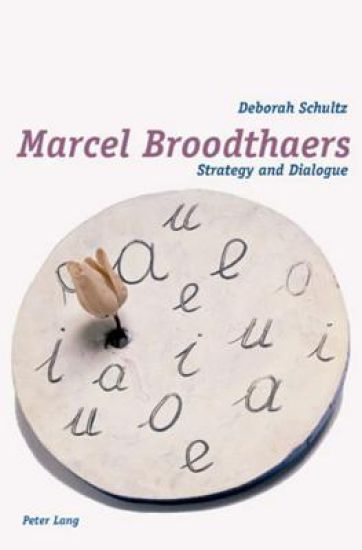
New exhibition catalogue on Belgian artist Marcel Broodthaers. Marcel Broodthaers‘s work is characterized by a complex exploration of the relationship of text and image. This catalog raisonné, prepared by WIELS and developed in close collaboration with the Marcel Broodthaers Succession, is the first to include all of the Belgian conceptual artist’s industrial poems created between 1968 and 1972. Borrowing from the aesthetics of industrially manufactured plastic signs, Broodthaers’s multi-layered, often enigmatic pictorial poems testify to his interest in the entanglements of language, punctuation, and symbols. In blurring the boundaries between word and image, painting and object, new levels of meaning are made visible. The index is supplemented by a collection of Broodthaers’s drawings, writings and “open letters” as well as scholarly contributions that position the poems as a crucial group of works within the artist’s oeuvre.
Marcel Chassot: Architecture and Photography
Assembling buildings designed by modern star architects from Tadao And - o to Peter Zumthor, this photography book is a total - work - of - art: its felicitous interplay of brilliant architectural photography, exquisite book design, and texts approaching the subje ct from the angle of the history of thought places Marcel Chassot’s imagery within European cultural history. Once it plunges into Chassot’s architectural photography, the eye feasts on a wealth of scenes from the repertoire of outstanding international c ontemporary architecture. Each of the photographs aptly captures a prototypical subject. Colouring, the arrangement of lines, lighting, as well as the photographic means are employed with such precision that viewers feel as if they are in a visual laboratory where photography interprets architecture in its particular language. In his essay the author Wolfgang Meisenheimer looks into the fundamental principles of Chassot’s photographic world view and distinguishes between three layers of thought in which the work is rooted: the Euclidian orders, echoes of the modern philosophy of the lived body, and the legacy of Cubism from the beginnings of modern painting.
Marcel Odenbach (Bilingual edition)
Using collage and montage as a medium and always in connection with his own biography, Marcel Odenbach investigates politically and culturally relevant topics of his time, such as for example the process of coming to terms with Nazi crimes, remembrance culture, the effects and after-effects of European colonialism in Africa, racism and time and time again the relationship between the individual and society. The artist Marcel Odenbach (*1953) lives in Cologne, Berlin and intermittently in Ghana. Since 1976 he has worked with video. His filmic collages and installations have contributed to the fact that today video art is a central medium in contemporary international art. Parallel to this he has created a wide-ranging graphic oeuvre. In the joint consideration of his video and paper works it becomes clear that Odenbach regards art and culture under a socio-political perspective and at the same time relies on the strength of the sensuous-aesthetical experience of images.
Marcel Duchamp: 100 Questions. 100 Answers
Celebrating Marcel Duchamp's revolutionary contributions to modern art, this innovative exploration of the Stuttgart Duchamp Collection and the Archive of Serge Stauffer offers new insights into both artists' philosophies. As the inventor of the Readymade and a founder of conceptual art, Marcel Duchamp's work is still provoking important discussions about what defines art. Accompanying the first exhibition of the important Stuttgart Duchamp Collection, this book also presents the work of the Swiss artist and educator Serge Stauffer and his renowned research on Duchamp's art and writings. The series of 100 questions Stauffer wrote to the French artist in 1960-and Duchamp's answers-provide important insights into Duchamp's intellectual and creative practice and bear witness to the depth of Stauffer's exceptional research. This book opens with an introduction to the relationship between Duchamp and Stauffer. It features brilliant reproductions of Duchamp's most renowned works, including Bottlerack, the painting study for Chocolate Grinder, No 2, and the window object La Bagarre d'Austerlitz. A biographical essay on both Duchamp and Stauffer provides important background to understanding the exceptional relationship between both artists.
Marcel Gautherot

Marcel Gautherot

Michel Frizot; Samuel Titan; Jacques Leenhardt

Scheidegger und Spiess AG, Verlag
2017
sidottu
Marcel Gautherot (1910-96) is regarded by many as one of the most significant French photographers, yet his work is relatively little known and even less published. Marcel Gautherot: The Monograph features some 200 of his striking pictures from all stages of his career, superbly reproduced in tritone printing. The images are complemented by essays on his affinity for modern architecture, his contribution to the history of photography, and on his attachment to Brazil. The most famous part of his work is the body of some 3,000 images documenting the construction of Brasilia 1958-1960. This, and other images he took of this extraordinary place until the 1970s, is widely appreciated as a high point of 20th-century architectural photography. Gautherot began an education in architecture but very soon took up photography as well. He travelled extensively in France and abroad and visited Brazil and Peru for the first time in 1939, before being drafted into the French army on the outbreak of World War II. Upon demobilisation in summer 1940 he returned to Brazil and made Rio de Janeiro his home for the rest of his life.