
Kirjahaku
Etsi kirjoja tekijän nimen, kirjan nimen tai ISBN:n perusteella.
1000 tulosta hakusanalla Matthias Ruffert


"Bibi, Tina und Alex finden eine Schatzkarte. Dei drei trennen sichzur Schatzsuche: Mädchen gegen Jungs! Plötzlich taucht Alex¿ Pferd Maharadscha ohne Reiter bei Bibi und Tina auf. Wird der Hengst die beiden Mädchen zu Alex führen können? Und werden sie den Schatz finden?Spannende Pferdegeschichten zum Lesenlernen mit Bibi und Tina,perfekt abgestimmt auf die Lesekompetenz von Leseanfängern:- Verhältnis Textmenge - Illustrationen- Zeilenlänge und Schriftgröße- KomplexitätAußerdem: ein Hufeisen-Quiz zur spielerischen Überprüfung des Leseverständnisses und einem Leseführerschein, der online erworben werden kann!"


Teaching Manual of Color Duplex Sonography
Matthias Hofer; MEDIDAK Publishing GmbH
Thieme Publishing Group
2010
nidottu
The Third Edition of this up-to-date and user friendly workbook helps medical students, sonographers, residents, and radiologists gain a fundamental grasp of the application of color duplex ultrasound by reviewing normal findings, important pathologic conditions, scanning techniques, and the role and importance of color duplex ultrasound in detecting and assessing various disease states. Topics include: Basic physical and technical principles Innovative techniques and ultrasound contrast agents (e.g., power Doppler, SieScape imaging, clarify vascular enhancement, tissue Doppler, precision upsampling, arterial stiffness, eTracking) Vascular surgery: peripheral arterial occlusive disease, venous insufficiency and thrombosis, AV fistulae, and aneurysms Endocrinology: thyroid gland Internal medicine: abdominal organs, lymph nodes, TIPSS Nephrology: kidneys and renal allografts Neurology: intra- and extracranial cerebral arteries Cardiology: B- and M-mode imaging, cardiac anomalies, wall motion analysis Urology: testicular torsion, tumors, erectile dysfunction Obstetrics and gynecology: tumors, anomalies, fetal perfusion defectsTeaching Manual of Color Duplex Sonography is well known for its highly educational approach and user-friendly features which include: Over 500 excellent illustrations -- ideal for visually oriented learners Diagrams that illustrate the correct way to handle the transducer and position the scan plane Self-test question & answers Tips, tricks, and common pitfalls Checklists and tables of normal values on sturdy pocket-sized cards for hospital and office use
For whom is this book designed? For all students and physicians in training who want to learn more about the systematic interpretation of conventional chest radiographs, and for anyone who wants to learn how to insert chest tubes and central venous catheters. What does this book offer? Detailed diagrams on topographical anatomy, with numerical labels for self-review. Coverage includes even relatively complex findings in trauma victims and ICU patients.Detailed, step-by-step instructions on the placement of CVCs and chest tubes.Simple aids and tricks, such as the "silhouette sign," are helpful in image interpretation.Images to illustrate all common abnormalities (systematically arranged according to morphological patterns).

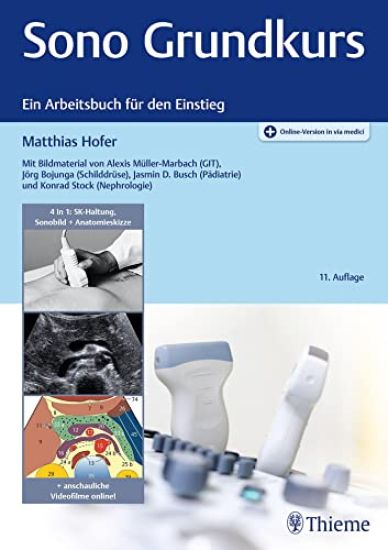
Step by Step to Proficiency in Diagnostic Ultrasound This workbook is divided into lessons that guide you-like an instructor in an ultrasound course-systematically through the individual organ systems and body regions. Key features of the fourth edition:Special multiple-exposure photos demonstrate the dynamics of handling the transducerTriplet-image units vividly illustrate transducer positioning, the ultrasound image, and relevant anatomyReference numbers on the accompanying diagrams help you to both actively develop your knowledge and to test it at any time. The legend located on the back cover flap is the key to the reference numbers that are used consistently in each diagram.Quiz images at the end of each chapter are the perfect tool for rigorous self-evaluationPhysical fundamentals are presented in vibrant, illustrative diagramsNumerous practical tips and tricks make it easy to familiarize yourself with ultrasoundA primer on ultrasound interpretation explains specialized terminology concisely and clearlyPrecise descriptions of algorithms for transducer positioning facilitate real-time examinations Videos (online access) showing relevant ultrasound anatomy, optimal transducer positioning, and the images you will see on the monitor during examination let you experience the content live-a perfect complement to the book that will greatly improve your retention of the material.
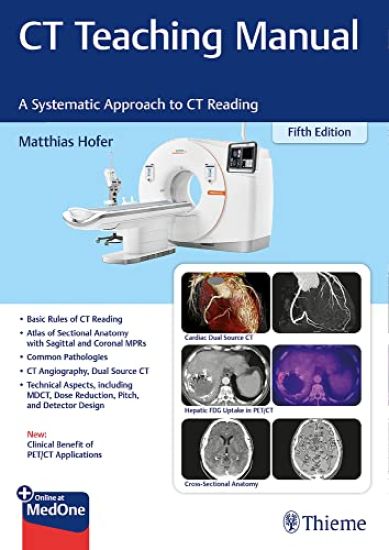
Ideal for residents starting in radiology and radiologic technologists, this concise manual is the perfect introduction to the physics and practice of CT and the interpretation of basic CT images. Designed as a systematic learning tool, it introduces the use of CT scanners for all organs, and includes positioning, use of contrast media, representative CT scans of normal and pathological findings, explanatory drawings with keyed anatomic structures, and an overview of the most important measurement data. Finally, self-assessment quizzes – including answers – at the end of each chapter help the reader monitor progress and evaluate knowledge gained. New in this fourth edition:Updated examination protocols for multidetector CT and CT angiographyAn extended chapter on dual source CTA new chapter on contrast injectors

Seydlitz Erdkunde 7 / 8. Schulbuch. Für Gymnasien in Niedersachsen
Matthias Akkermann; Andreas Bauer; Kirsten Böttcher-Speckels
Westermann Schulbuch
2023
muu

Seydlitz Erdkunde 9 / 10.Schulbuch. Für Gymnasien in Niedersachsen
Matthias Akkermann; Andreas Bauer; Kirsten Böttcher-Speckels
Westermann Schulbuch
2024
muu

Seydlitz Erdkunde. Schulbuch Einführungsphase. Für Gymnasien in Niedersachsen
Matthias Akkermann; Andreas Bauer; Kirsten Böttcher-Speckels
Westermann Schulbuch
2025
muu

Gesellschaft bewusst 2. Schulbuch. Stadtteilschulen. Hamburg
Matthias Bahr; Dieter Skolaster; Ulrich Brameier
Westermann Schulbuch
2019
sidottu

Industriekaufleute. Schulbuch. Spezielle Wirtschaftslehre
Matthias Schuh; Felizitas Schuh-Terhardt; Wolf-Dieter Rückwart
Westermann Berufl.Bildung
2021
nidottu