Kirjojen hintavertailu. Mukana 12 016 292 kirjaa ja 12 kauppaa.

Kirjahaku

Etsi kirjoja tekijän nimen, kirjan nimen tai ISBN:n perusteella.

1000 tulosta hakusanalla Maximo Serrano Hercules

Distinction Des Maxima Et Des Minima Dans Les Questions Qui Dépendent de la Méthode
Distinction des maxima et des minima dans les questions qui dependent de la methode des variations: these de mecanique presentee a la Faculte des sciences de Paris... / par Ch. Delaunay...Date de l'edition originale: 1841Ce livre est la reproduction fidele d'une oeuvre publiee avant 1920 et fait partie d'une collection de livres reimprimes a la demande editee par Hachette Livre, dans le cadre d'un partenariat avec la Bibliotheque nationale de France, offrant l'opportunite d'acceder a des ouvrages anciens et souvent rares issus des fonds patrimoniaux de la BnF.Les oeuvres faisant partie de cette collection ont ete numerisees par la BnF et sont presentes sur Gallica, sa bibliotheque numerique.En entreprenant de redonner vie a ces ouvrages au travers d'une collection de livres reimprimes a la demande, nous leur donnons la possibilite de rencontrer un public elargi et participons a la transmission de connaissances et de savoirs parfois difficilement accessibles.Nous avons cherche a concilier la reproduction fidele d'un livre ancien a partir de sa version numerisee avec le souci d'un confort de lecture optimal. Nous esperons que les ouvrages de cette nouvelle collection vous apporteront entiere satisfaction.Pour plus d'informations, rendez-vous sur www.hachettebnf.fr
The Military Maxims

The Military Maxims

Napoleon Bonaparte

Les Prairies Numeriques
2020
pokkari
The Military Maxims of NapoleonAn essential volume of Napoleon's wisdom on the art of warNearly two hundred years after his death, Napoleon remains widely regarded as one of the greatest military commanders of all time. Here, in one volume, is the essence of Napoleon's knowledge and wisdom, the fruit of his practical experience, and his study of the great empire-builders from Alexander to Frederick the Great. Working from the best among previous editions of Napoleon's maxims, including the work produced in 1901 by William E. Cairnes, noted Napoleonic historian David G. Chandler has contributed commentary that examines Napoleon's work from the twentieth-century perspective of the two world wars, Vietnam, and other conflicts, and analyzes the ways in which commanders have observed or failed to observe Napoleon's teachings.The Military Maxims of Napoleon is a unique collection of tenets on the art of war. They reveal the principles on which his military, diplomatic, and political triumphs were built. Now every military student and enthusiast can benefit from the brilliance of Napoleonic insight and wisdom.The Military Maxims of Napoleon provides a most valuable insight into the Napoleonic art of war . . . David G. Chandler is the foremost modern authority on the subject, which makes this work essential reading." Philip J. Haythornthwaite, author of Invincible GeneralsSkyhorse Publishing, as well as our Arcade imprint, are proud to publish a broad range of books for readers interested in history--books about World War II, the Third Reich, Hitler and his henchmen, the JFK assassination, conspiracies, the American Civil War, the American Revolution, gladiators, Vikings, ancient Rome, medieval times, the old West, and much more. While not every title we publish becomes a New York Times bestseller or a national bestseller, we are committed to books on subjects that are sometimes overlooked and to authors whose work might not otherwise find a home.
Kant on Maxims and Moral Motivation

Kant on Maxims and Moral Motivation

Peter Herissone-Kelly

Springer Nature Switzerland AG
2019
sidottu
This book outlines and circumvents two serious problems that appear to attach to Kant’s moral philosophy, or more precisely to the model of rational agency that underlies that moral philosophy: the problem of experiential incongruence and the problem of misdirected moral attention. The book’s central contention is that both these problems can be sidestepped. In order to demonstrate this, it argues for an entirely novel reading of Kant’s views on action and moral motivation. In addressing the two main problems in Kant’s moral philosophy, the book explains how the first problem arises because the central elements of Kant’s theory of action seem not to square with our lived experience of agency, and moral agency in particular. For example, the idea that moral deliberation invariably takes the form of testing personal policies against the Categorical Imperative seems at odds with the phenomenology of such reasoning, as does the claim that all our actions proceed from explicitlyadopted general policies, or maxims. It then goes on to discuss the second problem showing how it is a result of Kant’s apparent claim that when an agent acts from duty, her reason for doing so is that her maxim is lawlike. This seems to put the moral agent’s attention in the wrong place: on the nature of her own maxims, rather than on the world of other people and morally salient situations. The book shows how its proposed novel reading of Kant’s views ultimately paints an unfamiliar but appealing picture of the Kantian good-willed agent as much more embedded in and engaged with the world than has traditionally been supposed.
Finite Elements Using Maxima

Finite Elements Using Maxima

Andreas Öchsner; Resam Makvandi

Springer Nature Switzerland AG
2019
sidottu
This book provides a study aid on the finite element method. Based on the free computer algebra system “Maxima”, it presents routines to symbolically or numerically solve problems in the context of plane truss and frame structures. This allows readers to not only check classical “hand calculations” but also understand the computer implementation of the method. The mechanical theories focus on the classical one-dimensional structural elements, i.e. bars, Euler–Bernoulli and Timoshenko beams as well as their combination to generalized beam elements. Focusing on one-dimensional elements reduces the complexity of the mathematical framework and the resulting matrix equations can still be displayed with all components, and not only in a symbolic representation. The use of a computer algebra system and the incorporated functions, e.g. for equation solving, highlights the methodology of the finite element method rather than standard procedures.The book is based on the Springer Brief “Finite Elements for Truss and Frame Structures” (978-3-319-94940-6) by the same authors.
Finite Elements Using Maxima

Finite Elements Using Maxima

Andreas Öchsner; Resam Makvandi

Springer Nature Switzerland AG
2020
nidottu
This book provides a study aid on the finite element method. Based on the free computer algebra system “Maxima”, it presents routines to symbolically or numerically solve problems in the context of plane truss and frame structures. This allows readers to not only check classical “hand calculations” but also understand the computer implementation of the method. The mechanical theories focus on the classical one-dimensional structural elements, i.e. bars, Euler–Bernoulli and Timoshenko beams as well as their combination to generalized beam elements. Focusing on one-dimensional elements reduces the complexity of the mathematical framework and the resulting matrix equations can still be displayed with all components, and not only in a symbolic representation. The use of a computer algebra system and the incorporated functions, e.g. for equation solving, highlights the methodology of the finite element method rather than standard procedures.The book is based on the Springer Brief “Finite Elements for Truss and Frame Structures” (978-3-319-94940-6) by the same authors.
Concentration of Maxima and Fundamental Limits in High-Dimensional Testing and Inference
This book provides a unified exposition of some fundamental theoretical problems in high-dimensional statistics. It specifically considers the canonical problems of detection and support estimation for sparse signals observed with noise. Novel phase-transition results are obtained for the signal support estimation problem under a variety of statistical risks. Based on a surprising connection to a concentration of maxima probabilistic phenomenon, the authors obtain a complete characterization of the exact support recovery problem for thresholding estimators under dependent errors.
Les Épigrammes de Maxime Planude

Les Épigrammes de Maxime Planude

Ilias Taxidis

de Gruyter
2017
sidottu
This annotated critical edition presents the epigrams of the Byzantine scholar Maximus Planudes. Due to the absence of a critical edition of almost all Maximus Planudes’ epigrams as well as of a methodical commentary or a systematic review of their thematic, lexical, stylistic and metrical features, this study aims to elucidate the least recognised facet of the literary work of one of the most important scholar of the Palaiologan Renaissance.
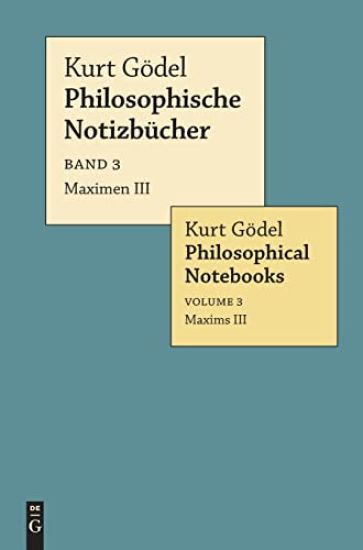
Maximen III / Maxims III

Maximen III / Maxims III

Kurt Gödel

De Gruyter
2021
sidottu
Over a period of 22 years (1934–1955), mathematician Kurt Gödel put down a series of philosophical remarks – the so-called Philosophical Maxims (Max Phil) – in writing. They have been passed down in 15 notebooks written in Gabelsberger shorthand. The first notebook contains general philosophical reflections, while the second and third notebooks consist of Gödel’s applied individual ethics. The notebooks that follow show that Gödel developed a philosophy of science in which he placed his considerations of physics, psychology, biology, mathematics, language, theology, and history within the context of a particular metaphysics. Now for the first time ever, a complete, historical-critical edition of Gödel’s philosophical notebooks is being prepared by the Kurt Gödel Research Center of the Berlin-Brandenburg Academy of Sciences and Humanities. One volume will be published yearly as part of this series. With the notebook "Maxims III," a new section of Gödel’s philosophical notebooks begins. This notebook sheds light on the relationship between various disciplines – in particular psychology, mathematics (specifically logic), and theology – and their respective significance for both the thinking and working scholar and for the knowledge system. It also contains considerations on heuristics and scholarly methods. The role of fundamental or simple concepts in thinking also becomes apparent.
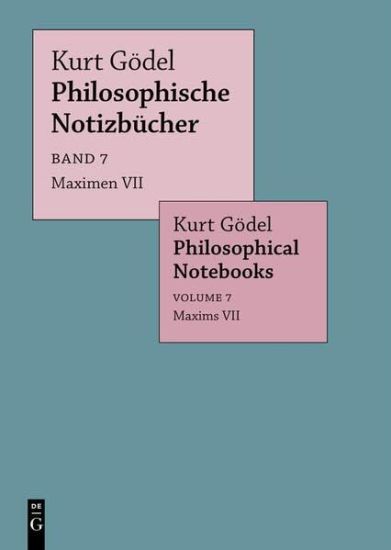
Maximen VII / Maxims VII

Maximen VII / Maxims VII

Kurt Gödel

De Gruyter
2025
sidottu
Der Mathematiker Kurt G del hat ber einen Zeitraum von 22 Jahren (1934-1955) philosophische Bemerkungen, die so genannten Maximen Philosophie (Max Phil), niedergeschrieben. Sie sind in 15 Notizb chern in der Kurzschrift Gabelsberger berliefert. Erstmals wird nun an der Kurt-G del-Forschungsstelle der Berlin-Brandenburgischen Akademie der Wissenschaften eine vollst ndige, historisch-kritische Edition von G dels Philosophischen Notizb chern vorgelegt. Im Rahmen dieser Edition erscheint j hrlich ein Band. In Band 7 befasst sich G del mit dem Thema >Sprache Die Verschiedenheit des Zugangs eines wissenschaftlichen und eines theologischen Weltbildes zur Welt und zum Leben stellt einen weiteren Schwerpunkt dieses Buches dar. Daneben setzt G del unter anderem seine berlegungen dazu fort, wie der Mensch die Welt wahrnimmt und erfasst.
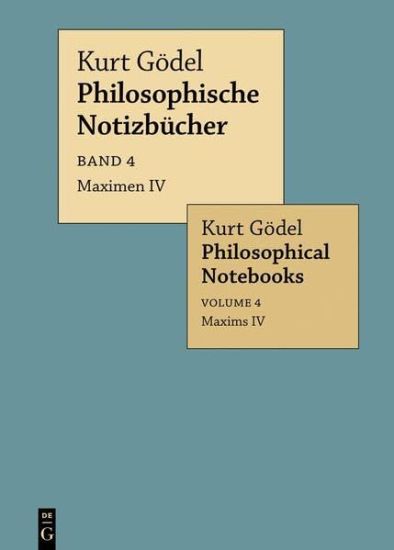
Maximen IV / Maxims IV

Maximen IV / Maxims IV

Kurt Gödel

De Gruyter
2024
nidottu
Over a period of 22 years (1934-1955), the mathematician Kurt G del wrote down philosophical remarks, the so-called Maximen Philosophie (Max Phil). They are preserved in 15 notebooks in Gabelsberger shorthand. The first booklet contains general philosophical considerations, booklets two and three consist of G del's individual ethics. The following volumes show that G del developed a philosophy of science in which he places his discussions on physics, psychology, biology, mathematics, language, theology and history in the context of a metaphysics. A complete, historical-critical edition of G del's Philosophical Notebooks is now being prepared for the first time at the Kurt G del Research Centre of the Berlin-Brandenburg Academy of Sciences and Humanities. One volume will be published each year as part of this edition. In volume 4, G del deals with fundamental questions of mathematics and logic as well as the philosophy of mathematics. In addition, the relationship between different scientific disciplines and their specific questions are at the centre of his considerations. These include, in particular, philosophy, psychology and theology.