Kirjojen hintavertailu. Mukana 12 390 323 kirjaa ja 12 kauppaa.

Kirjahaku

Etsi kirjoja tekijän nimen, kirjan nimen tai ISBN:n perusteella.

1000 tulosta hakusanalla Ming Han Li

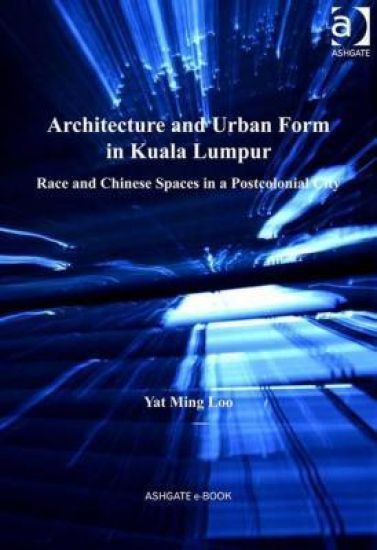
Architecture and Urban Form in Kuala Lumpur

Architecture and Urban Form in Kuala Lumpur

Yat Ming Loo

Ashgate Publishing Limited
2013
sidottu
Kuala Lumpur, the capital city of Malaysia, is a former colony of the British Empire which today prides itself in being a multicultural society par excellence. However, the Islamisation of the urban landscape, which is at the core of Malaysia’s decolonisation projects, has marginalised the Chinese urban spaces which were once at the heart of Kuala Lumpur. Engaging with complex colonial and postcolonial aspects of the city, from the British colonial era in the 1880s to the modernisation period in the 1990s, this book demonstrates how Kuala Lumpur’s urban landscape is overwritten by a racial agenda through the promotion of Malaysian Architecture, including the world-famous mega-projects of the Petronas Twin Towers and the new administrative capital of Putrajaya. Drawing on a wide range of Chinese community archives, interviews and resources, the book illustrates how Kuala Lumpur’s Chinese spaces have been subjugated. This includes original case studies showing how the Chinese re-appropriated the Kuala Lumpur old city centre of Chinatown and Chinese cemeteries as a way of contesting state’s hegemonic national identity and ideology. This book is arguably the first academic book to examine the relationship of Malaysia’s large Chinese minority with the politics of architecture and urbanism in Kuala Lumpur. It is also one of the few academic books to situate the Chinese diaspora spaces at the centre of the construction of city and nation. By including the spatial contestation of those from the margins and their resistance against the state ideology, this book proposes a recuperative urban and architectural history, seeking to revalidate the marginalised spaces of minority community and re-script them into the narrative of the postcolonial nation-state.
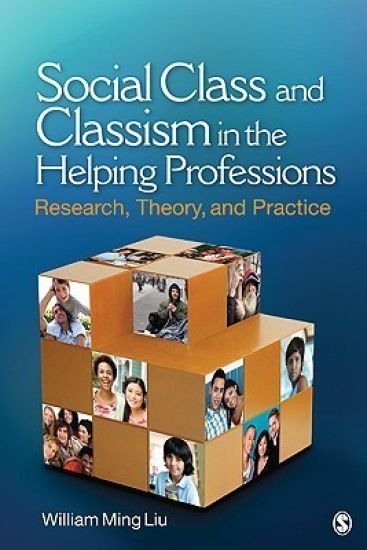
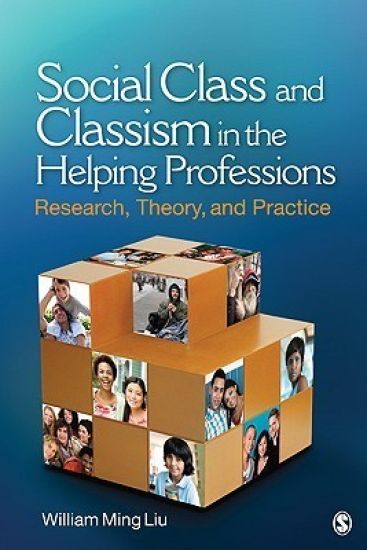
Social Class and Classism in the Helping Professions

Social Class and Classism in the Helping Professions

William Ming Liu

SAGE Publications Inc
2010
sidottu
Provide your students with engaging material on social class and classism The impact of social class and classism on mental health functioning crosses racial, ethnic, and social lines and significantly contributes to our overall well-being. Any attempt to understand individuals must include an understanding of how economic issues and class have contributed to their difficulties. In Social Class and Classism in the Helping Professions, author William Ming Liu presents theory and research on the impact of classism and social class on mental health. He provides an original framework—the Social Class Worldview Model—for exploring each person's individual and subjective life experiences. These experiences form a perspective that is unique to the individual. The author then helps the reader integrate this realization into the study of poverty, economic inequality, wealth, and the often overlooked implications of greed, materialism, and consumerism for a more complete understanding of social class and classism. Intended Audience This text is intended as a supplement for graduate and advanced undergraduate courses that address psychological and counseling theories, multicultural counseling, and research in the helping professions. These courses may be found in departments of counseling, rehabilitation, psychology, education, nursing, and social work.
Social Class and Classism in the Helping Professions

Social Class and Classism in the Helping Professions

William Ming Liu

SAGE Publications Inc
2010
nidottu
Provide your students with engaging material on social class and classism The impact of social class and classism on mental health functioning crosses racial, ethnic, and social lines and significantly contributes to our overall well-being. Any attempt to understand individuals must include an understanding of how economic issues and class have contributed to their difficulties. In Social Class and Classism in the Helping Professions, author William Ming Liu presents theory and research on the impact of classism and social class on mental health. He provides an original framework—the Social Class Worldview Model—for exploring each person's individual and subjective life experiences. These experiences form a perspective that is unique to the individual. The author then helps the reader integrate this realization into the study of poverty, economic inequality, wealth, and the often overlooked implications of greed, materialism, and consumerism for a more complete understanding of social class and classism. Intended Audience This text is intended as a supplement for graduate and advanced undergraduate courses that address psychological and counseling theories, multicultural counseling, and research in the helping professions. These courses may be found in departments of counseling, rehabilitation, psychology, education, nursing, and social work.
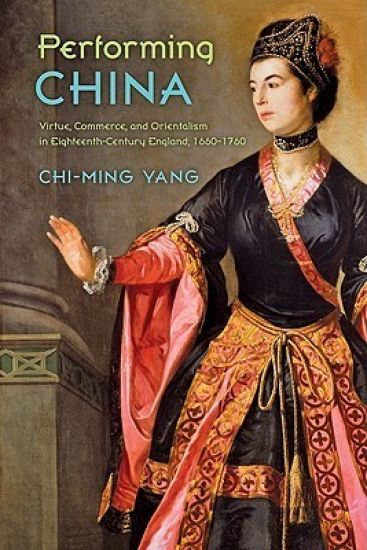
Performing China

Performing China

Chi-ming Yang

Johns Hopkins University Press
2011
sidottu
China in the seventeenth and eighteenth centuries was a model of economic and political strength, viewed by many as the greatest empire in the world. While the importance of China to eighteenth-century English consumer culture is well documented, less so is its influence on English values. Through a careful study of the literature, drama, philosophy, and material culture of the period, this book articulates how Chinese culture influenced English ideas about virtue. Discourses of virtue were significantly shaped by the intensified trade with the East Indies. Chi-ming Yang focuses on key forms of virtue-heroism, sincerity, piety, moderation, sensibility, and patriotism-whose meanings and social importance developed in the changing economic climate of the period. She highlights the ways in which English understandings of Eastern values transformed these morals. The book is organized by type of performance-theatrical, ethnographic, and literary-and by performances of gender, identity fraud, and religious conversion. In her analysis of these works, Yang brings to light surprising connections between figures as disparate as Confucius and a Chinese Amazon and between cultural norms as far removed as Hindu reincarnation and London coffeehouse culture. Part of a new wave of cross-disciplinary scholarship, where Chinese studies meets the British eighteenth century, this novel work will appeal to scholars in a number of fields, including performance studies, East Asian studies, British literature, cultural history, gender studies, and postcolonial studies.
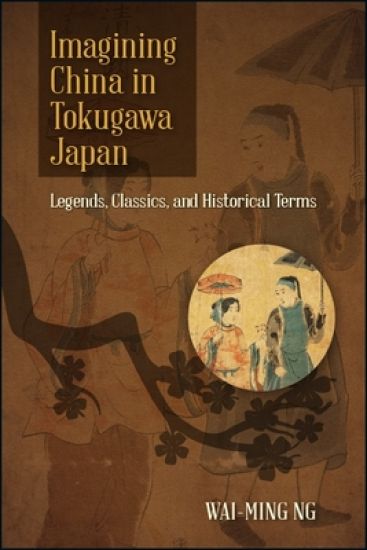
Imagining China in Tokugawa Japan

Imagining China in Tokugawa Japan

Wai-ming Ng

State University of New York Press
2020
pokkari
Pioneering study of the localization of Chinese culture in early modern Japan, using legends, classics, and historical terms as case studies.While current scholarship on Tokugawa Japan (1603–1868) tends to see China as either a model or "the Other," Wai-ming Ng's pioneering and ambitious study offers a new perspective by suggesting that Chinese culture also functioned as a collection of "cultural building blocks" that were selectively introduced and then modified to fit into the Japanese tradition. Chinese terms and forms survived, but the substance and the spirit were made Japanese. This borrowing of Chinese terms and forms to express Japanese ideas and feelings could result in the same things having different meanings in China and Japan, and this process can be observed in the ways in which Tokugawa Japanese reinterpreted Chinese legends, Confucian classics, and historical terms. Ng breaks down the longstanding dichotomies between model and "the other," civilization and barbarism, as well as center and periphery that have been used to define Sino-Japanese cultural exchange. He argues that Japanese culture was by no means merely an extended version of Chinese culture, and Japan's uses and interpretations of Chinese elements were not simply deviations from the original teachings. By replacing a Sinocentric perspective with a cross-cultural one, Ng's study represents a step forward in the study of Tokugawa intellectual history.
Origin of Cancers

Origin of Cancers

Shi-Ming Tu

Springer-Verlag New York Inc.
2010
sidottu
Précis This book is a treatise about the origin of cancers. I would like to convince readers that the basic tenets of the theory of a stem-cell origin of cancers also constitute a unified theory of cancer. Stem-cell origin of normal (and cancer) cells: Vitruvian version Every truth passes through three stages before it is recognized. In the first it is ridiculed, in the second, it is opposed, in the third, it is regarded as self-evident. – Arthur Schopenhauer v vi Preface Every person has a unique story to tell. My story is about cancer. Cancer touches the lives of countless people. Often enough, it leaves indelible tracks. Many lives have been lost; others are forever changed. For those who confront this deadly scourge, there is a sense of urgency, if not of desperation. For those who face im- nent death, life becomes even more precious and carries a special meaning. As an oncologist, I am touched daily by cancer. I feel its inception, evolution, and aft- math. It seems as though we are fighting an incessant war against cancer at the front line in the trenches. This is my story about cancer. Some people are terrific storytellers. Others have incredible tales to tell.
Applications of Finite Element Methods for Reliability Studies on ULSI Interconnections

Applications of Finite Element Methods for Reliability Studies on ULSI Interconnections

Cher Ming Tan; Wei Li; Zhenghao Gan; Yuejin Hou

Springer London Ltd
2013
nidottu
Applications of Finite Element Methods for Reliability Studies on ULSI Interconnections provides a detailed description of the application of finite element methods (FEMs) to the study of ULSI interconnect reliability. Over the past two decades the application of FEMs has become widespread and continues to lead to a much better understanding of reliability physics.To help readers cope with the increasing sophistication of FEMs’ applications to interconnect reliability, Applications of Finite Element Methods for Reliability Studies on ULSI Interconnections will:introduce the principle of FEMs;review numerical modeling of ULSI interconnect reliability;describe the physical mechanism of ULSI interconnect reliability encountered in the electronics industry; anddiscuss in detail the use of FEMs to understand and improve ULSI interconnect reliability from both the physical and practical perspective, incorporating the Monte Carlo method.A full-scale review of the numerical modeling methodology used in the study of interconnect reliability highlights useful and noteworthy techniques that have been developed recently. Many illustrations are used throughout the book to improve the reader’s understanding of the methodology and its verification. Actual experimental results and micrographs on ULSI interconnects are also included.Applications of Finite Element Methods for Reliability Studies on ULSI Interconnections is a good reference for researchers who are working on interconnect reliability modeling, as well as for those who want to know more about FEMs for reliability applications. It gives readers a thorough understanding of the applications of FEM to reliability modeling and an appreciation of the strengths and weaknesses of various numerical models for interconnect reliability.
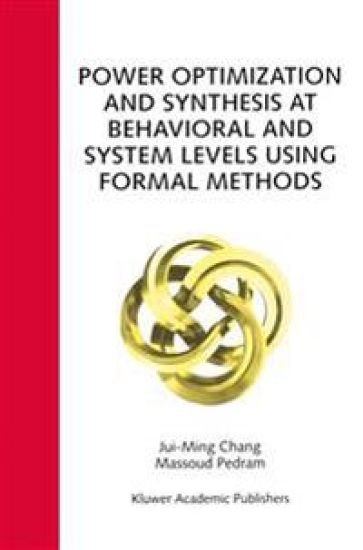
Power Optimization and Synthesis at Behavioral and System Levels Using Formal Methods

Power Optimization and Synthesis at Behavioral and System Levels Using Formal Methods

Jui-Ming Chang; Massoud Pedram

Springer-Verlag New York Inc.
2012
nidottu
Integrated circuit densities and operating speeds continue to rise at an exponential rate. Chips, however, cannot get larger and faster without a sharp decrease in power consumption beyond the current levels. Minimization of power consumption in VLSI chips has thus become an important design objective. In fact, with the explosive growth in demand for portable electronics and the usual push toward more complex functionality and higher performance, power consumption has in many cases become the limiting factor in satisfying the market demand. A new generation of power-conscious CAD tools are coming onto the market to help designers estimate, optimize and verify power consumption levels at most stages of the IC design process. These tools are especially prevalent at the register-transfer level and below. There is a great need for similar tools and capabilities at the behavioral and system levels of the design process. Many researchers and CAD tool developers are working on high-level power modeling and estimation, as well as power-constrained high-level synthesis and optimization. Techniques and tools alone are, however, insufficient to optimize VLSI circuit power dissipation - a consistent and convergent design methodology is also required. Power Optimization and Synthesis at Behavioral and System Levels Using Formal Methods was written to address some of the key problems in power analysis and optimization early in the design process. In particular, this book focuses on power macro-modeling based on regression analysis and power minimization through behavioral transformations, scheduling, resource assignment and hardware/software partitioning and mapping. What differentiates this book from other published work on the subject is the mathematical basis and formalism behind the algorithms and the optimality of these algorithms subject to the stated assumptions. From the Foreword: `This book makes animportant contribution to the field of system design technologies by presenting a set of algorithms with guaranteed optimality properties, that can be readily applied to system-level design. This contribution is timely, because it fills the need of new methods for a new design tool generation, which supports the design of electronic systems with even more demanding requirements'. Giovanni De Micheli, Professor, Stanford University
Origin of Cancers

Origin of Cancers

Shi-Ming Tu

Springer-Verlag New York Inc.
2012
nidottu
Précis This book is a treatise about the origin of cancers. I would like to convince readers that the basic tenets of the theory of a stem-cell origin of cancers also constitute a unified theory of cancer. Stem-cell origin of normal (and cancer) cells: Vitruvian version Every truth passes through three stages before it is recognized. In the first it is ridiculed, in the second, it is opposed, in the third, it is regarded as self-evident. – Arthur Schopenhauer v vi Preface Every person has a unique story to tell. My story is about cancer. Cancer touches the lives of countless people. Often enough, it leaves indelible tracks. Many lives have been lost; others are forever changed. For those who confront this deadly scourge, there is a sense of urgency, if not of desperation. For those who face im- nent death, life becomes even more precious and carries a special meaning. As an oncologist, I am touched daily by cancer. I feel its inception, evolution, and aft- math. It seems as though we are fighting an incessant war against cancer at the front line in the trenches. This is my story about cancer. Some people are terrific storytellers. Others have incredible tales to tell.
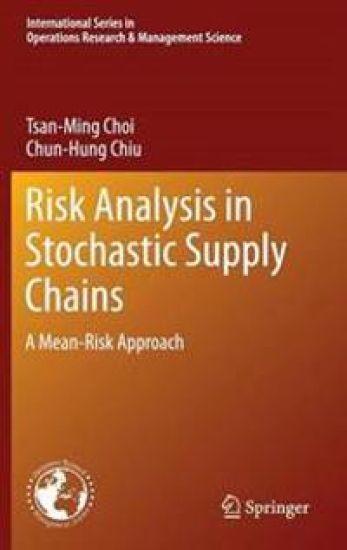
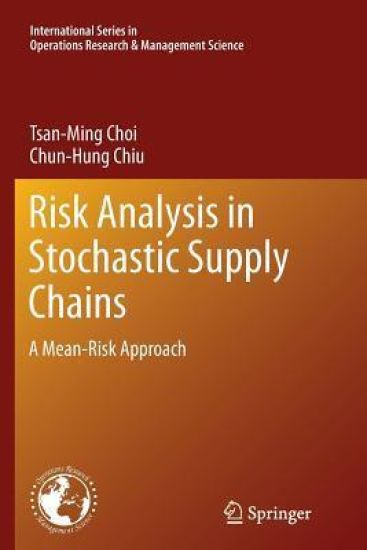
Risk Analysis in Stochastic Supply Chains

Risk Analysis in Stochastic Supply Chains

Tsan-Ming Choi; Chun-Hung Chiu

Springer-Verlag New York Inc.
2012
sidottu
Risk analysis is crucial in stochastic supply chain models. Over the past few years, the pace has quickened for research attempting to explore risk analysis issues in supply chain management problems, while the majority of recent papers focus on conceptual framework or computational numerical analysis. Pioneered by Nobel laureate Markowitz in the 1950s, the mean-risk (MR) formulation became a fundamental theory for risk management in finance. Despite the significance and popularity of MR-related approaches in finance, their applications in studying multi-echelon supply chain management problems have only been seriously explored in recent years. While the MR approach has already been shown to be useful in conducting risk analysis in stochastic supply chain models, there is no comprehensive reference source that provides the state-of-the-art findings on this important model for supply chain management. Thus it is significant to have a book that reviews and extends the MR related works for supply chain risk analysis. This book is organized into five chapters. Chapter 1 introduces the topic, offers a timely review of various related areas, and explains why the MR approach is important for conducting supply chain risk analysis. Chapter 2 examines the single period inventory model with the mean-variance and mean-semi-deviation approaches. Extensive discussions on the efficient frontiers are also reported. Chapter 3 explores the infinite horizon multi-period inventory model with a mean-variance approach. Chapter 4 investigates the supply chain coordination problem with a versatile target sales rebate contractand a risk averse retailer possessing the mean-variance optimization objective. Chapter 5 concludes the book and discusses various promising future research directions and extensions. Every chapter can be taken as a self-contained article, and the notation within each chapter is consistently employed.
Fundamentals of  Matrix-Analytic Methods

Fundamentals of Matrix-Analytic Methods

Qi-Ming He

Springer-Verlag New York Inc.
2013
sidottu
Fundamentals of Matrix-Analytic Methods targets advanced-level students in mathematics, engineering and computer science. It focuses on the fundamental parts of Matrix-Analytic Methods, Phase-Type Distributions, Markovian arrival processes and Structured Markov chains and matrix geometric solutions. New materials and techniques are presented for the first time in research and engineering design. This book emphasizes stochastic modeling by offering probabilistic interpretation and constructive proofs for Matrix-Analytic Methods. Such an approach is especially useful for engineering analysis and design. Exercises and examples are provided throughout the book.
Biomedical Applications of Immobilized Enzymes and Proteins

Biomedical Applications of Immobilized Enzymes and Proteins

Thomas Ming Swi Chang

Springer-Verlag New York Inc.
2012
nidottu
I) ADSORPTION EEEEEEEE E E carrier 2) COVALENT LINKAGE a) Insoluble support b) Intermolecular linkage N'E~ ~~ c) Soluble support 0 \:)....m 3) tM TRIX (MOLECULAR) ENTRAPMENT ~~~~~;;..,J~-polymer matrix 4) ENCAPSULATION membrane FIGURE I. Classification of immobilized enzymes. Covalently linked, adsorbed, and matrix-entrapped enzymes represent stage II, research on the microenvironment. Microencapsulation represents stage III, research on the intracellular environment. Further subdivision of microencapsulated enzymes will be found in Chapter 12. 4 T. M. S. CHANG matrix entrapment. In this section, detailed discussions will center on clinical analysis, urine analysis, monitoring of environmental pollution, radioimmune assay, enzyme-linked immunosorbent assay, enzyme electrodes, and other approaches involving immobilized enzymes, antibodies, and antigens. In the final section, research workers describe and discuss the perspectives of immobilized enzymes and proteins. Here, they speculate on the future potential of possible approaches, even though these may not have been extensively studied or tested at the laboratory stage. The biomedical applications of enzymes and proteins, especially in the thera­ peutic area, is in a very early stage of development. Much remains to be explored and studied, and the area is wide open for investigators interested in original research in a new interdisciplinary area. References Chang, T. M. S., 1972, Artificial Cells, Charles C. Thomas, Publisher, Springfield, Ill. Dunlop, R. B. (ed.), 1974, Immobilized Biochemicals and Affinity ChrOTIULtography, Plenum Press, N ew York.
Software Reading Techniques

Software Reading Techniques

Yang-Ming Zhu

APress
2016
nidottu
Learn twenty software reading techniques to enhance your effectiveness in reviewing and inspecting software artifacts such as requirements specifications, designs, code files, and usability. Software review and inspection is the best practice in software development that detects and fixes problems early. Software professionals are trained to write software but not read and analyze software written by peers. As a result, individual reading skills vary widely. Because the effectiveness of software review and inspection is highly dependent on individual reading skills, differential outcomes among software readers vary by a factor of ten. Software Reading Techniques is designed to close that gap.Dr Yang-Ming Zhu’s depth of experience as a software architect, team leader, and scientist make him singularly well-equipped to bring you up to speed on all the techniques and tips for optimizing the effectiveness and efficiency of your software review and inspection skills.What You'll Learn:Improve software review, inspection procedures, and reading skillsStudy traditional and modern advanced reading techniques applicable to software artifactsMaster specific reading techniques for software requirements specification, software design, and codeWho This Book Is For:Software professionals and software engineering students and researchers
Fundamentals of  Matrix-Analytic Methods

Fundamentals of Matrix-Analytic Methods

Qi-Ming He

Springer-Verlag New York Inc.
2015
nidottu
Fundamentals of Matrix-Analytic Methods targets advanced-level students in mathematics, engineering and computer science. It focuses on the fundamental parts of Matrix-Analytic Methods, Phase-Type Distributions, Markovian arrival processes and Structured Markov chains and matrix geometric solutions. New materials and techniques are presented for the first time in research and engineering design. This book emphasizes stochastic modeling by offering probabilistic interpretation and constructive proofs for Matrix-Analytic Methods. Such an approach is especially useful for engineering analysis and design. Exercises and examples are provided throughout the book.
Risk Analysis in Stochastic Supply Chains

Risk Analysis in Stochastic Supply Chains

Tsan-Ming Choi; Chun-Hung Chiu

Springer-Verlag New York Inc.
2014
nidottu
Risk analysis is crucial in stochastic supply chain models. Over the past few years, the pace has quickened for research attempting to explore risk analysis issues in supply chain management problems, while the majority of recent papers focus on conceptual framework or computational numerical analysis. Pioneered by Nobel laureate Markowitz in the 1950s, the mean-risk (MR) formulation became a fundamental theory for risk management in finance. Despite the significance and popularity of MR-related approaches in finance, their applications in studying multi-echelon supply chain management problems have only been seriously explored in recent years. While the MR approach has already been shown to be useful in conducting risk analysis in stochastic supply chain models, there is no comprehensive reference source that provides the state-of-the-art findings on this important model for supply chain management. Thus it is significant to have a book that reviews and extends the MR related works for supply chain risk analysis. This book is organized into five chapters. Chapter 1 introduces the topic, offers a timely review of various related areas, and explains why the MR approach is important for conducting supply chain risk analysis. Chapter 2 examines the single period inventory model with the mean-variance and mean-semi-deviation approaches. Extensive discussions on the efficient frontiers are also reported. Chapter 3 explores the infinite horizon multi-period inventory model with a mean-variance approach. Chapter 4 investigates the supply chain coordination problem with a versatile target sales rebate contractand a risk averse retailer possessing the mean-variance optimization objective. Chapter 5 concludes the book and discusses various promising future research directions and extensions. Every chapter can be taken as a self-contained article, and the notation within each chapter is consistently employed.