Kirjojen hintavertailu. Mukana 12 577 082 kirjaa ja 12 kauppaa.

Kirjahaku

Etsi kirjoja tekijän nimen, kirjan nimen tai ISBN:n perusteella.

1000 tulosta hakusanalla Multiple Contributors

Multiple-Criteria Decision Making

Multiple-Criteria Decision Making

Po-Lung Yu

Springer-Verlag New York Inc.
2012
nidottu
This book is an outgrowth of formal graduate courses in multiple-criteria decision making (MCDM) that the author has taught at the University of Rochester, University of Texas at Austin, and University of Kansas since 1972. The purpose is, on one hand, to offer the reader an integral and systematic view of various concepts and techniques in MCDM at an "introductory" level, and, on the other hand, to provide a basic conception of the human decision mechanism, which may improve our ability to apply the techniques we have learned and may broaden our llJ.ind for modeling human decision making. The book is written with a goal in mind that the reader should be able to assimilate and benefit from most of the concepts in the book if he has the mathematical maturity equivalent to a course in operations research or optimiz­ ation theory. Good training in linear and nonlinear programming is sufficient to digest, perhaps easily, most of the concepts in the book.
Multiple Criteria Optimization

Multiple Criteria Optimization

Springer-Verlag New York Inc.
2013
nidottu
The generalized area of multiple criteria decision making (MCDM) can be defined as the body of methods and procedures by which the concern for multiple conflicting criteria can be formally incorporated into the analytical process. MCDM consists mostly of two branches, multiple criteria optimization and multi-criteria decision analysis (MCDA). While MCDA is typically concerned with multiple criteria problems that have a small number of alternatives often in an environment of uncertainty (location of an airport, type of drug rehabilitation program), multiple criteria optimization is typically directed at problems formulated within a mathematical programming framework, but with a stack of objectives instead of just one (river basin management, engineering component design, product distribution). It is about the most modern treatment of multiple criteria optimization that this book is concerned. I look at this book as a nicely organized and well-rounded presentation of what I view as ”new wave” topics in multiple criteria optimization. Looking back to the origins of MCDM, most people agree that it was not until about the early 1970s that multiple criteria optimization c- gealed as a field. At this time, and for about the following fifteen years, the focus was on theories of multiple objective linear programming that subsume conventional (single criterion) linear programming, algorithms for characterizing the efficient set, theoretical vector-maximum dev- opments, and interactive procedures.
Multiple Choice Secrets

Multiple Choice Secrets

Complete Test Preparation

Createspace Independent Publishing Platform
2012
pokkari
Learn and practice proven multiple choice strategies for paragraph comprehension, English grammar, word problems and Basic Math If you are preparing for an exam, you probably want all the help you can get Multiple Choice Secrets is your complete guide to answering multiple choice questions You will learn: Powerful multiple choice strategies with practice questions - Learn 15 powerful multiple choice strategies and then practice. Answer key for all practice questions with extensive commentary including tips, short-cuts and strategies.How to prepare for a multiple choice exam - make sure you are preparing properly and not wasting valuable study time Who does well on multiple choice exams and who does not - and how to make sure you do How to handle trick questions - usually there are one or two trick questions to separate the really good students from the rest - tips and strategies to handle these special questions.Step-by-step strategy for answering multiple choice - on any subject Common Mistakes on a Test - and how to avoid themHow to avoid test anxiety - how to avoid one of the most common reasons for low scores on a testHow to prepare for a test - proper preparation for your exam will definitely boost your score How to psych yourself up for a test - tips on the the all-important mental preparation Learn what you must do in the test roomIncludes over 150 practice questions Once you learn our powerful multiple choice strategy techniques, practice them right away on paragraph comprehension, basic math and arithmetic reasoning Practice Really Does Make Perfect The more questions you see, the more likely you are to pass the test. And between our study guide and practice tests, you'll have over 400 practice questions that cover every category. You can fine-tune your knowledge in areas where you feel comfortable and be more efficient in improving your problem areas. Heard it all before? Maybe you have heard this kind of thing before, and don't feel you need it. Maybe you are not sure if you are going to buy this book. Remember though, it only a few percentage points divide the PASS from the FAIL students Even if our test tips increase your score by a few percentage points, isn't that worth it?
Multiple Factor Analysis by Example Using R

Multiple Factor Analysis by Example Using R

Jérôme Pagès

Apple Academic Press Inc.
2014
sidottu
Multiple factor analysis (MFA) enables users to analyze tables of individuals and variables in which the variables are structured into quantitative, qualitative, or mixed groups. Written by the co-developer of this methodology, Multiple Factor Analysis by Example Using R brings together the theoretical and methodological aspects of MFA. It also includes examples of applications and details of how to implement MFA using an R package (FactoMineR).The first two chapters cover the basic factorial analysis methods of principal component analysis (PCA) and multiple correspondence analysis (MCA). The next chapter discusses factor analysis for mixed data (FAMD), a little-known method for simultaneously analyzing quantitative and qualitative variables without group distinction. Focusing on MFA, subsequent chapters examine the key points of MFA in the context of quantitative variables as well as qualitative and mixed data. The author also compares MFA and Procrustes analysis and presents a natural extension of MFA: hierarchical MFA (HMFA). The final chapter explores several elements of matrix calculation and metric spaces used in the book.
Multiple Barriers

Multiple Barriers

Alison Smith

UNIVERSITY OF TORONTO PRESS
2022
pokkari
Despite decades of efforts to combat homelessness, many people continue to experience it in Canada’s major cities. There are a number of barriers that prevent effective responses to homelessness, including a lack of agreement on the fundamental question: what is homelessness? In Multiple Barriers, Alison Smith explores the forces that shape intergovernmental and multilevel governance dynamics to help better understand why, despite the best efforts of community and advocacy groups, homelessness remains as persistent as ever. Drawing on nearly 100 interviews with key actors in Vancouver, Calgary, Toronto, and Montreal, as well as extensive participant observation, Smith argues that institutional differences across cities interact with ideas regarding homelessness to contribute to very different models of governance. Multiple Barriers shows that the genuine involvement of locally based service providers, with the development of policy, are necessary for an effective, equitable, and enduring solution to the homelessness crisis in Canada.
Multiple Perspectives on Problem Solving and Learning in the Digital Age
This edited volume with selected expanded papers from CELDA (Cognition and Exploratory Learning in the Digital Age) 2009 (http://www.celda-conf.org/) addresses the main issues concerned with problem solving, evolving learning processes, innovative pedagogies, and technology-based educational applications in the digital age. There have been advances in both cognitive psychology and computing that have affected the educational arena. The convergence of these two disciplines is increasing at a fast pace and affecting academia and professional practice in many ways. Paradigms such as just-in-time learning, constructivism, student-centered learning and collaborative approaches have emerged and are being supported by technological advancements such as simulations, virtual reality and multi-agents systems. These developments have created both opportunities and areas of serious concerns. This volume aims to cover both technological as well as pedagogical issues related to these developments.
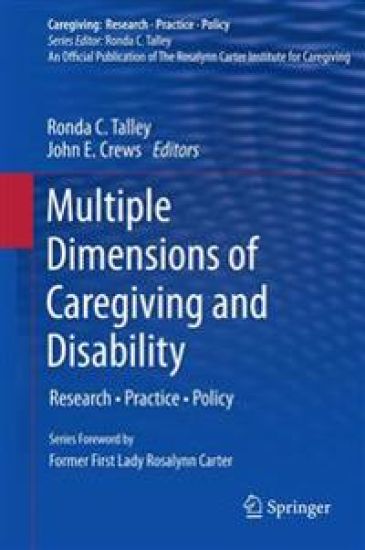
Multiple Dimensions of Caregiving and Disability
Caring for people with disabilities often becomes an all-encompassing responsibility for one or more family members. To manage the multifaceted demands, caregivers must possess strong multitasking skills, including the ability to assist with daily life tasks; provide emotional support; help with financial affairs; mediate and advocate with health care providers. Maintaining balance within their own lives can become incredibly challenging for caregivers. More often than not, providing care for family members or loved ones occurs at the expense of the caregivers’ well-being. And for caregivers who themselves have disabilities, it further complicates matters.Multiple Dimensions of Caregiving and Disability addresses concerns that have been long familiar to the caregiver population and examines the current state of family care for individuals with disabilities. With a lifespan perspective, this concise reference reviews the literature on specific problems of caregivers and explores which care strategies are effective, promising, or lacking in available resources and support interventions. Contributors also explore the more fluid and subjective aspects of caregiving, such as feelings, spirituality, and family roles. Suggestions for future policy improvements, particularly within the public health sector, are discussed as well.Topics covered include:• Family dynamics and caregiving for people with disabilities.• Parent caregiving of children with disabilities.• Race, ethnicity, socioeconomic status, and caregiving.• Educational, training, and support programs for caregivers.• Emerging technologies to aid caregivers.• Developing partnerships between caregivers and health care providers.Multiple Dimensions of Caregiving and Disability is a must-have resource for researchers, scientist-practitioners, policy makers, and graduate students across such disciplines as clinicalpsychology, nursing, social work, public health, medicine, and social and education policy.