Kirjojen hintavertailu. Mukana 11 611 292 kirjaa ja 12 kauppaa.

Kirjahaku

Etsi kirjoja tekijän nimen, kirjan nimen tai ISBN:n perusteella.

1000 tulosta hakusanalla Napoleone Colajanni

Napoleon and the Invasion of Britain

Napoleon and the Invasion of Britain

Alexandra Franklin; Mark Philp

Bodleian Library
2003
nidottu
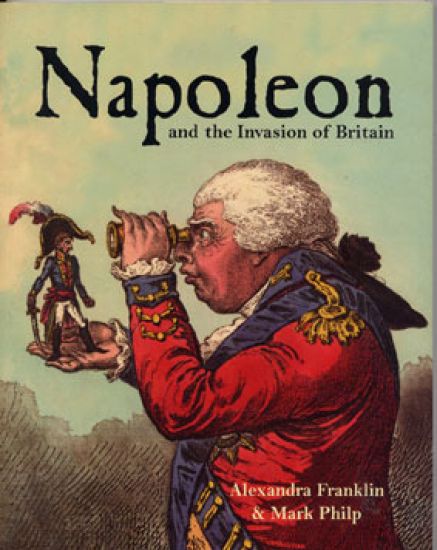
Chronicling the real fear of a Napoleonic invasion of Britain from 1798 to 1805, this book reconstructs Britain's political, social and military response, and tells the story of the forces dividing the nation in the 1790s, and the debates underlying the patriotism of 1803, through a rich collection of satirical cartoons, medals, pamphlets and broadsides. Cartoons and pamphlets produced during the two invasion scares show the transformation of British politics during the wars against Revolutionary France. In 1798, Britain was racked by internal divisions, fiscal crisis, and social unrest, factors that the French invaders hoped to capitalize on, turning the invasion into a war of liberation. Five years later, the renewal of the invasion threat in 1803 led to an unprecedented mobilization of the British population - nearly half a million men volunteered to defend the country against invasion - and an outpouring of patriotic literature and images. This fully-illustrated catalogue contains an extensive introduction as well as several additional essays.
Napoleon's Crimes

Napoleon's Crimes

Claude Ribbe

Oneworld Publications
2008
sidottu
Over 250,000 civilians were enslaved around the world, racial laws were introduced, mass deportations took place, hit squads and concentration camps were set up, and gas was used to massacre large groups of people. Yet this was 140 years before Hitler and the Holocaust, and these crimes were committed on the orders of a Frenchman: Napoleon, Emperor of France. In this riveting - and controversial - expose, historian Claude Ribbe reveals for the first time Napoleon's shocking legacy, and why he was so admired by Hitler.
Napoleon and Russia

Napoleon and Russia

Michael Adams

Hambledon Continuum
2006
sidottu
"Napoleon and Russia" tells, for the first time, the full story of Napoleon and his crucial relationship with Russia, from the 1790s and Bonaparte's rise to power, through the period of Austerlitz, Tilsit and the Russian invasion, to the Emperor's fall and its aftermath. In doing so, it not only puts the critical events of 1812 in their proper context as part of an even greater tale - of peace as well as war, friendship as well as enmity - but also provides fresh insight into the Napoleonic period as a whole, questioning many of the assumptions about the era prevalent in the English-speaking world. The tale boasts a cast of fascinating characters to rival any novel: the rulers, Napoleon himself, Catherine the Great, 'Mad' Tsar Paul and the enigmatic Alexander I; generals such as Ney, Murat, Davout, Suvorov, Kutuzov and Barclay de Tolly; statesmen like Talleyrand, Caulaincourt, Czartoryski and Rumiantsev; and, of course, the ordinary soldiers who fought some of the most intriguing, bloody and important campaigns in history. This is an enthralling story of fundamental importance in the history of Europe and, indeed, the world.
Napoleon's Men

Napoleon's Men

Alan Forrest

Hambledon Continuum
2006
nidottu
Napoleon's soldiers marched across Europe from Lisbon to Moscow, and from Germany to Dalmatia. Many of the men, mostly conscripted by ballot, had never before been beyond their native village. What did they make of the extraordinary experiences, fighting battles thousands of miles from home, foraging for provisions or garrisoning towns in hostile countries? What was it like to be a soldier in the revolutionary and imperial armies? We know more about these men and their reactions to war than about the soldiers of any previous army in history, not just from offical sources but also from the large number of personal letters they wrote. Napoleon's Men provides a direct into the experiences and emotions of soldiers who risked their lives at Austerlitz, Wagram and Borodino. Not surprisingly, their minds often dwelt as much on what was happening at hime, and on mundane questions of food and drink as on Napoloen himself or the glory of France. Alan Forrest is Professor of Modern History at the University of York.Among his recent books are Paris, the Princes and the French Revolution (Arnold, 2004) and (co-authored with Jean-Paul Bertaud and Annie Jourdan), Napoleon, le monde et les Anglais (Paris, Autrement, 2004)
Napoleon's Legacy

Napoleon's Legacy

Berg Publishers
2000
sidottu
This ground-breaking, revisionist collection of essays, based on the most recent research, provides a long-needed reassessment of the legacy of the French Revolution and the Napoleonic wars upon the governments of Restoration Europe. Traditionally the Restoration has been regarded by historians as a period in which European governments returned to the reactionary policies which prevailed before the upheavals of 1789, and which involved an outright rejection of the reforms of the Napoleonic era. In this book, leading historians challenge this interpretation and emphasize the sometimes surprising loyalty shown to Napoleonic policies of modernization by Restoration governments.The problems of dealing with new ideologies, accommodating the interests of old elites, and keeping the benefits of recent reforms were broadly similar across Europe, and provide a connecting theme throughout the volume. However, the nature of governmental response was never uniform. The essays explore these varieties of response, both through detailed case studies and more general surveys, and address issues such as policing and censorship, revolutionary symbolism, elite formation and bureaucratic structures in France, Spain, Italy, Germany and Poland, making a fascinating contribution to the study of the nature of political change in the modern period.'A dazzling collection of articles by the sharpest young historians in the field [that] overturns much of the received wisdom about Europe after Napoleon'Tim Blanning, Sidney Sussex College, Cambridge
Napoleon's Legacy

Napoleon's Legacy

Berg Publishers
2000
nidottu
This ground-breaking, revisionist collection of essays, based on the most recent research, provides a long-needed reassessment of the legacy of the French Revolution and the Napoleonic wars upon the governments of Restoration Europe. Traditionally the Restoration has been regarded by historians as a period in which European governments returned to the reactionary policies which prevailed before the upheavals of 1789, and which involved an outright rejection of the reforms of the Napoleonic era. In this book, leading historians challenge this interpretation and emphasize the sometimes surprising loyalty shown to Napoleonic policies of modernization by Restoration governments.The problems of dealing with new ideologies, accommodating the interests of old elites, and keeping the benefits of recent reforms were broadly similar across Europe, and provide a connecting theme throughout the volume. However, the nature of governmental response was never uniform. The essays explore these varieties of response, both through detailed case studies and more general surveys, and address issues such as policing and censorship, revolutionary symbolism, elite formation and bureaucratic structures in France, Spain, Italy, Germany and Poland, making a fascinating contribution to the study of the nature of political change in the modern period.'A dazzling collection of articles by the sharpest young historians in the field [that] overturns much of the received wisdom about Europe after Napoleon'Tim Blanning, Sidney Sussex College, Cambridge
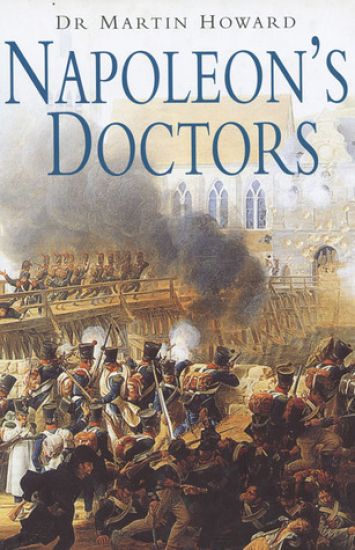
Napoleon's Doctors

Napoleon's Doctors

Martin Howard

Spellmount Publishers Ltd
2006
sidottu
A comprehensive account, in English, of the medical services of the famed "Grande Armee" - a story dominated by the Emperor, his loyal doctors and the brutal realities of Napoleonic warfare.
Napoleon's Immortals

Napoleon's Immortals

Andrew Uffindell

Spellmount Publishers Ltd
2007
sidottu
Elite fighting forces have always exercised an extraordinary hold on the the popular imagination. The Imperial Guard established a unique reputation for loyalty, courage and battlefiled effectiveness. Here, Andrew Uffindell uses previously unpublished primary sources to to reassess impartially this great fighting formation. Three of the guard's greatest battles are described in detail. Using revealing new research and photographs of the battlefields today he sheds new light on the controversial charge at Somosierra in 1808, and the Battles of Dresden (1813) and Montmirail (1814). At the same time, he describes for the first time just what it was like to join this elite band. 'Uffindell is that rare combination in military historians – oustanding researcher and sparkling writer.' (Military History Today, USA.)
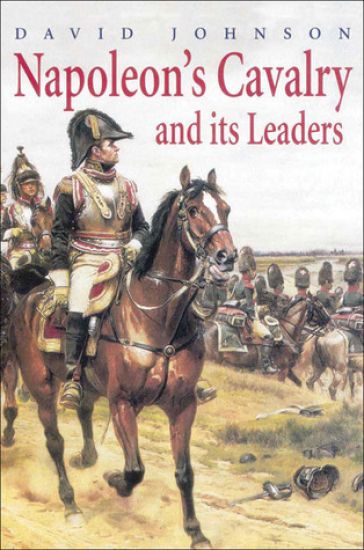
Napoleon's Cavalry and Its Leaders

Napoleon's Cavalry and Its Leaders

David Johnson

Spellmount Publishers Ltd
2007
nidottu
Dressed in outrageously romantic uniforms, led by a flamboyant clique of aristocrats and ex-troopers, Napoleon’s cavalry had a picturesque quality that belied its ruthless methods and tremendous service record. Nothing quite like its veterans had ever been seen before, for not even a horse soldier of Imperial Rome could claim to have fought in Austria, Germany, Egypt, Italy, Poland, Belgium and Spain.Alongside these battle-scarred veterans rode inexperienced young conscripts who never acquired their senior comrades’ lust for victory, though they came to share their philosophy. The force to which they belonged was far from perfect. The constant campaigning bred drunkenness and brutality, the levelling processes of the Revolution had already bred indiscipline. On a score of battlefields, nevertheless, Napoleon’s cavalrymen succeeded in rising above their faults, owing largely to the confidence which they placed in the most brilliant group of horse generals ever contained in one European army: generals like the handsome Lasalle, who said that no French hussar ought to live beyond the age of 30; Marulaz, who had 26 horses killed under him; and Murat, the inn-keeper’s son who became a king.
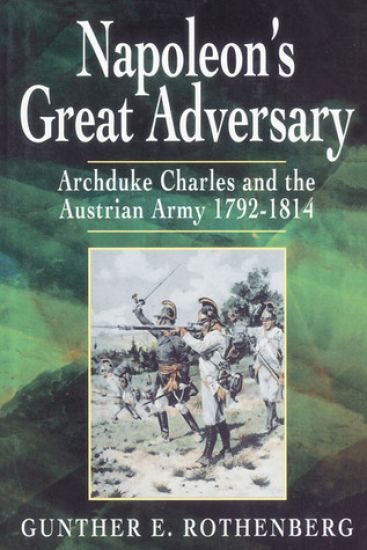
Napoleon's Great Adversary

Napoleon's Great Adversary

Gunther Rothenberg

Spellmount Publishers Ltd
2007
nidottu
The largest force continually engaged against Napoleon was the Imperial and Royal Austrian Army. It was this army which, throughout Europe, carried the burden of the war on land. Although Napoleon repeatedly defeated it, its record against French armies was generally good. In 1809 the Austrian army inflicted the first defeat on Napoleon and in 1813 contributed the largest contingent to the Allied effort in Germany.In 1982, Gunther E. Rothenburg, working mainly from the Austrian reference sources, but avoiding the bias following the Empire’s 1866 defeat in Germany, produced the first balanced and complete survey.This book gives a throughgoing survey of the Austrian army from its initial organisation through its subsequent reforms. As well as detailing all of the major battles and campaigns, it explains clearly the political, economic and social climate of Austria in the period in order to place the Austrian Army in its context. The standard reference work on the subject, Napoleon’s Great Adversary provides the foundation for further study for both historian and military enthusiast alike.
Napoleon Hill's Think and Grow Rich

Napoleon Hill's Think and Grow Rich

Karen McCreadie

Infinite Ideas Limited
2008
nidottu
Napoleon Hill is one of the world's most enduringly popular motivational authors. He spent much of his life researching the behaviours and activities of wealthy people to work out the characteristics that made them so successful. Through his interviews with hundreds of the most affluent men and women of his time he discovered that if we can learn to think like the rich we can start to emulate their success. In Think and Grow Rich Hill explained the thirteen simple steps in his formula for success, and by understanding and applying them you can change your life. The original version of Think and Grow Rich, which has sold 80 million copies worldwide, is a classic containing advice on everything from making your first million to leadership excellence and even maintaining loving relationships. It is unlikely that there is a personal development seminar anywhere on the planet that can't trace its roots back to Think and Grow Rich. Napoleon Hill's Think and Grow Rich by Karen McCreadie illustrates Hill's thirteen principles of achievement with modern case studies and reviews of recent scientific research to enable 21st century readers to learn how to manage their thinking and transform their quality of life. Readers will discover:* Why you need to know your 'definite major purpose' in order to make progress;* How remaining flexible can turn set-backs into success;* The power of language and how widening your vocabulary can set you free;* How to harness your subconscious and turn your dreams into reality;* Why you don't need to know it all in order to succeed.McCreadie's thoroughly up-to-date interpretation of Napoleon Hill's work is not a substitute for the 1937 original, but seeks to illustrate the timeless nature of Hill's extraordinary insights by bringing them to life with modern examples.
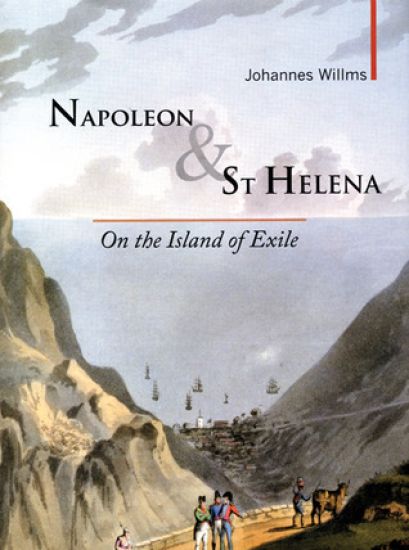
Napoleon & St Helena

Napoleon & St Helena

Johannes Willms

Haus Publishing
2008
sidottu
Isolated in the vastness of the South Atlantic and fortress-like in appearance, the Island of St Helena was important for centuries only as a victualling station for ships of the British East India Company, on their long voyages to and from India via the Cape of Good Hope. It was on one of these journeys that Arthur Wellesley, later the Duke of Wellington, took note of the island's remote impregnability. It was Wellington who suggested St Helena as Napoleon Bonaparte's place of imprisonment and exile after his defeat at Waterloo in 1815. Until his death in 1821, the former Emperor spent his final years under constant British guard. His exile transformed a speck on the maritime map into the most famous island in the world.
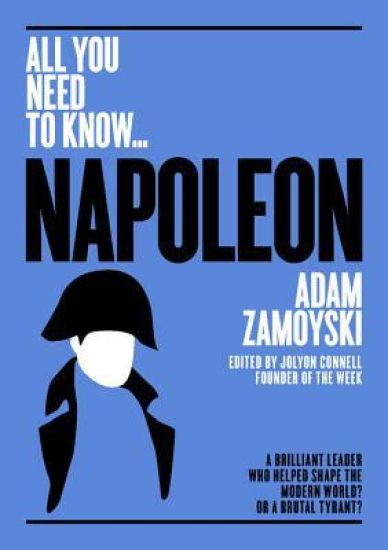
Napoleon

Napoleon

Adam Zamoyski

CONNELL PUBLISHING LTD
2018
pokkari
Born in Corsica, and a brilliant military leader during the French revolution, Napoleon became Emperor in 1804 and dominated European and indeed global affairs for the next ten years, leading France against a series of coalitions in what were later called the Napoleonic wars. His victories are the stuff of legend, as is his famous invasion of Russia in 1812, disastrous and shattering retreat from Moscow two years later, and final defeat by Britain and its allies at Waterloo in 1815. So how great a military leader was Napoleon? And how skilled a political operator? Why are his relationships with women, and especially his Empress, Josephine, so famous? And what of his legacy - in particular, how important was the so-called Napoleonic Code? "The ideas that underpin our modern world-meritocracy, equality before the law, property rights, religious toleration, modern secular education, sound finances, and so on-were championed, consolidated, codified and geographically extended by Napoleon," says Andrew Roberts. "To them he added a rational and efficient local administration, an end to rural banditry, the encouragement of science and the arts, the abolition of feudalism and the greatest codification of laws since the fall of the Roman Empie." Zamoyski assesses this verdict of Napoleon and gives his own view of the greatness and legacy of one of history's most compelling figures.
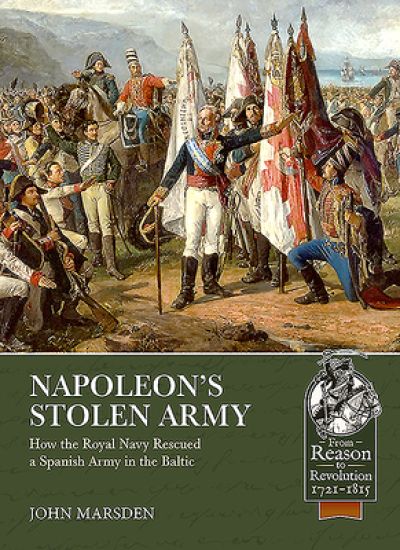
Napoleon’S Stolen Army

Napoleon’S Stolen Army

John Marsden

Helion Company
2021
nidottu
This is the story of a Spanish army, commanded by the Marqués de La Romana, which was sent to Denmark by Napoleon in 1807, whilst France and Spain were allies bound by the Treaty of San Ildefonso, signed in 1796. When relations between the two countries broke down in May 1808 they were soon at war with each other, and La Romana´s host became, in effect, a captive army in the hands of the French. When Spain looked to forge an alliance with Britain against her erstwhile ally, they found the British government only too eager to help. The Royal Navy’s dominant presence in the Baltic provided a ready opportunity to seal the new alliance and, once the political groundwork had been laid, plans for a daring rescue of the entrapped Spaniards by Vice Admiral Keats’ squadron were drawn up. However, whilst efforts were being made by the British to accumulate and prepare a sufficient amount of shipping to carry out the operation, difficulties soon arose in making contact with La Romana in order to convey to him the intentions of the Spanish and British high commands. This almost led to disaster, and the whole operation was saved only by some remarkable strokes of fortune, and the magnificent leadership provided by Keats and La Romana. Until now this remarkable and little–known story has had little coverage in the various histories written about the Peninsular War, and what has been said about it in the Anglosphere has been confined to a description of events taken almost solely from a British perspective. Now, with access to a comprehensive collection of documents in the Spanish archives, it is possible to tell the story of the Spanish contribution to the successful operation in the Baltic, when the greater part of La Romana’s army was evacuated from Danish Baltic territory during the summer of 1808. Due to circumstance and bad fortune, a significant part of the Spanish army was left behind during the Royal Navy’s action, and there is an interesting story told about what became of these men, related via the personal accounts left by two of the soldiers who did not return to Spain with La Romana.
Napoleon at Leipzig

Napoleon at Leipzig

George Nafziger

Helion Company
2021
nidottu
Leipzig dashed the dreams of a French Empire when the armies of Prussia, Russia, Austria and Sweden converged on Napoleon and his Grande Armée. It was the greatest battle of the Napoleonic Wars, so decisive it would be called "the battle of the Nations". Smaller countries like Poland and Saxony seemed to be submerged in the titanic struggle and the battle shaped Europe for more than a century. "Napoleon at Leipzig" not only covers this pivotal battle, but also the manoeuvres that led up to it and the retreat that followed. At Hanau, the Bavarians learned to their dismay the Napoleon was still the master of the battlefield. The book includes the campaigns of Marshal Davout in the north, and the fate of the besieged French fortresses. From glittering field marshals to ragged cossacks, in massive battles or small skirmishes, we see the dramatic campaign unfold. George Nafziger’s intensive research into the 1813 campaign shows how the finest general of all time was brought to bay. The greatest battle of the Napoleonic Wars, and the campaign that led up to it, is thoroughly studied for the first time in English in "Napoleon at Leipzig". This edition includes a new set of images and newly-commissioned colour maps.
Napoleon at Dresden

Napoleon at Dresden

George Nafziger

Helion Company
2021
nidottu
This work is the second in a three-volume series on the 1813 campaign; it is the first significant study on the 1813 campaign since Petre. Unlike the other English works on the campaign, it was prepared using French archival and published sources, as well as German, Danish and Russian published sources. It discusses every battle and significant action in all parts of Germany - including various sieges. Detailed color maps support the major battles and a large collection of orders of battle drawn from the French Archives, as well as period-published documents, support the discussion of the campaign, complemented by a large selection of images. Both images and maps are new to this edition of the work.