Patrick White within the Western Literary Tradition is a collection of essays demonstrating the strong influence of European, British, and American cultures on White's work. Representing the author's interest spanning over thirty-five years, the essays expose White's evocation of dimensions other than material reality, his preoccupation with epiphanies and mythmaking, and his constant forging of a poetic style. The book also contains a series of analytical studies of the themes and characters in White's major novels (The Aunt's Story, The Tree of Man and Voss).
All ages will enjoy this timeless game featuring a selection of Patrick Hruby's bold and imaginative illustrations.How to play: For younger children, play with nine pairs or fewer. For a more challenging game, geared toward older children and adults, play with all 36 pairs. Mix and spread cards face down. Players take turns flipping any two cards up. If cards match, play continues. If cards do not match, player's turn ends and cards remain in the same position. When all cards are matched, player with the most pairs wins.
Natural Wonders is a beautiful new coloring book by Patrick Hruby that features forests, flora and fauna.Patrick's colorful and intricate illustrations are gracefully translated here into 32 black-and-white line drawings for young, budding artists to interpret in their own color palettes. As a reference, the back cover shows every one of the 32 images featured in their full-color original versions. As a reference, the back cover features all 32 images in full color. Each drawing is printed on white paper one one side only so that markers don't bleed through to another image. Each page is also perforated at the top for easy removal to place your young artist's artwork on the wall or refrigerator."
Exploring the pathos and promise of the human experience, New Mexico artist Patrick Mehaffy creates sculptures, drawings, and, more recently, paintings that harken back to the timelessness of cultures past while affirming human relevance in a precarious world. Beneath the sensual surfaces of his works lies a keen understanding of the liminal spaces between nature and society and the impact of human activity on Earth, now known as the Anthropocene.Throughout his thirty-five-year career, Mehaffy has approached his art from the perspective of the unconscious. His work is informed by his education and training in anthropology and museology as well as his experiences in the wilderness and, ultimately, as an artist. He reveres animals while admiring how past cultures have done the same through their art and objects of veneration. Mehaffy's reveries are aesthetically perceptive and keep the past alive while interpreting it in new ways, reigniting our own need to appreciate and honor nature and culture, both past and present. - from the essay ""Beneath the Surface: The Work of Patrick Mehaffy"" byJulie Sasse, Chief Curator of the Tucson Museum of Art
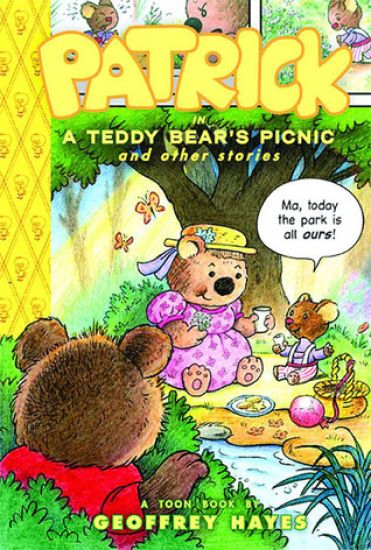
Patrick has a picnic in the park and meets some adventures there, but his Mama will always look after him - even if Patrick is a little naughty sometimes! This charmingly drawn tale tells the adventures of a sweet, cheeky little teddy bear.
Originally published in 1887, then revised in 1898, this biography of Patrick Henry is being reprinted to re-introduce this staunch defender of liberty and state's rights to a new generation of Americans -indeed a generation of Americans much in need of hearing the echo of the words, "...give me liberty, or give me death."Patrick Henry was truly an American patriot. As the first governor of Virginia, he will forever hold a place in the American spirit. It is appropriate that this famous leader never held a national public office (though had many opportunities), for he was an "anti-federalist," one who feared the federal system would become too powerful for our own good.If Patrick Henry could speak today, he might be shouting from every mountaintop, "I told you so "Dispensational Publishing House is pleased to present this timeless piece of history. Perfect for students and history buffs, or those who are concerned about the power-grab that is often seen in national politics.Patrick Henry's life is covered from his earliest years to his last days in a thorough, readable, and enlightening book. Though the words were written over 125 years ago, and the man had finished his living 225 years ago (with a witness to his Savior in his dying breaths), this man and these words are a man for our time.
Have you ever felt like you keep messing things up? That's exactly how Patrick feels Try as he might, he just can't seem to do everything perfectly. Join him as he makes mistakes and accidentally ruins special days, but ultimately makes the best of it. In Paul Gibson's story, based loosely on his own experiences, learn what Patrick learned: sometimes, even when mistakes are made, things can be perfect in the end.
Patrick is back Can YOU help him solve 10 different mysteries? Patrick Picklebottom has a knack for critical thinking. So it's not too surprising that he and his best friend, Claire, keep coming across everyday mysteries. In school, at the local ice cream shop, during a history fair - even in his own house - Patrick constantly comes across new cases to crack. In the great tradition of the classic Encyclopedia Brown books by Donald J. Sobol, The Patrick Picklebottom Everyday Mysteries takes the beloved picture book character into a completely new direction with an interactive book for early readers. Join Patrick and his friends in 10 short stories where YOU help solve the mysteries. Can you figure out the solutions based on the clues provided? Think carefully before checking the answers in the back Ideal for kids 7, 8, 9, 10 and 11, and grades 3-5
Patrick and Katie have found a new home and parents--out on the Midwest prairie. It is a very hard life they have been thrust into. Their friends Sarah and Jimmy live nearby. Along with them, as well as new friends, they manage to get into more scrapes and face new disasters--as well as fierce animals they are unfamiliar with. Will they survive in this harsh land...or will they succumb under the pressure of these new and sometimes terrible events?
Patrick Flynn's father dies, leaving him in charge or his younger sister, Katie, in 1901 New York City. Arranged by his father, Patrick embarks upon the Orphan Train, heading for a new home in the West. He meets and befriends Sarah the Sparrow, a street kid. There is also Jimmy the Brick and Scar Benny--a couple of mean Bowery boys. They taunt and abuse Patrick, making his life miserable. Patrick hopes to find a new family in the West, but is rebuked at every stop for various reasons: he is too old, too slight, too insistent on not parting with Katie. Even a tornado threatens to destroy his quest for a new home. Only upon arriving in Wichita, Kansas does Patrick find that which he is seeking. He and Katie begin fresh lives with a new family. And friends made aboard the train will remain friends forever. But will enemies remain enemies?
*Includes pictures *Includes Henry's quotes about his life and career *Includes a bibliography for further reading "If this is treason, make the most of it." - Patrick Henry The American Revolution is replete with seminal moments that every American learns in school, from the "shot heard 'round the world" to the Declaration of Independence, but the events that led up to the fighting at Lexington & Concord were borne out of 10 years of division between the British and their American colonies over everything from colonial representation in governments to taxation, the nature of searches, and the quartering of British regulars in private houses. From 1764-1775, a chain of events that included lightning rods like the Townshend Acts led to bloodshed in the form of the Boston Massacre, while the Boston Tea Party became a symbol of nonviolent protest. Of course, the Revolutionary era also produced some of the most famous Americans in history, and Patrick Henry has the ironic distinction of frequently being overlooked in comparison to his contemporaries while also being remembered for speaking one of the most famous lines in American history despite the fact he may never have actually said it. When Henry famously cried out, "Give me liberty or give me death," he knew a surprising amount about both. He had known the liberty of running across open fields on warm Virginia mornings and of riding at breakneck speed across fields he owned. He had fought for, and won, the liberty of numerous clients he defended in Virginia's colonial courts. He had also taken the liberty of others, though for different reasons. He owned slaves and saw what it cost them to serve him each day, and he had even kept his own young wife in chains to prevent her from harming herself or one of their children. In the midst of the Revolutionary War, he was spared the horror of ordering men to their deaths by instead serving in an executive role during the war. He buried one wife and married another, and he lived to see 17 children born to the freedom he so cherished. Over time, he also helped shape this hard won freedom, speaking out against a strong federal government that he felt might take away the new nation's liberty. At the same time, he also lived to see the effects of unbridled liberty in France, and he was shaped by what he learned, to the extent that he spoke toward the end of his life for a more centralized government. Henry played crucial roles both during the Revolution and before it, locally and nationally. He was Virginia's first governor, and he was instrumental in convincing Virginian politicians to go to war. And yet, his life and career have mostly been reduced to the famous phrase "Give me liberty, or give me death," even though it's actually unclear whether those most famous of words were actually in the speech. This is because the first transcript of the speech came over a generation after Henry delivered it, in a biography of Henry written by William Wirt. Thus, ironically, historians are divided over whether the phrase Henry's best known for was actually his words or those of his biographer. Moreover, similar variations of that phrase already existed, and it's possible Henry was familiar with them, much the same way Franklin Roosevelt's line about fear had predecessors as far back as Duke Wellington over a century earlier. Either way, the words and the debate over it have overshadowed what was a monumental career in service of his new country, and the fact that Henry was at the forefront of the battles that ultimately shaped its direction. Patrick Henry: The Life and Legacy of the Founding Father and Virginia's First Governor looks at one of colonial Virginia's most important political leaders. Along with pictures of important people, places, and events, you will learn about Patrick Henry like never before.
This story is about Patrick's first ever fashion show. He models his amazing tuxedo on a runway that's been designed specifically for him. Patrick the Penguin's First Fashion Show is the follow-on story from Patrick the Penguin Becomes a Model.